

Why a Narrower Pre-Owned Shelf Builds Stronger Expertise
The Stellaris Journal
Our pre-owned shelf runs narrower than most. By design. We carry a defined set of maisons: Rolex, Patek Philippe, Audemars Piguet, Vacheron Constantin, F.P. Journe, Richard Mille, Cartier, and a handful of others we know well. What we trade in breadth, we try to make up in reference depth, which is the granular knowledge of individual references, dial variants, production windows, and condition subtleties within those houses. That choice shapes how we authenticate, how we price, and how we guide a buyer through a decision. This article explains why.
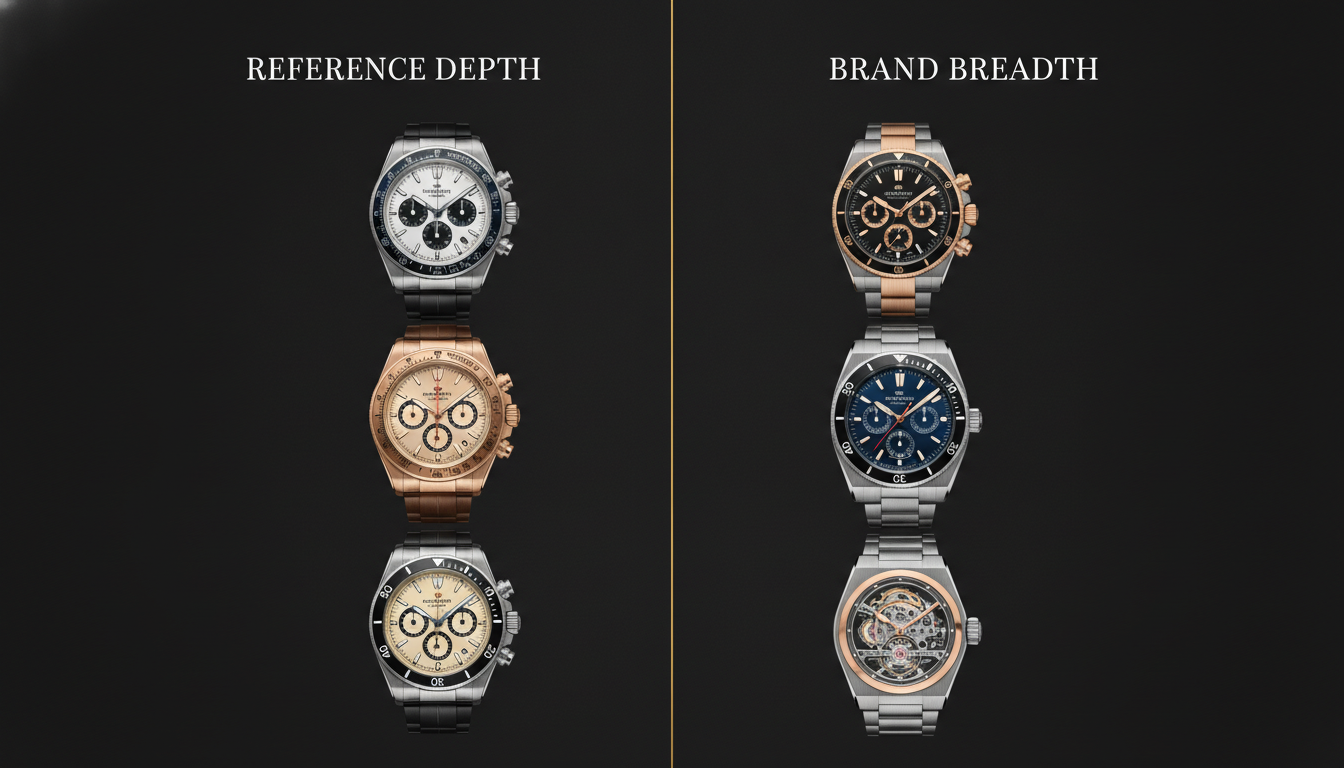
The Short Version
A pre-owned shelf built on reference depth rather than brand breadth tends to produce four concrete outcomes for buyers: more reliable authentication, more accurate pricing, faster sourcing on specific variants, and more useful advisory during the decision itself. The trade-off is honest: a curated shelf will not have every reference in stock at every moment. The Available Upon Request sourcing model exists specifically to close that gap without abandoning the depth principle.
If a buyer wants one of everything from every maison with same-day shipping, a broad marketplace is built for that. If a buyer wants a dealer who can tell the difference between a Rolex Daytona reference 116520 and a 116508 without reaching for a catalogue, depth-led curation is built for that.
What "Reference Depth" Actually Means
Brand breadth is straightforward to measure: how many manufacturer logos appear on the shelves. Reference depth is harder to measure and easier to undervalue. It refers to the working knowledge a dealer carries about individual references within those brands: which production years produced which dial variants, which bracelet configurations were period-correct, what a particular patina tells you about storage history, what a service-paper gap suggests, and which factory specifications changed between Reference A and Reference B.
Chrono24's editorial team describes a related collector practice as "vertical collecting," where a buyer deliberately specializes in one brand or model family rather than spreading purchases across the market. The Luxury Playbook makes the same point from a different angle: reference literacy, knowing the two or three references that define each line, is what separates collectors who buy well from those who pay premiums for adjacent variants that the auction houses do not care about. The same principle applies on the dealer side. A shelf that carries fifty brands at one reference each cannot develop the same depth of working knowledge as a shelf that carries eight brands at multiple references each.
Why the Trade Favors Depth on a Pre-Owned Shelf
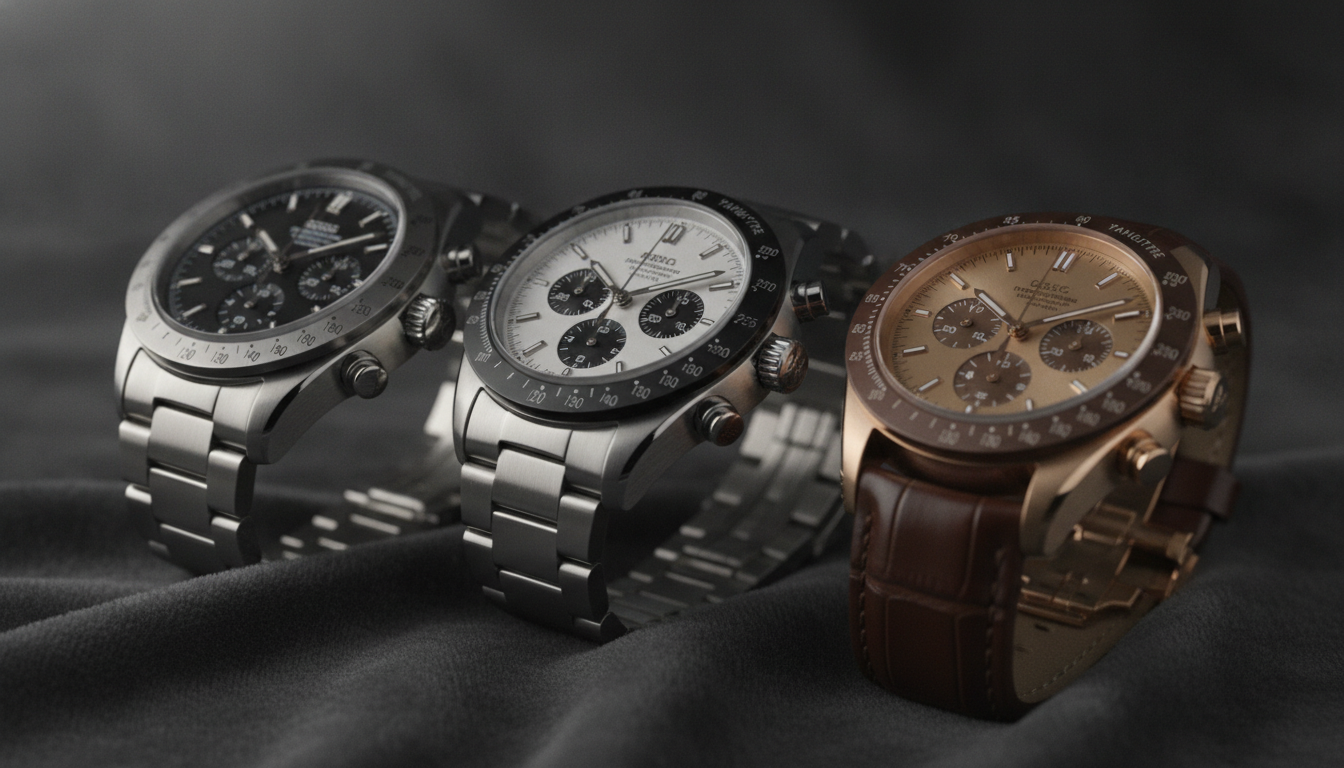
Pre-owned is not the same product as new. A new Rolex from an authorized dealer is, in most cases, a known quantity: current production, factory warranty, sealed packaging. A pre-owned piece carries uncertainty: prior service interventions, parts replacements, dial swaps, bezel inserts from a different reference, franken movements, polished cases that have lost their original geometry, and provenance gaps. The dealer who lists that watch is the de facto quality control layer.
Reference depth is what makes that layer work. Knowing that a Patek Philippe Nautilus 5711/1A in steel trades in a fundamentally different register than the same reference in gold, or that a vintage Submariner 5513 in unpolished condition carries a meaningful premium over a lightly polished sibling, requires studying the line. A dealer whose shelf includes three or four examples of a single model family develops pattern recognition that a dealer who handles each brand twice a year cannot replicate.
The Luxury Playbook observes that box-and-papers documentation alone moves a piece's secondary value by 10 to 30 percent versus a watch-only sale. Knowing which references come with credible full sets, which references rarely do, and which "papers" are worth less than they appear to be, is a depth skill, not a breadth skill.
Reference depth is the working capital of a pre-owned shelf. Brand breadth is the surface area.
How Depth Translates Into the Buyer's Experience
Authentication That Stands Up to Scrutiny
Every timepiece offered through the collection is independently authenticated before listing. That phrase is easy to write and harder to execute. Authentication at the reference level means checking that the dial, hands, crown, bracelet end-links, caseback engravings, and movement caliber are all internally consistent with the reference number stamped on the case. A 16610 Submariner should not contain a 16610LV bezel insert. A 5711/1A should not carry a dial printed for a 5712. A journe movement should match the case material indicated on the certificate.
These checks are mechanical, but they require knowing what correct looks like for each specific reference. The deeper the dealer's working knowledge of a model family, the faster and more confidently those checks resolve. A buyer who asks for a third-party authentication report on a high-value piece should expect a dealer who can produce it without hesitation.
Pricing That Reflects Reference, Not Just Brand
Transparent, market-based pricing is the stated approach across the inventory. Reference depth makes that statement operational. A Rolex Submariner Date in steel at retail trades in a tight band. A Submariner ref. 16610LV "Kermit," produced for a defined window in the 2000s, trades at a meaningful premium because of its production constraint and collector recognition. Both are "Rolex Submariners." They are not the same asset.
A shelf that knows the difference between those two references will price them differently and explain why. A shelf that does not know the difference will lump them together, or worse, misprice the variant that carries the actual collector premium.
Advisory During the Decision Itself
Buying a pre-owned luxury watch is rarely a one-click decision. Buyers ask about production years, dial variants, service intervals, bracelet sizing, market depth for resale, and how a reference compares to adjacent references in the same maison. A depth-led shelf can answer those questions because the same reference has been handled, researched, and priced multiple times. A breadth-led shelf can carry the reference but cannot always contextualize it against the rest of the line.
This is where the concierge model earns its name. The concierge buying and selling process is built around direct expert contact through every stage of a transaction. That model only works if the expert on the other end of the line knows the references well enough to speak about them without a script.
Faster Sourcing on Specific Variants
A narrower shelf does not mean a buyer has to wait indefinitely for the right reference. The Available Upon Request sourcing model uses a vetted network of partners to acquire specific references on a buyer's behalf. A 10% fully refundable deposit initiates the search, most requests are fulfilled within 24 to 72 business hours, and rare or highly sought-after models may require 7 to 14 days. If the exact piece cannot be secured to standard, the deposit is returned.
The point is not to pretend the shelf is wider than it is. The point is to extend reference depth through a sourcing network rather than padding brand breadth with shallow listings.
Depth shows up in what a dealer can tell a buyer about a specific watch. Breadth shows up in how many brands are on the home page. The first one matters more at the moment of decision.
The Honest Trade-Offs
A depth-led shelf has limitations, and they should be named.
First, a specific reference may not be in stock today. The sourcing model shortens that gap but does not eliminate it. Buyers who need immediate delivery on a particular variant from a maison not regularly carried will find broader marketplaces faster.
Second, the set of maisons carried is finite. A buyer attached to a maison outside the curated set will need to look elsewhere or request sourcing. The collection is built around maisons with consistent reference depth and documented authentication standards. Adding more brands without adding the depth to support them would dilute the model.
Third, depth takes time. A reference-by-reference understanding of a model family is built through handling, research, and pattern recognition across multiple transactions. It does not arrive from listing a single example of a brand once.
None of these are reasons to prefer a broad marketplace. They are reasons to understand what the curated shelf is and is not.
What This Looks Like in Practice
The pre-owned inventory at any given moment reflects the depth principle. Within the Rolex listings, multiple references appear across the Daytona, Submariner, Day-Date, and GMT-Master II lines, each with its own dial variant, bezel configuration, and case material. Within the Patek Philippe listings, the Nautilus, Perpetual Calendar, and Grand Complications lines are represented across references rather than collapsed into a single entry per model name. The same pattern holds across Audemars Piguet Royal Oak variants, Vacheron Constantin Overseas references, F.P. Journe Quantième Perpétuel and Chronomètre Souverain references, and Richard Mille RM references.
That distribution is not accidental. A reference-led shelf reads as multiple variants of a few maisons, not as a one-example-per-brand catalog. The visual signal matches the operational principle.

What a Buyer Should Expect From a Depth-Led Dealer
If a buyer chooses a dealer built on reference depth, the experience should differ from a broad marketplace in concrete ways.
The dealer should be able to compare two references in the same line, on the same call, without checking a database. Authentication reports should be standard on high-value pieces, not an upsell. Pricing should be defensible against market data, with reference-specific reasoning rather than brand-level generalizations. Sourcing should be straightforward when a specific variant is needed. And the same expert should be reachable from first inquiry through insured delivery, not a rotating set of account managers.
The Stellaris Collection is built around that expectation. The shelf is narrower than some, and the selection criteria are deliberately constrained. In return, the working knowledge behind each listing is meant to be deeper than what a broad catalog can offer. That is the trade, and it is the one we have chosen.
For collectors who want to compare this approach against the broader pre-owned market, the Chrono24 guide to starting a watch collection outlines how vertical and horizontal collecting strategies differ at the buyer level. The same distinction applies on the dealer side, and the same logic holds: depth is where the real work happens.
