

Why Fewer Watches and Deeper Selection Wins in Pre-Owned Luxury
The Stellaris Journal
A luxury watch is one of the few purchases where the catalog itself can work against you. The pre-owned market now offers more choice than at any point in its history, and that abundance has made buying harder, not easier. The case for fewer watches and deeper selection is not a marketing preference. It is a practical response to what the market has become.
The secondary market has outgrown the buyer
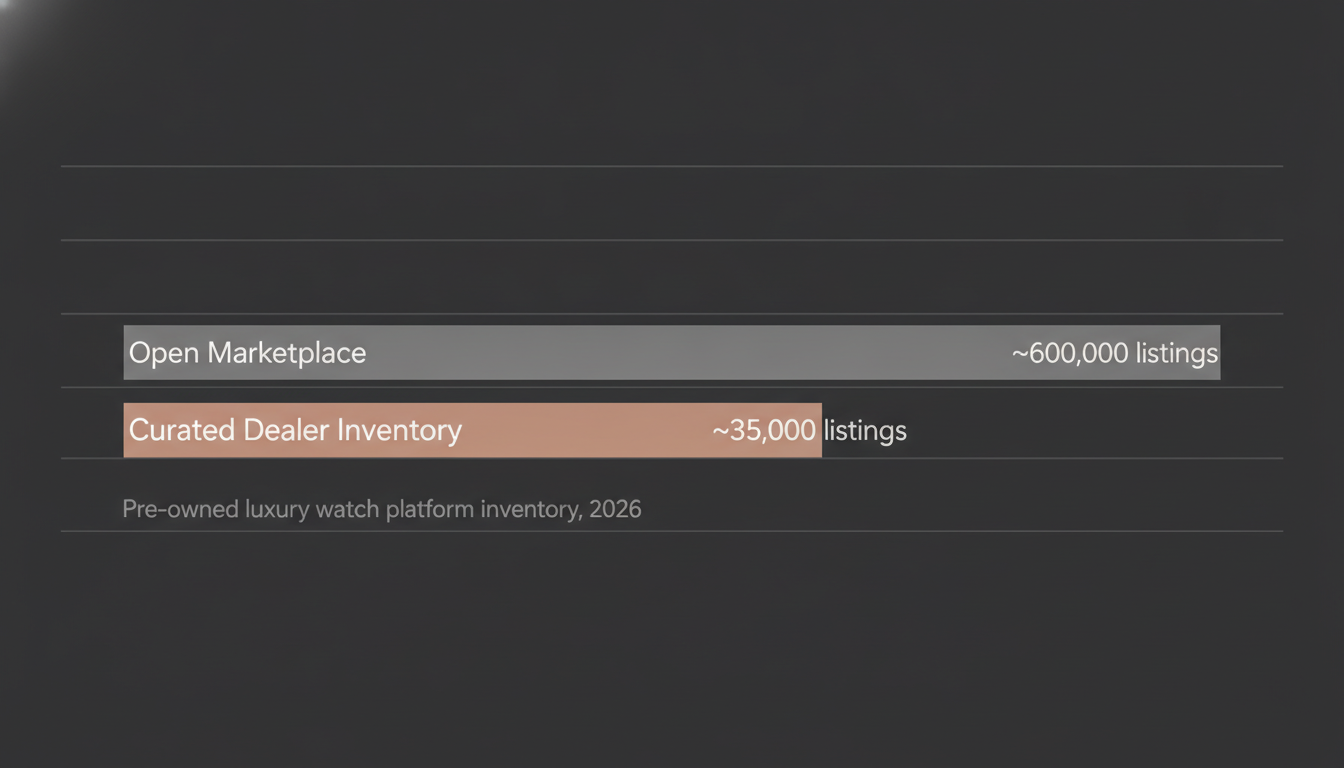
The numbers put the scale in perspective. Secondary luxury watch transactions reached roughly $16.73 billion in 2025, up 36.4% year-over-year, with dealer pre-owned channels alone generating about $15.65 billion of that total, according to a February 2026 secondary market report from EveryWatch. The largest open marketplace lists more than 600,000 watches at any given time, against roughly 35,000 on platforms that restrict listings to KYC-verified professional dealers, as documented in a Wristler comparison of dealer-only versus open marketplaces.
That volume is genuinely useful for the industry. It improves price discovery. It brings down variance: the same reference now trades within roughly 8-12% across serious secondary channels, compared to 25-40% variance as recently as 2019. For a buyer who knows the exact reference, dial variant, and year, a large catalog is a feature.
For everyone else, it is a problem.
The hidden cost of unlimited choice
Behavioral research has a name for what happens when options expand past the point of usefulness: choice paralysis. As a Forbes Tech Council piece on decision fatigue puts it, "users still have autonomy, but the list of choices is shorter and, importantly, more personally curated." The same dynamic shows up in a CMSWire analysis of choice overload in retail, which notes that expert curation consistently outperforms open catalogs in conversion, satisfaction, and post-purchase confidence.
A pre-owned luxury watch is not a streaming queue or a pair of sneakers. The downside of a wrong decision is measured in five figures, plus the cost of authentication, possible servicing, and the time spent resolving any dispute. In high-stakes categories, smaller and more selective inventories tend to produce better decisions because the cognitive load shifts from the buyer to the curator. The Luxepricing analysis of the paradox of choice in luxury makes the same point in a luxury-specific frame: when the goal is long-term satisfaction rather than momentary browsing, fewer, better-considered options almost always win.
The 2026 pre-owned market, in other words, has crossed a threshold where scale stops helping the typical buyer and starts costing them time.
What "deeper selection" actually means in practice
"Deeper" is not the same as "premium" or "high-end." A deep selection is one where each piece has cleared a documented bar before it reaches the buyer. For timepieces, that bar typically rests on three things: design, mechanical significance, and enduring collector appeal. Each of those terms does real work.
Design covers the choices that make a watch recognizable decades later: case geometry, dial proportions, hand shape, the relationship between the bezel and the crystal. Mechanical significance refers to what is happening inside the case: an in-house caliber, a meaningful complication, a movement architecture the maison is known for. Enduring collector appeal is the harder test, and the one that separates a watch people want from a watch people want right now. It is the answer to a question: will this reference still be interesting to a serious buyer in fifteen years, or will the market have moved on?
In practice, deeper selection looks like this:
- Authentication happens before listing, not after purchase. Every piece has been opened, inspected, and verified against documented criteria rather than relying on the buyer's own examination.
- Pricing is transparent and consistent per piece, anchored to current market data, rather than reflecting whatever a seller thinks the market will bear.
- Set completeness is disclosed. Original box, papers, service history, and provenance are part of the listing, not surprises discovered later.
- The catalog carries fewer references but covers the meaningful ground within each maison. A Patek Philippe section is not three random Calatrava variants; it is a small, considered set that reflects what the maison actually stands for.
- The dealer has a story to tell about why each piece is on the page. The reasoning is visible, not hidden behind marketing language.
This is the model that our approach to curating an exceptional watch collection describes in detail, and it is the model that serious pre-owned dealers across the industry converge on once they stop trying to compete on raw count.
The buyer experience that follows is different. You are not browsing 600,000 listings. You are reading 50 or 100, and each one has already passed a filter that you would otherwise have to apply yourself.
Where curation pays off, and where it does not
A focused catalog does three things that an open catalog cannot:
1. Concentrates authentication risk. A dealer handling 50 pieces per month can know each one. A platform listing 600,000 cannot inspect every one, which is why open marketplaces rely heavily on third-party checks and varying seller warranties. The protections are real but uneven. According to the Wristler comparison cited above, the strength of buyer protections on large marketplaces depends on whether you are buying from a professional dealer or a private individual, and what escrow and return terms apply to that specific listing.
2. Concentrates expertise. A curated dealer develops point-of-view knowledge about a small set of references. They know which dial variants are correct, which service intervals matter, which bracelets were period-correct, and which "minor details" actually signal a frankenwatch. That knowledge is hard to scale across half a million listings.
3. Concentrates accountability. When a dealer puts its name behind 100 pieces, the firm's reputation is bound to each one. When a marketplace lists 600,000 pieces through thousands of independent sellers, accountability is fragmented. A buyer who has a problem with a specific reference may find that the path to resolution runs through a specific seller's policies rather than the platform's.
There are honest limits to this argument, and they deserve naming.
A curated catalog is the wrong tool if you already know exactly what you want. If you have spent a year studying a specific reference, know the production years, and have a price target in mind, the open marketplace is faster, and the price you negotiate may be lower than any curated dealer's. It is also the right tool for hunting rare vintage pieces with very long tails, where no single dealer can carry the inventory and aggregation genuinely serves the buyer. And for buyers who enjoy the search itself, browsing a large catalog is part of the appeal, not an obstacle to it.
The argument for deeper selection is not that broad catalogs are bad. It is that the typical buyer, facing a six-figure decision on a watch they may keep for decades, is usually better served by a smaller, more deliberate set than by maximum volume.
How to tell whether a dealer is actually curating
The word "curated" is used loosely in the pre-owned market. A few practical signals separate genuine curation from a marketing label.
Documented selection criteria. A real curator can tell you what makes a piece eligible for the catalog. If the answer is vague, the selection probably is too. The overview of our selection criteria is one example of how this is made visible; any reputable curator should be able to do the same.
Authentication transparency. Look for independent, multi-point inspection rather than self-attestation. The pieces should arrive with documentation of what was checked, not just a generic certificate of authenticity. Our guide to the questions buyers should ask before a pre-owned purchase walks through what that documentation should contain.
Direct expert contact. Curation is not a static PDF; it is a conversation. A dealer who handles each piece personally should be reachable for questions about condition, provenance, and service history before and after the sale. That is the model our concierge approach is built around.
Honest pricing. Curated dealers publish clear, market-anchored prices and explain how they are set. Open-market pricing is often opaque by design, with the listed number serving as a starting point rather than a commitment.
Visible skepticism. The strongest signal of curation is that the dealer says no to most pieces offered to it. If a dealer appears to list every piece they come across, they are not curating; they are aggregating.
The point of a smaller shelf
The goal of a watch purchase is not to optimize the catalog you browse. It is to end up with a piece that you will still want to wear in ten years. A smaller, deeper shelf tends to produce that outcome more reliably than a large one, because the work of filtering has already been done by someone whose reputation depends on getting it right.
That does not make open marketplaces useless. They remain the right venue for specific-reference hunters, vintage specialists, and buyers who treat the search itself as part of the pleasure. But for the buyer who wants the decision to feel settled, who wants authentication handled before the watch arrives, and who values expertise applied to a manageable number of references, the math points toward fewer watches and deeper selection.
Browse our current inventory for an example of what that approach looks like in practice, or reach out to the team if you would rather talk through a specific reference than scroll through a list of thousands.
