

What Mechanical Significance Means in Watch Curation
The Stellaris Journal
"Mechanical significance" is a phrase that circulates in watch writing without a settled meaning. It appears in collector forum threads, dealer descriptions, and auction notes, often used loosely to mean any movement that is mechanical, or any complication that adds complexity, or simply any watch the writer happens to admire. The result is a term that sounds authoritative and proves almost nothing on inspection.
We use the phrase with more precision. It is one of three documented criteria we apply when deciding whether a timepiece belongs in our inventory, alongside exceptional design and enduring collector appeal. The purpose of this article is to set out, in plain language, what mechanical significance means inside that curatorial framework, what it does not mean, and how it shows up in pieces we actually carry.
What "Mechanical Significance" Actually Means in Our Curation
In our context, mechanical significance is a measure of whether a movement contributes something meaningful to the broader practice of watchmaking. It is not a synonym for "complicated," "expensive," or "mechanical." A three-hand watch with no complications can carry it. A grand complication without it does not.
A movement earns the designation when at least one of the following is true:
- It introduces, or is part of an early lineage that introduced, a technical solution the rest of the industry later adopted or built upon.
- It represents a deliberate, documented step by a manufacture toward vertical integration, in-house development, or finishing standards that go beyond what is required for function.
- It combines existing complications in a way that required new architectural choices rather than off-the-shelf modules.
- It is the foundational caliber of a manufacture whose subsequent movements trace their lineage back to it.
The list is not a checklist. Significance is not additive. A movement does not become "more significant" by accumulating boxes. The standard is whether the caliber, considered as a whole, did work that mattered in the history of mechanical horology.
The Four Dimensions We Evaluate
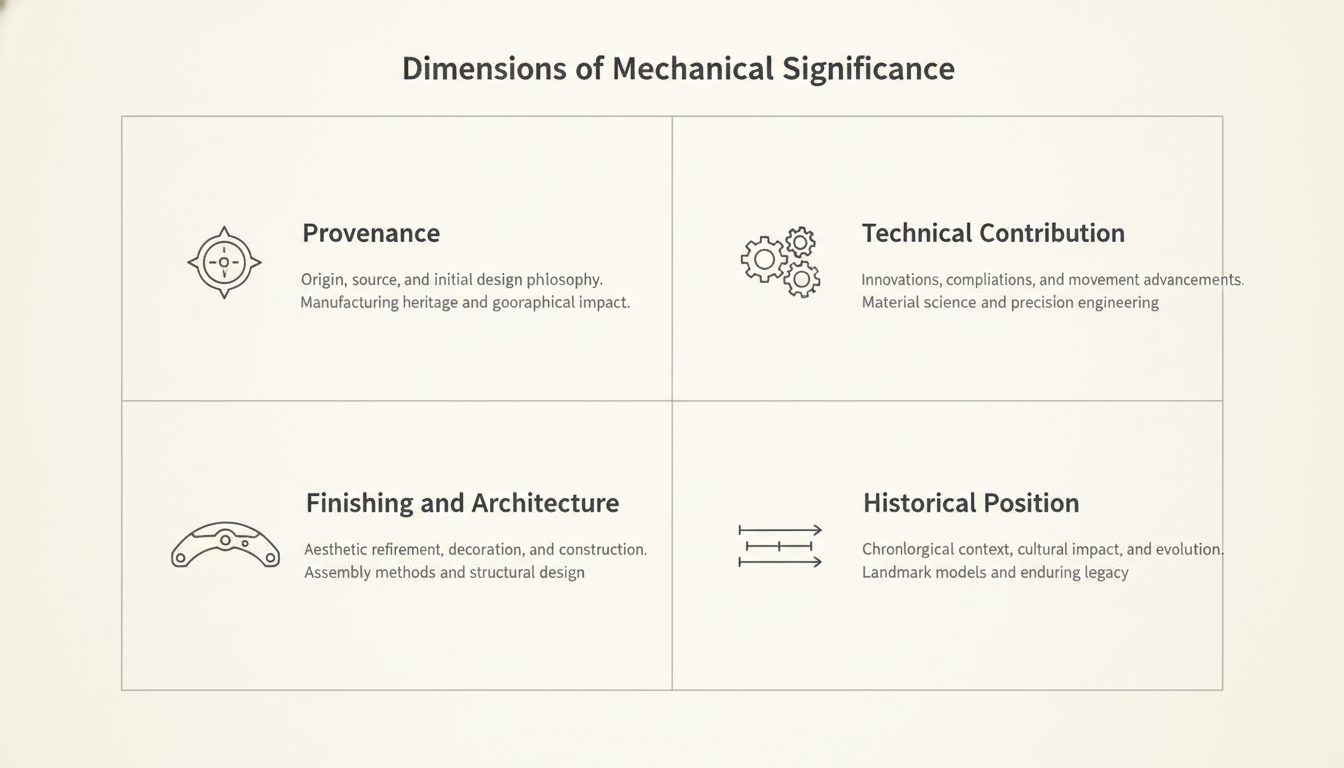
When we assess a movement for mechanical significance, we look at four dimensions. They are not weighted equally in every case, and a piece can be significant for reasons that emphasize one over the others.
Provenance of design and construction
A movement designed and built inside the manufacture that puts its name on the dial carries different weight than one sourced from an external ébauche supplier. The distinction is older than the modern marketing use of "in-house" suggests. As Bob's Watches notes in its overview of the debate, "even the simplest, most basic designs won't operate without somewhere in the region of 100 different parts," and it is "extremely rare for one manufacturer to make every single one of those constituents themselves." The full article is worth reading for the nuance it adds.
We treat provenance as a strong signal when a manufacture has chosen to invest in vertical integration for genuine technical reasons: to control tolerances, to enable specific complications, or to evolve a caliber family over decades. The same label applied to a brand that simply re-finishes a stock movement is, in our view, less meaningful.
Technical contribution
Some movements matter because they solved a problem that had not been solved before, or solved it in a way that proved durable. The tourbillon, the minute repeater, and the perpetual calendar are the obvious historical examples. Each represents a category of mechanical solution whose first serious horological implementation reshaped what was possible afterward.
Technical contribution can also be incremental. A caliber that improves power reserve meaningfully, introduces a new escapement geometry, or combines existing complications in a configuration that required new architectural work qualifies. The point is not novelty for its own sake. The point is whether the contribution can be located in the technical record.
Finishing and architectural intent
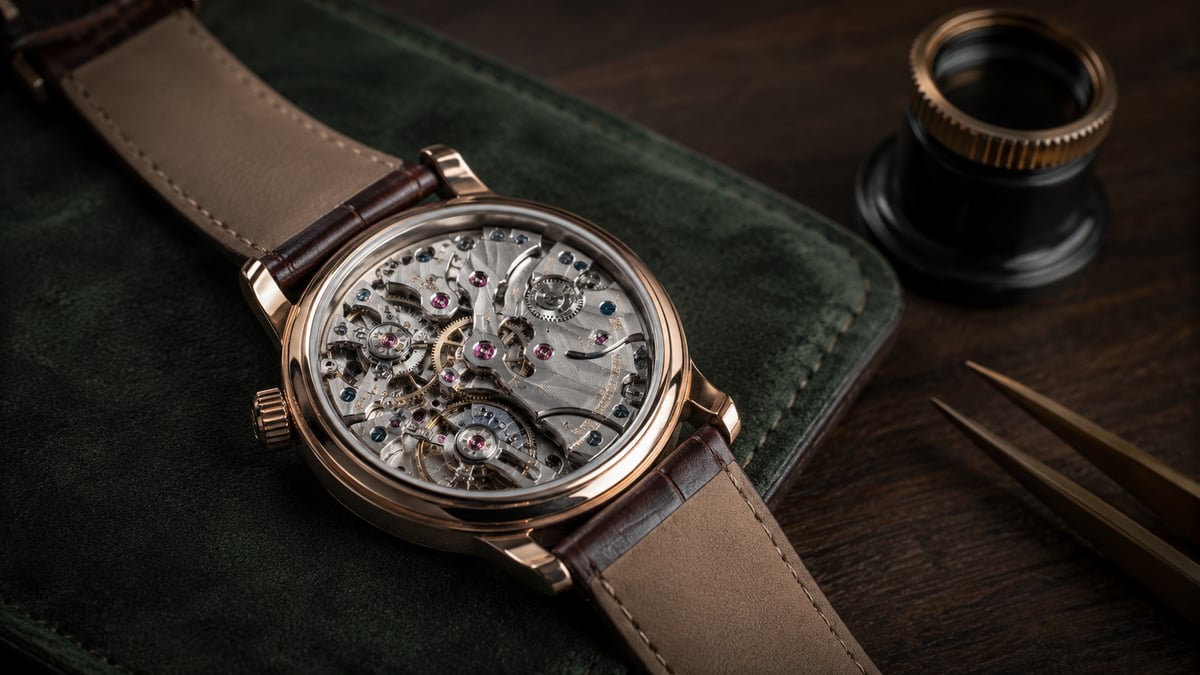
Hand-finishing is sometimes treated as separate from mechanical significance. We consider it part of the same conversation. Finishing is the visible evidence of architectural intent: a movement finished to haute horlogerie standards has been designed for inspection as well as function, which affects how its parts are made, not just how they look. The Chronomètre Souverain from F.P. Journe is a useful example. According to its official technical page, the caliber 1304 is built on a base plate and bridges in 18K rose gold, finished with circular graining, barleycorn guilloché, polished screw heads with chamfered slots, and pegs with polished rounded ends. The finishing choices are inseparable from the design choices.
Historical position
A movement can be mechanically significant because of where it sits in a lineage. A first-series caliber that defined how a maison approached movement design for the next generation qualifies. A caliber produced in very small numbers to demonstrate a technical capability the maison would later industrialize also qualifies. Significance here is about contribution to a house's own trajectory and, by extension, to the broader practice.
Where Mechanical Significance Differs From Movement Categories
This article is a companion to our earlier explainer on understanding watch movement types. The two pieces answer different questions, and conflating them is the most common reason "mechanical significance" gets used badly online.
Movement categories describe what a caliber is. A manual-wound caliber, an automatic caliber, and a quartz caliber each describe a power source and a regulating organ. Within those categories sit sub-categories: chronograph, perpetual calendar, minute repeater, tourbillon, and so on. These labels tell you what the movement does and how it is built in broad strokes.
Mechanical significance describes what the movement contributed. It is a judgment about the caliber's place in horological history, not its configuration. A manually wound caliber from the 1950s and a manually wound caliber introduced last year can sit in the same category and carry very different weights of significance. The same is true of two perpetual calendars: one may have defined how the category was built for a generation, the other may be a competent execution of a known solution.
The distinction matters when you are buying with intent. Movement categories help you decide what kind of watch you want on your wrist. Mechanical significance helps you decide whether the specific watch you are considering is the kind of piece that tends to retain interest over decades.

How This Standard Applies to Pieces We Carry
The maisons we work with were not selected because we wanted a long brand list. They were selected because each, in different ways, has produced movements that meet the standard above.
Patek Philippe sits at the center of any serious conversation about mechanical significance. The maison's response to the quartz crisis, rather than retreating from complications, was to extend them. The reference 5016, introduced in 1993 and combining a minute repeater, tourbillon, and retrograde perpetual calendar in a 36.8 mm case, stood as Patek Philippe's most complicated wristwatch for almost a decade. Collectability's collector's guide to the reference describes how the 5016 embodied Patek Philippe's deliberate strategy of "doubling down on Haute Horlogerie rather than competing on price and lowering its standards, a vision that would shape Patek Philippe's identity for decades to come." Movements like the caliber inside the 5016 are mechanically significant not because they show what Patek Philippe can do today, but because they shaped what the category of high complications looked like afterward.
F.P. Journe represents a different kind of significance. The maison was founded in the late 1990s and industrialized quickly, but its early subscription models and the decision to build base plates and bridges in rose gold were deliberate positions about what a contemporary mechanical watch could be. The caliber 1304 inside the Chronomètre Souverain is mechanically significant because of the constraints it accepts and the standards it holds itself to within those constraints. The maison's later movements extend the same line.
Audemars Piguet, Vacheron Constantin, Rolex, and Richard Mille round out the set for different reasons. Audemars Piguet and Vacheron Constantin each carry centuries of accumulated in-house movement development and continue to introduce calibers that extend the haute horlogerie category. Rolex represents mechanical significance of a different kind: the consistent, large-scale investment in proprietary calibers whose reliability and serviceability have shaped industry expectations for tool and sports watches. Richard Mille sits at the contemporary end of the spectrum, with movements and case architectures that treat the watch as an applied research project as much as a product.
This is not an exhaustive account of why we work with these maisons, and it is not an attempt to rank them. It is an illustration of how mechanical significance shows up across very different design philosophies.

What Mechanical Significance Is Not
A few common uses of the phrase, online and in dealer copy, do not match how we apply it.
It is not a synonym for complexity. A movement can be mechanically significant and visually simple. It can also be complex and not significant. The number of parts and complications listed on a spec sheet measures the first and tells you almost nothing about the second.
It is not a synonym for "in-house." The in-house label, as the broader industry discussion notes, is applied inconsistently and to different degrees. We treat in-house construction as one signal of significance, not as significance itself.
It is not a guarantee of investment return. Movements that meet this standard have historically retained collector interest across market cycles more reliably than those that do not, but no standard of mechanical merit is a substitute for understanding the specific market dynamics around a given reference. Any framing of mechanical significance as an investment thesis is a misuse.
It is not a measure of how the watch looks on the wrist. Some of the most mechanically significant pieces we encounter are also restrained in design. Others are visually striking without much under the caseback. The two qualities are separate.
Finally, mechanical significance is not a settled industry term. The horological community does not have a formal definition the way it has formal definitions for, say, "tourbillon" or "perpetual calendar." We have offered our working definition here because the phrase is useful, and because the way we use it shapes which pieces enter the inventory at The Stellaris Collection. Other dealers and collectors will use the phrase differently. That is worth knowing if you are reading the same description in two places and trying to decide what to make of it.
Closing Thought
The three filters we apply when adding a piece to our inventory (exceptional design, mechanical significance, and enduring collector appeal) are deliberately broad. They overlap, and they are meant to. A watch that scores strongly on one of the three but weakly on the others will not enter the inventory. A watch that scores well on all three, across very different design languages and price points, is what we are looking for.
Mechanical significance is the filter that asks the most of the movement. It is also the one most often misunderstood. The purpose of defining it openly is to give clients a clearer view into the reasoning behind what we carry, and a sharper tool for evaluating pieces they encounter elsewhere.
If you are considering a specific reference and want to know how we would assess its mechanical significance against this framework, the concierge team is available to talk it through.
