

How to Pair a Custom Jewelry Piece With a Luxury Watch
The Stellaris Journal
A custom jewelry piece and a luxury timepiece are not two separate purchases. They share a wrist, a wardrobe, and a moment, and the relationship between them is something a thoughtful buyer plans for rather than discovers by accident. Getting the conversation right is less about rigid matching and more about deliberate restraint: shared metal logic, balanced proportions, and an awareness of how each piece performs next to the other.
This is the kind of question only a retailer working at the intersection of authenticated timepieces and made-to-order jewelry can credibly answer. We approach both sides of the conversation directly, and we have built our process to support a client who is choosing, designing, or commissioning one of these pieces with the other already in mind.
Brief
- The watch is usually the anchor. Begin there, then design or commission the jewelry to respond.
- Metal tone matters, but geometry and proportion carry more weight than people expect.
- Shared design details (diamond accents, finishing, line language) create a quiet conversation between pieces.
- Custom commissions allow you to specify metal, setting, and scale to harmonize with a specific timepiece rather than approximate it.
- Restraint is the through-line. Two pieces in dialogue should never compete.
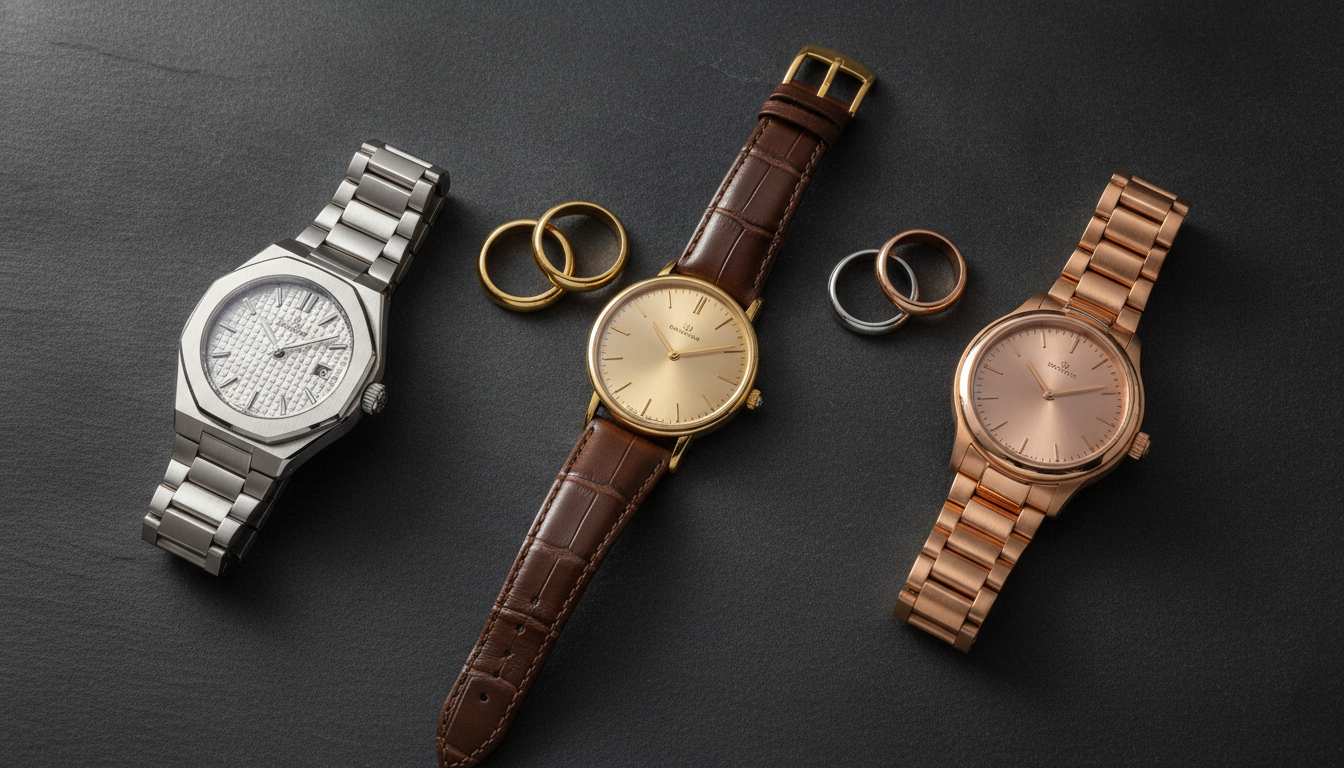
Why the Watch Sets the Conversation
A timepiece is the more permanent object in most collections. It is also the harder piece to redesign, restyle, or replace on a whim. That is not a small reason. When two pieces share a wrist, the watch is almost always the more fixed reference point.
This is the working principle used by stylists who think about jewelry and watches as a single composition rather than two separate accessories. As the team at Weston Jewelers frames it in their coordination guide, the watch is the anchor piece, and the jewelry around it should respond. Aucoin Hart makes the same point in their styling guide for pairing watches with jewelry: pairing works when one piece leads and the other supports.
For our purposes, that means the jewelry does not need to mimic the watch, but it should acknowledge it. Acknowledge it in metal, in proportion, in the way light is allowed to move across the wrist. That is the conversation.
For a client designing a piece to wear alongside a specific watch, the practical starting point is simple: lay the watch down, look at it honestly, and identify the three or four things that define its character. The case shape. The dial texture. The bracelet finish. The color of the indices. A custom piece can then be designed to share one or two of those traits without copying any of them.
Reading the Metal Together
Metal tone is where most people begin the pairing conversation, and for good reason: it is the most immediately visible shared element. But the rule is more nuanced than "match everything."
A watch in steel or white gold reads cleanly next to platinum, white gold, and silver-toned jewelry. A yellow-gold case pairs naturally with yellow gold jewelry. Rose gold on the wrist extends the same warm range, including warm-hued stones like morganite or champagne diamonds. Two-tone watches, which intentionally mix metals, give the jewelry permission to be more flexible, because the watch itself has already broken the constraint.
The LV Luxury guide to matching luxury watches with designer jewelry describes the principle well: matching metal tones does not require everything to be identical, but consistency in tone creates a refined appearance. Identical is not the goal. Coherent is.
This is where a custom commission becomes genuinely useful. A client can specify metal exactly, down to the karat and color of gold, so the new piece sits inside the existing range rather than drifting toward it. Our custom jewelry process lets you define the metal at the design stage, and our collection jewelry is offered in either yellow or white gold to keep that range honest from the start.
A word on mixing metals, because it is worth naming. Mixing works when it is designed in, not when it happens by accident. A two-tone watch and a yellow-gold bracelet is a deliberate conversation. A steel watch and a rose-gold ring is not necessarily wrong, but it asks the eye to do extra work. If that is the intent, fine. If not, stay in one metal family and let one piece carry the warmth.
Scale, Geometry, and the Proportion Question
This is the part most buyers skip, and it is the part that determines whether two pieces feel like a set or like a coincidence.
Proportion is the real conversation. A 42 mm sports watch with a chunky integrated bracelet reads as a heavy wrist presence. A delicate gold bracelet placed beside it will not visually compete, but it will look like an afterthought. A heavier link bracelet, or a cuff-style piece with more material, will hold its own. The same logic runs in the other direction: a slim dress watch on a leather strap leaves room for a more substantial piece of jewelry to share the wrist without crowding it.
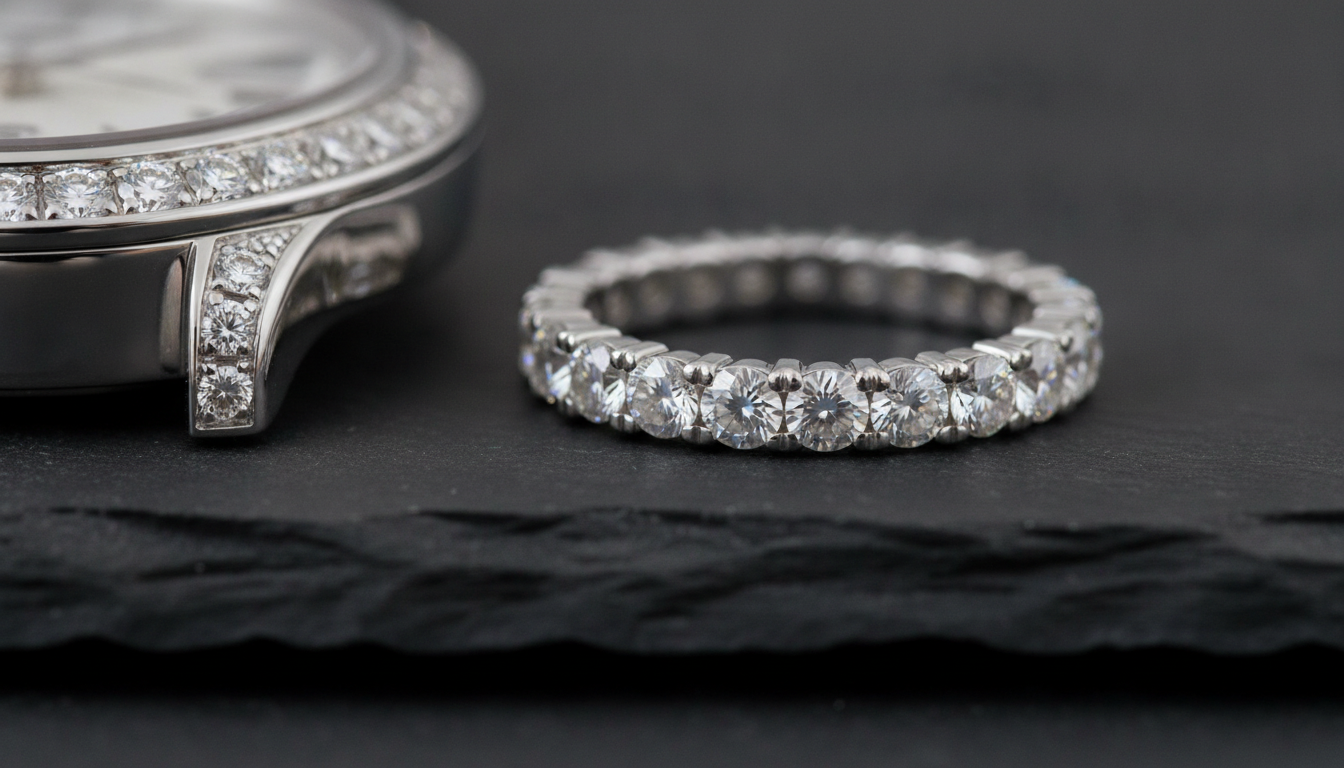
Geometry is the second layer. Round cases sit comfortably next to almost anything. Square or octagonal cases, like the Audemars Piguet Royal Oak family or the Cartier Santos, are visually assertive and tend to dominate the wrist. Jewelry designed to pair with them benefits from cleaner lines and less ornamentation, so the geometry of the case remains the structural reference. A bezel-set eternity band with hard edges can speak the same geometric language as an octagonal case. A soft, curved piece creates useful contrast but should not be busy enough to compete.
Case height matters too, though it is rarely discussed. A tall case on a thick bracelet takes up vertical space on the wrist. A bracelet or bangle that sits directly next to a thick watch case will either need clearance or will need to be designed to nest against it. For clients considering a custom bangle or link bracelet to wear beside a specific timepiece, the design brief can include those dimensional constraints from the start.
The honest version of the proportion question is this: two pieces in conversation need a hierarchy of scale. The piece that carries more visual weight sets the terms. The other piece either rises to meet it or steps back to support it. There is no neutral middle ground.
Stone Language Across Two Pieces
Diamonds and accent stones are where the dialogue gets specific.
A diamond-set bezel or diamond indices on a watch are not decoration. They are a commitment to a particular visual register. A custom jewelry piece designed to sit next to that watch should either match that register or step away from it cleanly. A pavé diamond bracelet next to a steel sports watch reads as two languages; a single line of diamonds in a half-eternity band on the same wrist reads as one.
Stone color is part of the language. The warmth of a yellow-gold case with champagne or cognac diamonds reads differently from a white-gold case with icy D-color stones. Both work, but they do not work together on the same wrist. Choose a register and hold it.
This is one of the areas where custom design gives a client an honest advantage over off-the-shelf jewelry. The stone selection in a custom commission is deliberate: cut, color, clarity, and setting style are chosen for the piece they will live next to. Our design process presents four or five directions for a custom concept, each grounded in a different structural and material logic, so the conversation with an existing watch can be planned in from the first sketch rather than discovered at the wrist.
A subtle point worth raising: lab-grown and natural diamonds sit on the same wavelength optically. They are chemically and structurally the same stone. The choice between them is about origin and long-term positioning rather than a visual one, and it does not change how the stone performs next to a timepiece. We work with both, and the ethical sourcing guide we have published walks through the difference without flattening it.
Designing the Custom Piece With the Timepiece in Mind
This is the practical version of the conversation, and it is the work our studio is built for.
When a client approaches us with a specific timepiece already in the collection, the design process is essentially a translation exercise. The watch has its own vocabulary: case geometry, dial texture, finishing, scale, and material. The jewelry will need to exist in relation to that vocabulary, either echoing it or holding its distance.
Our custom jewelry design process handles this by design. A custom concept begins with a conversation about the client's existing pieces, including any timepiece the new jewelry is intended to live alongside. From that brief, the studio develops several original design directions, each grounded in different structural decisions. The client selects a direction, the design is refined, and the final piece is produced on a made-to-order basis. Production typically runs around three weeks once every specification is confirmed.
For clients who would rather start from an existing design and adjust it, our collection jewelry is offered made to order or tailored to specification. Yellow or white gold, natural or lab-grown diamond, and dimension choices can be set against an existing watch at the design stage. This is often the right path when the watch is fixed and the jewelry needs to fit into its visual language without dominating it.
Two practical examples clarify the difference. As a hypothetical scenario: a client owns a 41 mm yellow-gold dress watch with a champagne dial and applied gold indices, and wants a bracelet to wear beside it. A made-to-order gold link bracelet with a similar profile and finish would speak the same language without copying the watch. As a second hypothetical scenario: the same client owns a 40 mm steel sports chronograph and wants a ring to wear on the same hand. A simple platinum band with a single bezel-set diamond would respect the watch's clean geometry and let the chronograph remain the visual anchor. Both choices are deliberate. Neither is forced.
The Restrained Composition
A wrist, or a hand, or an outfit, is a small canvas. Two pieces in conversation cannot both be loud without producing visual noise. The pieces that work best together are the ones where one leads and one supports, where the shared elements are chosen rather than coincidental, and where the differences in style, era, or scale are part of the interest rather than a problem to solve.
The buyer who gets the pairing right is not the one who matches every element. It is the one who decides, before buying, what each piece is responsible for. The watch owns time, structure, and weight. The jewelry owns intimacy, light, and detail. When those responsibilities are clear, the conversation between the two is easy to read.
This is the philosophy that informs how our timepiece curation and our made-to-order jewelry are designed to work together. Each is built with intention, and each is meant to be worn alongside pieces that have been chosen with the same care.
A custom jewelry piece and a luxury timepiece in conversation is, ultimately, a question about restraint. If you are designing or commissioning a piece with a specific watch in mind, bring that watch into the conversation at the start. Contact our studio to begin a brief, and the rest of the design work follows from there.
