

Watch Marketplace vs. Curated Dealer
The Stellaris Journal
A watch marketplace brings listings from multiple sellers into one searchable environment. Depending on the platform and listing, it may manage discovery, identity checks, payment, authentication, shipping, returns, or disputes, but it may not own, possess, describe, or guarantee every watch itself.
A curated or direct dealer can sell owned inventory, consigned inventory, or a specifically sourced watch under its own process. One counterparty can simplify accountability, but “curated” does not prove inspection quality, originality, favorable price, or buyer protection.
Compare the exact transaction by seller, custody, listing responsibility, inspection, payment, protection, returns, shipping, and dispute owner. Breadth is a discovery advantage. A direct counterparty can be an accountability advantage. Neither establishes the quality of the watch.
Watch Marketplace vs. Curated Dealer: The Short Answer

The two models organize supply and responsibility differently.
A multi-seller marketplace is useful when a buyer wants broad discovery across references, configurations, sellers, and locations. The platform may provide significant transaction services, but the scope can vary by country, seller, price, category, and payment path.
A direct dealer is useful when the buyer wants one business to present, invoice, and stand behind the transaction. That business may physically hold the watch, source it after a request, or sell on consignment. Its own policies and evidence still need review.
Hybrid models are common. A platform may sell some inventory directly and host third-party sellers. A dealer may advertise its own watches while sourcing others externally. A watch can also move from a marketplace listing into a dealer-to-buyer sale. The label on the website does not settle the contract.
The invoice and listing-specific terms should settle it.
Use this decision boundary:
- Choose the model only after identifying the exact seller and listing.
- Verify which party owns or holds the watch.
- Confirm who created the description and photographs.
- Identify who examines the watch and issues each promise.
- Keep payment inside the path required for any protection you intend to use.
- Read the exact return, warranty, delivery, and dispute terms before funds move.
- the inventory owner or consignor;
- the seller of record;
- the marketplace or listing platform;
- the direct dealer or sourcing provider;
- a payment or escrow provider;
- an authentication or inspection party;
- the carrier and coverage provider; and
- the buyer.
- Owned inventory: the seller owns the identified watch.
- Consignment: another owner retains an interest while the dealer or platform presents the watch.
- Third-party listing: the watch and description may remain primarily with an external seller.
- Incoming inventory: a watch is expected but may not yet have been physically received or finally inspected.
- Sourcing request: the buyer has supplied criteria, but no exact watch may yet be approved.
- seller identity or business verification;
- item eligibility;
- payment collection or escrow;
- authentication or inspection;
- custody and shipment;
- delivery confirmation;
- return eligibility;
- non-delivery or misdescription claims; and
- dispute review and remedy.
The wider question of where to buy used watches also includes authorized certified pre-owned, auction, and private-sale routes. This guide goes deeper only on marketplace and direct-dealer operations.
Map the Seller, Platform, and Watch Before Comparing
Draw a simple transaction map. It may include:
One business may perform several roles, or each role may belong to a different party. Ask whose name appears on the invoice, who receives and releases payment, and whose terms control the sale.
Inventory status changes the comparison:
Do not describe a sourcing lead as in-stock inventory. Do not assume an online listing means the platform or dealer currently holds the piece. Ask when availability was last confirmed and whether the photographs show the exact watch.
The same marketplace can assign different terms to a professional dealer, private seller, high-value item, cross-border listing, or transaction completed outside its payment system. Read the terms attached to the exact opportunity rather than relying on a platform-wide headline.
The responsibility matrix below stays conditional because no category has one universal model:
| Function | Multi-seller marketplace | Direct curated dealer | Buyer verification |
| ---------------- | ---------------------------------------------------------- | ------------------------------------------------------- | ------------------------------------------ |
| Inventory source | May be professional, private, platform-owned, or consigned | May be dealer-owned, consigned, incoming, or sourced | Who owns the exact watch? |
| Seller of record | May be listing seller or platform entity | May be dealer or disclosed consignor arrangement | Whose invoice and terms control? |
| Physical custody | May remain with seller or move through inspection | May be with dealer or external source | Who has handled it, and when? |
| Listing | Seller, platform, or both may supply information | Dealer usually publishes under its name | Who is responsible for errors? |
| Inspection | May be seller, platform, third party, or none | May be dealer, specialist, manufacturer, or third party | What was inspected and by whom? |
| Payment | Platform, escrow, processor, or seller may receive it | Dealer or disclosed processor usually receives it | When is payment released or final? |
| Protection | Platform process may apply to eligible transactions | Dealer warranty, guarantee, and return terms may apply | Which promise covers this item? |
| Shipping | Seller, platform service, inspection hub, or carrier | Dealer or source may arrange it | Who bears transit risk and handles claims? |
| Returns/disputes | Platform and seller roles may be divided | Dealer is often direct contact | What deadline, evidence, and remedy apply? |
Where a Watch Marketplace Adds Value
Breadth is the clearest marketplace advantage. Multiple sellers can expose a buyer to more references, dial variants, bracelets, production periods, conditions, locations, and price points than one dealer is likely to hold at a moment in time.
Search and filter tools help with discovery. A buyer can compare how many examples appear, which configurations recur, where sellers are located, and how asking prices change with stated condition or completeness. Alerts can surface new candidates without proving that those candidates meet the buyer's standards.
The comparison still requires normalization. Two sellers may use “excellent” differently. One price may include buyer protection and domestic shipping while another excludes tax, duty, inspection, or service. A watch described as a full set may include different items. Compare the exact components and obligations, not only the reference and headline price.
Marketplaces can also concentrate reputation and transaction records, but a platform's reputation does not establish every seller's reliability. Read recent seller-specific reviews, complaint patterns, response history, and current contact information. Review evidence should lead to further verification, not substitute for the watch and contract.
Some marketplaces sell directly, inspect eligible watches, manage payment, or offer a return or dispute process. Others operate more like classified listings. Do not assume that “marketplace” means uncurated, chaotic, or unprotected. Verify the service actually attached to the listing.
Breadth can become noise when the target is poorly defined. Establish the acceptable reference, material, dial, condition, component history, accessories, budget, location, and transaction terms before using filters. A larger result set is useful only if the buyer can distinguish a real alternative from a superficially similar listing.
Marketplace asking prices are observations, not completed-sale values or appraisals. They can support research when dated and compared carefully, but they should not be summed into a false market certainty.
Buyer Protection Depends on the Exact Transaction

The FTC's online-marketplace guidance emphasizes that platforms differ in how they display listings, process payment, and handle delivery, returns, refunds, and problems. A protection headline does not tell the buyer whether a particular item qualifies.
Break protection into separate functions:
For each function, identify the issuer, scope, exclusions, deadline, evidence requirement, and remedy. A platform may authenticate eligible watches while leaving condition and originality disclosures with the seller. It may hold payment until a defined event without insuring every claim. It may offer returns for some sellers or locations but not others.
Keep the transaction inside the required payment and communication path. The FTC warns that moving outside a marketplace can remove protections. A request to pay another account, communicate only off-platform, undervalue a customs declaration, or bypass an inspection step should be treated as a material change.
Authentication, warranty, and returns are different. A favorable inspection does not promise future mechanical performance. A seller warranty is not a manufacturer warranty. A service contract is another agreement. The FTC's warranty guidance recommends checking what is covered, for how long, and how a claim is made.
Record the listing, actual photographs, seller statements, checkout page, payment confirmation, protection terms, inspection report, shipping record, and deadlines. Web content can change after purchase. Protect full serials and personal data while retaining the private evidence needed for a legitimate claim.
What a Curated Dealer Can and Cannot Change
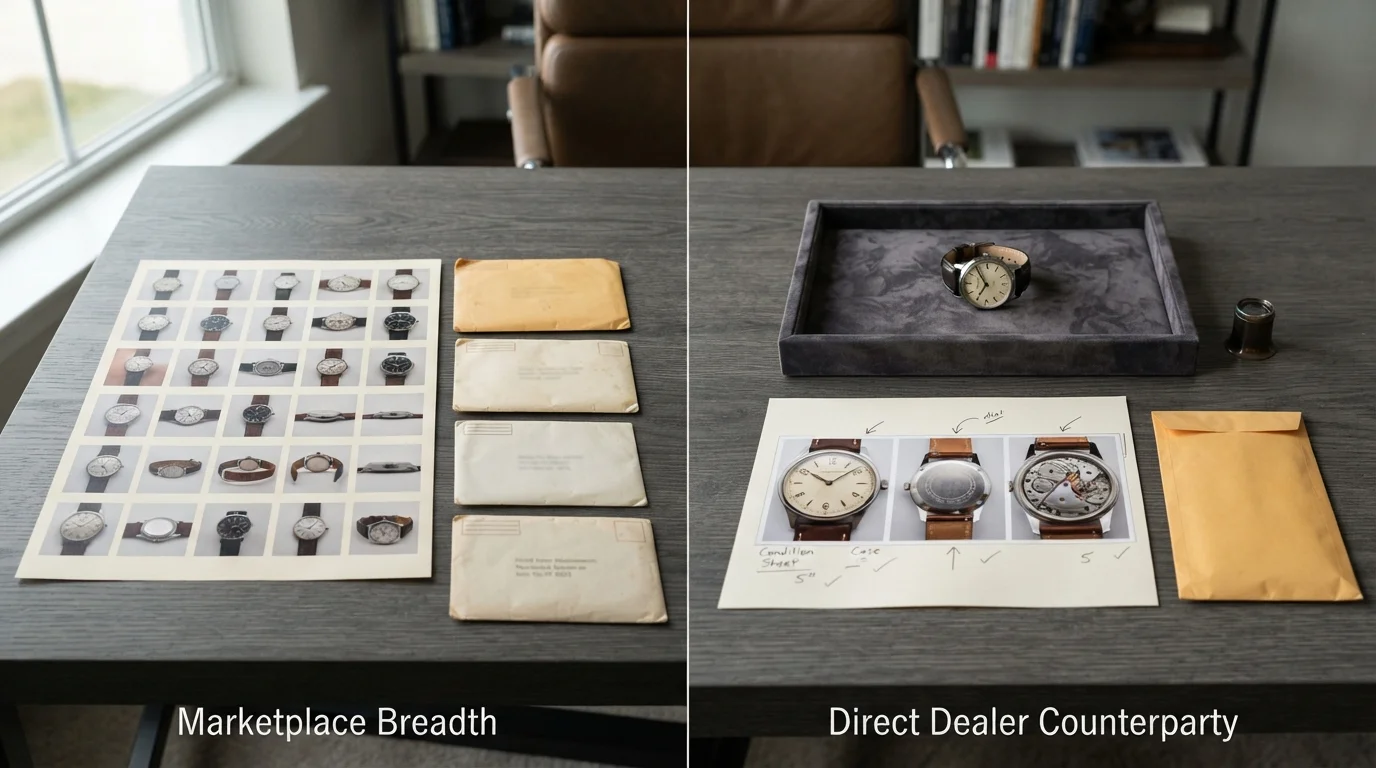
A direct dealer can potentially consolidate roles. It may own or hold the watch, create consistent photographs and condition descriptions, arrange inspection, receive payment, issue the invoice and guarantee, ship the parcel, and handle a return through one process.
Potentially is the important word. Verify every promise. A smaller catalog does not prove that every watch was physically inspected. One invoice does not prove favorable return terms. A dealer guarantee does not establish manufacturer affiliation or complete component originality.
Meaningful curation should produce an explainable selection. Ask why the particular example is offered, what differentiates its condition or configuration, which alternatives were considered, what documents and accessories accompany it, and which limitations remain. “Curated” without supporting criteria may mean only that the catalog is small.
Curation cannot establish suitability for every buyer. A watch may be authentic, well documented, and fairly represented while falling outside a buyer's size, condition, originality, service, or budget requirements. The dealer should help expose those tradeoffs, not turn selection into a universal recommendation.
A direct sourcing service also begins without an exact watch. The brief should state reference, configuration, condition, components, accessories, budget, location, and approval rights. Once a watch is found, it needs its own photographs, disclosures, inspection, price, invoice, guarantee, and return terms. Access to a reference is not approval of the piece.
Direct accountability is valuable only when it remains after delivery. Ask who handles an authenticity concern, condition discrepancy, service issue, missing item, shipment loss, or return. The same contact may coordinate all of them, but different policies and issuers can still apply.
How Stellaris's Published Direct-Dealer Model Works
The Stellaris Collection identifies itself in its FAQ as an independent dealer, not an authorized retailer for the brands it offers. Its authenticity guarantee is therefore a Stellaris commitment rather than a manufacturer certification.
The FAQ distinguishes priced watches in inventory from pieces marked Available Upon Request. For a request, it describes a buyer brief, a 10% refundable sourcing deposit, a search through vetted partners, presentation of a specific qualifying watch, buyer approval, and collection of the remaining balance after approval.
The FAQ contains timing language that is not consistent across every sourcing passage, so this article does not promise a fixed rare-watch deadline. A buyer should confirm the current search period and deposit-refund trigger for the specific request in writing.
For watches it sells, Stellaris says it uses photographs of the actual item, specifies included accessories, authenticates the watch on arrival through a multi-point inspection, and reverifies it before shipment. Those statements support asking for exact-watch evidence. They do not mean every component is original, every watch receives the same internal procedure, or every manufacturer warranty remains active.
The company also publishes payment, delivery, inspection, and return terms. Its refund policy controls current return eligibility and procedure. Buyers should review the live FAQ and policies for the actual watch rather than relying on this summary.
Stellaris's direct model can create one commercial counterparty for a watch it sells. That still requires the same questions about custody, exact condition, service and component history, included items, guarantee scope, payment, shipping, and post-sale responsibility.
This article is published by Stellaris and therefore has a commercial interest in the comparison. A marketplace should be evaluated by its exact transaction terms, and Stellaris should be evaluated by its own evidence and written commitments.
Marketplace or Dealer: A Responsibility Checklist
Before payment, answer:
1. Who owns the watch, and who is the seller of record?
2. Is the piece in stock, consigned, incoming, or still being sourced?
3. Who produced the listing, condition report, and exact photographs?
4. Who has physically held and examined the watch?
5. What does the authentication or inspection conclusion cover?
6. Which originality, service, condition, function, and completeness questions remain?
7. Who receives and releases payment, and when does it become final?
8. Which marketplace protection, seller guarantee, manufacturer warranty, service contract, and return policy applies?
9. Who packages, covers, ships, and monitors delivery?
10. Who resolves non-delivery, damage, misdescription, authenticity, or return disputes?
11. What evidence and deadline apply to each remedy?
Get material answers in writing. Save the approved listing, photographs, disclosure, invoice, inspection report, payment record, policies, and shipping evidence. If another example of the same reference is substituted, repeat the review.
Choose a marketplace when its breadth and exact transaction protections fit the search. Choose a direct dealer when its inventory, evidence, and one-counterparty model fit the purchase. Neither route removes the need to assess the individual watch.
For a Stellaris inquiry, use the contact page to confirm whether the watch is in stock or sourced, the exact evidence, deposit and payment terms, inspection scope, included items, delivery controls, and return terms before proceeding.
