

Personalizing Luxury: A Practical Guide to the Custom Jewelry Design Process
The Stellaris Journal
Everyone romanticizes custom jewelry. "It's art! A unique expression!" The reality? It's a complex, often expensive, project that most people approach without adequate preparation.
So, you envision something truly custom? A one-of-a-kind ring, a necklace that authentically expresses you. This aspiration is commendable, but before succumbing to romantic notions of "craftsmanship," grasp this fundamental truth: creating a custom piece isn't an ethereal creative act. It's a demanding, multi-stage process—a job. And if you don't understand that job, you risk significant disappointment.
This guide moves beyond glossy aesthetics. It's about equipping you with the knowledge to achieve precisely what you desire, navigate common pitfalls, and ultimately own a custom piece that genuinely lasts—far beyond the average 4-6 week design window. We'll demystify the technical stages: CAD, wax models, and all the behind-the-scenes work. More critically, we'll illuminate the crucial decisions of who to hire (your artisan), what to expect regarding cost, and the realistic timeline involved. Our promise: no surprises, just unvarnished, practical insights.
Brief and TL;DR
Custom jewelry isn't just about the final sparkle; it's a meticulously managed project. Success hinges on clear communication, active participation through critical review stages (like CAD and wax models), and rigorous due diligence in vetting your artisan. Approach this journey with a clear understanding of costs, timelines, and policies to ensure your vision translates into a cherished heirloom, free from unexpected pitfalls.
Successful custom jewelry is a disciplined collaboration, not a wish whispered into existence.
The Custom Jewelry Blueprint: A Five-Stage Journey
Let's be clear: a custom ring doesn't simply materialize from a wish. It's a rigorous journey, start to finish, comprising five critical stages. Your active, informed feedback is indispensable at each stop. Fail to voice your perspective, and you accept the outcome—a consequence entirely on you. True custom work is inherently a collaboration; anything less defeats its very purpose.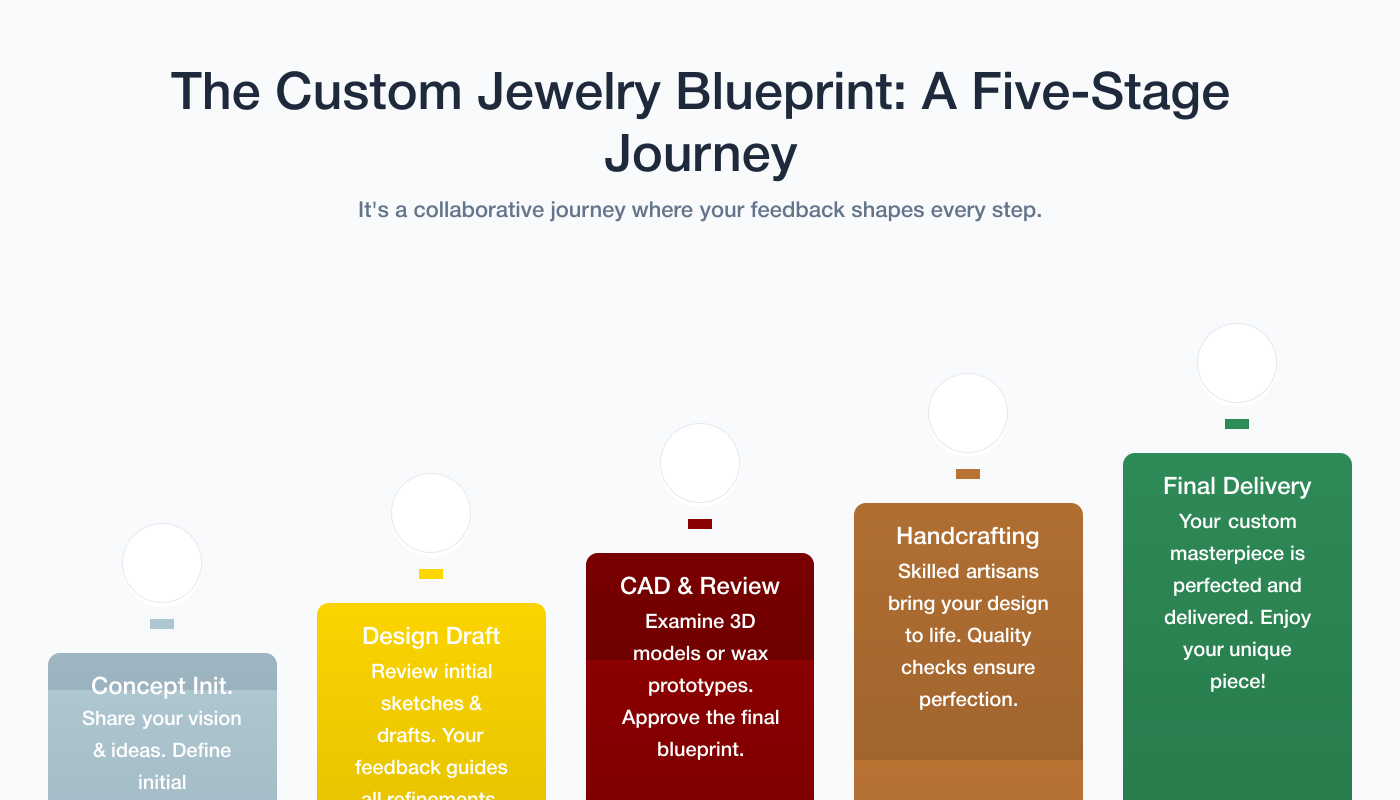
Every stage demands your active involvement; silence guarantees regret, not perfection.
1. The Talk (Consultation)
This is where your custom journey either takes flight or tragically falters, often depending on the jeweler. You arrive, perhaps armed with a sprawling Pinterest board or just a nebulous concept. Your paramount task? Articulate your vision. Detail your preferences, your absolute dislikes, and the unique aesthetic you're pursuing. Crucially, be transparent about your budget. Holding back here is a critical error; an uninformed jeweler can only guess, and those guesses invariably inflate costs. As Kennedy's Jewelers rightly emphasizes, this is the foundational step where they listen. They must listen, and you must speak, conveying your ideas, preferences, and even your most ambitious expectations so they can be realistically tempered.
This is your shot to lay it all out there. Get clear. Be honest. Because a bad start means a worse finish.
2. The Digital Magic (CAD Design)
The conversation complete, your jeweler now translates your vision into a digital realm, typically utilizing CAD (Computer-Aided Design) software. This isn't just a fancy term; it's the creation of a precise 3D model on screen—a blueprint you can virtually manipulate and inspect from every angle. Modern technology truly shines here, transforming your intricate imagination into a tangible on-screen representation. You might think you know what you want, but seeing it in 3D is an entirely different experience. This is your opportunity to meticulously scrutinize details, refine prong settings, or reposition a diamond. A Reddit user famously lauded Emily Chelsea Jewelry for dedicating three hours to CAD refinement, ensuring absolute perfection—that's the level of commitment you need. Without such diligence, you're merely blindly trusting, and misplaced trust in this context proves exceptionally costly.
You absolutely must scrutinize this 3D model. This is where big changes are cheap. Later? Not so much.
3. The Wax Or Resin Model (Physical Preview)
Assuming the CAD design meets your approval, the next step involves printing it—yes, printing it—in wax or resin. This small, physical prototype represents your final straightforward opportunity to experience the actual proportions and tactile feel of your piece. Hold it. See if that chunky band you admired in 2D suddenly feels cumbersome on your finger, or if the stone setting appears too elevated. A discerning Reddit user praised their jeweler for revising the CAD after reviewing the wax model—a testament to smart practice. The screen can sometimes deceive, and the wax model serves as an undeniable reality check. Do not bypass this stage. Do not simply nod along. Deconstruct it. This is the most inexpensive mistake you'll ever fix.
Hold the model. Feel it. Imagine it on you. Your decision here saves you a world of hurt (and money) later.
4. The Real Deal (Casting & Setting)
With your unequivocal stamp of approval on the wax model, the actual creation begins. The metal is melted and poured into a mold of your wax, then cooled. What emerges is your piece, albeit in a raw, unfinished state. Reputable jewelers like Chinchar Maloney often provide detailed photos of your chosen stones, followed by documentation of the entire building process. It’s a remarkable level of transparency. Next, those diamonds, sapphires, or whatever gems you've selected are meticulously set. This technical phase typically unfolds without your direct involvement, which is a relief. It's where the artisan's true craftsmanship is either brilliantly showcased or glaringly absent. No pressure.
This is where the theoretical becomes physical. You just gotta trust them (and their reputation) to get it right.
5. The Grand Finale (Final Polishing & Delivery)
The culmination is nigh. The metal undergoes final polishing, buffing, and any last-minute adjustments to achieve its dazzling finish. Then, it's finally yours. You receive the call, make your appointment, and behold your creation. The hope, of course, is that it embodies everything you envisioned, and more. After all the dialogue, the anxiety, the significant investment—it absolutely must be exceptional. The entire custom journey, from initial consultation to this triumphant moment, typically averages four to six weeks. However, I’ve witnessed timelines spiral dramatically. One unfortunate soul on Reddit endured a four-month wait for a non-custom piece, only for it to arrive defective—a veritable nightmare. Therefore, when your custom piece is finally presented, inspect it. Scrutinize every angle. Because if a problem exists, now is the only acceptable time to address it.
This is the payoff. Your vision, finally real. But don't just grab and run. Make sure it's perfect.
*
Choosing Your Materials: A Guide to Metals and Gemstones
Selecting the right materials is as critical as the design itself, influencing both the aesthetics and durability of your custom jewelry. Don't rush this decision; it's an investment in longevity.
Metals:
- Gold (10K, 14K, 18K, 22K): The most popular choice, available in yellow, white, and rose. Higher karat numbers (e.g., 18K) mean more pure gold, but also a softer metal, making it more prone to scratches. 14K offers a good balance of durability and purity. White gold is typically alloyed with white metals and plated with rhodium, which eventually wears off, requiring re-plating. Rose gold gets its hue from copper alloys.
- Platinum: A naturally white, hypoallergenic, and extremely durable metal. It's heavier and denser than gold, and also more expensive. Platinum doesn't wear away; it simply displaces over time, making it excellent for holding gemstones securely.
- Palladium: A platinum-group metal, lighter than platinum, also naturally white and hypoallergenic. Less common now due to market price fluctuations, but still a viable, durable choice.
- Silver (Sterling Silver): Affordable and beautiful, but significantly softer than gold or platinum and prone to tarnishing. While suitable for fashion jewelry, it's generally not recommended for pieces intended for daily wear, like engagement rings.
- Diamonds: The classic choice for brilliance and hardness (10 on Mohs scale). Evaluate based on the 4 Cs: Carat, Cut, Color, and Clarity. Consider lab-grown diamonds as an ethical and often more affordable alternative to natural diamonds, offering identical chemical and physical properties.
- Sapphires & Rubies: Corundum family, second only to diamonds in hardness (9 on Mohs scale). Available in a vast array of colors (sapphires are not just blue, but pink, yellow, green, etc.), offering excellent durability for daily wear.
- Emeralds: Beryl family, known for their vibrant green. Softer than sapphires (7.5-8 on Mohs), and often have natural inclusions (jardin), making them more susceptible to chipping. Require careful wear and handling.
- Moissanite: A brilliant, durable (9.25 on Mohs) diamond alternative with more fire (sparkle) than a diamond. A popular choice for those seeking an ethical, budget-friendly, and very tough gemstone.
- Ethical Sourcing: Always inquire about the origin and ethical sourcing practices for both your metals and gemstones. Responsible sourcing ensures your beautiful piece doesn't come at a human or environmental cost.
- This is not an impulse purchase, nor has it ever been. It's a demanding, collaborative journey, a continuous back-and-forth essential for forging a future heirloom. Anticipate a process that unfolds deliberately, not one that instantly materializes on your desired timeline.
- Your chosen artisan is far more than a mere technician. They serve as your compass, your quality assurance. The discernment you apply in selecting the right partner will dictate everything—from the design's structural integrity to your ultimate satisfaction with the finished piece. Choose poorly, and you will undoubtedly experience the repercussions, both financially and emotionally.
- Dispel any notions of unrealistic timelines or bargain-basement pricing. This involves genuine labor, premium materials, and specialized expertise. Embrace the reality of weeks, often months, of waiting. And accept that authentic value rarely comes cheaply; this is an investment, not a clearance item.
Gemstones:
Your material choices define not just the aesthetic, but the longevity and ethical footprint of your custom piece. Exploring a curated selection, like the one at The Stellaris Collection, can provide inspiration for your own material choices.
Finding Your Artisan: How to Vet a Custom Jeweler

So, you’re committed to custom jewelry—a brilliant aspiration. But the true challenge lies in selecting an artisan who possesses the skill and integrity to execute your vision flawlessly. Believe me, countless others will fall short. This isn't merely about possessing shiny rocks or knowing how to melt metal; it's about forging a collaborative relationship with someone you can genuinely trust. Without a true partner, you're setting yourself up for considerable frustration.
Start with direct conversation. Engage them in dialogue, and critically observe their communication style. Their patience, clarity, and responsiveness are as crucial as their impressive portfolio—perhaps even more so. You need real, thoughtful replies, not radio silence or generic templates. One Reddit user lauded KJG on Etsy for providing 3D drawings and wax models without requiring an upfront payment for the initial review—a clear demonstration of trust. Conversely, a jeweler who habitually ducks calls or offers terse, unhelpful responses is a significant, undeniable red flag.
Next, meticulously examine their past work. Is the quality consistent? Does it reveal meticulous attention to detail? Does it align with the aesthetic you desire? If their expertise is exclusively in bold, modern designs, and you seek delicate filigree, they are likely not the right fit. More importantly, delve into their process. Do they leverage CAD? Offer wax models? How do they address your feedback when you express dissatisfaction with a specific element? You absolutely must know. Another user recounted a jeweler dedicating two hours to refining the CAD design with them, ensuring absolute precision—that’s the mark of true commitment, not merely hoping you’ll accept a rushed effort.
Finally, go beyond superficial glances at reviews. Read them thoroughly, from multiple sources—not just their own website. Search for recurring themes. Positive remarks about transparent problem-solving are a good sign. However, if you consistently encounter mentions of "long delays," "broken piece," or "ghosted me," withdraw immediately. Seriously, run. A customer of July Rose Jewelry, for instance, waited four months, received a broken piece, and was subsequently met with total radio silence. Another Theo Grace customer received a replacement necklace that was shorter and featured a dented clasp—an unbelievable lapse in service. These aren't isolated missteps; they indicate fundamental business failures. These anecdotes serve as your early warning system. Furthermore, beware of jewelers who shortchange you; one user reported their gold chain returning from repair inches shorter—a blatant act of theft.
Your money, your time, your peace of mind—it all depends on vetting them like your life.
The Practical Details: Cost, Timelines, and Policies
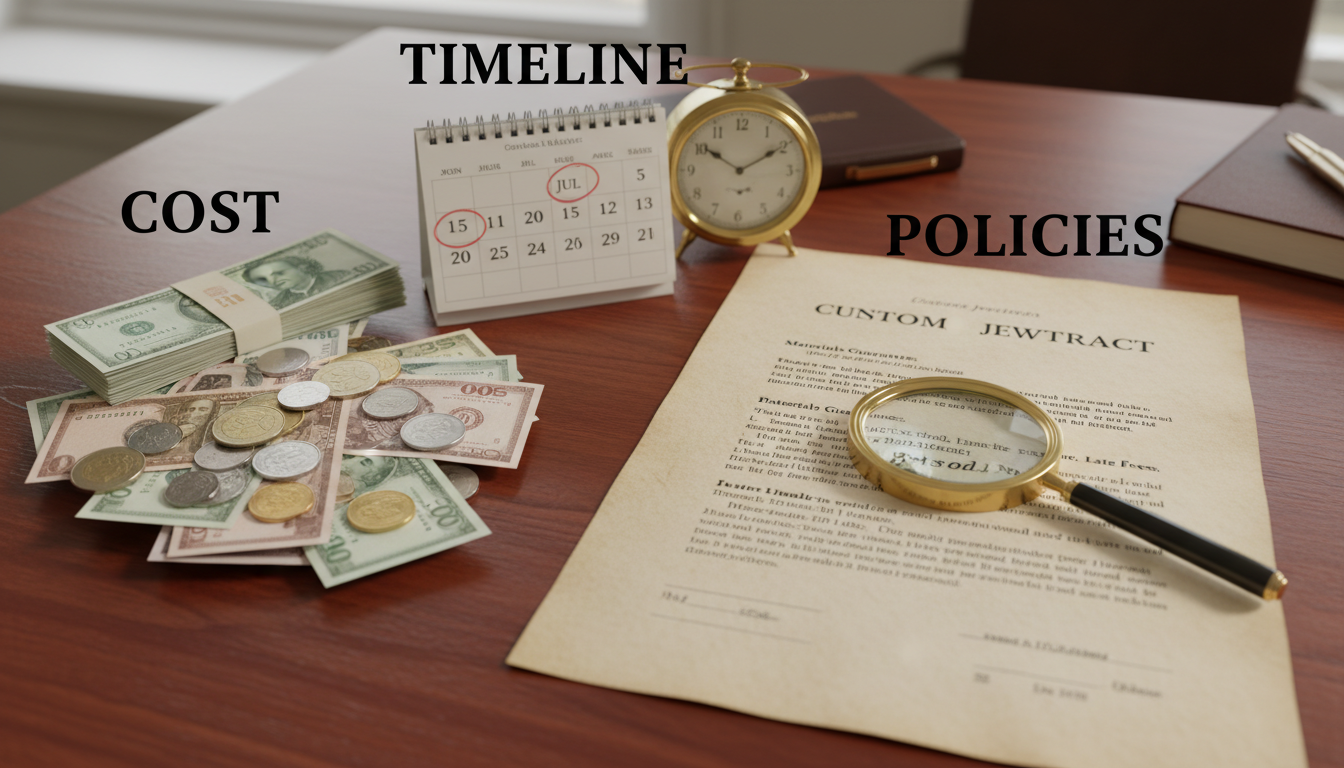
Let's confront the realities of cost and time, because nobody appreciates unwelcome surprises. The common assumption is that custom always equates to expensive. Not necessarily. The final price is a complex interplay of variables: your chosen metal, the gemstones, and the intricacy of the design—all factors largely within your control. Therefore, a custom piece can indeed be surprisingly reasonable, with pricing directly reflecting your deliberate choices.
However, be prepared for the waiting game. While a typical timeline of four to six weeks is often quoted, consider this merely a hopeful starting point. Complex designs and necessary revisions frequently extend this considerably—potentially to twelve weeks or even longer. You must secure an estimated timeline upfront, in writing. For example, Emily Chelsea Jewelry's quoted 12-week turnaround expanded to 13 weeks after a client change. And July Rose Jewelry customers on Reddit recounted 12-week maximums that evaporated into months, accompanied by zero communication. So, adjust your expectations accordingly.
Before committing a single dime, proactively inquire about all policies. What are the procedures for design changes? What is the required deposit, and is it refundable? What warranty or guarantee is provided? Obtaining these answers is non-negotiable; without them, you risk being trapped. Recall the Theo Grace customer forced to file a chargeback over a shortened chain—a testament to policy failures. Vague or unfavorable policies are a glaring red light. Some jewelers impose exorbitant restocking fees for returns, with 38% being an unconscionable example.
Excessively long or, worse, unpredictable wait times are more than just an inconvenience; they signal profound mismanagement and a lack of control within the business. This directly translates to potential grief for you. Maintain meticulous records of every communication, every design approval, and every discussion regarding deadlines. Should things unexpectedly go awry—and they can—this documentation will be your critical defense.
Because a custom piece isn't just about the finished product; it's about not tearing your hair out getting there.
Frequently Asked Questions
Cost of custom jewelry?
No. Not necessarily expensive. Pricing can be super reasonable, actually. It's about your choices. Your materials. So, don't think it's automatically out of reach.
Custom quality versus in-stock?
Nope. Not automatically better. Quality depends on the jeweler. Their standards. Some stock pieces are amazing. Some custom jobs? A total mess. It's the artisan. Not the "custom" label.
Choosing a custom style for a gift?
Totally. A good designer will ask you questions. The right questions. About her style. Her existing pieces. And they'll help you zero in. Because you're not supposed to be the expert. They are.
Engagement and wedding rings need to match?
Nah. Your call. Many people like the matchy-matchy look. But plenty don't. And that's fine. It's your finger. Your style. So, just pick what you like.
Can I use my old gold?
Yes. Sometimes. Many jewelers will let you. Recycled metal is a thing. But always ask first. Because not everyone does it. And some charge a fee to refine it. So, just check.
How long does it really take?
Usually four to six weeks. That's the estimate. But plan for more. Like, maybe 10-12+ weeks. Especially if there are changes. Or if the jeweler is totally slammed. And some jewelers take months to ship even non-custom items. So, don't wait until the last minute. Or you'll be sad.
What if I get the size wrong?
Most can resize. But ask about their policy upfront. Some charge. Some do it for free. But it's way easier to get it right the first time. So, measure carefully. Or get measured. Don't guess.
Clear communication and proactive questioning are your best defense against custom jewelry surprises.
So, you've successfully navigated the pervasive hype surrounding custom jewelry. Good. Understand this: custom isn't a magic trick; it's a profound commitment. You're not merely purchasing an object; you're commissioning a legacy, a piece destined to endure and truly mean something. This endeavor demands significant effort—from both you and your artisan.
Here's the undeniable truth:
While the process is undeniably demanding, the ultimate reward is profound: a piece that transcends mere adornment. Something uniquely yours, deeply imbued with personal significance.
Your next step? Cease endless scrolling. Initiate thorough vetting. Seek out a partner who communicates with unwavering candor, offers transparent pricing, and provides an unequivocal roadmap from initial sketch to final delivery. Align yourself with someone who trades in certainty, not ambiguous promises. In this intricate business, clarity and impeccable execution are paramount. If you are truly serious about this significant investment, collaborate only with professionals who embody market value, meticulous craftsmanship, and flawless delivery, such as those found in premier collections. Period.
