

Debunking Common Myths About Luxury Watch Authenticity
The Stellaris Journal
He’s been immersed in the world of luxury watches since the Reagan era—three decades, handling more high-end timepieces than most people encounter in a lifetime. Yet, last month, he held a particularly convincing piece and simply... shrugged. "Can't tell," he admitted. "Not by eye alone." Let that sobering truth resonate.
Your go-to "foolproof" authenticity checks—the smooth sweep of the second hand, the satisfying weight, the perfectly aligned date window? Discard them. They are perilously obsolete, remnants of an era when counterfeit watches were visibly inferior. Today's high-end fakes represent an entirely different echelon of deception — and this is precisely why sourcing from trusted luxury watch dealers matters more than ever. They are terrifyingly good. Buyers browsing a second hand watch shop or exploring the pre-owned luxury watch market who rely on those outdated myths are on a direct path to acquiring a five-figure paperweight. Even seasoned collectors navigating the world of pre-owned high end watches have been deceived — which is why authentication must go far beyond surface-level checks, whether you're shopping independently or through high end watch dealers.
This isn't an exercise in fear-mongering; it's a stark confrontation with reality — one that every buyer in the pre-owned luxury watch market needs to hear. It's time to abandon the superficial 'hacks' touted by amateur enthusiasts. Whether you're visiting a second hand watch shop or dealing with high end watch dealers, we're about to systematically dismantle the most tenacious myths, one by one. Following that, I'll reveal the precise methodologies employed by industry professionals — the same standards upheld by reputable luxury watch dealers and specialists in pre-owned high end watches. No pretense, just verifiable facts, because your financial security in this market depends on it.
In the current landscape, relying on visual 'tells' for luxury watch authentication is no longer just ineffective—it's financially catastrophic.
Why Your Old Authenticity 'Hacks' No Longer Work
You might believe you can identify a counterfeit. You can't. Not anymore. Having navigated this complex landscape for decades, I can confirm that previously reliable methods are now utterly ineffective. A trusted dealer—a professional with thirty years of unparalleled experience examining watches—recently confessed on a Reddit forum that even he is routinely deceived by "super clones." He can no longer discern authenticity by eye alone. And neither can you.
These sophisticated counterfeits are far removed from the easily detectable knock-offs of the past. They meticulously replicate every tangible aspect: the weight, the tactile feel, and even the minute details that once served as secret tells. How? Dedicated online communities, like RepTime, function as collaborative hubs where individuals obsessed with replication openly share insights, refine techniques, and crowdsource the pursuit of perfection. Any 'trick' or visual cue you’ve learned is quickly identified and flawlessly replicated. They adapt, relentlessly.
This phenomenon extends beyond watches, transcending specialized jargon like 'VSF' movements. Consider Cartier jewelry: certain bangle models have become so indistinguishable from genuine articles that Cartier itself has reportedly ceased authenticating them. The implications are profound for anyone in the pre-owned luxury watch and luxury goods market: a brand refusing to verify its own products because the fakes are too good. This trend is especially alarming for buyers of pre-owned high end watches, as the number of watchmakers equipped for true forensic inspection dwindles. Even high end watch dealers and established luxury watch dealers are feeling the pressure — and for the average buyer walking into a second hand watch shop, the stakes have never been higher. Within a few years, as one colleague predicts, distinguishing genuine from fake will be virtually impossible for the average consumer. You're on your own, navigating an increasingly treacherous financial minefield — unless you know exactly who to trust.
Your reliance on outdated authentication methods now constitutes a high-stakes gamble where the odds are against your fortune.
Myth 1: A Ticking Second Hand Always Means It's a Fake
The Most Impressive Quartz Watches on the Market
Ever heard the definitive pronouncement: "A true luxury watch sweeps, it never ticks"? This is unequivocally false—a pervasive misconception. It’s a belief widely echoed and, quite possibly, one you’ve accepted as fact. However, the reality is that numerous top-tier brands, esteemed names in horology, produce exquisite high-end quartz watches. And these watches, by design, tick. Absolutely.
Consider a genuine Omega Seamaster with a quartz movement: it ticks, often audibly, just like any other battery-powered timepiece. Even Patek Philippe, a titan of haute horlogerie, has produced quartz models, such as certain Aquanaut references. F.P. Journe, one of the most revered independent watchmakers alive, created the Élégante—a quartz watch that ticks, yet commands the price of a luxury automobile. Yet, self-proclaimed internet "experts" will erroneously label such watches as fake based solely on their ticking motion.
Furthermore, a mechanical watch's lauded "smooth sweep" is not, in fact, truly smooth. It's a rapid succession of micro-ticks, typically eight times per second, which your eye perceives as continuous motion — an optical illusion. Yet this remains one of the most cited "tests" among buyers in the pre-owned luxury watch market and even in some second hand watch shops. To employ this singular, simplistic criterion as your sole method of authentication is profoundly misguided. It demonstrates a fundamental ignorance of a significant and legitimate segment of the luxury watch industry — one that reputable luxury watch dealers and high end watch dealers understand deeply. For anyone seriously exploring pre-owned high end watches, relying on this myth potentially leads to costly errors or the regrettable dismissal of authentic masterpieces.
Dismissing a luxury watch as fake solely because its second hand ticks reveals a profound lack of understanding about diverse legitimate horological movements.
Myth 2: 'Box and Papers' Are the Ultimate Proof of Authenticity
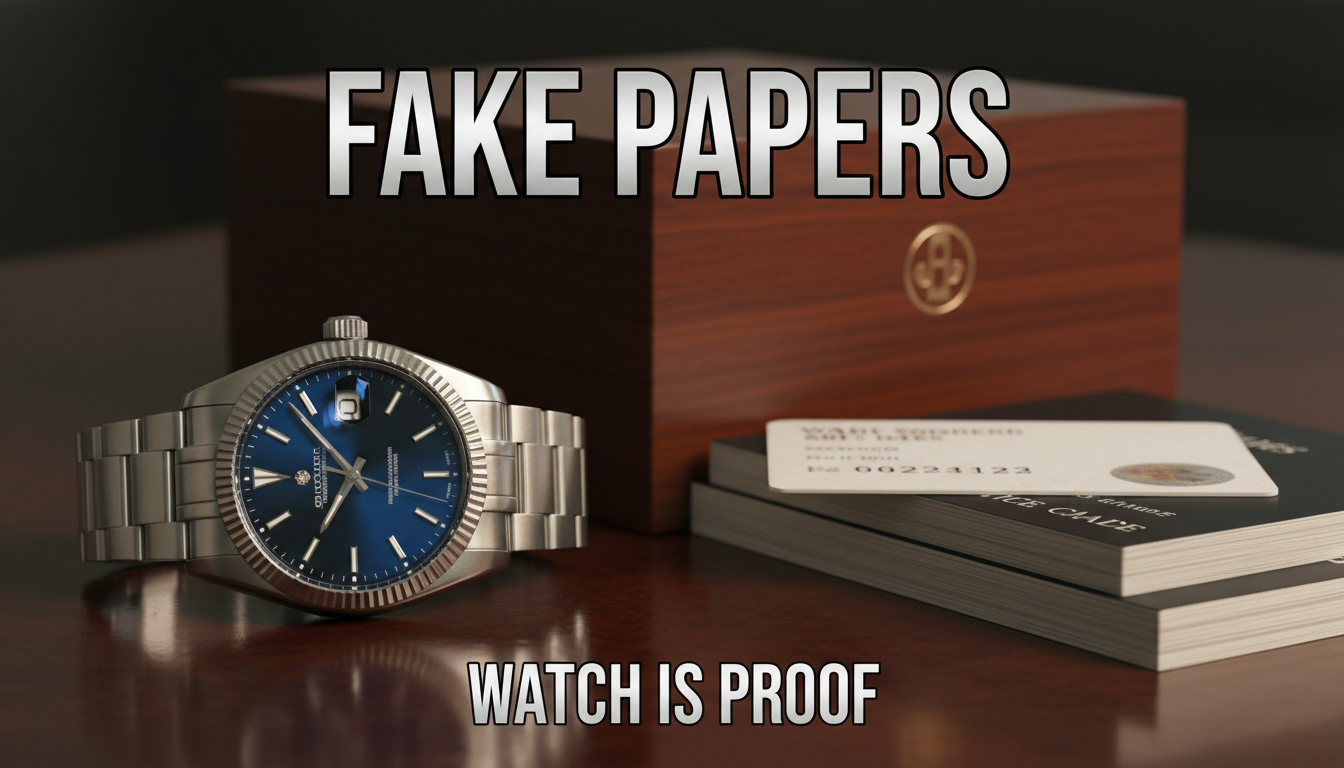
The mantra "Box and Papers!" is often declared as the indisputable guarantee of authenticity, a veritable holy grail. However, this perspective overlooks a crucial reality—or, more accurately, a pervasive deception. The boxes, the instruction manuals, the warranty cards themselves: all can be counterfeited, and they are, with alarming frequency. Highly convincing counterfeit sets are readily available online. Remember the era of fake Rolex hologram stickers? They were easily procured. Therefore, to assume a pristine box equates to an authentic watch is a dangerous fallacy.
Furthermore, consider the realm of vintage timepieces. In past decades, the original packaging was rarely preserved; it was simply a box. Are you prepared to disregard an unequivocally legitimate, historically significant vintage watch solely because it lacks a forty-year-old cardboard container? Such an approach is illogical and would lead to the unfortunate rejection of true horological treasures, all because of an ill-informed internet dictate of "no papers, no deal." This advice is fundamentally flawed.
The ultimate arbiter of authenticity must always be the watch itself — a principle that every credible luxury watch dealer stands firmly behind. The accompanying documents, while valuable for provenance and enhancing resale value in the pre-owned luxury watch market, are merely supplementary. They cannot, in isolation, confer genuineness upon the timepiece. This is a hard truth that seasoned high end watch dealers know well. Exclusive focus on "box and papers" is a common trap, leading unsuspecting buyers — whether purchasing from a second hand watch shop or a private seller — to acquire a counterfeit watch complete with a sophisticated, yet equally fake, set of accompanying documentation. For serious collectors of pre-owned high end watches, this distraction, born from the belief that a decorative piece of paper holds the answer, is a significant and costly vulnerability.
While supporting documents add value, the intrinsic authenticity of a luxury watch rests entirely within the timepiece itself, not its accompanying box or papers.
Myth 3: Any Visual Flaw Means It's a Counterfeit
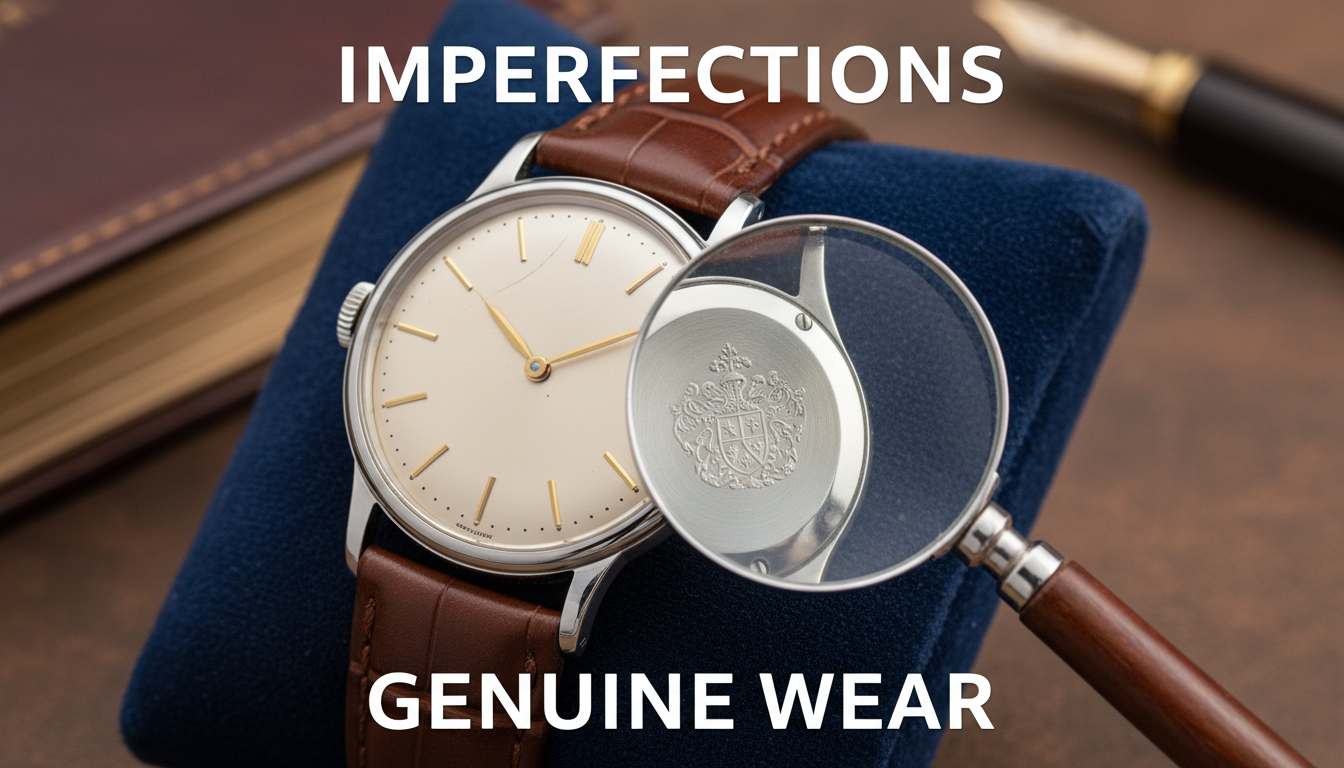
Do you operate under the assumption that every legitimate luxury watch emerges from its production line with diamond-like perfection? Reconsider. This flawed belief is precisely how buyers are misled or, worse, reject authentically valuable pieces based on a minor blemish highlighted by an internet "expert."
The truth is, genuine watches are not always flawless — far from it, and any experienced luxury watch dealer will tell you the same. Production still involves human oversight, and consequently, minute variations are inherent to the manufacturing process. This is especially relevant in the world of pre-owned high end watches, where signs of age, minor factory tolerances, and subtle variations are completely normal. A bezel that's marginally misaligned due to factory tolerances does not invalidate a watch's authenticity — something reputable high end watch dealers understand but amateur buyers frequently do not. The hyper-specific 'flaws' that replica communities obsess over — like a 'milky' crystal or a slightly off-center rehaut engraving — have ironically led fake experts on forums like r/RepTime to erroneously label genuine Rolex watches as fakes. This is a dangerous mindset that bleeds into the pre-owned luxury watch market, causing buyers at a second hand watch shop or online marketplace to reject perfectly authentic timepieces. (Seriously, research these incidents; they're both illustrative and absurd.)
Furthermore, consider the impact of servicing. A watch serviced by a competent but non-official third-party watchmaker might undergo repairs that introduce what some perceive as 'flaws.' A replacement crystal, for instance, might lack the laser-etched crown typically found on a Rolex crystal (a detail, incidentally, not present on all genuine models, such as the Milgauss GV—a fact often overlooked). Such service-related changes can mistakenly be interpreted as evidence of a counterfeit.
The passage of time also plays a role. A genuine watch subjected to years of wear and repeated polishing will naturally exhibit softened or faint engravings on the case, crown, or caseback. It will appear "less crisp" than a factory-fresh counterpart precisely because it has been lived-in and maintained. Similarly, a professionally "redialed" watch may feature lettering that, while genuine, is not as sharp as the original factory application. Thus, not every imperfection signals a death knell for authenticity.
Even the much-debated Rolex 'Cyclops' lens, the date magnification bubble, is often incorrectly expected to possess a perfectly consistent 2.5x magnification. In reality, a slight variance is common even across genuine models. Despite this, online forums are rife with endless debates on this very point. Reputable sources like KeepTheTime have thoroughly debunked these myths, confirming that the Cyclops, winding crown, and etched coronet can all exhibit minor manufacturing variations. Even factory-fresh watches or those returning from a less-than-meticulous service can occasionally present with internal dust or fingerprints. Do not allow minor details to mislead you.
Authentic luxury watches often feature minor manufacturing variations, exhibit natural wear, or show changes from professional servicing; these nuances do not inherently indicate a counterfeit.
How Experts Authenticate: Beyond the Visual 'Tells'
So, you've honed your eye to detect a marginally misaligned bezel? Commendable. However, this is fundamentally not how professional authentication operates. True authentication transcends mere 'spot the difference' games played with photographs; it necessitates a comprehensive forensic investigation.
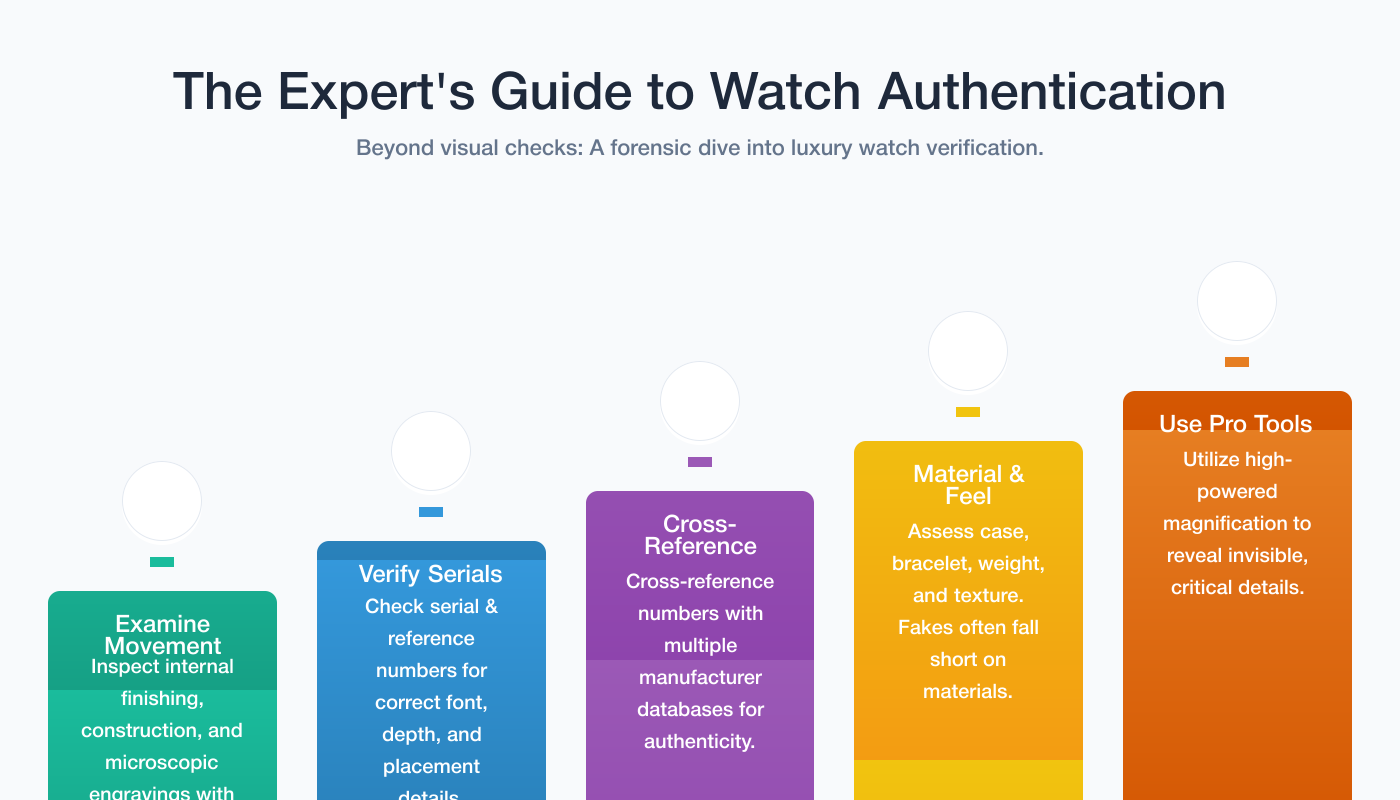
The process invariably begins with the watch's internal mechanism: the movement. This component represents the most formidable challenge for counterfeiters to accurately replicate. Upon opening the caseback, an expert scrutinizes the finishing, the structural integrity, and the specific engravings adorning the minute plates and bridges. Counterfeits consistently fail to match the precision and meticulous attention to detail inherent in genuine movements. Experts examine microscopic engravings and the exacting finish of even the smallest screws—a critical point highlighted by specialists like Gray & Sons, who emphasize the necessity of advanced equipment for such scrutiny. This is the bedrock of authentic assessment.
Beyond visual inspection, the serial and reference numbers are meticulously verified: assessing the correctness of the font, the depth of the engraving, and its precise placement. Counterfeiters frequently err in these critical details. These numbers are then cross-referenced against official manufacturer databases, and critically, experts consult multiple sources rather than relying on a single, potentially compromised, data point.
The remainder of the watch—the case, the bracelet—undergoes a thorough tactile and material examination. Genuine luxury watches employ specific, high-grade materials like proprietary steel alloys, gold, or platinum. While fakes attempt to emulate these, they almost invariably fall short. The subtle nuances of weight, texture, and overall weight distribution often betray a counterfeit, producing a discernibly "wrong" feel in an experienced hand.
Crucially, none of this intricate analysis is possible with a smartphone camera — a limitation that any trustworthy luxury watch dealer will be upfront about. It demands specialized tools: high-powered magnification, for instance, to reveal details imperceptible to the naked eye. This is the standard that separates serious high end watch dealers from casual sellers operating out of a second hand watch shop with no formal authentication process. These are observations that only a rigorously trained expert, endowed with years of specialized experience, can accurately interpret. It is precisely this depth of expertise that makes due diligence non-negotiable when investing in pre-owned high end watches. The very essence of any luxury timepiece resides within its movement, and truly understanding it requires an intimately close examination — the kind that only professionals deeply embedded in the pre-owned luxury watch market are equipped to perform.
Genuine authentication demands a deep dive into the watch's intricate movement, verifiable serial numbers, and precise material science, necessitating specialized knowledge, advanced tools, and an expert's trained discernment.
How to Buy a Pre-Owned Luxury Watch with Confidence
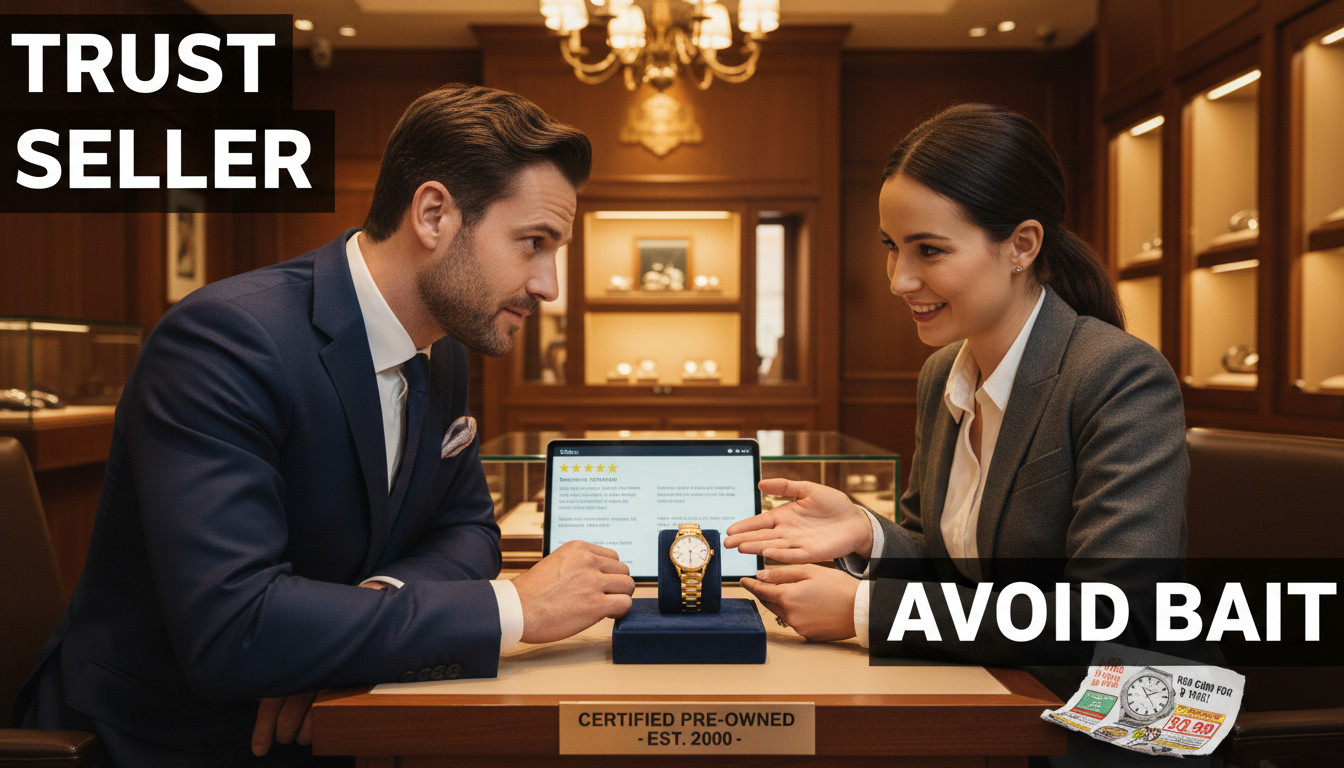
Considering the purchase of a pre-owned luxury watch and aiming to avoid deception? A wise ambition, given the unfortunate prevalence of fraud in this market.
A seller with an unimpeachable reputation is your strongest bulwark against counterfeits. Such entities have a significant professional standing to uphold and are fundamentally disinclined to compromise their integrity by dealing in fakes. Therefore, rigorous vetting is paramount. Scrutinize their reviews, analyze their transaction history, and assess the platforms they utilize. Reputable marketplaces like Chrono24, for instance, offer robust buyer protection mechanisms, which is a significant advantage. Even within community forums, such as r/watchexchange on Reddit, seasoned participants consistently advise adhering to established, trusted names.
Crucially, maintain an extreme vigilance for "deals" that appear too good to be true. They invariably are. A substantial discount on a highly coveted or notoriously difficult-to-acquire model should trigger immediate, significant red flags. If someone is offering a Rolex Submariner at half its market value, disengage immediately. That is precisely how financial losses occur; as Windsor Jewelers cautions, such pricing is a definitive lure.
Should you ever harbor even a scintilla of doubt, heed your intuition. Do not proceed with the purchase. Instead, insist on an independent inspection by a trusted, certified watchmaker before any funds change hands. Your local jeweler can often facilitate this. Allowing a professional to open the case and examine the internals provides the definitive truth. This minor upfront investment in an inspection fee is a small price to pay for circumventing potentially monumental financial and emotional distress.
When acquiring a pre-owned luxury watch, unequivocally prioritize the seller's established reputation and explicit guarantees over any seemingly irresistible, but ultimately suspicious, bargain.
So, you believed your authentication skills were infallible? Eyeballing a counterfeit? That era concluded years ago, likely taking numerous investments with it — and the pre-owned luxury watch market has never been more unforgiving as a result. The 'tells' you painstakingly learned from online forums in 2010 are now not merely outdated but actively perilous, misleading you into dangerous territory regardless of whether you're buying from a private seller or a second hand watch shop. These are no longer amateur garage replicas; they are meticulously engineered, precise deceptions, crafted to ensnare anyone relying on obsolete assumptions — even seasoned high end watch dealers. And they are succeeding brilliantly. The demand for pre-owned high end watches has never been higher, and counterfeiters know exactly where to position themselves to exploit it. Discard the notion of a 'smooth sweep,' ignore the subjective 'feel' of a rotor. Your gut instinct, in this transformed landscape, is demonstrably flawed — because unlike the rigorous verification standards upheld by professional luxury watch dealers, counterfeiters are operating on an entirely new plane, a technical battle waged with advanced machinery and zero compunction. In a market this complex, only established high end watch dealers with forensic-level expertise stand between you and a catastrophically costly mistake.
Let’s be unequivocal:
- The quick-check 'hacks' you endorse are obsolete and dangerously expose you to high-grade counterfeits rather than offering protection.
- Box and papers provide absolutely no standalone guarantee of authenticity; they are easily replicable, and their validity is entirely contingent on the genuine nature of the physical watch they supposedly accompany.
- Reliable verification is solely achieved through an exhaustive, technical inspection—involving opening the case, meticulous examination of the movement, and cross-referencing against robust manufacturer databases. Any lesser approach is an unacceptable gamble.
This isn't a matter of elitism; it is a direct confrontation with present-day reality. The market dynamics have irrevocably shifted, and consequently, your authentication methodologies must evolve in lockstep.
Cease the conjecture. Discard reliance on amateur assessments. Seek out a certified expert equipped with specialized tools and an unimpeachable track record. Someone who scrutinizes beyond superficial aesthetics, delving into the very core of the timepiece. This is the solitary path to acquiring an authentic luxury watch, rather than an exorbitantly priced paperweight. Or, choose not to. The financial consequence, ultimately, is yours alone.
In today's sophisticated market, only a comprehensive, expert-led forensic examination can guarantee the authenticity of a luxury watch, rendering all other methods obsolete and risky.
