

Consignment vs. Direct Sale: How to Maximize Your Watch's Value
The Stellaris Journal
Considering selling your luxury watch? Hasty decisions often come at a significant cost, potentially sacrificing 10-15% of its true market value right from the outset.
This margin represents the critical difference between immediate liquidity and a strategically optimized return. The fundamental choice lies between consignment and a direct sale. While the allure of 'fast cash' is strong, it's rarely the optimal path for maximizing value.
Consignment demands patience, typically involving a waiting period of 60 to 120 days as your timepiece awaits the ideal buyer. In contrast, a direct sale offers rapid closure, often within days, sometimes even hours. The core dilemma, therefore, is straightforward: does speed or maximum financial return hold greater significance for your individual circumstances?
Selling Your Watch: Quick Cash vs. Maximum Value
That luxury timepiece on your wrist, or perhaps in your safe, now represents a potential financial asset. As you consider liquidating it, you face an immediate and crucial decision: prioritize speed of transaction or maximize your financial return. These two objectives are, almost universally, mutually exclusive.
For those seeking rapid liquidity, a direct sale offers the quickest route, potentially concluding within a single day. However, this convenience comes at a significant financial cost. Conversely, consignment is designed to achieve 10-15% higher returns, though it necessitates patience. The typical waiting period ranges from 60 to 120 days, and in some cases, can extend further. Industry insights, including data from Similarweb (2026), consistently reflect these standard timelines in the luxury goods market.
Ultimately, your personal circumstances dictate the optimal path. An urgent need for funds may necessitate accepting a lower immediate offer. However, if you possess the flexibility to endure the waiting period, the additional profit from a consignment sale can be substantial, making a tangible difference, especially for high-value pieces.
Choosing how to sell your watch isn't merely a transaction; it's a strategic decision tailored to your individual financial objectives. We will delve into the distinct advantages and disadvantages of each primary selling method, alongside exploring other potential avenues.
How Watch Consignment Works: A Step-by-Step Guide

Consigning your luxury watch involves entrusting it to a specialist luxury watch dealer who handles the sale on your behalf. This process typically begins with an appraisal and authentication — the same rigorous standards applied across the broader pre-owned luxury watch market — followed by an agreement on pricing strategy and commission. The high end watch dealer then markets your watch to their network of qualified buyers, leveraging their expertise and established reputation in the pre-owned high end watches space. Whether your piece ends up placed with a private collector or listed through a reputable second hand watch shop, once a sale is made, the dealer processes the transaction, deducts their agreed-upon commission, and remits the net proceeds to you. This method removes the complexities of direct selling, allowing you to benefit from the professional marketing and client reach that only experienced high end watch dealers can provide.
Consignment simplifies the selling process by leveraging expert marketing and a broader network to secure the best possible price.
The Case for Consignment: Weighing the Pros and Cons
Consignment offers several compelling advantages, primarily the potential for a significantly higher selling price compared to a direct sale. Expert dealers have access to a wider pool of vetted collectors and enthusiasts, often leading to better offers. They also manage all aspects of marketing, photography, authentication, and secure payment processing, saving you considerable time and effort. However, this approach demands patience, as the sale can take several months. You also relinquish possession of your watch during this period, relying on the dealer's security and insurance protocols.
Consignment prioritizes maximizing your watch's value through professional handling, despite requiring a longer timeline and temporary relinquishment of possession.
The Direct Sale Option: Fast, Simple, and Certain

For sellers whose primary motivation is speed and immediacy, a direct sale to a luxury watch dealer presents the most straightforward solution. This method involves selling your watch directly to a high end watch dealer or an individual buyer for an agreed-upon cash price — a common and well-established practice in the pre-owned luxury watch market. The transaction is typically completed within days, sometimes even hours, eliminating the prolonged waiting period associated with consignment. Unlike listing your piece independently online, working with established high end watch dealers or walking into a reputable second hand watch shop means you receive immediate payment and transfer ownership, removing all further responsibility or risk related to the timepiece. This certainty and efficiency make direct sales highly attractive for collectors looking to exit the pre-owned high end watches market quickly, particularly those with urgent financial needs or a preference for quick, uncomplicated transactions.
A direct sale guarantees immediate cash and eliminates selling complexities, offering unparalleled speed and certainty at the cost of potential peak value.
The Case for a Direct Sale: A Practical Analysis
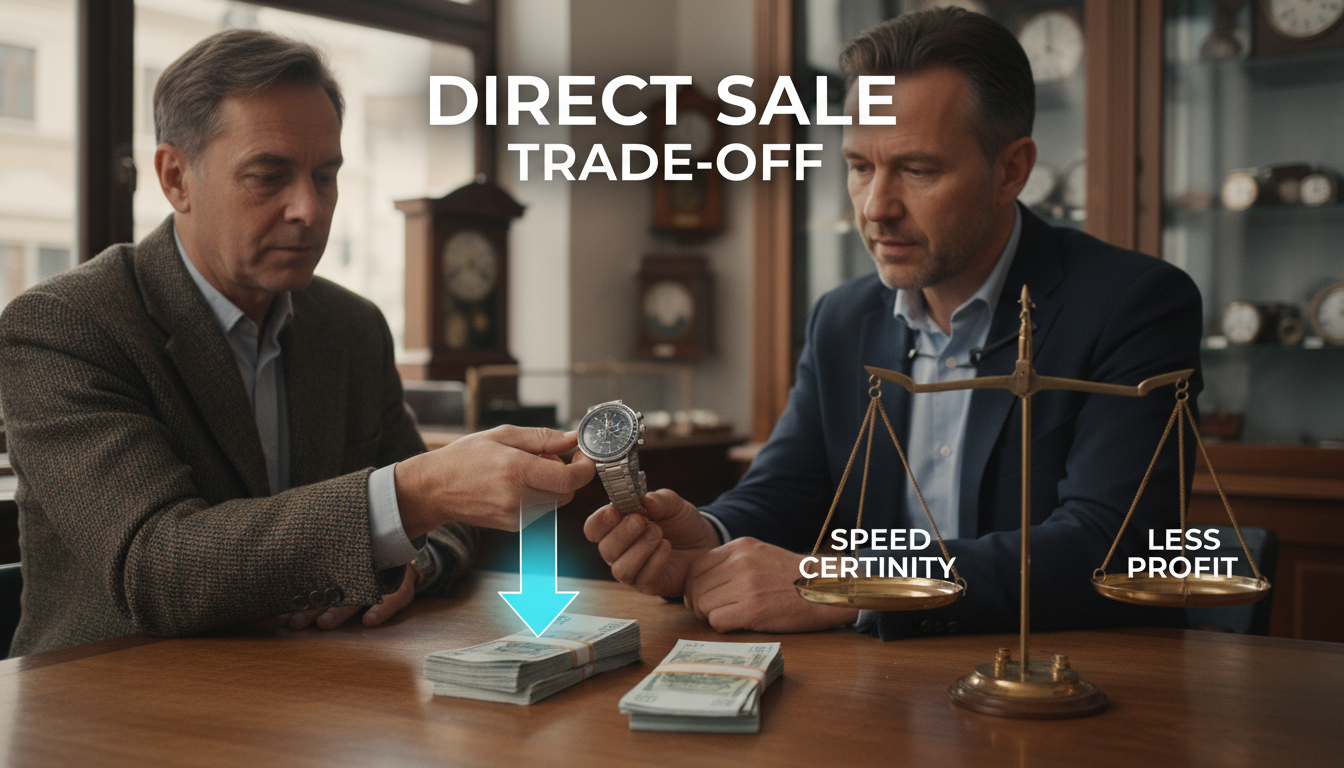
Among your selling avenues, only one guarantees immediate cash in hand. A direct sale is not universally suited for every seller, but it is the optimal choice when speed and certainty outweigh the pursuit of every last percentage point of potential profit. The incremental 10-15% often attainable through other methods may simply not justify the extended timelines and associated effort.
When an urgent need for funds arises, a direct sale offers the most expedited and frictionless path. It eliminates prolonged waiting periods and the frustration of managing prospective buyers, concluding the entire process typically within 2-3 business days. You transfer the watch, receive payment, and the transaction is complete. All associated risks are immediately transferred to the buyer upon sale, providing you with definitive closure. Market trends, even as observed through platforms like Similarweb, underscore the premium buyers place on swift and decisive transactions.
However, the unavoidable reality of a direct sale is a lower selling price. Expect, on average, 10-15% less than what might be achieved via consignment. This differential reflects the dealer's assumption of immediate risk, inventory holding costs, and the necessary margin for their business model. Consequently, your bargaining power is significantly diminished, as the dealer dictates the pricing structure. This is the inherent cost of valuing speed and certainty above all else.
If your priority is the swift liquidation of your watch for immediate funds and complete disengagement from the selling process, a direct sale is your most practical and efficient strategy. It transcends sentimental value, focusing purely on tangible transactional efficiency.
Consignment vs. Direct Sale: A Head-to-Head Comparison
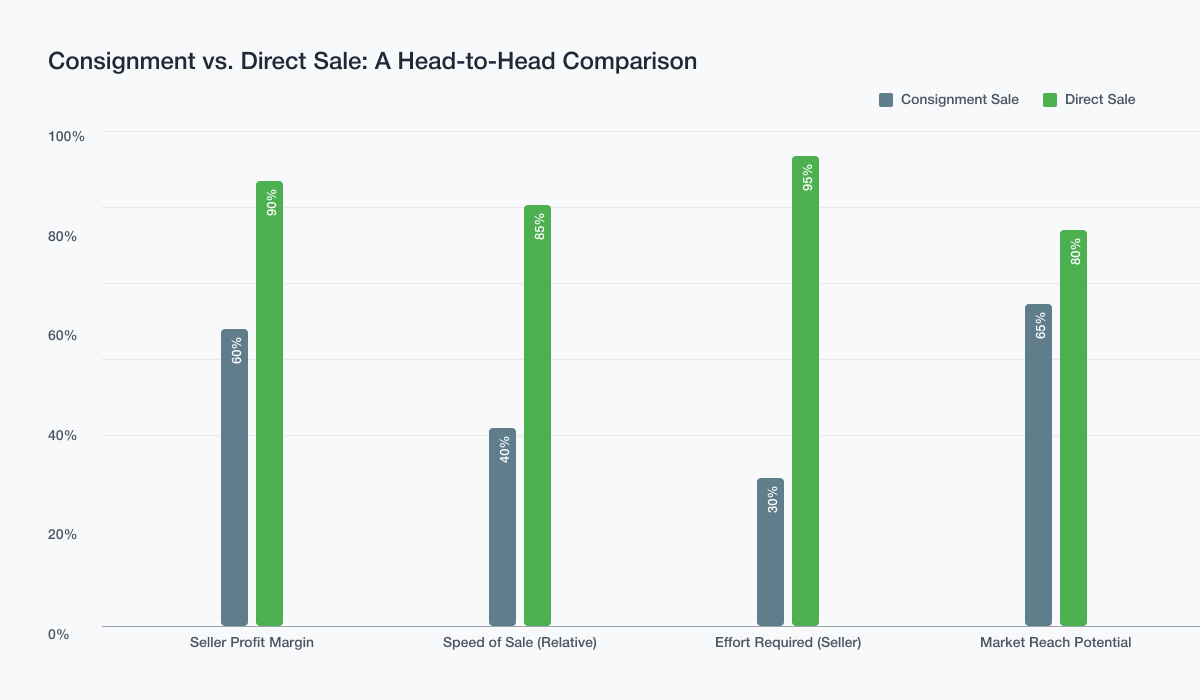
To aid in your decision, a direct comparison of consignment and direct sale methods highlights their core differences. Consignment offers the potential for higher returns (10-15% more), leverages professional expertise and broader market reach, and spares you the selling effort. However, it requires significant patience (60-120 days or more) and involves relinquishing possession of your watch. A direct sale, conversely, provides immediate payment, rapid transaction closure (2-3 days), and transfers all risk upon sale. Its primary drawback is a lower selling price (10-15% less) and minimal bargaining power.
Your choice between consignment and a direct sale hinges on whether your priority is maximizing financial return over time or securing immediate liquidity and transactional certainty.
Frequently Asked Questions
What commission can I expect on a consignment sale?
Commission rates typically range from 15% to 30%, depending on the watch's rarity, market demand, and the consignor's services. While 20% is a common benchmark for reputable operations, premium pieces or those requiring specialized marketing might command higher rates. Your net gain, after all fees, is the true measure of a successful consignment, not just the gross sale price.
How long does it take to receive payment after a consignment sale?
While direct sales to a luxury watch dealer offer immediate payment, consignment sales in the pre-owned luxury watch market involve a waiting period after the watch sells. Expect anywhere from 60 to 120 days, and potentially longer, depending on market conditions and the specific demand for your timepiece — a reality that even the most established high end watch dealers will be transparent about upfront. Even general luxury market data, such as that provided by Similarweb, can indicate periods of slower movement across the pre-owned high end watches segment, particularly for rarer or more niche references. Whether you're consigning through a second hand watch shop or a premium dealer network, patience is a prerequisite, as desirable pieces take time to find the right buyer among a pool of truly qualified collectors.
Will my watch be insured while on consignment?
Absolutely. Any reputable consignor must provide comprehensive, end-to-end insurance coverage for your watch from the moment it enters their care until the sale is finalized. A lack of transparent and robust insurance documentation should be considered a major red flag. Accidents or unforeseen events can occur, so iron-clad protection is non-negotiable. Robust insurance coverage is not an optional extra; it is a fundamental requirement for any legitimate consignment service.
Can I monitor the progress of my watch's sale?
Most professional consignors offer some form of transparent tracking, whether through a dedicated online portal or regular, proactive updates. You should not have to constantly pursue information regarding your asset. Inquire about their communication protocols upfront. If a potential consignor is evasive about providing clear visibility into the selling process, it
Can I monitor the progress of my watch's sale?
Most professional luxury watch dealers operating in the consignment space offer some form of transparent tracking, whether through a dedicated online portal or regular, proactive updates — and this standard should be non-negotiable when entrusting your piece to anyone in the pre-owned luxury watch market. You should not have to constantly pursue information regarding your asset. Inquire about their communication protocols upfront, whether you're dealing with high end watch dealers or a more accessible second hand watch shop. If a potential consignor is evasive about providing clear visibility into the selling process, it's a strong indicator to reconsider — because reputable players in the pre-owned high end watches space understand that transparency is the foundation of trust. Legitimate high end watch dealers will never treat clear communication as a discretionary courtesy; transparent access to sales progress is an essential right for every seller, not an optional add-on.
In conclusion, the decision of how to sell your luxury watch is less about navigating complex formulas and more about an honest assessment of your priorities.
The core trade-off is clear:
- Immediate Capital vs. Optimized Return: You are weighing the convenience of swift payment against the potential for a substantially higher financial outcome. This fundamental choice should drive your strategy.
- Patience as Profit: Consignment offers the opportunity to secure an additional 10-15% on your sale. This requires a willingness to wait several months, a commitment not every seller is prepared for.
- Personal Circumstances are Paramount: Your financial urgency and ability to defer payment are the ultimate determinants. Be candid about whether you require immediate funds or if you can strategically allow your asset more time to appreciate in sale value.
There's no universal 'best' method; only the most appropriate one for your specific goals. It's about aligning hard market realities with your individual needs and timeline.
To gain a precise, obligation-free valuation and tailored market insight for your timepiece, we encourage you to connect with our experts. We provide straightforward assessments based on daily market dynamics, ensuring you make an informed decision.
