

Dial Refinishing and the Printed Signature in Watch Authentication
The Stellaris Journal
A dial refinish is one of the most quietly consequential interventions in a pre-owned luxury watch. Done properly and disclosed, it can preserve a damaged timepiece and return it to service. Done quietly and left unmentioned, it can quietly convert a documented piece into a question mark. The signature on the dial is where these two outcomes meet, and it is the focal point of any serious authentication.
This article is for buyers, sellers, and curious owners who want to understand exactly what dial refinishing does to a watch, why the printed signature carries so much diagnostic weight, and how that weight shifts the moment the dial is repainted or re-coated.
What "Dial Refinishing" Actually Covers
Dial refinishing is an umbrella term. It can mean almost anything from a gentle, partial touch-up to a complete repaint, re-plate, and re-lume. Service centers describe the work in roughly four categories: stripping degraded coatings, resurfacing the background texture, re-printing logos and minute tracks, and re-plating or re-luminous-coating applied markers and hands. Some specialist restorers also rebuild damaged enamel or re-stamp lost text at the six o'clock position. The technical scope is wide enough that two refinished dials, side by side, can describe very different levels of intervention.
The point that matters for authentication is what gets repainted. The signature on the dial, which includes the brand wordmark, the model line, and the Swiss (or Swiss Made) line at six, is printed, and any refinisher who touches the surface is touching the printed layer. Some restorations carefully mask and reproduce the print. Others hand-apply it with varying degrees of fidelity. According to KR Dial's service description, the inscriptions on a refinished dial are restored with the intent of matching factory quality. My Jewelry Repair describes a comparable process that includes stripping old paint, re-surfacing textures, re-printing logos using original dies, and re-plating applied hour markers.
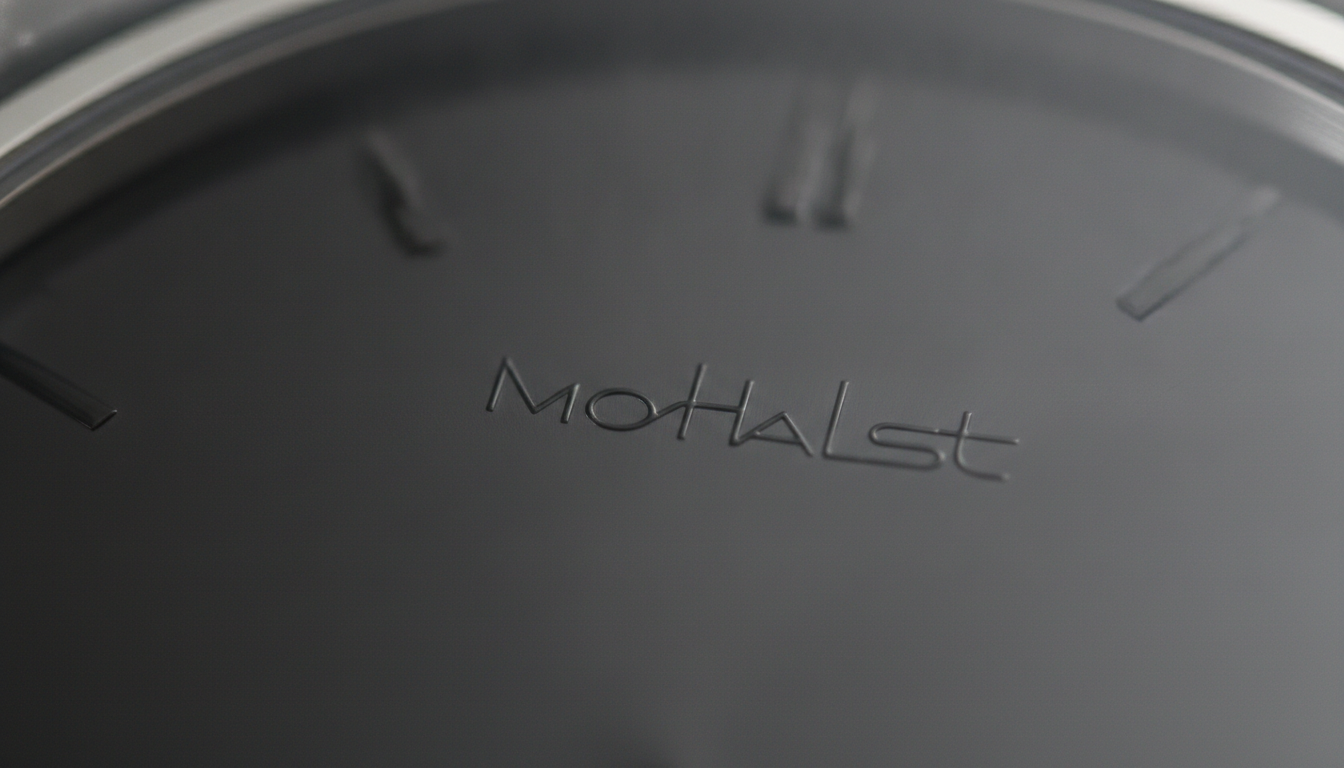
The intent is genuine. The forensic question is whether the result is indistinguishable from the original, and that is where refinishing begins to affect authentication.
A refinished dial is not the same object as a dial that left the factory. Whether that matters to a buyer depends entirely on what was touched, who touched it, and whether the work was disclosed.
Why the Signature Carries So Much Authentication Weight
On a modern luxury watch, the dial signature is not a label. It is the most diagnostically dense element on the entire timepiece. The brand wordmark, the line of subsidiary text beneath it, the model designation, the depth rating, and the country-of-origin marking at six are all printed using processes specific to the manufacturer, on equipment specific to the manufacturer, with inks and lacquers specific to the manufacturer. Under loupe or microscope, factory-original printing reveals consistent ink density, hairline-precise edges, and uniform character spacing. It sits inside the lacquer layer rather than on top of it. It is, in a meaningful sense, a factory fingerprint.
The diagnostic value of the signature also shifts with era. On modern watches, the printed wordmark is the cleanest authentication surface because factory automation produces near-mechanical consistency. On mid-century pieces, where some logos were applied as separate metal or enamel elements rather than printed, the diagnostic shifts toward the application, the rivet, and the proportions of the applied element itself. Either way, the signature remains the part of the dial most likely to betray an inconsistency.
This is why authenticators focus there. As the team at Watch Warehouse notes, on a genuine luxury watch every printed element is razor sharp under magnification, with perfectly even spacing and consistent font weight; counterfeits frequently show fuzzy printing or ink that sits on top of the dial rather than integrated into it. The signature is where counterfeits most reliably betray themselves.
That diagnostic power is also the signature's vulnerability. Once the surface is stripped and re-printed, the original fingerprint is gone, and the question of whether what remains matches the factory fingerprint becomes a question about the restorer, not the factory.
The signature is the dial's most informative authentication surface. Any work that disturbs it reduces the watch from a documented object to a partially documented one.
How Refinishing Disturbs the Diagnostic Chain
Three things tend to go wrong when a dial is refinished, regardless of the restorer's intent.
First, typography drifts. Original dials are printed in factory conditions, while refinished dials are typically printed by hand or by semi-automated equipment. Subtle differences emerge: spacing between letters in the wordmark, the precise height of numerals in the minute track, the relative weight of strokes in the brand monogram. SwissWatchExpo's guide catalogs the most common tells: inconsistent font types and spacing, incorrect numbering, un-crisp tracks and indices, and the frequent absence of the Swiss or Swiss Made marking at six o'clock, which a refinisher often omits because it requires an additional print pass.
Second, lume loses its period coherence. Vintage tritium lume is supposed to age to a yellowish or brownish tint, with a half-life of roughly twelve years. Refinishing often introduces fresh lume that is too bright, too white, or applied with too uniform a fill. The mismatch between a patinated case and a youthful lume plot is a soft signal, but it is one a trained eye notices immediately.
Third, the surface tells its own story. Original dials oxidize and develop a specific microfinish over decades. A high-gloss, almost-new dial under a heavily worn case is one of the most common external warnings of intervention, and it is the kind of inconsistency that a buyer can spot before any expert is involved.
The combined effect is that authentication moves from a forensic question to a comparative one. Instead of asking whether the dial matches the factory specification, the question becomes whether the refinisher's work matches the factory specification well enough to count. That is a much harder question to settle, and it is one most buyers are not equipped to answer alone.
Refinishing does not destroy authenticity. It shifts the burden of proof from the dial to the seller, and from the dial to the restorer.
Three Categories of Refinished Dial
Not all refinishing carries the same implications. The market in practice divides the work into three categories, and buyers should treat each one differently.
Factory service refresh. Major maisons, including Rolex and Patek Philippe, do perform in-house dial work during authorized service. The pieces are documented, the components used are manufacturer-original, and the service record is traceable. Where the service center replaces a dial outright, the new dial is a manufacturer-original component, and the watch remains fully documented. The category exists and is uncontroversial.
Documented third-party restoration. Independent specialists perform high-quality work on damaged or degraded dials, often disclosing the intervention on the sale listing and sometimes keeping the original dial as a companion to the watch. Buyers in this category are paying for a watch with a known history of intervention. Value is typically lower than an unrefinished example, but the watch is honest, and the restorer's name is part of the provenance.
Undisclosed refinishing. This is the category the market worries about most. A dial that looks too clean for its age, with printing that is subtly off, with lume that is too even, with a Swiss line that is missing, is the classic pattern of an undisclosed intervention. Sellers benefit financially from the absence of disclosure. Buyers discover the intervention only when a later inspection reveals it, by which point the transaction is long settled.
The well-known case of a watch collector who purchased seven supposedly rare Rolex dials, later informed by the brand that the dials were non-original, and pursued legal action against the dealer, as covered in Chrono24's vintage watch guide, is the canonical example of the third category. The dial had been replaced. The watch was no longer in the configuration that left the manufacturer. The transaction became a dispute.
The category that matters most is the third. A disclosed refinish can be evaluated on its merits. An undisclosed refinish can only be evaluated after the fact.
What a Serious Authentication Process Looks For
For a buyer who cannot personally inspect a watch under magnification, the relevant question is not whether to inspect the dial yourself. It is whether the seller's authentication process is built to catch the categories described above.
A documented inspection should, at minimum, cover the printed signature against known factory examples for the specific reference and production period. It should evaluate lume consistency and lume age. It should compare case condition against dial condition, flagging any meaningful mismatch. It should weigh movement, case, bracelet, and dial as a single configuration, asking whether the watch as a whole could have left the factory in the form being offered. It should produce written findings that survive the transaction, so that a later owner can retrace the inspection. The most reliable inspections also reference period-correct databases: archival catalogs, factory service sheets, and known reference photographs that allow the inspector to compare the specific dial against a documented baseline rather than against general impressions.
Some independent authentication services, such as the approach described by MVS Watches, combine physical inspection with reference databases for known genuine examples. The structural detail at Diamonds Above describes a comparable process, with separate steps for case examination, dial verification, and movement confirmation. These are not proprietary to any single dealer; they are the standard that any serious authentication program, including our own at The Stellaris Collection, is expected to meet.
The point for the reader is not which service performs the inspection, but whether any inspection was performed at all. A watch offered without inspection findings, on a market saturated with sophisticated counterfeits, is a watch offered on the seller's word alone.
Authentication that does not specifically address the dial signature is incomplete. Authentication that does not produce a written record is unverifiable.
A Practical Framework for Buyers and Sellers
Whether you are buying a pre-owned piece, selling one, or simply curious about your own watch, the same five questions tend to surface the most important facts.
1. What is the dial's condition relative to the case? A dial that looks twenty years younger than its case is the most common external warning of intervention. Both pieces should age in step.
2. Has any refinishing been performed, and is it disclosed? Disclosed refinishing can be evaluated. Undisclosed refinishing is a problem to be discovered.
3. Who performed the work, if any? Factory service, a named independent specialist, and an anonymous refinisher carry very different implications.
4. Is the printed signature consistent with factory examples for the reference? Sharp edges, consistent spacing, and a complete Swiss or Swiss Made line at six are baseline expectations.
5. Does the seller's authentication paperwork specifically address the dial? A general authenticity statement that does not describe dial verification is incomplete for any pre-owned watch.
A watch is not devalued by refinement. It is devalued by undisclosed refinement, because undisclosed refinement breaks the chain of trust that any collector, dealer, or insurer relies on. The signature on the dial is the most exposed element of that chain, and it deserves the most careful look.
For those interested in a deeper look at how authentication is structured more broadly, our journal entries on independent authentication services and the practical side of distinguishing genuine from counterfeit watches cover adjacent ground. For a frank discussion of the frankenwatch phenomenon, in which dials are replaced rather than refinished, the Chrono24 piece on original condition versus the frankenwatch remains a useful reference.
The dial signature is small. The questions it raises are not.
