

Genuine vs. Counterfeit: A Practical Guide to Luxury Watch Authentication
The Stellaris Journal
Forget what you think you know about spotting fake watches. Seriously, the game has changed. Massively.
These aren't some cheap market stall knock-offs anymore, the kind where the hands fell off if you looked at them wrong. No, we're talking superfakes—watches so impeccably crafted they'll fool most people, even some so-called "experts" who should know better.
Getting stuck with a counterfeit isn't just a bad deal; it’s a betrayal. It's a financial gut-punch, certainly, but also a profound disrespect to genuine heritage and skill.
This isn't some "ten quick tips" blog post, because frankly, those are useless now. We're going deep: from the subtle unease you get from a questionable seller (your first line of defense, by the way) right down to the microscopic etchings on the movement. It's about truly knowing what you're buying, so you acquire a real piece, every single time.
The era of obvious fakes is over; welcome to the age of superfakes, where meticulous knowledge is your only defense against financial and emotional betrayal.
Briefing: Why Authentication Matters More Than Ever
So, you're eyeing a luxury watch. Perhaps a pre-owned Patek, a classic Rolex. A smart move, right? Tapping into history without the brand-new price tag. But here's the brutal truth: the pre-owned luxury watch market is a genuine minefield.
This game has gotten crazy. Seriously. The fakes circulating today bear no resemblance to the obvious garbage of yesteryear. We're now contending with super-replicas, the kind that challenge even our expertise. These aren't backyard operations; they're meticulously produced in dedicated factories, known by names like 'Clean' or 'VSF' (as discussed on communities like r/RepTime, if you're brave enough to look). They don't just look right anymore; some mimic the feel and even rudimentary mechanics. It's astounding.
We've seen them, and so have legitimate dealers. A quick visual inspection offers little protection. Your wallet is clearly at risk, but it extends beyond mere money; it jeopardizes the integrity of your collection and the heritage of these timepieces. Counterfeits have become so sophisticated (as evidenced by market trends, per Similarweb (2026)) that you need to get significantly smarter, and fast.
It all boils down to microscopic precision. Real luxury resides in the details—those subtle nuances only a true expert, or someone who knows what to seek, will discover. Fakes will inevitably fail to replicate that perfection, somewhere.
Pillar 1: The Source - Your First and Best Defense
You're ready to buy. But before you even consider the watch's appearance, pause. Critically assess your source. This isn't a casual inquiry; the seller's legitimacy is your absolute first—and often only—defense against being defrauded.
Anyone who suggests otherwise is either peddling something suspicious or woefully ignorant. Trust me on this; I've witnessed countless scenarios. An Authorized Dealer (AD) remains the gold standard—your safest bet for a genuine watch, complete with a manufacturer's warranty and undeniable peace of mind. However, securing watches from ADs can be challenging; the "AD game" is notorious (just browse Reddit's 'Actual Rolex Owner' posts for a dose of hilarious, yet truthful, frustration), prompting many to seek alternatives.
Next in line are reputable pre-owned dealers. These are established businesses with long histories, stellar reviews, and operations built entirely on the principle of not selling fakes. They stand by their watches, offering their own warranties and authentication papers, providing a significant degree of safety. For example, exploring a curated selection from a reputable dealer like The Stellaris Collection provides a layer of security you won't find in private sales. Their business survival depends on their integrity. In stark contrast, private sales and obscure online marketplaces are treacherous territory. If a deal seems too good to be true, or appears to be an unbelievable steal, it almost certainly is. Reddit forums are replete with warnings about "unqualified users" in these spaces. Due diligence is paramount; never transfer a single dollar until you've thoroughly researched your seller.
As for original boxes and papers? While valuable for adding provenance and confirming aspects of the watch, they are far from foolproof. Counterfeiters can—and do—replicate these as well. Therefore, papers alone do not constitute absolute proof of authenticity, though they offer a supplementary layer of confirmation.
Your seller's integrity is the true warranty, not just a fancy piece of paper; a verifiable, solid source fundamentally mitigates most of the risk from your transaction.
Pillar 2: The Physical Exam - Weight, Finishing, and Feel
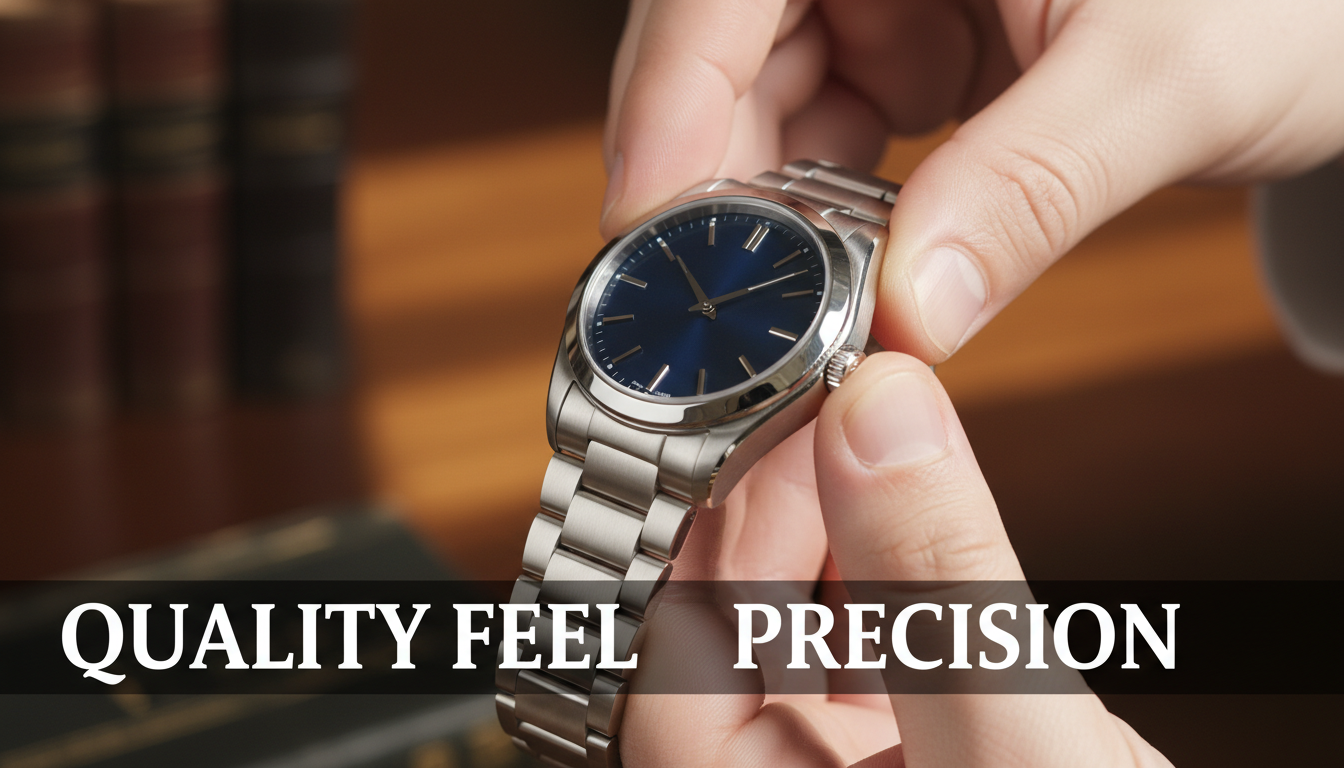
Alright, so you've thoroughly vetted the source. Excellent. Now, with the watch in your hand, your senses become paramount. Before diving into microscopic serial numbers, simply feel it, hold it. The watch must convey a distinct sense of authenticity.
A genuine luxury timepiece possesses substantial heft; it feels perfectly balanced and settled in your palm. It's neither too light nor clunky, precisely because it's crafted from the good stuff—be it 904L stainless steel, real gold, or platinum. These are dense, heavy metals. Fakes invariably cut corners here, resulting in a watch that feels "off"—lighter, or simply cheap, like costume jewelry. With enough exposure to authentic pieces, this difference becomes instinctively obvious to experienced collectors.
Next, scrutinize the finishing across every surface: the case, the lugs, the bracelet. Genuine watches boast lines so precise they appear laser-sharp, perfectly polished surfaces that gleam uniformly, or brushed finishes that are flawlessly consistent. There are absolutely no rough edges, anywhere. Watchmakers consistently confirm that counterfeiters invariably compromise on parts not immediately visible or expected to be examined, leading to sloppy workmanship, uneven logos, or inferior finishes.
The bracelet, too, should feel solid, never rattly or flimsy. The clasp must snap shut with precise, satisfying click, entirely devoid of looseness or jankiness. A true luxury watch is engineered for generations, meaning every component operates with smooth, deliberate movement.
Finally, examine the crown—the small knob on the side. When winding or setting the time, it should turn with fluid grace, free from grinding, grittiness, or excessive play. Any sensation of looseness or roughness is an enormous red flag, as replicating this consistent internal precision is where even the most advanced fakes consistently falter.
Trust your gut and your hands implicitly, as the feel of a genuine watch—its substantial weight, flawless finish, and seamless mechanics—is an immediate, undeniable truth that fakes can never truly replicate.
Pillar 3: The Devil in the Details - Dial, Crystal, and Engravings
Alright, so you think you’ve stumbled upon a great deal, seen the pictures, and everything looks legitimate. But here’s the stark reality: modern fakes are incredibly convincing from a distance, easily fooling most observers. Your job, however, is to get much, much closer. The real battle against these sophisticated counterfeits unfolds under glass, my friend—under a loupe. This is where the microscopic precision of a genuine watch utterly overwhelms the shoddy shortcuts of a knock-off.

Let’s begin with engravings. On authentic, high-quality watches, serial numbers, brand names etched into the case back, clasp, or the inner bezel (the rehaut, for the technically inclined) are exquisitely crisp and deep, as if laser-etched by a neurosurgeon. Fakes attempt to replicate this, but you’ll invariably notice shallow, slightly wobbly, or misaligned text. For instance, a Reddit enthusiast once acquired a fake GMT-Master II and noted its date magnification was 3x, not the authentic 2.5x—a small detail, but a significant tell. Observe the rehaut: on a genuine piece, it’s flawless. Collectors on platforms like RepTime are so discerning that a genuine watch was once questioned because its rehaut wasn't deemed "crisp enough." They scrutinize these elements because that's where true authenticity is revealed.
Then there’s the dial, the watch’s very face. It must be perfect on a real watch. On a fake, you might find a smudged logo, slightly uneven lettering, or a subtly incorrect font. The lume—the glow-in-the-dark material on markers and hands—should be applied flawlessly, without blobs or unevenness, which is a major red flag. Counterfeiters consistently cut corners, and these visible imperfections are proof.
For Rolex aficionados, the date cyclops is critical. This magnifying bubble over the date window on a genuine Rolex provides 2.5x magnification, creating a distinctive "black hole" effect around the date. Fakes almost always miss this detail; either the magnification is wrong, or the crystal itself appears milky rather than crystal clear. Watch forums are filled with discussions lamenting a "milky" crystal or a cyclops lacking that crucial "black hole effect." They know because they've seen the real deal and recognize the fakes’ shortcomings. This crystal is a dead giveaway.
Imperfection is the enemy of a real watch and the most valuable ally for anyone trying to spot a fake. You must get up close, use a loupe, and scrutinize every minute detail. Because the devil, and your investment, is precisely in those damn details.
Always, always, inspect the tiny stuff; it never lies.
Pillar 4: The Heart of the Matter - The Movement
So, you’ve meticulously examined the exterior, and everything appears flawless. But here’s the brutal truth: a skilled faker can get the outside almost perfect—they can replicate the weight, the tactile feel, and the finishes visible without opening the case. However, the movement? That’s the engine, the very soul of the watch. It’s also the most complex, most expensive component, and critically, the hardest thing for counterfeiters to truly replicate. This is where they invariably falter; this is where they cannot keep up.
How to spot a fake watch, really not easy!
A genuine movement is a profound work of art, blending intricate engineering with masterful artistry. You'll find meticulous finishing techniques like Geneva stripes—those perfectly parallel lines—or perlage, tiny overlapping circles, often applied by hand. Each component has a specific layout, meticulously positioned, down to the smallest screws. Brand markings, frequently invisible without microscopic aid, are present and precise. The key insight? Even professional authentication services and seasoned experts rely on high-powered magnification to scrutinize these details, examining the finish on every single component. They’ll tell you: watchmakers can discern a fake by nuances as subtle as the specific jewels used or the precise finishing of a screw. It's not merely "pretty"; it's extraordinarily specific.
And yes, high-end fakes are clever, employing what they term “clone” movements. On the surface, they may appear similar to the original. But here's the dirty secret: they are not. They utilize cheaper materials, lack genuine finishing (often just a printed pattern instead of true depth), and exhibit subtle architectural discrepancies. For instance, an authentic Rolex 3135 caliber features an asymmetrical automatic bridge, whereas most fakes will have symmetrical bridges—a significant difference to the trained eye. A buyer on r/RepTime might specifically choose a 'Clean' factory replica because it's known for a "better, more reliable clone movement." They understand the compromise; you, as a buyer of genuine luxury, should not accept it.
Ultimately, you cannot truly understand or verify a watch until you’ve seen its inner workings. Since you're likely not a watchmaker and lack the specialized tools, the absolute, definitive, unquestionable authentication step for any high-value piece is to have a trusted watchmaker open the case back. Let them inspect what's inside. Let them confirm whether you’ve acquired a horological masterpiece or merely a fancy paperweight.
The movement is the ultimate and undeniable proof of a watch's authenticity; there is no substitute for its expert examination.
Frequently Asked Questions
These are the questions I get asked constantly, often when someone has either just acquired something dubious or is on the verge of making a questionable purchase.
- Which watches get copied most?
- Can a professional get fooled by a "superfake"?
- How important is the box and papers?
- What about testing if it’s water resistant?
- Your first defense is the source. Purchasing from dubious channels invariably leads to dubious timepieces. A clear paper trail, verifiable history, and an impeccable reputation are not optional extras; they are non-negotiable.
- Details aren’t just details; they are definitive tells. The inherent weight, the precision of the finish, the satisfying click of a bezel, the depth of an engraving—these are not abstract concepts. They are tangible physical evidence. Engage your senses.
Unsurprisingly, it's the incredibly popular, high-value brands: Rolex, Omega, Cartier, Patek Philippe. These are the household names with immense resale value. Why bother faking a Timex? Market logic dictates that these brands are prime targets, a fact corroborated by trends observed on platforms like Similarweb (2026).
A casual observer? Absolutely. Even me, potentially, without my tools. But a real watchmaker, equipped with their instruments and decades of specialized experience? Absolutely not. They’ve encountered thousands of watches, both genuine and counterfeit, and they observe details microscopic to the untrained eye—finishes, materials, specific construction nuances. As Gray & Sons famously states, professionals discern aspects invisible to the naked eye. So, no, they cannot be fooled.
They certainly add value and provide supporting narrative to a watch's provenance. However, they are not definitive proof of authenticity. Consider this: if someone can convincingly fake an entire watch, replicating a set of papers or a box is trivial. The watch itself remains the ultimate authority, always. You are investing in the timepiece, not the accompanying fancy brochure.
Genuine luxury watches are engineered to precise specifications and will reliably perform within their water resistance ratings. Fakes, however, are notoriously unreliable and will likely leak like a sieve the moment they encounter water, primarily because they skimp on proper gaskets and seals. Under no circumstances should you attempt to test the water resistance of a potentially fake watch yourself; you risk ruining it, even if it were genuine. This demands specialized pressure testing, always performed by a professional.
Don’t succumb to complacency or hype; maintain constant vigilance, always verify your purchase, and ensure professional authentication before making any significant investment.
Alright, listen up. Nobody enters the world of luxury watches to suffer financial loss or public embarrassment. Yet, the current market is undeniably a minefield. What you've just read isn't merely an academic exercise; it's the essential playbook for protecting your investment and your reputation.
The game has fundamentally shifted. Super fakes are no longer "good enough"—they are meticulously engineered to deceive the unwary, the overconfident, and even seasoned professionals who aren't paying close attention. Success isn't about being clever; it's about unwavering diligence and perpetual skepticism.
Here's the bottom line:
The movement is the ultimate judge. It is the intricate engine room of the watch. While you may not be a trained watchmaker, understanding what to look for—or more accurately, what not* to see—can spare you immense trouble. Never assume; always verify.
This challenge isn't diminishing; it's an ongoing arms race, and your wallet is on the front lines.
In an age of sophisticated counterfeits, unwavering diligence in vetting the source, scrutinizing physical details, and verifying the movement is your only path to genuine luxury.
So, here's your imperative: never guess, and certainly don't attempt to be a lone hero. If you're investing significant capital, you absolutely demand significant verification. This means either educating yourself to an extraordinary degree or partnering with an expert organization whose entire operation is dedicated to infallibly weeding out fakes, every single time. Your precious investment deserves nothing less than the peace of mind offered by a fully authenticated inventory, such as the one found at The Stellaris Collection.
