

Independent Authentication Services: A Modern Guide to Verifying Luxury Goods
The Stellaris Journal
The global counterfeit market? It's a staggering $4.2 trillion. This isn't just a large number; it represents an annual, corrosive drain on the global economy.
And the threat is escalating. "Superfakes" are circulating counterfeits so meticulously crafted that they are routinely returned to official boutiques, often going unnoticed. Consider the implications of that.
If even the brands themselves sometimes struggle to identify these fakes, what confidence can you have? Or your "trusted" seller? Your financial investment is at risk, and your reputation is on the line if you're involved in product movement.
In today's market, relying on a mere logo or handshake is dangerously naive; robust verification is now an absolute imperative. This guide aims to equip you with the knowledge to navigate this complex landscape and secure genuine answers.
The Superfake Epidemic: Why Brand Trust Is No Longer Enough

You invest in a luxury item an exquisite bag, a precision timepiece something you’ve worked hard for. The natural assumption is, "This is from a legitimate source or a reputable seller." This allows for a sense of security. However, this mindset is now fundamentally flawed and dangerously outdated.
We are no longer dealing with easily identifiable, low-quality knockoffs. The market is saturated with "superfakes" replicas so sophisticated that even seasoned professionals can struggle to discern them. Your typical retail associate, focused on sales, possesses neither the training nor the mandate to authenticate products, leaving you vulnerable.
The scam methodology has evolved further. A common tactic involves purchasing an authentic item, acquiring a high-tier fake, and then returning the counterfeit to the original boutique. These unsuspecting stores, in turn, often accept the returns, unknowingly reintroducing fakes into the primary market. This means you could be acquiring what you believe is a legitimate item directly from the brand, only to receive a swapped counterfeit. Research from Real Authentication (2026) consistently highlights the prevalence of this deceptive practice.
The implications extend far beyond personal financial loss. This sprawling fake economy is colossal, representing $4.2 trillion drained from the global economy. This immense sum doesn’t vanish; it often fuels illicit enterprises, including organized crime, human trafficking, and child labor. Every purchase of a counterfeit, even an unwitting one, contributes directly to this destructive ecosystem.
Furthermore, there are serious health risks. Unlike legitimate products, counterfeits are produced in unregulated environments using the cheapest, often toxic, materials. Your desired luxury sneakers might contain lead paint, or children's counterfeit toys could expose them to hazardous chemicals, all without any oversight.
The demarcation between genuine and counterfeit has all but disappeared, demanding that you rely on verifiable expertise, whether your own or that of a trusted authenticator.
*
Human vs. Machine: Understanding the Core Authentication Methodologies
So, you've decided to verify an item's authenticity a prudent decision. The question then becomes: how is this achieved? Broadly, professionals employ two primary methodologies: traditional human expertise and advanced artificial intelligence (AI). Each approach offers distinct advantages.
The human-centric method relies on the "artisan's eye." This involves an expert with extensive experience, having handled thousands of items. They possess an intimate knowledge of intricate details the nuances of stitching, the tactile quality of leather, the precision of hardware, and the subtleties of typography. Their expertise is derived from repeated exposure to both authentic and counterfeit goods. Real Authentication (2026), for instance, exclusively champions this approach, asserting that "AI lacks the human expertise needed" and boasting a team of "world-renowned experts."
Conversely, the machine-driven approach harnesses AI. This cutting-edge technology utilizes ultra-high-resolution cameras, often incorporating microscopic capabilities, to analyze materials down to their fibrous structure. These microscopic "fingerprints" are then cross-referenced against vast databases of authenticated genuine and verified counterfeit items. Entrupy (2026) exemplifies this methodology, claiming "nearly 100% accuracy" through its data-intensive, objective analysis.
A hybrid model integrates both approaches. This strategy leverages the speed and data-processing capabilities of AI, complemented by a final review from a human expert a critical sanity check. LegitApp (2026) is one such service, explicitly stating it is "Powered by expert authenticators and AI technology," aiming to combine the strengths of both worlds.
Ultimately, the decision boils down to entrusting either human discernment, algorithmic analysis, or a combination of both.
*
The Artisan's Eye: The Strengths of Expert-Led Authentication
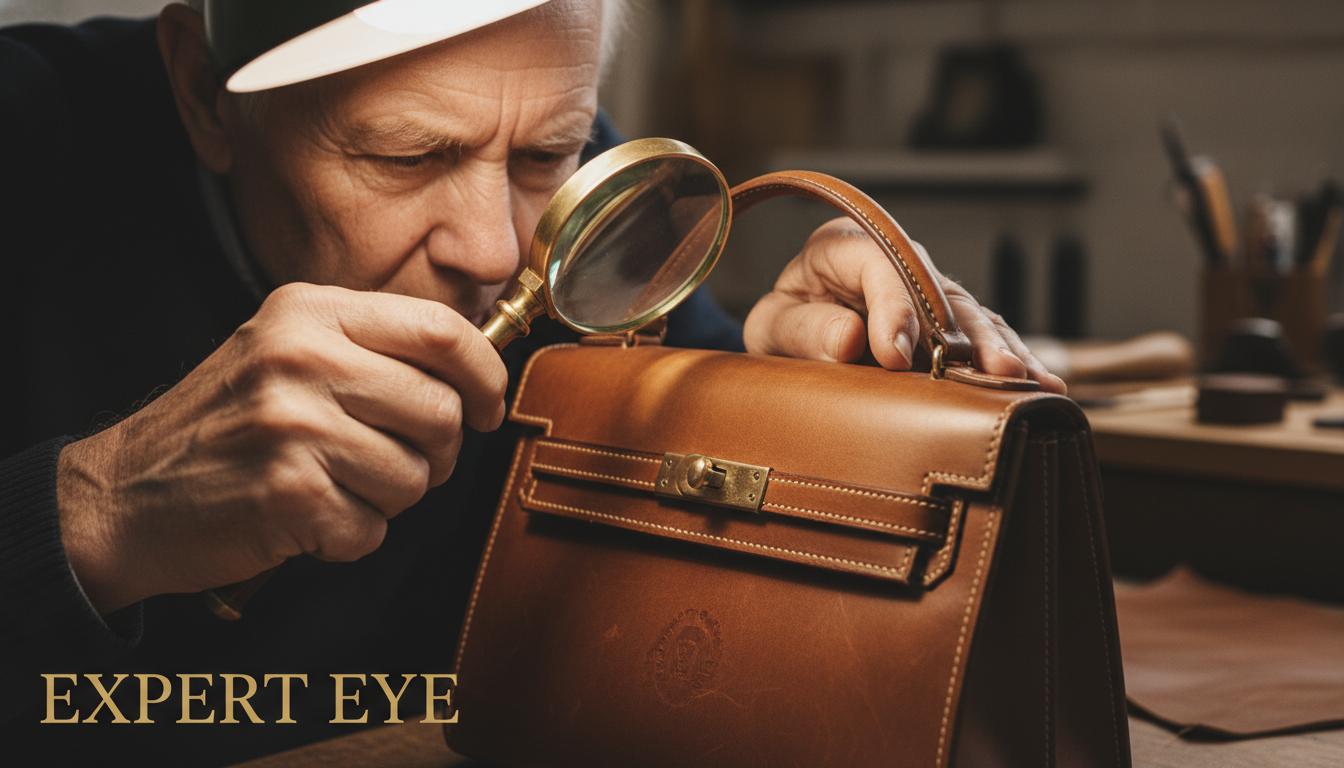
Having explored the two core authentication methods, let's delve deeper into the human element often referred to as the "Artisan's Eye." Its significance lies in the qualitative difference: a machine processes programmed data, whereas a human expert possesses an intrinsic understanding of context, craftsmanship, and intent.
The cornerstone of this approach is profound experience. Experts accumulate years of hands-on interaction with countless pieces, developing a nuanced feel for weight, subtle variations inherent in handcrafted items, the natural fall of a stitch, or the slight inconsistencies in a logo stamp. These are details an algorithm might overlook or fail to interpret within context, as such nuances aren't always reducible to a database entry but reside in practical experience and intuitive discernment. Real Authentication (2026) emphasizes its "Founder Advantage" deep, hard-won industry knowledge, with experts analyzing everything "down to the denier of a stitch."
Consider the dynamic challenge posed by "superfakes" and their continuous evolution. AI systems require constant feeding of new data and retraining to keep pace. A human expert, however, adapts organically. They observe emerging counterfeiting trends and adjust their assessment criteria swiftly, without the need for software updates. As they correctly assert, AI can "struggle to keep up with evolving luxury brand styles," highlighting the continuous cat-and-mouse game between authenticators and counterfeiters.
Furthermore, authenticating vintage or rare pieces items with sparse or non-existent digital footprints is where human expertise truly shines. An AI system lacks the historical data for such items, yet a seasoned human expert, conversant with past eras, can reliably authenticate pieces untouched by digital records. Legit Check By Ch (2026) demonstrates this openly, offering public libraries of fake-vs-real guides showcasing their specialized knowledge.
A critical advantage of reputable human-led services, such as Real Authentication (2026), is the multi-expert review process. Items are typically examined by at least two, often more, experts. This layered verification acts as a robust safety net. While individual human error is possible, the likelihood of a counterfeit evading multiple, highly trained expert eyes is significantly reduced, underscoring the depth and collective wisdom brought to bear.
\\Ultimately, for certain assets, an authentic read necessitates the nuanced understanding of a human expert a discernment that transcends mere process and enters the realm of art.\\
Scaling Trust: How AI is Revolutionizing Authentication

Discard any preconceived notions about counterfeit detection. Human authentication, while valuable, is inherently prone to error and fatigue. In contrast, AI authentication offers relentless, tireless precision, discerning details imperceptible to the human eye, even with magnification.
This transcends rudimentary flaw detection like an incorrect stitch, which is a slow and outdated approach. Modern AI leverages high-powered microscopy to analyze minute, often invisible, material characteristics. These hyper-detailed scans are then cross-referenced against a colossal database containing millions of data points a task that would overwhelm human capacity. The result is an objective, extraordinarily rapid authentication process.
For high-volume operations be it an online marketplace or a major reseller the demand is for swift, scalable, and reliable verification. The ability to move product quickly while ensuring authenticity is paramount. AI technology scales effortlessly, processing thousands of items daily without breaks, biases, or subjective interpretations. It delivers a clear, unambiguous "yes" or "no," which is the only actionable outcome that truly matters.
A significant differentiator for some AI services, such as Entrupy, is their robust financial guarantee. This commitment underscores their confidence: if their AI errs (they boast 99.86% accuracy, a claim supported by Similarweb (2026)'s market leadership confirmation), they assume the financial liability. Such a guarantee is exceptionally rare in the authentication industry, highlighting the disruptive confidence AI brings to the table.
Ultimately, AI authentication transcends complex algorithms; it's about mitigating risk, ensuring profitability, and securing your assets.
*
A Practical Guide: Selecting the Right Service for Your Needs
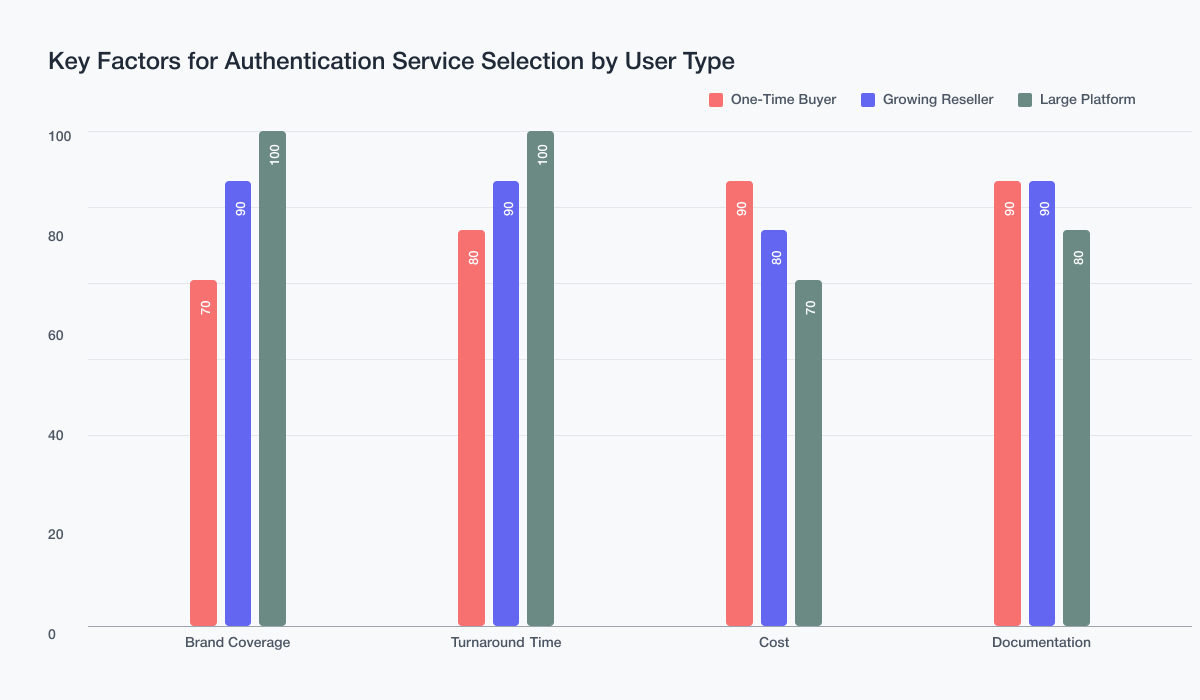
Navigating the myriad of authentication services can be a complex endeavor. The notion of a single "best" service is a pervasive myth, often a byproduct of marketing. The truly "right" service is bespoke, tailored to your specific objectives, operational volume, inherent risks, and budgetary considerations.
Therefore, a thoughtful evaluation is paramount, focusing on key criteria:
- Brand Coverage: Does the service comprehensively authenticate the brands you deal with, or only the commonly faked items? For instance, a service excellent for Louis Vuitton might be inadequate for high-complication timepieces like Richard Mille. Verify compatibility; never assume.
- Turnaround Time: What is your critical path for verification
- Cost Structure: Is pricing per item or subscription-based? A single watch at $30 is manageable, but scaling to hundreds necessitates a cost-effective model. Services like Entrupy offer tiered plans (e.g., Petit, Moyen, Grand) designed for varying business scales, not just sporadic personal use.
- Documentation: Do you require formal certification for dispute resolution (e.g., PayPal claims) or a simple authenticity confirmation? Robust documentation can be critical leverage in the event of a scam.
- The One-Time Buyer: If you've acquired a suspiciously good deal, say, on eBay, or a high-value item from a collection like The Stellaris Collection, and require peace of mind, a straightforward, one-off verification is appropriate. These services are typically quick and affordable, often under ten dollars. It's a negligible expense for invaluable certainty.
- The Growing Reseller: For those regularly flipping items, reputation is everything. Even a single counterfeit can severely damage your brand. Consistent, reliable verification, potentially via a subscription, is essential to maintaining clean inventory, protecting your reputation, and scaling operations without constant anxiety a factor that directly impacts your margins.
- The Large-Scale Platform (Marketplace, Pawnshop): Handling thousands of items daily demands seamless integration. An API-driven solution, such as those offered by Real Authentication or Entrupy, is crucial for automating processes and ensuring rapid, robust authentication. Manual verification is unsustainable for this scale. A platform inundated with fakes risks immediate reputational and business collapse.
- The "superfake" epidemic renders traditional provenance tracking increasingly futile. Rigorous scrutiny of the item itself is the sole, definitive proof of authenticity.
- Both human experts and advanced AI systems contribute uniquely to verification. Experts provide nuanced, contextual judgment, while AI offers scalable, data-driven analysis. Sole reliance on either introduces unnecessary risk.
- Selecting an authentication service should not be guided by superficial marketing. The critical factors are a proven methodology, transparent accountability, and a consistent track record of accurate assessments especially when significant capital is at stake.
hours, a day, or a week? Expediency often correlates with cost, yet the value of rapid authentication can be indispensable for maintaining momentum.
To streamline your selection, consider your operational profile:
The objective isn't to identify the universally best service, but rather the one that most effectively safeguards your business and mitigates your specific operational risks.
*
Frequently Asked Questions About Luxury Authentication
Naturally, lingering questions persist. Here are concise answers to common inquiries regarding luxury item authentication:
Can an authentication certificate assist in obtaining a refund?
Absolutely. Many services, such as Legit Check, design their certificates specifically for payment disputes. These documents serve as tangible evidence, recognized by platforms like PayPal and credit card companies. Leverage them.
Are these authenticators affiliated with brands like Chanel or Rolex?
No. Reputable authentication services operate as independent, third-party entities. This impartiality is foundational to their credibility. Without this independence, their objective assessments would be compromised, eroding trust.
What recourse is available if an authentication service makes an error?
While rare, errors can occur. In the case of AI-driven services like Entrupy, a financial guarantee is often provided. They explicitly commit to covering losses if their authentication proves incorrect. Always review the specific terms, but this guarantee represents significant assurance.
What are the typical costs for authentication?
Costs vary based on the item and service. For a standard item, expect a range of $10 to $30. However, for exceptionally high-value or rare items such as a Hermès Birkin or a vintage Patek Philippe fees can easily exceed $100. Real Authentication's basic service starts at $30, but for Hermès, it can surpass $100. The cost reflects the expertise and risk mitigation provided.
Prioritize verification; it is the most effective means to protect your investment and yourself.
The landscape has irrevocably shifted. The statistics are clear, and the prevalence of superfakes sophisticated enough to deceive even trained retail personnel is undeniable. Relying on mere trust is no longer viable; what's essential is absolute certainty, and that certainty comes at a price.
This guide has illuminated the core realities:
The market will not become safer. Your diligence must escalate proportionally, or you risk substantial losses. This is the new paradigm.
The mandate is clear: abandon conjecture and secure verifiable proof. Your assets demand it. For high-value acquisitions be it luxury watches, intricate jewelry, or other significant investments like those available from The Stellaris Collection a specialized intermediary is not merely an option, but a necessity. They eliminate ambiguity, assure accuracy, and empower you to transact with complete confidence. Act decisively.
