

Colored Gemstone Investment: A Data-Driven Guide to Rarity and Value
The Stellaris Journal
Last year, colored gemstones weren't merely beautiful ornaments; they were formidable investments, delivering a robust 16% price growth. This significant appreciation occurred while many conventional "safe" assets struggled, solidifying gemstones' position as a serious contender for wealth preservation.
Most perceive a gem as a simple bauble or fancy trinket, an oversight that can be costly for those focused on wealth growth. We aren't discussing mass-market sparkle; our focus is exclusively on the absolute top 1% of what nature produces he pinnacle of rarity and quality.
This isn't an exploration of subjective aesthetics for discerning collectors; it's a deep dive into the objective metrics. This guide cuts through the superficiality, presenting the numbers, geological rarity, and global demand dynamics that underpin enduring value. We provide a data-driven framework explaining why specific stones function as genuine assets, not just adornments. Because true appreciation is intrinsically linked to proven rarity, and without prioritizing rarity, one is merely shopping, not investing.
Beyond Beauty: Why Investment-Grade Gemstones Are a Resilient Asset Class
Many mistakenly view precious stones solely as aesthetic accessories. However, this perspective overlooks their profound potential as robust financial assets. For the astute investor, a gemstone transcends mere adornment; it represents a strategic instrument for wealth preservation.
Our focus is strictly on the elite echelon: the absolute top 1% of the market. These are not the "retail-quality" stones that suffer immediate depreciation. Instead, we refer to investment-grade gems, functioning as a potent hedge against market volatility and a foundational component for a diversified portfolio. The inherent market instability makes non-correlated assets particularly valuable.
The intrinsic value of these stones stems from their finite nature. Unlike currency or equities, gemstones are irreplaceable natural resources, meaning their scarcity is permanent and continually drives long-term value. This market operates outside the conventional rules of Wall Street, offering a genuine shield when other asset classes falter.
Furthermore, their compact size offers unparalleled advantages in portability and discretion. A million dollars in investment-grade gemstones can be discreetly held in a small pouch, a stark contrast to the bulk and weight of an equivalent value in gold (over 15 kilograms). The Knight Frank Luxury Investment Index, notably, reported a 16% price growth for these assets in just twelve months, underscoring their quiet yet consistent efficacy as a long-term wealth strategy.
True gemstone appreciation isn't some marketing spin; it's driven by geological rarity, iron-clad provenance, and sustained global demand for that razor-thin top 1% quality, the very focus of premier collections like those found at The Stellaris Collection.
The 5 Pillars of Gemstone Valuation: An Investor's Framework
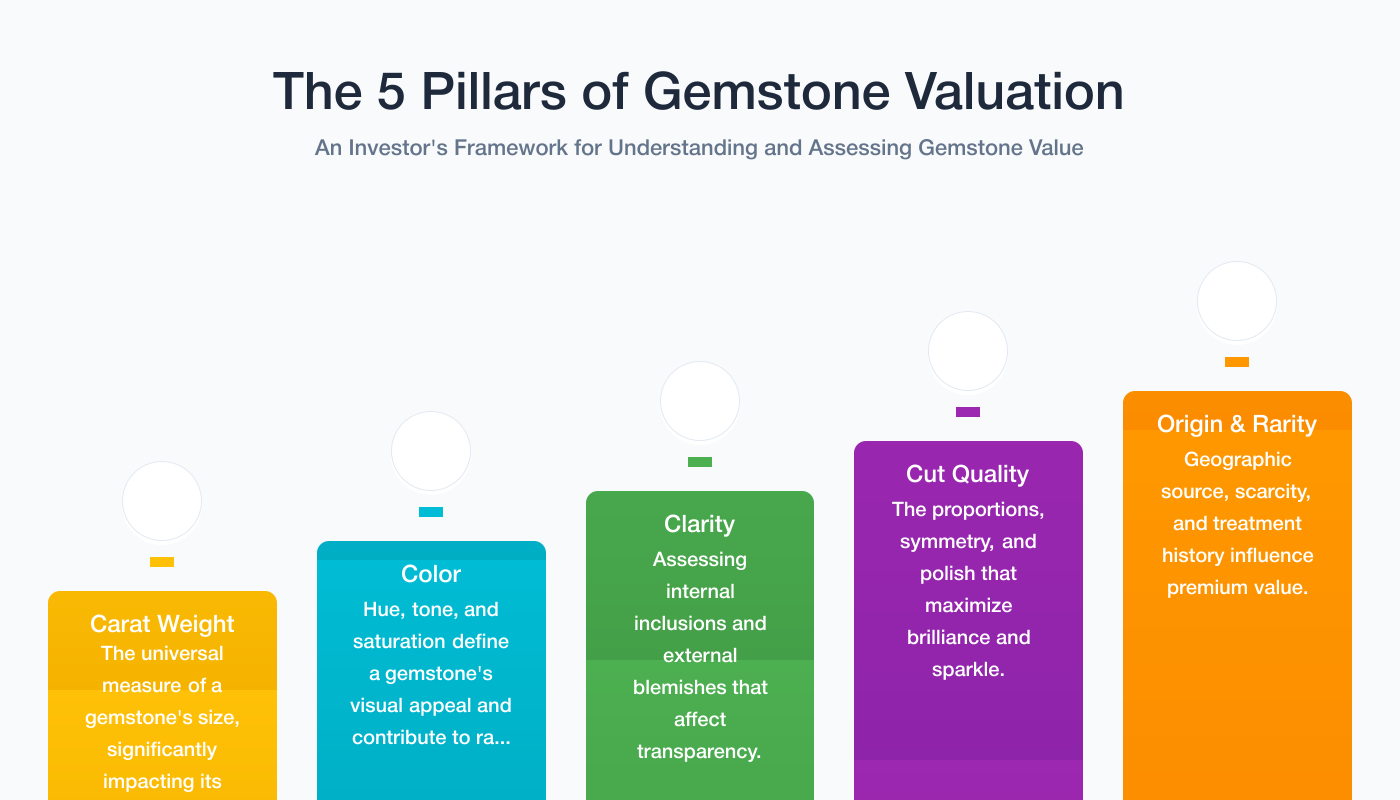
This section will delve into the critical factors that objectively determine a gemstone's investment value. From color saturation to origin, understanding these pillars is essential for discerning true asset potential from mere aesthetic appeal. While the specifics require a deep dive, grasping these foundational valuation principles is paramount for any serious gemstone investor.
Core Holdings: Investing in Rubies, Sapphires, and Emeralds
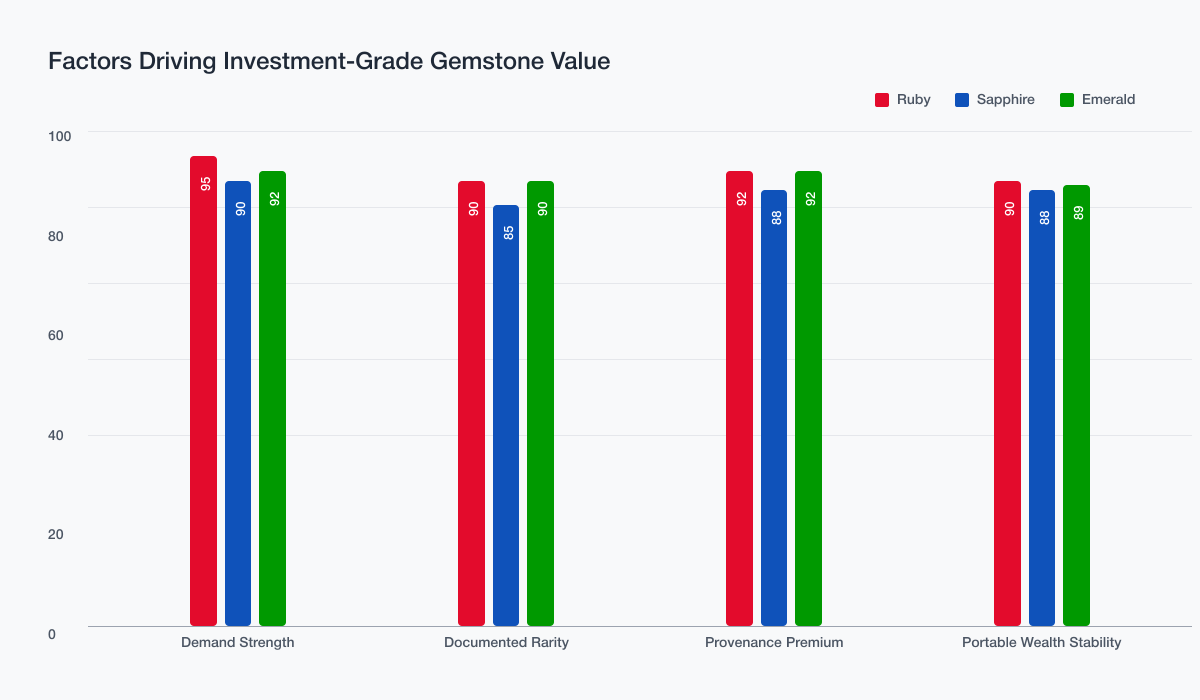
The "Big Three" he Rubies, Sapphires, and Emeralds he represent the bedrock of investment-grade gemstones. These are not ephemeral trends but historical bastions of portable wealth, used for centuries to safeguard and transport fortunes across tumultuous landscapes. This enduring legacy speaks to their inherent stability and sustained global demand, making them indispensable components of any robust portfolio.
A crucial driver of value is provenance he the documented origin of the stone. A gem from a historically renowned mine commands a significant premium, underscoring that not all stones are created equal. Long-term appreciation is inextricably linked to authenticity and verifiable rarity, forming the core pillars of their market value.
Investment-grade specimens represent the absolute pinnacle of quality within these categories. Their extreme rarity means they are quickly absorbed into private collections, further tightening supply and driving values through basic economic principles. The enduring demand and finite supply of the "Big Three" ensure their continued status as foundational assets for serious investors.
Rubies: The Red Hot Mess You Need
Rubies, often hailed as the "King of Gems," epitomize power and passion, making them perennial objects of desire. Their historical demand and impressive auction records consistently demonstrate their exceptional store of value. For investment, focus on the elusive "Pigeon's Blood" color he a deep, vivid red with a fluorescent glow he and a certified origin from Burma, particularly the Mogok Valley. A Mogok ruby of certified "Pigeon's Blood" hue represents one of the most strategic plays in the gemstone market.
Sapphires: Blue Chip, Blue Money
Sapphires are revered for their captivating blue hues, with the velvety, intense "cornflower blue" being the most prized. Kashmir sapphires hold legendary status due to their unparalleled rarity, as their mines have been largely depleted for decades. While Ceylon (Sri Lanka) and Madagascar also yield beautiful specimens, Kashmir remains the ultimate benchmark, a fact powerfully reflected in their market prices and the intense search volume shown by data platforms. The extreme scarcity of Kashmir sapphires, combined with their iconic color, positions them as a true blue-chip investment.
Emeralds: The Green Light, Or Red Flag?
Emeralds, with their vibrant green, symbolize prosperity, but they are also notoriously delicate and frequently treated. Therefore, meticulous attention to detail is paramount. Colombian emeralds set the global benchmark for their distinct color he a rich, deep green often with a subtle blue secondary hue he and unique internal characteristics, affectionately known as the "Garden of Colombia." Mines like Muzo and Chivor are synonymous with superior quality. For investment, an emerald with minimal, documented treatment and a certified Colombian origin represents the pinnacle of value and a true green investment.
High-Growth Opportunities: Gems with Rising Collector Demand
While the "Big Three" offer foundational stability, savvy investors and discerning collectors are increasingly looking beyond these established categories towards high-growth opportunities. The focus has shifted to extreme, verifiable scarcity he the kind that cannot be manufactured or artificially inflated he in gems such as Paraa Tourmaline and Spinel. These unique assets are experiencing rapid, sometimes exponential, value appreciation.
The conventional gems, while reliable, may not offer the explosive upside seen in these niche alternatives. Collectors, increasingly sophisticated, are moving past manufactured scarcity and marketing hype, seeking truly rare, untreated gems with unique, vibrant colors that defy imitation. The limited supply, often originating from a single or very few sources, means that even a modest increase in demand can trigger dramatic price surges.
Consider Paraa Tourmaline, once overlooked, now a sensation. Its electrifying neon blue-green hue has propelled its market value, with a staggering 118% single-year price increase for Paraa Tourmaline in 2022. This is not merely growth; it's an unprecedented surge that redefines expectations for gemstone investment.
Spinel also presents compelling growth. Mahenge spinel, renowned for its vivid pink-orange fire, saw an astonishing 250% growth between 2018 and 2022, a 3.5x return on investment. Even more dramatic is the trajectory of Cobalt Blue Spinel, which soared from approximately $1,000 per carat to $20,000-$30,000 per carat in just a few years, driven by early adopters who recognized its profound rarity before wider market recognition.
Tanzanite, a universally recognized gem, offers another compelling case. Its singular source scarcity he mined exclusively in Tanzania he is compounded by reliable reports from miners indicating depletion within decades. The fundamental economic principle of diminishing supply meeting sustained demand dictates that its value is poised for significant appreciation as availability dwindles.
The prudent strategy, therefore, extends beyond the usual suspects. These are not merely beautiful stones; they are serious investments characterized by exceptional clarity, often untreated status, and colors that far surpass conventional gems. Their value appreciation is not just rapid; it's parabolic. For investors seeking genuine alpha, the pursuit of unique, verifiable scarcity is the most compelling strategy.
Certification: The Non-Negotiable Proof of Rarity and Value
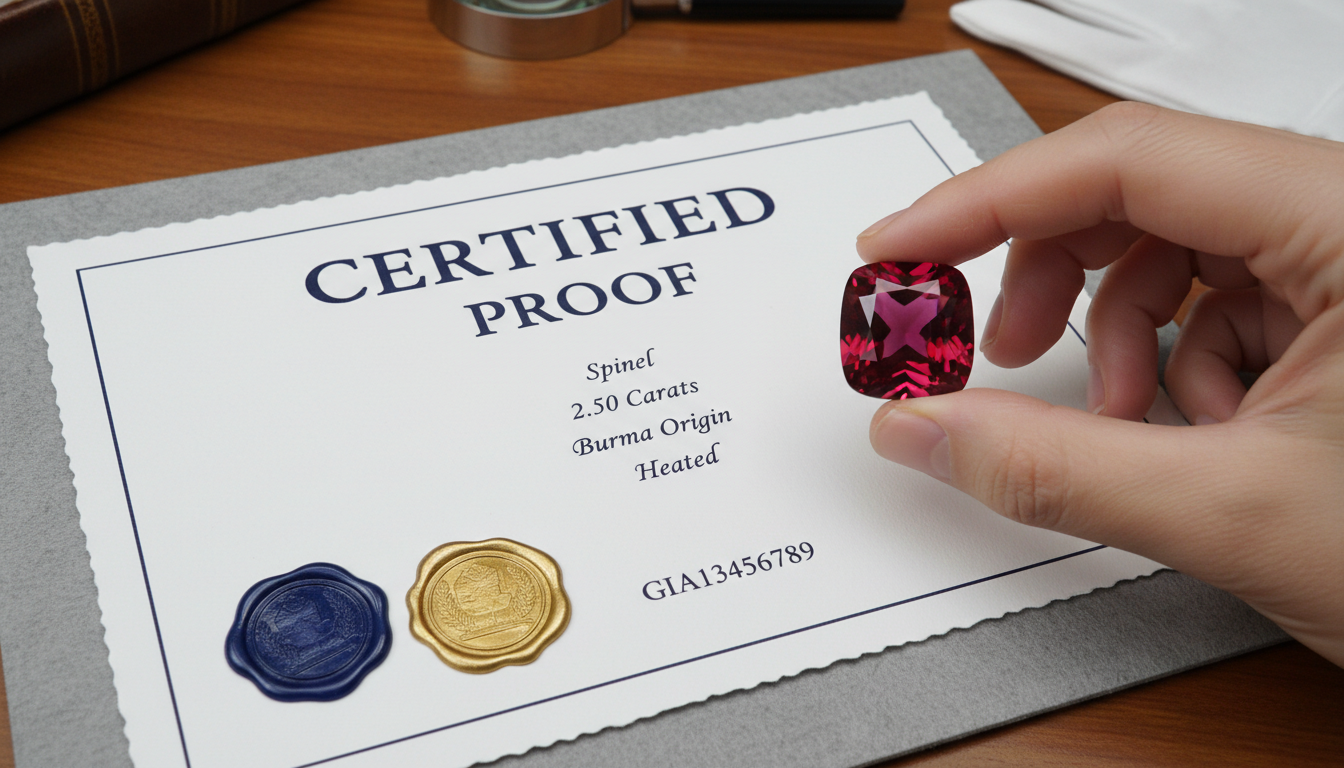
Under no circumstances should an investor acquire a gemstone without a universally recognized gemological report. Relying on speculation when deploying significant capital is not a viable investment strategy.
The unequivocal truth is that without certification from institutions like GIA, SSEF, or Gelin, the asset is merely a gamble. These are the sole laboratories whose reports are respected and accepted by major auction houses, which represent a critical component of any future exit strategy. If global arbiters like Christie's or Sotheby's refuse to handle an uncertified stone, an individual investor should exercise the same discernment.
It is crucial to understand the function of a certificate: it is not an appraisal of market value but a stringent verification of objective facts. It confirms the stone's species, authenticity, and any treatments it may have undergone (or, critically, its untreated status, which often commands the highest premium). This document is the definitive distinction between a verifiable tangible asset and a piece of fancy glass.
Furthermore, certified geographic origin is a profound value differentiator. A Kashmir sapphire or a Burmese ruby, definitively confirmed by a reputable report, can command a premium of 100% or more compared to a visually similar stone from a less esteemed locale. Without this authenticated paper trail, that substantial geographic premium simply vanishes, tethering the investment to its verifiable documentation.
Market data further corroborates that market interest among sophisticated buyers escalates significantly when provenance is unequivocally established. The value lies not in subjective sparkle but in objective, verifiable data. In the world of investment-grade gemstones, irrefutable proof is the ultimate currency.
Therefore, any attempt by a seller to downplay the necessity of comprehensive certification should be met with immediate and decisive disengagement.
An Investor's Strategy: Acquiring and Managing Gemstone Assets
Developing a meticulous strategy for both acquiring and managing gemstone assets is paramount for optimizing returns and mitigating inherent risks. This involves due diligence in sourcing, understanding market cycles, and implementing secure storage protocols. Crafting a robust acquisition and management strategy is crucial to maximize returns and mitigate risks in this specialized asset class.
Frequently Asked Questions About Gemstone Investment
Gemstones vs. Gold: A Better Investment?
While gold offers liquidity and traditional security, its bulk and susceptibility to broad economic trends contrast sharply with investment-grade gemstones. Gemstones inherently pack extraordinary value into minimal space, often yielding superior returns due to their intrinsic rarity he a quality gold cannot replicate. They serve as a non-correlated asset, providing essential portfolio diversification. Data from Similarweb (2024) shows growing market interest, and the Knight Frank Luxury Investment Index reported a 16% growth for gems, suggesting they outpace gold in seeking significant gains. Gold offers safety, but investment-grade gemstones pursue demonstrably higher returns.
Top Gemstone for Resale Value?
Without question, unheated Burmese rubies and Kashmir sapphires consistently command the highest resale values. These legendary gems originate from largely depleted mines, resulting in critically limited supply and persistent, robust demand, especially within the auction market. Prices for unheated Burmese rubies can exceed a million dollars per carat. Ultimate resale value is dictated by unparalleled rarity, historical significance, and a completely untreated state.
How to Identify "Investment Grade" Quality?
Investment-grade quality mandates the top 1% of all available stones. This translates to impeccable color, exceptional clarity, and, for rubies and sapphires, an unequivocally unheated status he any heat treatment disqualifies them as investment pieces. Essential proof comes from a GIA, SSEF, or Gelin report, which authenticates origin and treatment status. Without such authoritative certification, a stone cannot be considered a serious investment.
Recommended Holding Period for Gemstone Investments?
Gemstone investment is a long-term strategy, not a speculative quick flip. A minimum holding period of five to ten years is generally advisable to allow value to fully accrue. As supply tightens over time, the rarity and intrinsic worth of specific, high-quality pieces naturally increase. Patience is a virtue that significantly amplifies returns in this asset class. For optimal appreciation, consider your holding period in terms of decades, not mere months.
Is Setting Investment Gems in Jewelry Risky?
While technically possible, setting investment-grade gemstones in jewelry carries substantial risk. Wearing an asset exposes it to potential impacts, abrasions, or chips, which can instantly devalue a stone by 20% or more. If setting is unavoidable, engage a master jeweler for a protective design and limit wear to the most exceptional occasions, or ideally, forgo wearing them altogether. To preserve its value, treat an investment-grade gemstone as a secure, protected asset.
The preceding discourse has unequivocally established the facts: investment-grade colored gemstones are not mere decorative items but tangible, resilient assets. Their ability to navigate market volatility stems directly from their intrinsic rarity, driven by immutable geological forces and unwavering global demand.
To distill the core insights from this guide:
- The objective is to pursue profound geological scarcity, not just aesthetic appeal. The convergence of natural rarity and sustained demand is the singular engine of true appreciation.
- Valuation must be quantifiable, devoid of subjective fluff. The established valuation criteria (like the 5 Cs) are non-negotiable benchmarks, not mere suggestions. Critically, a stone lacking certification from a reputable lab is a gamble, not an investment.
- This is a strategic portfolio component, not a speculative lottery ticket. Diversify wisely, even within top-tier gems, building a foundation with blue-chip assets like rubies, sapphires, and emeralds, then judiciously exploring high-growth opportunities, always with a clear exit strategy in mind.
This path is not for those seeking effortless returns; it demands intelligent capital, rigorous discipline, and an unwavering focus on objective value, unclouded by emotion.
Your immediate next step is clear: Begin your due diligence. Identify a stone, meticulously verify its provenance, then re-verify every aspect of its narrative and certification. Move beyond superficial observation to deep understanding, engaging with legitimate experts who manage these assets, not just those who merely sell them. Exploring curated portfolios like The Stellaris Collection can be an excellent starting point for this journey.
