

Why Patience Matters When Buying a Luxury Watch
The Stellaris Journal
A luxury watch should not be decided because someone has filled the silence. It should be decided because the watch is right, the facts are clear, and the terms are understood.
When one of those is missing, our concierge steps back. That is not indifference. It is a deliberate part of the service: give you the material information, make the tradeoffs visible, and leave the final judgment where it belongs, with you.
The right pace is not always the fastest pace.
What It Means for a Concierge to Step Back
Stepping back means that assistance does not end the moment a sale becomes possible. It means a conversation can remain useful without becoming persuasive for its own sake.
That distinction matters because a high-value watch is evaluated on several levels at once. There is the fact of the watch: its reference, condition, provenance, and included components. There is the transaction: its price, deposit terms, payment schedule, and delivery. There is also the question of fit, which is entirely personal. Will it suit your wrist, your wardrobe, your habits, and the rest of your collection?
A concierge can clarify the first two. The client must decide the third.
This is the standard we set for the conversation at The Stellaris Collection. We provide direct, white-glove guidance from inquiry to delivery, but guidance is not a substitute for your judgment. The role is not to turn every question into a reason to proceed. It is to identify which questions are material, answer what can be answered, and allow you to reach a conclusion at your own pace.
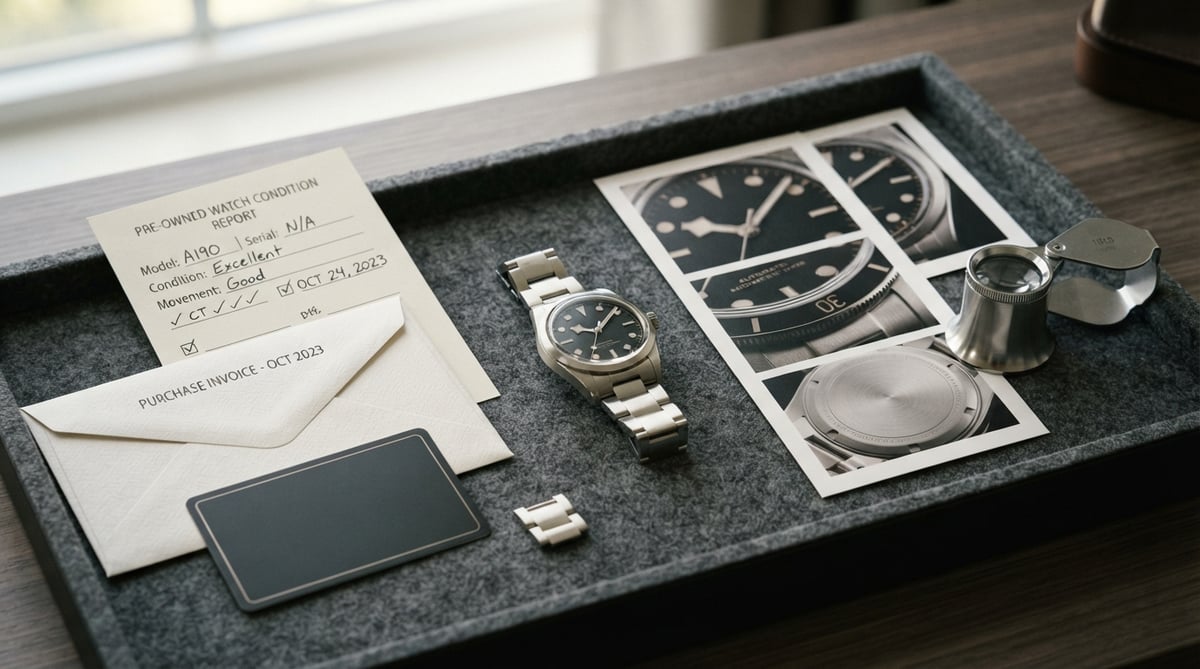
A quiet service can be measured more accurately by the quality of the decision than by the speed of the transaction. A useful conversation may end with a purchase. It may also end with a request for more photographs, a revised budget, a different reference, or no decision at all.
Time Pressure Changes the Frame, Not Only the Clock
A deliberate pause is not a guarantee of a better decision. No amount of reflection can make a purchase risk-free, predict how your preferences will change, or remove uncertainty from a transaction. The purpose of a pause is simpler: to keep a manufactured sense of urgency from making the decision for you.
Consumer research supports treating time pressure as a relevant variable rather than ignoring it. A 2024 study published in PsyCh Journal ran two experiments and found that time pressure significantly affected consumers’ variety-seeking behavior. The study does not establish that speed always improves or harms a decision. Its narrower finding is important: the presence of a deadline can change what people notice, how they compare options, and which alternative gains appeal.
Choice deferral also has a more complicated role. A 2018 study in the International Journal of Research in Marketing described how consumers often postpone a choice when several attractive options create decisional conflict or uncertainty about preferences. The researchers also showed that anticipated regret can influence whether someone chooses now or defers.
In practical terms, waiting can represent two different things:
- A structured pause: material questions are being answered, terms are being clarified, and the client is testing the watch against a clear purpose and budget.
- Decision avoidance: the conversation continues, but no one can name the unresolved issue, the criteria keep changing, or urgency is being used to avoid a conclusion.
The first deserves room. The second needs definition.
A genuine constraint should not be confused with artificial pressure. A watch physically in inventory is different from one that must be sourced. A fully refundable deposit that begins a search is different from full payment for a completed purchase. Those distinctions may influence timing, but they should not be used to crowd out judgment.
For pieces marked Available Upon Request, our current watch collection describes a specific process. The watch is not presently in stock. A fully refundable 10% deposit initiates sourcing through our network of vetted partners. You review and approve the exact watch before the remaining balance is collected. The current policy states that, if an acceptable piece is not secured within 7 days, the deposit is returned in full.
That structure is relevant for one reason: the deposit begins a process, but approval of the exact watch remains a separate decision. The transaction is not reduced to “pay now or lose everything.” It creates an intentional review point.
What Should Be Clear Before You Decide
The right to take time is most useful when you know what the time is for. Before deciding on a luxury watch, separate the decision into five areas.
1. The identity of the exact watch
Begin with the reference, not a broad collection of similar watches. Two watches from the same maison and model family can differ in material, dial, bezel, bracelet or strap, production period, and included components. Those differences can affect both the ownership experience and the transaction.
Ask for the exact reference and configuration. Confirm what is included, what has been replaced, and whether the description refers to the individual watch rather than manufacturer-level specifications or generic product photography.
A model name is a starting point. It is not the complete identification of the piece in front of you.
2. The condition, provenance, and documents
Condition and provenance belong to the individual watch, not automatically to its model. Relevant details can include service history, available records, included accessories, signs of polishing, component originality, and any known changes.
Write down what you know and what remains unverified. “Rolex,” “Patek Philippe,” or “Audemars Piguet” identifies a maison, but it does not answer whether this particular example has the documents, condition, and history represented in the discussion.
Authentication is a separate matter from personal fit. We state publicly that every item we offer is guaranteed authentic, is authenticated on arrival, undergoes a multi-point inspection, and is reverified before shipment. Those steps address authenticity, condition, and mechanical integrity. They do not decide whether the watch belongs in your collection.
That distinction is healthy. The authentication information on our website can establish what has been verified; your review should still establish whether the watch is right for you.
3. The all-in price and written terms
The displayed price is only one part of the financial decision. Ask for the total amount due, when it becomes due, what deposit is required, and which portions are refundable. Confirm shipping arrangements, insurance, inspection terms, and any other condition that affects the transaction.
Do not rely on a phrase such as “available” without asking what it means at that moment. On our current collection page, priced watches are described as physically in inventory and available for immediate shipping upon cleared payment. Pieces marked Available Upon Request are not in stock and follow a sourcing process instead.
These are not minor differences in language. They affect when the transaction begins, what the deposit does, when you see the exact watch, and when the balance is due.
4. How the watch will be worn
A watch can be admired in a photograph and feel entirely different in regular use. Diameter is only one measurement. Case thickness, lug span, crown position, bracelet articulation, weight, and dial opening all shape how a watch sits on the wrist.
Define the intended use before the final decision. Daily wear, formal occasions, travel, sport, and collection display place different demands on a watch. A complicated piece that you will never wear may be less suitable than a simpler watch you will reach for often.
If the watch is being considered remotely, request the measurements and the available photographs, and ask about inspection or return terms before paying. Where possible, trying the watch on is the clearest way to answer a question that images cannot.
5. The role it will play
A collection does not improve merely because another watch enters it. The better question is what role the candidate will serve and what will change after ownership.
Consider:
- Is this replacing an existing watch, completing a focused collection, or adding a deliberate form of variety?
- Does it overlap with something you already own?
- If it does overlap, is the difference meaningful to you?
- Does it remain within the all-in budget after foreseeable ownership costs?
- Would waiting produce a clearer answer to the same goal?
A pause is especially justified when the watch is attractive but its place in the collection remains vague. Our guide to choosing each new piece states the principle plainly: an empty space is not a defect. Waiting can be the most disciplined collecting decision when the available watch does not add a clear role.
How to Take Time Without Creating a False Expectation
Patience should not be confused with an informal hold, a guaranteed price, a reserved watch, or a cooling-off period unless those terms are written and applicable.
That boundary matters. “I will think about it” does not automatically mean the watch will remain available, the price will remain unchanged, or the item can be returned. Do not make a consequential decision while relying on an assumption that has not been confirmed.
Instead, make the time explicit. Ask:
- Is this exact watch already in inventory or will it be sourced?
- What action starts the process?
- Is any deposit fully or partially refundable?
- When do I review and approve the exact watch?
- When is the remaining balance due?
- What written inspection, shipping, and return terms apply?
The answers can be concise. They simply need to remove ambiguity.
For a sourced watch, the current Available Upon Request process already provides a useful structure: a 10% fully refundable deposit begins the search, the specific watch is presented for review, and the balance is collected only after approval. The current policy also states that the deposit is returned after 7 days if an acceptable watch has not been secured. For an in-stock watch, confirm present availability and delivery terms directly rather than assuming that a listing remains a reservation.
This is where a concierge earns trust. The aim is not to manufacture certainty. No responsible advisor can promise that a watch will always remain available, that a particular watch will feel perfect on the wrist, or that a preference will not change. The aim is to make the known facts and known limits equally clear.
A Simple Decision Reset
If a conversation has left you interested but not ready, use a short reset rather than extending the conversation indefinitely.
Start by writing one sentence: “I am considering this watch because...” If the reason is only that the opportunity may disappear, pause. If the reason is specific, test it against the details that follow.
Next, divide the remaining questions into two groups:
- Material questions: identity, authenticity, condition, provenance, price, deposit, payment, inspection, delivery, and return terms.
- Preference questions: size, style, color, complication, collection role, and how often you expect to wear it.
Material questions deserve a direct answer. Preference questions deserve time and comparison, but they should not be disguised as missing facts.
Then review the same criteria after the initial excitement of the conversation has passed. Do not ask yourself to feel less interested. Ask whether the reasons for interest are still specific and sufficient. A watch does not become a better fit simply because you have spent another week looking at photographs of it.
Finally, choose the next state deliberately:
- Proceed when the exact watch is identified, the material questions are answered, the terms are understood, and the purchase remains within your boundary.
- Ask when a material fact or term is still unknown.
- Wait when the watch is plausible but its collection role, suitability, or timing remains unclear.
- Walk away when the facts are qualified, the terms are evasive, or the watch continues to exceed the budget after the total cost is considered.
This is not indecision. It is a decision about how the decision will be made.
The Final Judgment Still Belongs to You
Our role is to make a luxury watch transaction more legible. Our service standards include authentication, market-based pricing, clearly disclosed condition, direct expert contact, and insured delivery. None of them requires you to surrender your own judgment.
You can begin with the current collection, review an exact piece, and take note of the questions it creates. You can also contact our team to discuss an acquisition, sale, trade-in, or custom commission. Every inquiry is handled with discretion, precision, and personal accountability.
If you need another conversation, ask for it. If you need a day, take it. If a material question remains, do not confuse a polished presentation with a complete answer.
The concierge’s job is not to make uncertainty disappear. It is to place the facts in front of you, explain the terms without disguise, and respect the time required for a clear decision.
