

Why Discerning Buyers Choose Curated Pre-Owned Watch Houses
The Stellaris Journal
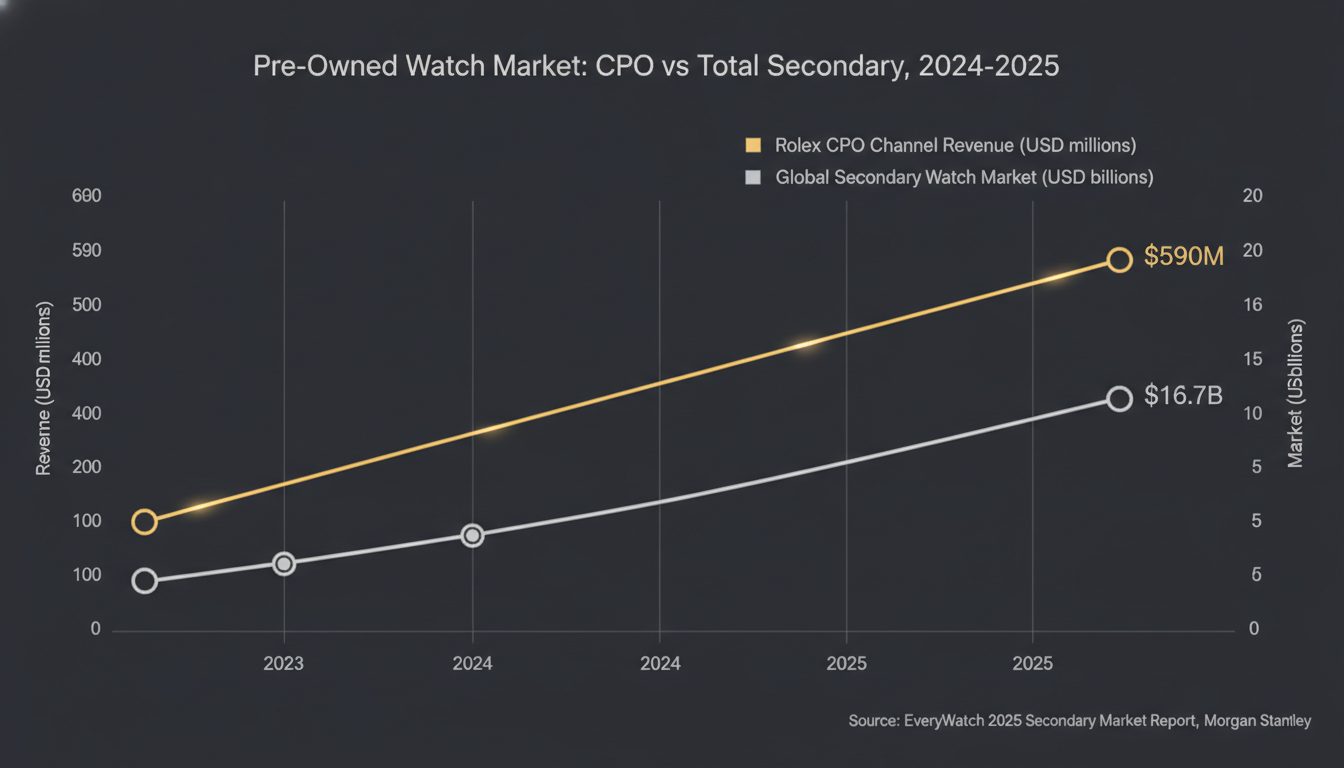
The pre-owned luxury watch market is no longer a back room of the trade. It is the trade. In 2025, the global secondary watch market reached roughly $16.7 billion, growing 36% in a single year. Inside that figure, even Rolex's own Certified Pre-Owned program moved $590 million. The market is large, liquid, and increasingly legitimized. Which makes the central question for a serious buyer more pointed, not less: in a market this mature, who do you actually buy from, and why?
The answer most casual buyers give is price. The answer discerning buyers give is curation.

TL;DR
- The pre-owned market is large and growing, but its size is also the source of its risk: more inventory means more variance in quality, authentication, and disclosure.
- "Curation" in a pre-owned house is not marketing language. It is a working process: sourcing, authentication, inspection, pricing, and post-sale support, applied to every piece before it reaches the page.
- Discerning buyers choose curated houses because the alternative, whether anonymous marketplaces, private sellers, or generalist auction listings, pushes authentication, condition disclosure, and accountability back onto the buyer.
- The market itself has moved toward curation. Brand-backed CPO programs and specialist dealers are absorbing share precisely because they reduce buyer friction.
- Curation is not free, and it is not magic. It trades some price flexibility for risk reduction, access, and documentation. The buyer should know what they are paying for.
What "Curation" Actually Means in a Pre-Owned House
The word is everywhere. Most uses are decorative. In a working pre-owned watch house, curation has a specific meaning: a small, named set of people decides which watches enter the inventory and which do not, and that decision is visible in the published list.
A curated catalog is short. A filtered catalog is long. A filtered catalog is a marketplace that has applied search parameters; a curated catalog is a selection someone argued about. The difference is accountability. If a watch is on the page, a person at the house has decided it belongs there, and that person's reputation is attached to it.
Three things separate curation from selection:
First, the intake is selective, not exhaustive. A generalist marketplace wants every listing it can get. A curated house can refuse a piece that does not meet its standards, and frequently does.
Second, the standard is documented, not just felt. A house that has curated for years can articulate, in plain language, what it is looking for: design significance, mechanical relevance, condition thresholds, documentation, and provenance.
Third, the curator is named. A marketplace has a platform. A curated house has a person you can call, email, or text, and who can speak to the specific piece you are considering.
That is what the word is supposed to mean. In practice, not every house that uses it operates that way, which is part of why discerning buyers learn to read past the language.
The Four Functions a Curated House Performs
If a house is genuinely curating, it is performing four functions that anonymous channels typically leave to the buyer.
Authentication. The watch is opened, examined, and verified against known characteristics of the reference, the movement, the dial, the case, and the serial. Authentication at the listing stage is what protects the buyer from counterfeits and from "Frankenstein" pieces assembled from mismatched parts, a problem that has become more common as the secondary market has scaled. Every piece we offer is authenticated on arrival, goes through a multi-point inspection, and is reverified before shipment, with a 100% authenticity guarantee behind it.
Condition and provenance disclosure. A curated house grades the watch and states what it knows: service history, original components, replaced parts, polishing, and any documentation that comes with the piece. This is not glamorous work, but it is the work that prevents the most common post-purchase disputes.

Transparent, market-based pricing. The price is set with reference to the current secondary market for the specific reference and condition, not by what a desperate seller or a casual buyer will accept. This is one of the quieter advantages of a curated house: the buyer is not asked to negotiate against their own information deficit.
Concierge support across the transaction. From the first inquiry to delivery, one person handles the buyer. Questions, condition photographs, payment logistics, insured shipping, and any post-sale follow-up flow through a single contact. The concierge model is documented in more detail in our guide to white-glove service in luxury transactions, and it is the difference between buying a watch and being sold a watch.
These four functions are not unique to any one house, but they are not universal either. They are what a curated house is buying its margin to provide.
Why Curation Reduces Real Risk for the Buyer
The pre-owned market is a buyer's market in the loose sense. There is a lot of inventory. It is not a buyer's market in the contractual sense. In a private sale or a large open marketplace, the buyer carries most of the verification load. The seller, in many cases, is under no obligation to disclose what they do not want to disclose.
The risks are well documented. Counterfeits at all price tiers. Replacement parts passed off as original. Over-polished cases sold as "mint." Service papers that cannot be verified. Dial swaps. Hands that are not period-correct. None of these problems are theoretical. They are the daily working reality of authentication, and they are why an independent authentication step is a baseline requirement, not a premium service.
A curated house takes those risks onto itself, in writing, before the transaction closes. That transfer of risk has a price, and the price is real. But for a buyer spending five, six, or seven figures on a single piece, the price of the warranty is smaller than the price of the mistake.
There is a secondary risk that gets less attention: time. A buyer who purchases from an anonymous source may spend weeks verifying the piece after the fact, opening a dispute, arranging a return, or simply accepting a quiet loss. The cost of that time is not on any invoice, but it is real, and it is one of the reasons experienced collectors prefer to spend a known premium to a known house rather than chase an unknown saving with an unknown seller.
The Market Has Quietly Moved Toward Curation
Five years ago, the institutional and the secondary markets were largely separate conversations. Authorized dealers sold new. Independent dealers and auction houses sold pre-owned. The two sides did not overlap much, and the brand-new retail experience was the default for buyers who wanted certainty.
That has changed. In 2022, Rolex launched its Certified Pre-Owned program through authorized retailers, and the program reached $590 million in 2025, a 204% year-over-year increase. By the end of 2025, roughly 107 retail locations worldwide carried about 7,500 certified pre-owned pieces. Brand-side CPO now accounts for around 10% of total secondary Rolex transactions, against a secondary Rolex market estimated at $5.8 billion.
This matters for two reasons.
First, the entry of the brand itself into the secondary market is an institutional endorsement of the pre-owned channel. When a maison that guards its distribution as carefully as Rolex does decides to formalize resale, it signals that the secondary market is the primary market for many buyers, and that those buyers are entitled to the same authentication and documentation standards as first-time buyers.
Second, CPO has not replaced independent curated dealers. The two now coexist, serving different buyer needs. As one industry observer put it to Glossy, "CPO gets the person who has not found a dealer they trust yet, while the secondary market gets the person who has." Independent curated dealers are the long-term home for buyers who already have a relationship and who want access to inventory the brand channel does not carry, including discontinued references, neo-vintage pieces, and independent watchmakers.
The wider market data supports the same read. The EveryWatch 2025 Secondary Market Report showed the broader secondary market growing 36.4% in 2025, with dealer networks expanding 38.3%. Dealer participation, not auction participation, was the engine. That is consistent with buyers preferring specialist counters with disclosed inventory, documented processes, and reachable people, over opaque listings with stock photos and anonymous sellers.
What Curation Cannot Do
It is worth being precise about the limits, because honest framing is what makes the rest credible.
Curation does not guarantee appreciation. A well-selected pre-owned Rolex is not a financial instrument, and a thoughtful curator will say so. Pre-owned pricing moves with brand allocation decisions, retail cycles, and broader luxury demand. A house that promises returns is not curating; it is selling.
Curation does not eliminate the need for the buyer's own judgment. The buyer still needs to know what they want, what wrist size they wear, what complications matter to them, and how the piece fits into a longer collection. The curator is not a substitute for taste.
Curation is not free. The premium a curated house charges covers authentication labor, condition photography, documentation, insured shipping, and the carrying cost of inventory that a marketplace does not have to absorb. Buyers who are price-sensitive and have the expertise to do their own authentication may legitimately prefer other channels.
And not every house that claims to curate actually does. The label is unprotected. A small number of pieces is not a curated catalog. A nice website is not a process. The discerning buyer reads the published authenticity standard, the inspection language, and the shipping and return terms, and judges whether the operations match the marketing.
When a Curated House Is the Right Choice
Curation fits a particular buyer profile, and it is worth naming that profile honestly.
A curated house is the right channel when the buyer is buying a piece significant enough that the cost of being wrong is larger than the premium of buying right. That includes most watches above the five-figure threshold, and every watch where authentication, originality, or service history materially affects value.
It is the right channel when the buyer values documentation and provenance enough to pay for them. A watch with papers, original box, and verifiable service history is worth more at resale, and a curated house is set up to deliver that record.
It is the right channel when the buyer wants access that the open market does not surface easily. A discontinued Patek Philippe reference, a specific dial variant, a neo-vintage Cartier, an independent watchmaker's earlier production, all of these are more reliably sourced through a house with a network and a track record than through a public listing page.
It is the right channel when the buyer wants one person to be responsible for the transaction. The concierge model is not for everyone, but for buyers who would rather send a text than fill out a checkout form, it changes the experience of buying substantially.
It is not the right channel for buyers who know exactly what they want at the lowest available price, have the expertise to verify the piece themselves, and are willing to absorb the residual risk in exchange for the savings. That is a real buyer, and the curated house is not going to be their best option.
The Discerning Buyer's Underlying Logic
The pattern is straightforward once it is named. A discerning buyer is not paying a premium for the word "curated." The buyer is paying for the curator's judgment, the curator's accountability, and the curator's access. The premium is the price of not having to be an expert in everything that touches the watch, from movement finishing to paperwork chain.
That logic does not require trust in any one house. It requires trust in the structure: a small operation with a named curator, a documented authentication process, transparent pricing, and a real person on the other end of the transaction. Where that structure exists, the buyer benefits. Where it does not, the buyer is back to doing the curator's job themselves.
The pre-owned market is large enough now that buyers can afford to be selective about who they work with, and selective about how they think about the category as a whole. The houses that will earn the next decade of that buyer's business are the ones that take the work seriously enough to make it invisible.
