

How to Authenticate Pre-Owned F.P. Journe Watches Safely
The Stellaris Journal
If you bought a vintage Rolex or a modern Patek, you would have a fairly robust roadmap to follow. Reference databases archive nearly every reference number. Authorised service centres can pull up production years. Decades of auction catalogues have built a public record of dial variants, bracelet codes, and case proportions. The infrastructure for authenticating those pieces is, in a word, mature.
F.P. Journe is a different problem entirely. The brand has been in continuous production for only 25 years. It releases fewer than 1,000 watches annually, and the most coveted pieces from its early years are scarce in a way that goes beyond mere low numbers. The catalog, the case numbering, the engraving conventions, even the materials themselves have all changed within a single generation of collectors. Authentication here is not a matter of running a serial number through a database. It is a matter of understanding an evolving logic that the brand itself has refined in real time.
For anyone considering a pre-owned F.P. Journe, whether a brass-movement Chronomètre à Résonance or a current Octa Lune, that subtlety matters. Get it wrong, and the financial and emotional loss is not theoretical. It is a six-figure mistake.
The Independent Horologist Problem
Authenticating a Patek Philippe benefits from one quiet advantage: scale. The maison has produced hundreds of thousands of watches, most of which have been catalogued, serviced, and resold repeatedly. Each generation of dealerships has built institutional knowledge on top of the last.
F.P. Journe has none of that cushion. The manufacture was founded in 1999, with the first 20 watches, the Subscribers series Tourbillon Souverain, sold to clients who had placed advance deposits to fund its launch (Sotheby's, 2026). Annual production has remained around 900-1,000 watches since, a level that the brand treats as deliberate rather than incidental. When a watchmaker produces fewer than a thousand pieces a year, the population of any given reference is small. Reference comparisons become difficult. Variant studies rely on the work of a handful of specialists rather than aggregated industry data.
The independent status is also the point. F.P. Journe is not part of any larger luxury group. The brand does not have the same aftermarket service infrastructure that heritage maisons maintain through authorised networks. Service is handled through the F.P. Journe Boutiques and authorised points of sale, and the manufacturer's own service centre in Geneva creates an individual file for each watch by serial number the moment it arrives. That traceability is real, but it is also centralised in a way that puts more weight on the boutique network than on third-party dealers.
The result is a brand where authenticity depends less on standardized reference checks and more on familiarity with the maker's specific habits: how the maison numbered cases, when it transitioned from brass to gold movements, where it inscribed serial numbers, and how its engraving style evolved over time.
Serial Numbers, Casebacks, and the Geography of Engravings
The single most cited authentication reference for early F.P. Journe is the case numbering system, and it is worth understanding because it does not behave like a conventional serial number.
In the early years, the maison used a supplier for its cases and ordered in batches. The caseback engraving reflects when the case was ordered, not when the watch was cased or delivered. A case marked with an "01" suffix, for example, was part of a batch ordered in 2001 (Sotheby's, 2026). The format is broadly `XX/YY`, where XX is a unique case number and YY is the year the case was ordered. A suffix letter typically identifies the complication: T for Tourbillon, R for Résonance, A for Octa.
The first 20 watches, the Subscribers series Tourbillon Souverain, are the clearest example. They were all 38mm platinum with yellow gold dials, and uniquely, they were numbered in two places: the dial and the caseback (Revolution Watch, 2023). The dial was marked in an `XX/20` format to show position within the run of 20. The caseback carried `No. XX`. After the 35th watch, the maison shifted to the more familiar `XX/YY` format with the `YY` suffix, and dials were no longer numbered.
That transition is authentication-relevant. A Subscribers series watch has the dial number; a production-series watch does not. Confusion between the two is one of the most common mistakes made by sellers unfamiliar with the brand's history.
There is also a documented case-numbering gap. Based on publicly known examples, no F.P. Journe cases appear to have been ordered in calendar year 2000. The numbering jumps from 1999 to 2001 (A Collected Man, 2024). Résonance cases from 2000 do exist and use the `XX/00R` format, but the Tourbillon line shows no 2000 examples on the public market. Any caseback claiming a 2000 Tourbillon number warrants careful scrutiny.
Then there is the engraving style itself. Early casebacks were hand-engraved, with a slightly shallow, less consistent cut. As the manufacture grew in the early 2000s, the maison moved to deeper, more uniform laser engraving. The transition is gradual rather than absolute, but it provides another reference point when judging a piece (Sotheby's, 2026).
Finally, every dial carries the inscription Invenit et Fecit, Latin for "He invented it and he made it." This is not decorative. The phrase encapsulates the maison's positioning as a vertically integrated manufacture, and it appears on every F.P. Journe wristwatch. Its consistent placement, typography, and proportion are themselves authentication cues, ground truth that can be checked against documented examples.
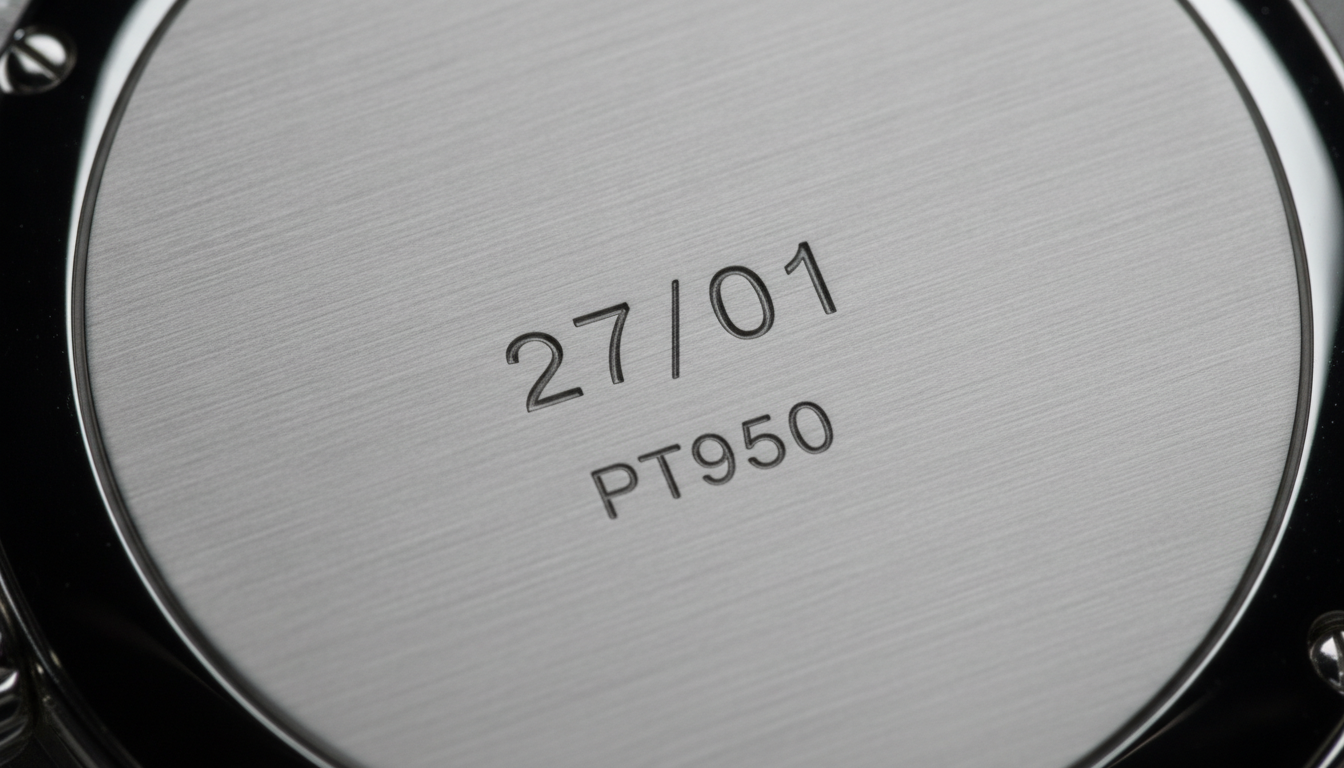
The case numbering and dial inscription are not decorative data; they are the maison's own paper trail, and any inconsistency between dial, caseback, and reference is a flag worth investigating.
Brass vs. Gold Movements: A Definitional Divide
No single feature separates early F.P. Journe from later production more clearly than the movement material. From 1999 until early 2004, the maison built movements in brass. From 2004 onward, F.P. Journe transitioned to movements in 18k rose gold (Phillips, 2023).
That distinction is not subtle. The visual difference between a brass movement and a gold one is immediate. Brass yellows; rose gold reads warmer and more uniform. The two materials respond to patina differently, and surfaces that have been merely cleaned look different from surfaces that have been partially replated or substituted.
The maison gave the brass era a deliberate send-off with the Ruthenium Collection, five batches of brass movements coated in silvery-white ruthenium, produced across the Tourbillon Souverain, Chronomètre à Résonance, Octa Calendrier, Octa Chronograph, and Octa Réserve de Marche, with only 99 examples of each (Sotheby's, 2026). Ruthenium pieces are among the most frequently misrepresented early Journe watches, because the dark coating can obscure movement details that would otherwise telegraph authenticity. The serial number, the caseback engraving, and the provenance of the original purchase invoice become disproportionately important.
Material questions also extend to the case. Early Tourbillon Souverain prototypes from 1991 used platinum cases with gold movements. The Subscribers series switched to platinum with yellow gold dials. The Octa Réserve de Marche, from its early production, was cased in rose gold and platinum. Knowing which case metal was paired with which complication and which serial range is part of the authentication puzzle, and one that the boutique or service centre can cross-reference when the watch is presented.
It is worth stating plainly: visual confirmation of a brass or gold movement requires the watch to be opened. That is not a casual step. F.P. Journe's warranty is explicitly voided if the watch is opened by a non-authorised person (F.P. Journe, 2026). For a prospective buyer, this creates a practical tension. The most definitive authentication step is one that only an authorised party can perform, and only if the watch is sent to a Boutique or authorised point of sale.
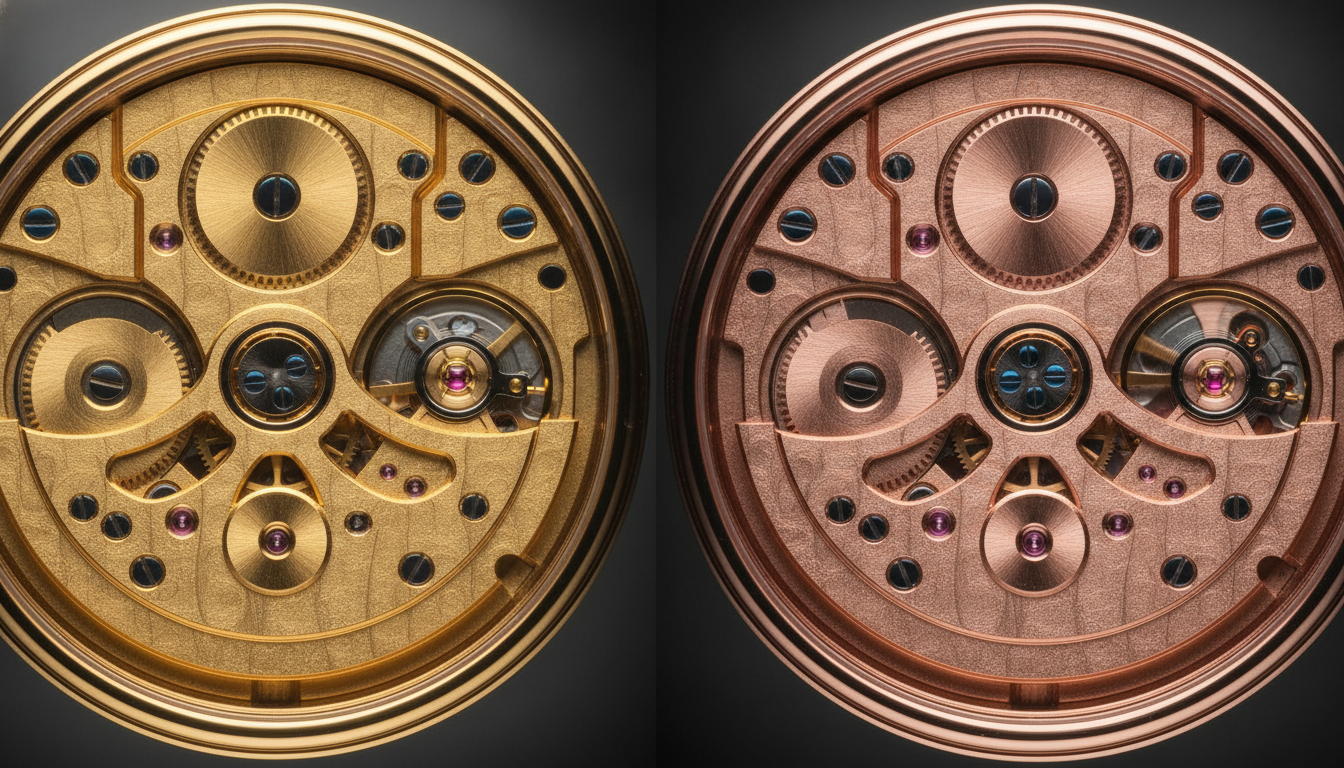
Movement material is one of the few authentication checks that is essentially binary: a brass-era Journe is a brass-era Journe, and any state of mixed or substituted materials is a serious provenance issue.
Limited Series, Boutique Editions, and the Provenance Question
F.P. Journe's catalogue is more complex than its annual production volume suggests. Beyond the core lines, the maison has produced limited series, anniversary pieces, and Boutique editions, each with its own conventions.
The Black Label collection, for example, signals a specific aesthetic execution across Octa, Quantième Perpétuel, and other base references, with production typically noted in reference series guidance from specialists (Wrist Aficionado, 2024). Boutique editions are referenced within the cataloguing system as well, with examples like the Quantième Perpétuel QP Boutique Edition appearing in current inventories. Each variant requires its own reference check.
The maison has also produced unique pieces for special clients, sometimes in serial ranges that step outside the standard convention. In 2005, F.P. Journe produced a set of unique 38mm platinum pieces with yellow gold dials using the old brass-movement serial format, including one bearing the number 1000-R (A Collected Man, 2024). The maison has, on occasion, granted clients a number they specifically requested. Such pieces are rare and documented, but their existence is a reminder that the serial system is more nuanced than a simple count.
For the second-hand buyer, the practical implication is straightforward: pre-owned F.P. Journe authentication requires understanding which variant, which edition, and which era. A limited series without original documentation is a higher-risk object than a standard production reference with full provenance. A box and papers set is not a guarantee of authenticity, but its absence is a meaningful flag.
The Manufacturer's Own Verification Path
F.P. Journe offers a formal authentication route, with specific constraints.
The maison can issue a certificate of authenticity, but only for timepieces whose date of first sale exceeds five years from the date of the request. The certificate is nominative, meaning it is issued to a specific named owner, and the watch must be certified by one of the F.P. Journe Boutiques (F.P. Journe, 2026). For current production, the warranty is automatic: 36 months when purchased from a Boutique, 24 months from an authorised point of sale, with a 12-month extension available through the maison's website.
For a buyer evaluating a pre-owned piece, the manufacturer's service history is one of the most useful documents. When a watch is sent to the manufacture or an authorised service centre, an individual file is created by serial number, and the watchmaker's notes and any intervention history are recorded. A watch with documented service through the official network has a verifiable chain; one without that history requires more careful inspection.
The maison also notes, plainly, that purchasing from an authorised point of sale is the recommended path because it avoids the risk of acquiring a counterfeit or stolen piece. Pre-owned buyers do not have that option in the same form, which is why independent verification carries more weight in this segment.
What Genuine Authentication Looks Like in Practice
The combination of low production, evolving case conventions, distinctive movement materials, and limited-edition complexity makes F.P. Journe the kind of brand where a casual visual inspection is not enough. The risk is not that a fake will be obviously wrong. The risk is that a fake will be carefully constructed, using a genuine caseback engraving or a brass-movement component from a salvaged donor watch, with details that look correct until they are examined against documented examples.
Genuine authentication, in this segment, is multi-point. It involves cross-referencing the caseback engraving against the documented convention for the reference and era. It involves verifying movement material through authorised inspection. It involves matching the serial number to the brand's internal records where possible. It involves reviewing provenance documentation, including original purchase invoices, service records, and prior certificates. And it involves the willingness to walk away from a piece where any of these elements cannot be confirmed.
At The Stellaris Collection, every watch is authenticated on arrival, undergoes a multi-point inspection, and is reverified before shipment, with all items backed by a 100% authenticity guarantee (The Stellaris Collection, 2026). We are not authorised dealers, and we have no affiliation with F.P. Journe, but authentication for the current F.P. Journe inventory draws on the same reference conventions described above: caseback engraving checks, era-appropriate movement material, and provenance documentation reviewed at intake and again before listing. The current F.P. Journe inventory includes pieces from the Octa, Chronomètre Souverain, Chronomètre à Résonance, Centigraphe, and LineSport lines, each documented through the same multi-point process.
For a buyer considering a pre-owned F.P. Journe, the practical question is not whether authentication is possible. It is whether the seller has the patience and the relationships to do it thoroughly. The maisons that thrive in this space are the ones that treat every early Subscribers Tourbillon, every Ruthenium-coated Résonance, and every Boutique-edition Octa as a distinct authentication problem rather than a uniform SKU. That is the standard a piece of this caliber deserves, and it is the only standard that holds up under scrutiny.
