

What Separates a Curated Pre-Owned Watch Catalog From an Aggregated One
The Stellaris Journal
A catalog is not a collection. The difference between the two comes down to a single idea: the discipline of leaving things out.
In the pre-owned luxury watch market, this distinction matters more than anywhere else. The market has swelled into a multi-billion-dollar arena where almost anything is available, often within a few taps. The pre-owned segment alone is now estimated at roughly $29 billion in 2026, projected to reach nearly $60 billion by 2035. Growth like that brings volume. It also brings noise.
A discerning catalog is not built by chasing that volume. It is built by standing in front of it and choosing what to ignore.
The short version:
- A pre-owned catalog earns its name through exclusion, not through the number of references it carries.
- Three quiet tests tend to separate a considered catalog from an aggregated one: authentication with certainty, mechanical or historical significance, and endurance over a decade or more.
- The buyer's advantage in a curated setting is context: condition notes, provenance, and pricing that connects to a transparent market rather than to a seller's target month.
The Market Has Never Been Larger, or More Confused
The expansion of pre-owned has changed the shape of the trade itself. Where independent dealers and auction houses once dominated, digital platforms like Chrono24, WatchBox, and Bob's Watches now route the majority of transactions. Buyers can compare listings across continents within minutes. Sellers can list in seconds.
That access has a cost. Counterfeiting has scaled alongside it. Watches now account for nearly 20% of all counterfeit goods sales globally, and an estimated 30 to 40 million fake watches enter circulation each year, against roughly one million genuine Rolexes produced annually. The phrase "superfake" has moved from fringe internet slang into a recognized category. Some of these pieces replicate serial numbers, caseback engravings, and movement finishing well enough to fool even practiced eyes.
This is the environment any responsible pre-owned catalog now operates within. A large selection, on its own, means very little. What separates one dealer from the next is not how many references they list. It is the rigor behind the ones they do.
The Discipline Is What Stays Out
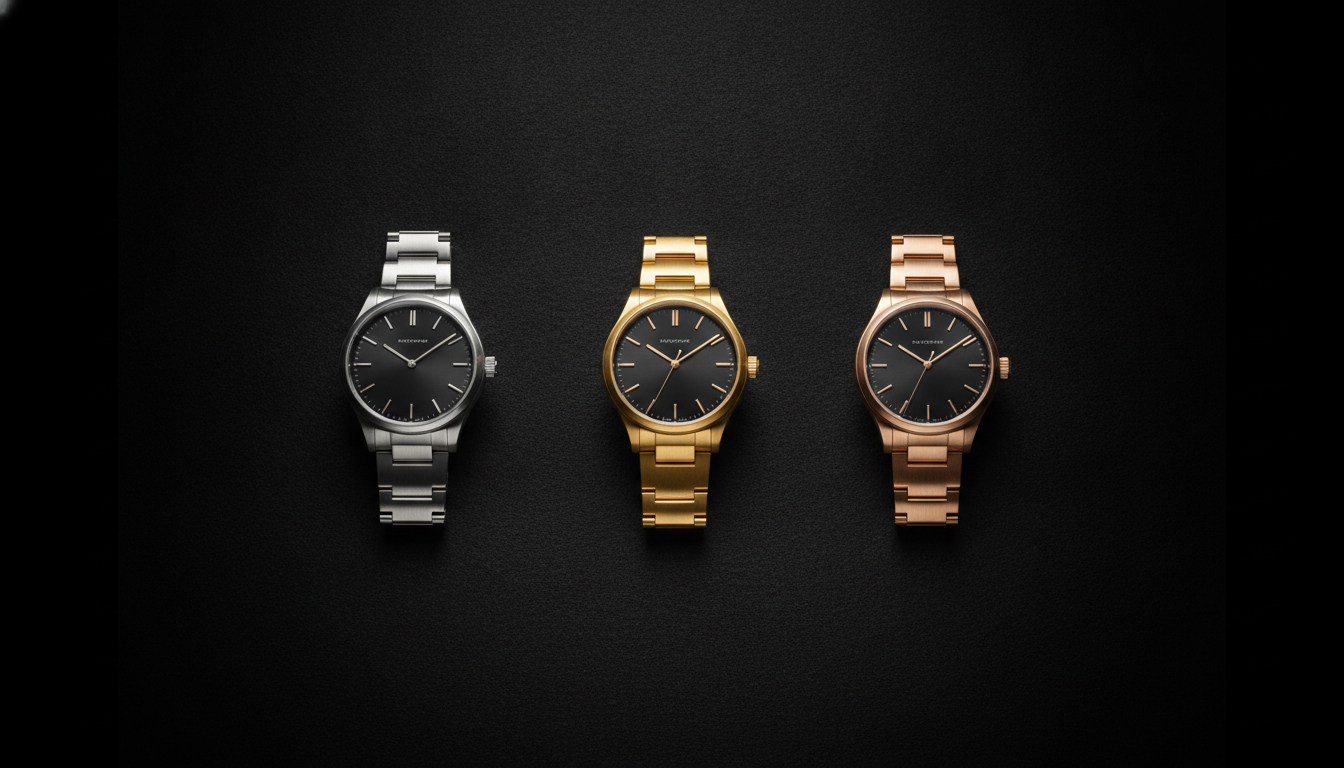
Curated is a word that has lost most of its meaning in luxury retail. Every boutique, every marketplace, every aggregator uses it. Most apply it loosely. A genuine curation philosophy is harder to describe than to practice, because it shows up mostly in what is absent.
A piece might be excluded from a discerning catalog for any number of quiet reasons: a movement that cannot be independently verified, a service history too thin to support its asking price, a reference that lacks any meaningful collector following despite strong name recognition, a dial that has been refinished and resold without disclosure. None of these are the buyer's problem in the moment of a sale. All of them become the buyer's problem later.
The discipline of exclusion means the catalog is smaller, the bar is higher, and the answer to "why is this not on the shelf" is always something specific. Not a vibe. A reason.
This is consistent with what established maisons have done for decades. Patek Philippe, Audemars Piguet, and Rolex, the three names that dominate the pre-owned segment by volume and value, did not become reference points by flooding the market. They became reference points by holding back. The dealers who handle these names well operate on the same principle.
Three Quiet Tests for Every Consideration
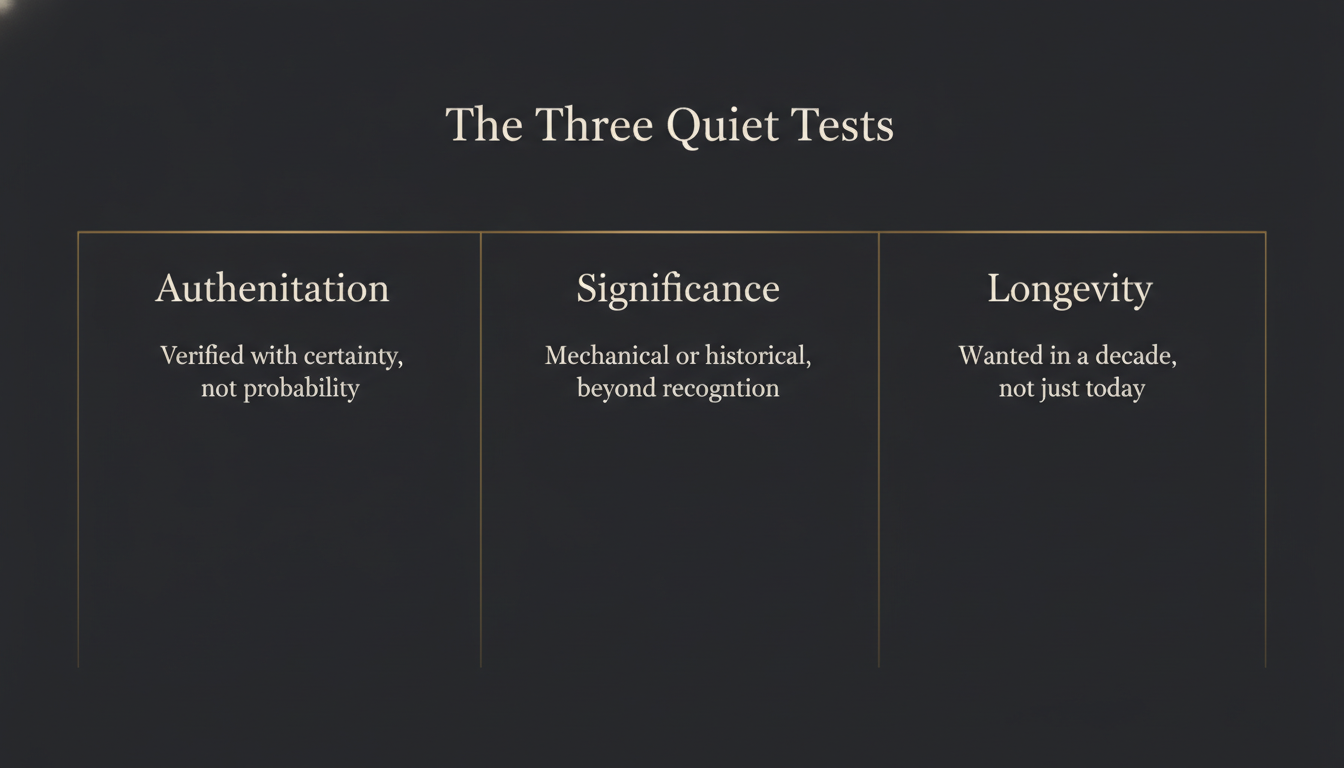
A working framework for what makes it into a discerning catalog can be reduced to three questions. None of them are about price. All of them matter more than price.
1. Can the piece be authenticated with certainty, not probability?
Authentication in the modern market is forensic work. Serial numbers, papers, and box presence are starting points, not conclusions. The pieces that pass a serious inspection are the ones where movement architecture, dial finishing, caseback engraving, material composition, and provenance align without contradiction. If any of those elements cannot be verified, the piece stays out, regardless of how famous the reference is. Independent authentication, performed before a watch is ever listed, is the only responsible position. The market has too many superfakes with cloned serial numbers and convincing movements to rely on anything less.
2. Does the piece carry mechanical or historical significance, beyond recognition?
A watch can be famous without being significant. Some references are widely known because they were heavily marketed, or because they appeared in popular culture, or because they are simply the most available entry point in their respective brand's catalog. None of that automatically makes them worthy of a focused pre-owned offering. Mechanical significance, design originality, or a documented place in the brand's horological lineage: these are what give a piece staying power. Without one of them, a watch is just an accessory with a recognizable dial.
3. Will it still be wanted in a decade?
This is the question most catalogs avoid, because it requires conviction. Trends in pre-owned move quickly. References that traded at premiums two years ago now sit at retail, or below. The pieces that hold attention over a longer horizon tend to share certain traits: production restraint from the maison, an identifiable design language, and a collector community that has stayed engaged with the reference through market cycles. They are not always the loudest names in the room. Often they are not.
What the Buyer Receives in Return
Restraint at the catalog level produces something specific at the buying level: less to scroll past, more to consider seriously. A smaller, more deliberate selection makes it possible to give each piece a fair amount of context. Condition notes, provenance where available, service history, and a pricing rationale that connects to the broader market rather than to what a seller hopes to clear in a given month.
This is also where the concierge dimension becomes tangible. Transparent pricing, direct expert contact, and insured domestic and international shipping are not perks layered onto a transaction. They are the infrastructure that makes a curated catalog work in practice. A pre-owned watch is only as good as the chain of custody behind it, from intake through delivery.
The pre-owned buyer's advantage, when the catalog has been built with care, is not lower prices. It is access to pieces that have already passed through a meaningful filter, presented with the context to evaluate them properly.
A Brief Note on What the Catalog Reflects
A pre-owned catalog reveals more about a dealer's values than any about page. A wide, undifferentiated inventory suggests that the priority is volume. A narrow, considered one suggests something else: an opinion about what belongs in front of a serious buyer, formed over time and held to even when a faster sale would have been easier.
The brands that anchor this kind of work, Rolex, Audemars Piguet, Patek Philippe, Vacheron Constantin, F.P. Journe, Richard Mille, share a common trait. They were not built on accessibility. They were built on restraint, on producing less than the market demanded, and on letting that restraint do the work of conferring value. A catalog built around these houses should operate the same way.
The quiet discipline is not a marketing posture. It is the only honest way to present pieces this significant to people who can tell the difference.
The Test of the Shelf
A discerning pre-owned catalog, in the end, is not measured by how many watches it lists. It is measured by what is missing, and whether the missing pieces were excluded for reasons a thoughtful buyer would respect.
That is the work. Slow, deliberate, often invisible. The catalog itself should look quiet. It should also be honest about what made the cut.
---
For inquiries about specific pieces or to discuss what belongs in your collection, the team can be reached directly at (213) 444-0926 or through the Exclusive Timepieces & Fine Jewelry page.
