

What Makes a Custom Earring Actually Suit the Wearer
The Stellaris Journal
"Custom earrings" usually means one of two things: a one-of-a-kind design no one else owns, or a piece coordinated to a specific outfit or moment. Both are real. Neither is what determines whether the earring actually suits the person wearing it.
A piece can be made from a sketch no one else has seen, set with the exact stone you chose, and still feel wrong once it's on. Not because the design failed. Because the design answered a question you didn't ask. You asked, "What should this look like?" You forgot to ask, "What does it have to do all day, on this ear, for this person?"
This post is about that second question. The earring-specific one. The one most custom jewelry writing skips, because rings are easier to talk about: a ring has one job, on one finger. An earring has to hang correctly, sit correctly, move correctly, frame correctly, and survive daily life from a piece of soft, unsupported tissue. It is a more demanding category than most buyers realize, and a more rewarding one when it's done well.
Brief and TL;DR
A custom earring actually suits the wearer when three things align: anatomical fit (lobe type, weight tolerance, asymmetry, piercing position), visual proportion (drop length, scale, how it interacts with hair and neckline), and lived reality (daily wear, activities, sleep, security). Off-the-rack and custom pieces both fail when any of these is ignored. The custom process earns its keep when it explicitly designs for them, not just for uniqueness.
The piece that suits you is the one designed for your ear, your face, and your week. Not just your taste.
What "Suit" Actually Means for an Earring
In custom work, "suit" is a three-dimensional word, because "matching" or "looking nice" undersells what a piece has to do.
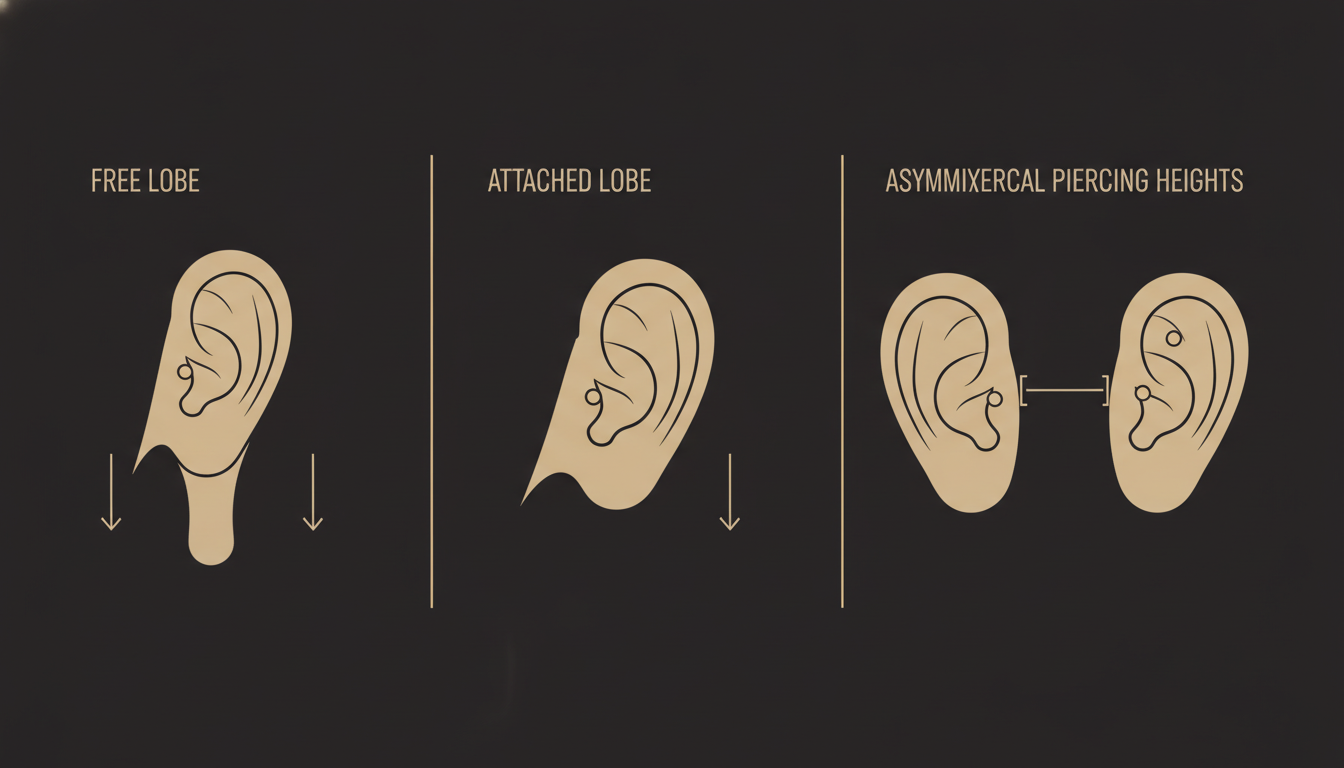
Anatomical fit is whether the earring physically works with the specific ear wearing it: lobe type, weight tolerance, piercing height and angle, and whether the two ears are even remotely symmetrical. They almost never are.
Visual proportion is how the piece interacts with the face, neck, hair, and the rest of the jewelry worn nearby. A drop earring that ends at the right point on the jawline can sharpen a softer face. The same drop, three millimeters longer, can chop the jawline in half. Scale and proportion are not preferences. They are mechanics.
Lived reality is what the day demands of the piece: weight over eight hours, interference with hair, glasses, masks, scarves, headphones, phone calls, sleep, work, the gym. A piece designed only for the mirror fails here.
A custom earring is one designed in response to all three. A custom earring designed in response to only one of them is, at best, half a custom job.
The Anatomy Most People Skip
Most custom jewelry conversations begin with the design. They should begin with the ear.
Lobe type matters more than face shape. Earlobes are free, attached, or partially attached, and the difference changes which styles hang correctly. A heavy drop with a sharp vertical line looks elegant on a long, free lobe. On a short, attached lobe, it can press against the jaw or sit at an awkward angle. The variation has been measured in clinical literature; researchers have grouped earlobes into distinct morphological types because the differences are real and consistent across populations.
Weight is the silent variable. A pair of statement earrings that feels fine at the boutique for two minutes can leave an ear aching after a workday, and stretched, sagging lobes over months. There is no universal safe weight; it depends on the lobe, the post gauge, and how often the piece is worn. The honest move is to specify the total gram weight of the finished piece and try a weighted prototype before committing to fabrication.
Almost no one has symmetrical piercings. One ear is usually slightly higher, one lobe slightly larger, one cartilage curl a bit different. This is normal, not a flaw. Off-the-rack earrings disguise this with visual weight. A custom pair can be designed to compensate: a marginally longer drop on one side, a slightly fuller motif, a deliberate asymmetry that reads as intentional design rather than as drift.
Piercing position changes over a lifetime. Earlobes stretch gradually as collagen and tissue shift with age, and some studies have measured average increases in ear circumference over time. A pair designed for a 28-year-old's piercing may sit differently at 45. Custom work can specify a slightly longer post or a more open setting that accommodates this drift without looking loose.
The takeaway: The ear is a moving target. A custom earring that ignores the ear's actual current state will look correct in photos and feel wrong on.
Proportion, Movement, and How It Frames You
The second dimension is what the earring does to the face, not what it does to itself.
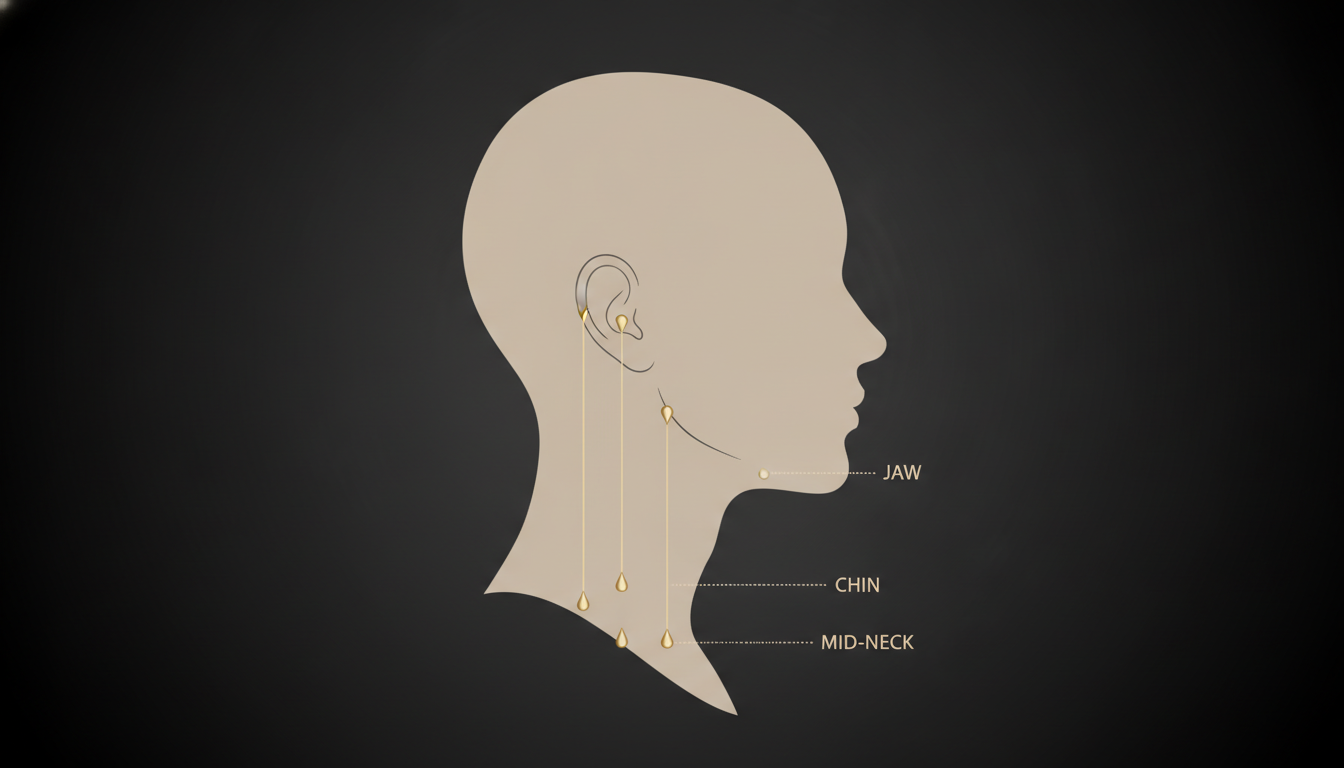
Drop length is the single most consequential variable. End the piece at the wrong point and you reshape the face in a way most buyers don't notice but everyone else does. End a drop at the chin and you cut the lower face in half. End it just below the jaw and you extend the neck. End it mid-cheek and you draw the eye upward. Standard references group recommendations by face shape and length, with elongated drops for rounder faces and shorter or wider shapes for longer ones. Those are useful starting points, not rules. The real test is the wearer's neck length, jaw definition, and hairstyle, none of which a face-shape chart can capture.
Scale has to answer to the wearer, not the occasion. A bold cocktail stud looks proportional on a frame that can carry it. On a finer frame, the same stud reads as costume. Custom work lets you dial carat weight, motif size, and metal gauge to the specific person. That is something a ready-to-wear collection, by definition, cannot do across its full range.
Hair is a frame you cannot ignore. Hair that sits behind the ear exposes the earring fully and competes with it. Hair that falls forward hides part of the design and shifts the visible weight. A custom design can be planned for the way the wearer actually wears their hair, not the way a model does in a product shot.
The takeaway: Proportion is mechanics. The piece does not get to have an opinion. It has to answer to the face and neck it sits against.
The Lived Reality: What the Day Demands
Most custom earring designs are reviewed in good light, in a quiet room, on a rested wearer. That is not how the piece will live.
Daily weight adds up. Eight hours of a 6-gram dangle is not the same as ten minutes of a 6-gram dangle. The lobe is soft tissue. Over months, that adds up. For daily-wear pieces, lighter is more honest than heavier, and a custom order can specify lighter metals, open construction where appropriate, or open settings that reduce visual mass without reducing presence.
Closures are not an afterthought. They are the entire daily experience. The wrong closure turns a beautiful piece into something you dread putting on. Closure types vary widely in security, comfort, and ease of use, and the right answer depends on the wearer's routine: screw backs for high-value pieces you barely remove, lever backs for drops that need to stay put, flat backs for sleep, butterfly backs when frequent changes matter. In a ready-to-wear piece, this decision is usually made for you. In a custom commission, it can be deliberate.
Glasses, masks, headphones, scarves, and phone calls. Each one is a small collision test for an earring. A drop that catches a scarf, a hoop that hits a phone, a stud that presses against a mask loop. The piece has to clear these quietly. In a fitting or wax prototype stage, these collisions can be tested, not assumed away.
Sleep and security. Some pieces are made to live in. Some are made to come off at night. That distinction shapes closure choice, post length, and weight from the very first sketch.
The takeaway: The most flattering earring in the world fails the moment it becomes annoying. Custom work lets you design the wear, not just the look.
Where Custom Actually Earns Its Keep
Off-the-rack earrings are a perfectly good answer for many people, most of the time. Custom is not a default upgrade. It is a specific tool for a specific problem.
Custom earns its keep when the wearer has a non-standard ear, a non-standard aesthetic goal, or a non-standard lifestyle that the ready-to-wear market doesn't serve. A small lobe. An attached earlobe. A piercing that healed at a slightly different height. A face shape that doesn't match the standard recommendations. A profession where heavy earrings aren't practical. A wedding where the earring has to coordinate with a specific neckline, hairstyle, and dress fabric. A piece meant to be passed down.
Our custom design process, for reference, follows a defined sequence: consultation, design directions, a formal production proposal, stone selection, payment, and roughly three weeks of fabrication after final approval. That structure exists because each stage surfaces a different one of these decisions, and skipping one usually surfaces it later as a problem.
The part that often surprises people is how often the consultation surfaces an anatomical or lifestyle constraint that changes the original brief. A hypothetical example: a client wants a long drop, has a shorter-than-average neck, and the piece as drawn would crowd her jaw. The right answer is to redesign the piece, not to build the one she asked for. The earrings we make to order all begin from this kind of negotiation between vision and anatomy.
Decisions Worth Making Before the First Sketch
If a custom pair is going to be commissioned, these are the conversations that need to happen before any rendering. Skipping them is how projects go off the rails.
Length and end point. Where does the piece stop? At the lobe, mid-jaw, just below the jawline, mid-neck? This is set by face, neck, and hairstyle, not by the design.
Total weight. What is the finished gram weight, and what is the wearer's tolerance for daily wear of that weight? Get the number in writing.
Closure type. What backing, hook, or lever is on the finished piece, and why that one? Don't accept the default.
Asymmetry compensation. If the wearer's ears aren't symmetrical (they almost never are), what is the deliberate response? Slightly different drops? A motif designed to read evenly from both sides?
Metal and stone choices. Natural or lab-grown diamond, yellow or white gold, set low or set high. Each is a real decision with tradeoffs, and the tradeoffs between natural and lab-grown diamond are worth understanding before the design locks in.
The takeaway: The first sketch is not the start of the project. The decisions above are. Walk into the consultation with answers, and the design has somewhere to go.
A custom earring is not automatically better than a ready-to-wear one. It is better when it is designed for the specific ear, the specific face, and the specific week it will live in. That is the part of "custom" that is actually scarce, and the part that matters.
