

Ethical Brilliance: Natural vs. Lab-Grown Diamonds Explained
The Stellaris Journal
Half the engagement rings bought today are lab-grown. And everyone assumes they're the 'ethical' choice. They're wrong. The reality is far more complex than the marketing brochures want you to believe.
While you often hear "eco-friendly" in reference to lab diamonds, creating one can actually pump out over three times the CO2 of mining a natural one. Consider that. Then there's the financial impact: you're redirecting income from forty million artisanal miners – real people whose livelihoods depend on it – straight to a few high-tech labs. There's no middle ground.
This isn't about dictating your purchase. It's about pulling back the curtain. We're cutting through the marketing hype, the feel-good narratives, and the outright misinformation. Because making a truly ethical diamond choice demands genuine knowledge: understanding traceability, energy consumption, and who actually benefits from your purchase—a philosophy central to collections like those at The Stellaris Collection.
The Diamond Dilemma: What to Know Before You Buy
Forget everything you thought you knew about diamonds. Lab-grown stones are now ubiquitous, often up to 70% less expensive, and chemically identical to those found naturally.
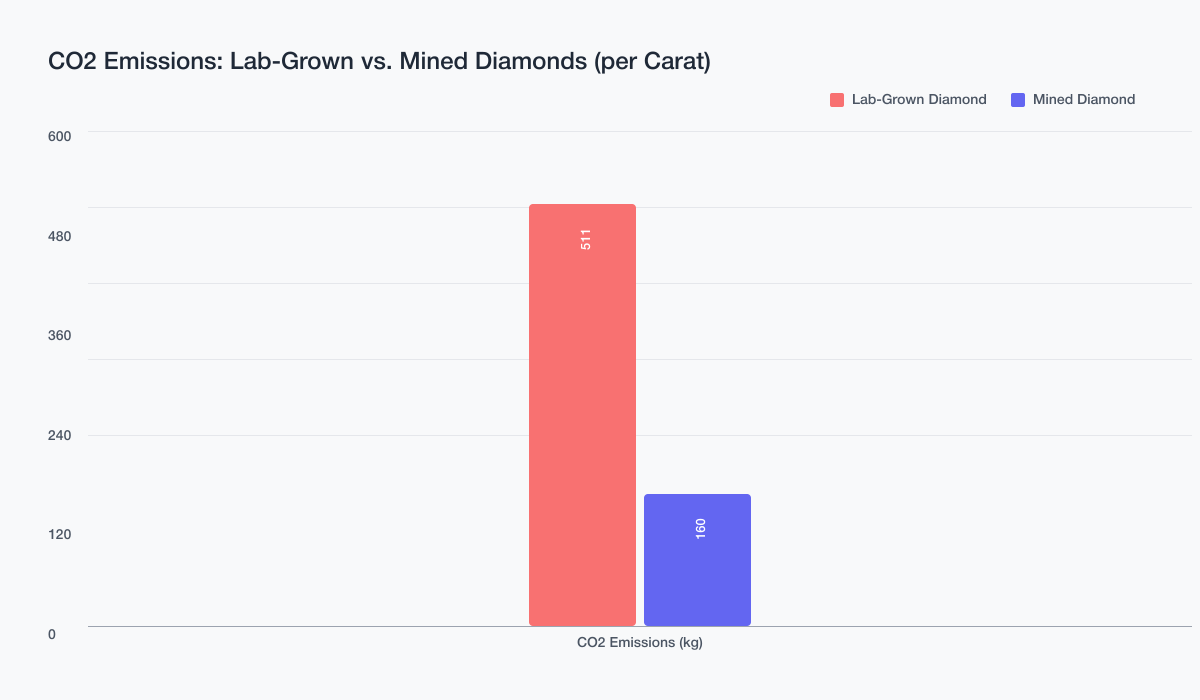
According to Similarweb (2025), lab-grown diamonds account for half the engagement rings sold in the US. However, their 'eco-friendly' reputation is largely a myth. While traditional mining undeniably impacts land, lab diamonds are immense energy hogs. Producing a single carat can generate 511 kg of CO2, starkly contrasting with the mere 160 kg for a mined diamond. This significant disparity warrants serious consideration.
The human element also presents a crucial difference. The lab-grown industry primarily benefits tech companies and investors in regions like Silicon Valley, China, and India. In contrast, responsibly sourced natural diamonds support forty million artisanal miners and underpin entire economies, such as Botswana's. The choice becomes whether to funnel capital to tech magnates or to communities striving for sustainable livelihoods. Furthermore, natural diamonds historically retain, and sometimes appreciate in, value. Lab-grown diamonds, being mass-produced commodities, typically offer negligible resale value, making them a poor investment from a financial perspective.
As you can see, the issue is far from simple. It’s not a clear-cut case of 'good' versus 'bad.' You need to understand the true origin and impact of your diamond. In this complex landscape, absolute transparency is the only play that truly matters.
Understanding Lab-Grown Diamonds: Science, Not Fiction

The Environmental Debate: Is 'Lab-Grown' a Synonym for 'Green'?
Let's confront the narrative around "green" diamonds. You constantly hear terms like 'lab-grown,' 'eco-friendly,' and 'the future' – a convenient package for a clear conscience. Yet, a closer look reveals this is far from the clean, solar-powered utopia often advertised.
Certainly, the primary appeal of lab-grown diamonds is the absence of large-scale ground excavation, deforestation, soil disruption, or waterway pollution. This argument holds intuitive appeal; no one advocates for environmental degradation. And indeed, traditional mining can impose a brutal toll on the planet. However, this represents only half the story – the easily digestible half that marketers want you to focus on.
The critical, often-ignored truth is that creating these supposedly eco-friendly stones is an enormous power hog, a massive energy suck. We're talking about HPHT machines operating at over 2,000°C – an insane amount of heat requiring monumental energy, comparable to lighting a small town. The crucial question is: where does this colossal power come from? It's not from renewable sources across the board.
Consider the hard numbers, which rarely lie, no matter how inconvenient. A single carat of a lab-grown diamond can be responsible for around 511 kg of CO2. Now, compare that to a mined diamond, often cast as the environmental villain: the average is approximately 160 kg of CO2 per carat. This means lab-grown diamonds can be more than three times worse for carbon emissions. Even data from Similarweb, when parsed for energy consumption, highlights these prodigious energy requirements.
Given the pursuit of cheap power, the majority of these labs are established in places like China, whose energy grid is heavily reliant on coal – a dirty, fossil-fuel-intensive, carbon-spewing resource. Thus, avoiding one environmental problem (mining) often leads to another (a massive carbon footprint from fossil-fueled energy grids). This isn't a solution; it's a lateral shift disguised with a green label.
This pervasive 'eco-friendly' marketing is textbook greenwashing. They champion sustainability while conveniently omitting the actual energy expenditure and its source. It's a carefully crafted narrative, not an honest truth.
However, it's also important to acknowledge that not all natural diamond mining is an environmental catastrophe. Countries like Canada, for instance, have stringent environmental regulations and strict reclamation laws, ensuring land is restored to its original state, or as close as possible, thanks to robust government oversight. It's far from a wild west scenario universally.
Ultimately, that 'green' label on lab-grown diamonds is a smokescreen. They might prevent a hole in the ground, but they consume power voraciously, often releasing significantly more CO2 into the atmosphere than their natural counterparts.
The Human Impact: Where Does the Money Really Go?
Let's momentarily set aside environmental concerns. While carbon footprints are important, what about the human element? The flesh-and-blood people behind the product? When you select a lab-grown stone, the money doesn't simply vanish; it flows to specific recipients.
Where does that capital typically land? Primarily with high-tech companies, investors, and affluent individuals in the US, China, and India. This results in a concentrated accumulation of wealth among a select few. It's a closed financial loop with minimal ripple effect, largely benefiting those who are already prosperous. Lab-grown diamonds, in essence, feed the already-fed.
Contrast this with natural diamonds. While the specter of 'blood diamonds' once loomed large (and historical abuses were indeed horrific), the industry has undergone significant transformation. Today, it supports an estimated 40 million people – artisanal miners who rely on traditional methods rather than advanced robotics. An additional 100 million individuals, including families and entire communities, depend indirectly on this trade for their livelihoods. These are not mere statistics; these are real people. Responsibly sourced natural diamonds sustain entire communities.
Your decision to purchase a lab-grown diamond effectively diverts a substantial revenue stream from these vulnerable communities in the Global South. It's not a neutral choice; it’s a deliberate wealth transfer from those who genuinely need it to corporate shareholders. Even Similarweb data indicates a growing consumer demand for greater transparency regarding the ultimate destination of their purchase funds, beyond just the sparkle. It's a wealth transfer, plain and simple. Your purchase has profound real-world consequences, every single time.
Consider Botswana: a tangible example of ethical diamond management. The nation has leveraged its diamond profits to build a prosperous country, offering free education and public healthcare to its citizens, with 80% of those profits remaining within Botswana. Imagine if these had been lab-grown revenues; it's highly improbable that tech giants would share such a significant percentage with the countries hosting their labs. When managed right, diamonds build nations, not just investor portfolios.
The natural diamond trade's darker chapters are undeniable, but it has evolved significantly. Robust systems, traceability initiatives, and even diamond certification, including direct sourcing, now allow consumers to find responsibly mined diamonds that directly support these communities. The focus has shifted from simply avoiding harm to actively fostering good and investing in the future of those who need it most. Ethical natural diamonds are a tangible choice, not a myth.
Conversely, transparency within the lab-grown industry is a significant challenge. There's no equivalent to the Kimberley Process for their labs, no mandatory international certifications for labor conditions or worker wages. The conditions for workers manufacturing these stones in, say, a Chinese factory, remain largely a black box, offering consumers no insight into their ethical sourcing from a labor perspective. For labor ethics, lab-grown diamonds are a black box.
Ultimately, you have a choice. But it’s imperative to understand the profound implications of that choice. It's not just about what glitters on your finger or about saving a tree. It's about who benefits, who thrives, and who struggles. This, arguably, is a far more significant consideration. Make your decision with open eyes.
Value and Scarcity: A Question of Legacy
Let's set aside the sparkle for a moment. If you're considering a significant investment in a diamond, you're likely also thinking about its long-term value, something that won't become worthless. This is where the diamond debate becomes particularly intricate. Fundamentally, there's natural, and then there's everything else. The core distinction, the true determinant, lies in their origin: one forged over eons, billions of years deep within the Earth; the other manufactured in a factory within weeks. This distinction changes everything when discussing actual value, beyond merely the price tag.

Natural diamonds have consistently maintained their worth because they are, quite simply, a finite resource. Each stone is a tangible piece of geological history, irreplaceable and unique. Their scarcity ensures they function as tangible assets, often passed down as family heirlooms. This isn't just sentiment; it's about possessing something real that holds its ground, especially in an unpredictable world. Auction houses consistently affirm this, with significant natural stones commanding premium prices and appreciating over time.
Lab-grown diamonds, conversely, are anything but rare. They can be produced rapidly, in a matter of weeks, by simply activating another machine. This virtually infinite supply inevitably drives down prices, a trend clearly documented by Similarweb over recent years. If you envision a future where your 'shiny thing' retains its value, reconsider. These are not heirlooms; they are mass-produced commodities. The resale market for lab-grown diamonds is profoundly challenged, with most jewelers unwilling to purchase them back, preferring to order new, cheaper stock directly from manufacturers.
Ultimately, purchasing a natural diamond is an investment in scarcity, securing something unique, time-tested, and a piece of legacy. With a lab-grown diamond, however, you're acquiring a manufactured product whose value, like most manufactured goods, is prone to steady depreciation. If your objective is long-term value, something to bequeath, something that truly signifies enduring worth, the choice is clear. The real value and lasting legacy unequivocally belong to the Earth-made diamond.
How to Choose Your Diamond: A Guide for the Conscious Buyer
For a curated selection of ethically sourced diamonds, you can explore collections like The Stellaris Collection.
Frequently Asked Questions
So, will this actually* fix my mess? Look, nobody's waving a magic wand here. But I've seen enough half-baked plans blow up to know what sticks. You've got to commit. And yes, it’s going to be ugly sometimes (it always is), but the core ideas? They work. They've worked for me. You just have to try. Don't expect miracles, but expect real progress if you put in the damn work.
- How much budget do I need for this? Not as much as those "gurus" want you to believe. They’ll tell you to sink thousands, but that's just padding their own pockets. Most of what needs doing? It’s elbow grease. It’s smart choices. And it’s not wasting money on crap that looks good on a spreadsheet but does squat in the real world. Spend wisely. Focus on what moves the needle, not the pretty stuff. You can get a lot done with a lean wallet if you’re smart.
- When will I see results? Tomorrow? Next week? Get real. This isn't some lottery ticket, friend. It's a grind. Some things pop fast (a lucky break, maybe). Other stuff takes months. Or years. It depends on your starting point, your industry, and how damn hard you push. But trust me, you won't see anything if you don't even start. So just start. It’s a marathon, not a sprint. Always has been.
- The 'ethical' badge on lab-grown diamonds is largely a marketing slogan, not a universal truth. Your carbon footprint might actually be higher in their creation, and the revenue often bypasses 40 million artisanal miners who genuinely need it, instead redirecting wealth to a handful of tech-heavy laboratories.
- Natural diamonds possess a distinct kind of value – one built on inherent scarcity, profound history, and a legacy that lab-grown alternatives, by their very nature of infinite replication, simply cannot achieve. Grasp this fundamental distinction before making your commitment.
Can't I just use AI for some of the writing? Oh, you mean churn out more of that soul-dead, beige copy? The kind that makes people's eyes glaze over faster than watching paint dry? Seriously? No. Don’t even think about it. I see that crap everywhere (even Similarweb flags how much bland content is out there), and it's a quick trip to irrelevance. It screams "I don't care enough to actually talk* to you." Because it's not talking. It’s just regurgitating. You want to connect? You write it yourself. Period.
So, you've now wrestled with the diamond debate, peeling back the layers of marketing gloss from both sides. Good. Because what often begins as a seemingly simple choice quickly devolves into an ethical maze. The undeniable truth? It's never as pristine as the brochures promise.
Here's the unvarnished reality:
Truly ethical choices demand specific scrutiny. You need to delve into the traceability of a stone, its energy consumption, and precisely where the money from its sale actually lands. It's not merely a binary choice between natural versus lab; it's about which natural or which* lab.
The truth is, neither option represents an absolute villain nor an unequivocal saint. It's simply a choice. A complex one.
So, what's your next step? Filter out the incessant noise. Articulate your core priorities – whether they are environmental impact, social equity, or long-term economic value retention. And when you're ready for genuinely clear answers, unburdened by sales pitches, seek out an expert who can truly cut through the industry spin. Someone who intimately understands the market, not just the marketing. (And yes, such people do exist.)
