

Rolex Box and Papers vs. Provenance: What to Know
The Stellaris Journal
“Box and papers” describes the presentation box and documents that accompany a Rolex, especially its original guarantee paper or card. Provenance is broader. It is the supported history of the watch across its original sale, later ownership, servicing, and known component changes.
Neither is a substitute for examining the watch offered today. A complete-looking set can contain accessories added later, while a Rolex without its original papers can still be genuine. The practical question is what each item supports, how it connects to the physical watch, and which parts of the history remain unknown.
What “Rolex Box and Papers” Actually Means
There is no useful universal checklist for a Rolex “full set.” Packaging and documents vary by era, market, retailer, and the specific transaction. Sellers also use the phrase differently.
A set may include some combination of:
- the inner presentation box and outer box;
- an original paper guarantee or later plastic guarantee card;
- booklets and a card holder;
- hang tags or other retailer materials;
- spare bracelet links;
- the original sales receipt; and
- later service documents.
- original-sale documents and receipts;
- service estimates, invoices, and service cards;
- dated photographs or catalog records;
- insurance schedules or appraisals that identify the watch;
- disclosed component replacement or refinishing; and
- prior transaction records that can be matched reliably.
- the watch’s present mechanical or cosmetic condition;
- the originality of every current component;
- everything that occurred before or after the documented event;
- that an accessory was supplied with this exact watch when new; or
- that a matching-looking watch or card is genuine.
- What is included? Request an itemized list and clear photographs of the box, card, booklets, tags, links, and service records.
- Which card is it? Distinguish the original guarantee card, a Rolex Service Card, and a Rolex CPO card.
- What does the record identify? Check whether the reference, date, seller, or other legitimate identifier connects the document to the watch.
- What changed later? Ask about service, replacement components, restoration, and refinishing.
- How is the watch assessed today? Review the seller’s authentication, condition, and disclosure process separately from the papers.
- What does “CPO” mean here? Confirm whether the claim refers to the official Rolex Certified Pre-Owned program or a separate dealer program.
- What happens if the watch differs from the description? Read the return, inspection, payment, shipping, and delivery terms.
These items do not all carry the same weight. A booklet may be period-correct but not unique to one watch. A spare link helps establish what is included, but it says nothing about authenticity. A receipt can support a dated transaction if it identifies the watch reliably. The original guarantee document can connect a reference or identifier with the first recorded sale.
Ask for an itemized list and photographs of the exact set. “Complete” should be treated as a seller’s claim until the contents are specified. If a box or accessory cannot be tied to the watch, accurate wording such as “included presentation box” is better than “original to this watch.”
Three Rolex Cards Buyers Should Not Confuse
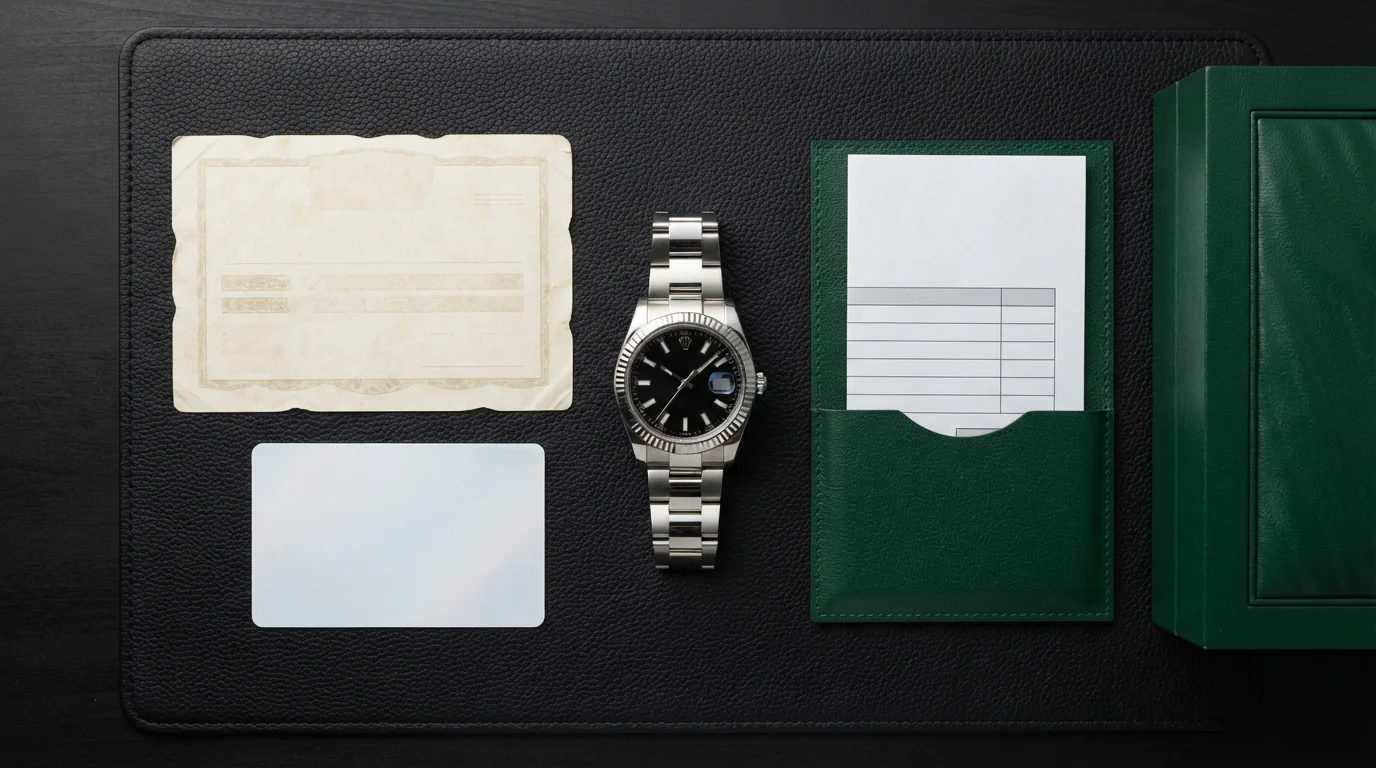
Rolex documentation may come from different moments in a watch’s life. Understanding the issuer and purpose of each card prevents a later service record from being mistaken for original-sale paperwork.
Original guarantee paper or card
Rolex states that a new watch purchased from an Official Rolex Jeweler carries a five-year international guarantee. The guarantee card is completed at the time of purchase. For a pre-owned watch, that document can support the watch’s original-sale context and identifying information within its scope.
It is not a current condition report. It does not establish that every component remains as first sold, that no later work occurred, or that the physical watch matches the document without further review.
Rolex Service Card
A Rolex Service Card relates to a complete service performed through Rolex’s authorized service network. Rolex says the card accompanies a two-year international service guarantee.
That is useful later-life evidence, but it is not the original retail guarantee card. Read any supporting service material carefully to understand what was examined or replaced and when the work occurred.
Rolex Certified Pre-Owned card and seal
The Rolex Certified Pre-Owned program is an official program offered through participating Official Rolex Retailers. An eligible watch sold through that program receives Rolex CPO documentation and a two-year international guarantee.
The Stellaris Collection is an independent dealer, not an Official Rolex Retailer and not a Rolex CPO participant. A dealer’s own authentication process or guarantee should never be described as Rolex CPO.
Box and Papers vs. Provenance
Papers are individual records. Provenance is the supported timeline that results when reliable records are connected to the same physical watch.
Consider a hypothetical Rolex sold with an original guarantee card, a later authorized service invoice, and current photographs. The card may support the original transaction. The invoice may document a service and a replacement crystal. The photographs show the watch in its present state. Together, they support more than any one item alone.
They still do not prove that nothing happened between those dated events. The honest account preserves both the supported facts and the gaps.
Useful provenance can include:
A family story or remembered purchase location may be a useful lead, but it is not documented provenance by itself. Likewise, a period-correct box does not become original to a watch merely because the dates appear plausible.
What Documents Can and Cannot Establish
A document is strongest when its issuer, date, purpose, and connection to the watch are clear. Check reference information and identifiers only where they are legitimately visible, and use qualified help for any internal inspection.
An original guarantee card may support the first sale. A service record may identify the provider, date, and work performed. A receipt may place the watch in a transaction. Each record should be described only within that scope.
Documents do not automatically establish:
Agreement between a record and the watch is encouraging, not conclusive in isolation. A plausible identifier can be copied. Documents can be altered or paired with a different watch. Conversely, a genuine watch can lose its original card during decades of ownership.
This is why documentation, authentication, originality, condition, and completeness must remain separate judgments. A genuine service replacement is not the same as a counterfeit component, but it may change an originality claim. A well-documented watch can still need service. A watch in excellent condition can have a short surviving paper trail.
Can You Buy a Rolex Without Papers?
Yes, but the missing record changes documentary certainty. It does not automatically make the Rolex counterfeit.
When original papers are absent, place more weight on the complete transaction:
1. Confirm the seller’s identity and accountability.
2. Establish the exact reference and represented configuration.
3. Review the physical watch and actual listing photographs.
4. Ask about known service, refinishing, and component changes.
5. Read the authentication process and any written guarantee carefully.
6. Confirm return, inspection, payment, and delivery terms before paying.
For the full watch-assessment task, use a dedicated guide to how to authenticate a Rolex. Papers are one evidence layer, not the complete procedure.
Box and papers can affect buyer demand and price, but there is no responsible universal premium. The effect changes with the reference, age, rarity, condition, actual completeness of the set, and current market. A sensible comparison uses the same reference in similar condition, with and without comparable documentation, at the same point in time.
Avoid investment promises and fixed percentage rules. A documented set can improve clarity and appeal, but it cannot control future demand or compensate for poor condition, questionable components, or weak transaction terms.
A Rolex Box-and-Papers Checklist Before Payment
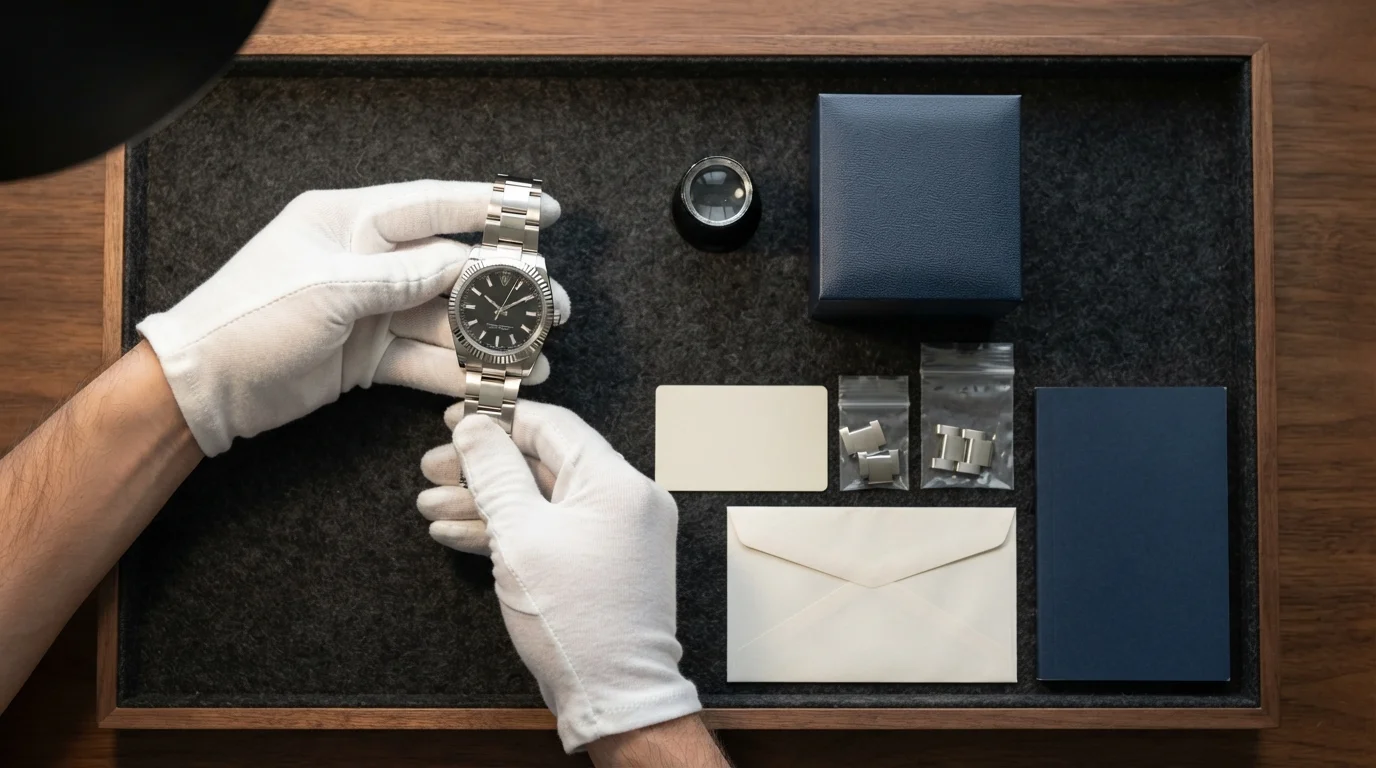
Before approving a purchase, ask for answers that are specific to the exact watch:
If any material claim remains unsupported, pause rather than allowing a box or card to resolve an unrelated doubt.
Save the itemized listing and document photographs because later changes should be compared with the version approved before payment.
How Stellaris Describes the Set You Are Buying
The Stellaris FAQ says listings use photographs of the actual watch, provide a Condition tab, and specify included items such as the box, warranty card, booklets, tags, straps, or links. It also says watches without box and papers may be considered in select cases, although complete sets are generally prioritized.
That listing-specific approach is more useful than assuming every pre-owned Rolex includes the same package. When reviewing the current Rolex collection, confirm the contents, condition, known history, and terms for the individual watch rather than relying on a general “full set” label.
If you are preparing a watch for sale, the separate guide to documents for selling a luxury watch addresses the seller’s task. This page remains focused on what a buyer should understand before payment.
What does box and papers mean for a Rolex?
It usually means the presentation box and accompanying materials, especially the original guarantee paper or card. Because included items vary, ask for an itemized list rather than assuming a universal package.
Can a Rolex be authentic without papers?
Yes. Missing papers reduce the available documentary history, but they do not decide authenticity by themselves. The seller, exact watch, condition, components, assessment process, and transaction terms still require review.
Do Rolex papers prove authenticity?
No single document should replace examination of the physical watch and verification of the seller. Papers can support specific facts such as an original sale or later service when they can be connected reliably to the watch.
What is the difference between a Rolex guarantee card and Service Card?
The original guarantee card relates to the watch’s initial retail sale and Rolex’s new-watch guarantee. A Rolex Service Card documents a later complete service through an authorized Rolex service channel and carries its own service guarantee.
