

Beyond the Three-Watch Collection: A Strategic Guide to Diversifying Your Watch Portfolio
The Stellaris Journal
Anyone who has genuinely managed money, not merely gambled it, understands a fundamental truth: a 1991 study, though ancient, starkly highlighted that asset allocation, not individual stock picks, accounted for 91% of a financial portfolio's success. It’s about smart distribution, not chasing "game-changer" hype.
This core lesson applies equally to watches. While timepieces don't yield dividends, the principle of strategic distribution is identical. Yet, so many collectors miss the mark. They possess an undeniable passion for watches, but often accumulate a box full of clones – a parade of tool watches, or an endless array of dress pieces. Same aesthetic, different logos.
The result is monotony and, worse, a chronic lack of utility for the myriad occasions life presents. You're perpetually either over-dressed or under-dressed. The popular "perfect three-watch collection" mantra is a start, perhaps a kindergarten primer, but it ultimately leaves you ill-equipped. This isn't about acquiring pieces haphazardly; it's about constructing a strategic, resilient portfolio.
We're talking about robust utility, enduring enjoyment, and genuine personal expression. A truly diversified watch portfolio transcends mere aesthetics; it mitigates collector fatigue and acts as an assembly of timepieces that truly reflects your evolving journey, not just fleeting trends. Ultimately, a well-curated watch collection is a strategic portfolio designed to meet every demand of your dynamic life.
The TL;DR: Quick Guide to a Balanced Watch Collection
Forget the endless scroll and endless debate. Building a truly robust watch collection isn't about chasing hype or ticking off arbitrary lists. It’s about intentional strategy, ensuring every piece serves a distinct purpose, reflects diverse origins, and offers unique aesthetics. Your goal is utility and genuine enjoyment across every facet of your life. Stop collecting watches and start curating a resilient, versatile portfolio that works as hard as you do.
Rethinking Diversification: Beyond a Financial Hedge
The term "diversification" typically conjures images of suited financial advisors droning on about stocks, advocating against concentrating all capital in a single volatile asset. In finance, it's about spreading risk, preventing a total collapse. Why then do we pretend this principle is any different for watches? It isn't.
The variables may change, but the core concept remains constant: building resilience. Not just against market fluctuations, but against your own evolving tastes, transient market hype, and the inherent chaos of life itself—including your lifestyle.
Most collectors misunderstand this. They perceive watch diversification as a mere checklist—a Reddit-endorsed "holy trinity" of a Speedmaster, a Santos, and a Submariner, all in black. This approach is lazy and formulaic, not intentional. While such pieces are undoubtedly excellent, functionally they exhibit significant overlap. Similarly, the trap of acquiring five dive watches in different colorways fails to achieve genuine diversification.
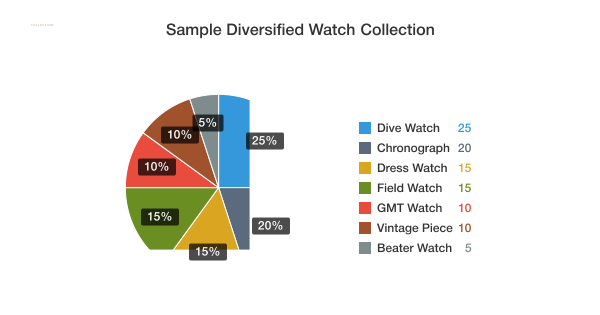
True, effective diversification demands a daily interrogation: "Do I possess the ideal watch for this exact moment?" You require timepieces equipped for any scenario: a robust beater for demanding tasks, an elegant dress watch for formal events, a GMT for international travel (or aspirational travel), a chronograph for its inherent cool factor, and a simple time-only piece for moments of tranquility.
The solution lies in curating a collection where pieces exhibit low "correlation" – not in a financial sense, but in style and function. Every watch you own must possess a distinct purpose, a unique role within the ecosystem of your collection. Your collection shouldn't just look diverse; it needs to be diverse enough to handle your entire crazy life.
Pillar 1: Diversifying by Function and Occasion
You acquire one watch, then another, and before long, your dresser drawer becomes a chaotic repository of metal and leather, with nothing truly suitable for your current activity. This scenario is all too common: a bulky diver paired with a suit, or a delicate dress piece enduring the rigors of a beach trip. These are rookie errors, and many of us (myself included) have made them. The solution is strategic variety—real variety.

Consider your watch collection not as a display case for trophies, but as a comprehensive toolbox. Each task requires the appropriate instrument. You wouldn't use a screwdriver to loosen a bolt, nor attempt to time a sprint with a minute repeater. Such misapplication is simply illogical. Historically, seasoned collectors understood this, advocating for a "three-watch model": a daily driver, a tool watch, and a dress watch. This simple, elegant framework typically covers most eventualities.
Your "Go Anywhere, Do Anything" piece is your daily wear. It’s the watch that consistently performs, effortlessly transitioning from a desk job to a casual dinner. Robust yet understated, it’s an indispensable foundation that many collections erroneously bypass, rushing straight to flashier acquisitions. This is a significant misstep.
Next, the tool watch category offers profound depth. "Tool" encompasses a broad spectrum. A dive watch, ideal for aquatic pursuits, often serves a purely aesthetic purpose in an office setting (indeed, Similarweb (2024) data confirms the popularity of these pieces among land-dwellers). Beyond divers, chronographs excel at timing everything from races to boiling eggs, while GMTs are perfect for navigating different time zones—or simply for the illusion of doing so. The essence here is utility. These watches are designed to perform a specific function. Too often, collectors acquire complex pieces whose pushers remain unpushed and bezels unturned, negating their very purpose.
Finally, the dress watch: compact, slender, and designed to glide seamlessly under a cuff. This is for life’s most significant occasions—weddings, crucial board meetings, or even a parole hearing. A dinner-plate-sized watch is entirely inappropriate for such moments. Acquiring one is not about ostentation, but about respect for the occasion and for oneself.
But there’s one more, the open secret among serious collectors: the beater watch. This is an inexpensive, indestructible piece, perhaps a G-Shock, designed to withstand abuse. For tasks like changing a tire or gardening, you don’t want to jeopardize your prized possessions. A dedicated beater offers liberation, a watch impervious to scratches or drops.
Possessing this functional variety eliminates those common missteps. You’re never "under-watched" nor "over-watched," and you extract maximum utility from every single piece. Your accumulation transforms from disparate individual watches into a cohesive, functional collection. And that's the whole damn point of buying more than one watch, isn't it?
Pillar 2: Diversifying by Brand Ethos and Origin
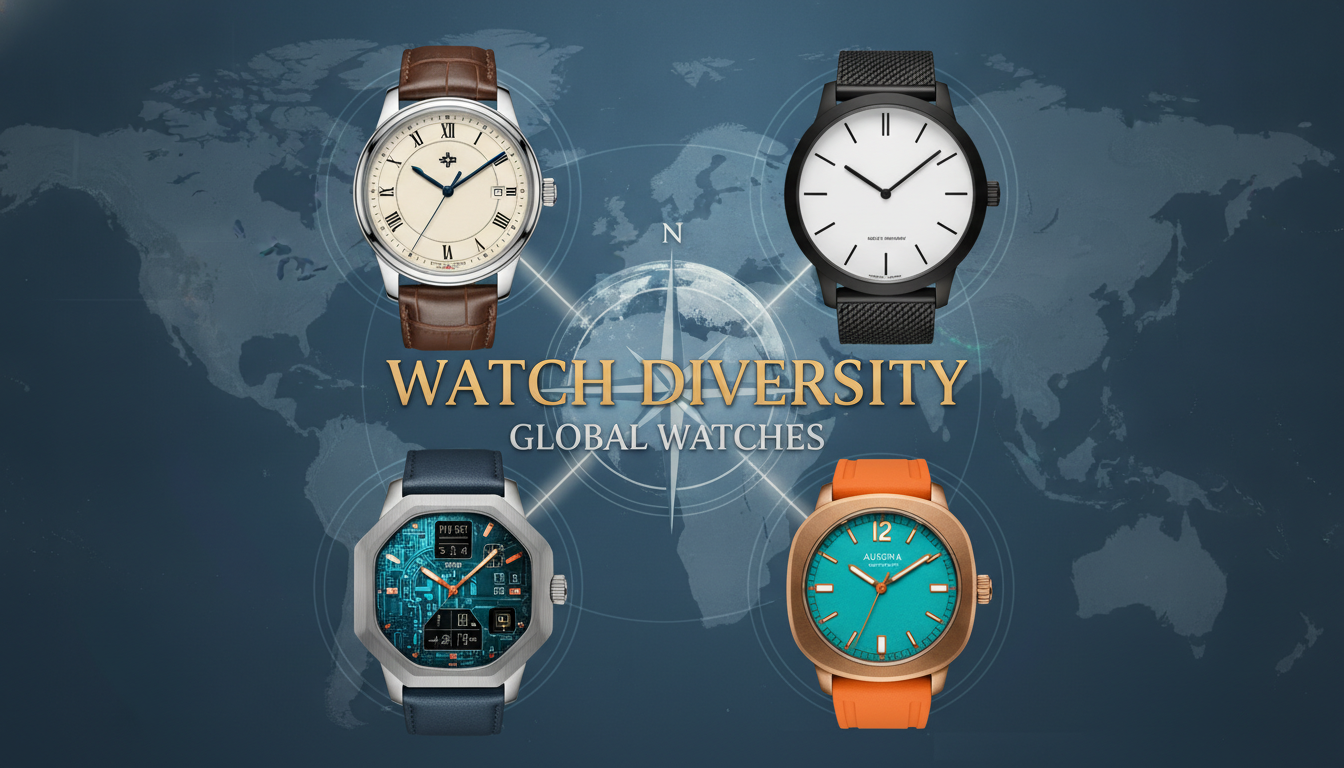
Collecting watches transcends mere acquisition; it demands a strategic plan. A robust plan means resisting the urge to simply mimic a friend's purchase or an influencer's latest Instagram post. That’s amateur hour, akin to eating the same meal daily until monotony sets in. Diversifying your collection by brand origin is like diversifying your palate, exposing you to the rich, idiosyncratic philosophies of global watchmaking, far beyond a singular "house style." The horological world is vast and full of unexpected delights.
Most collectors begin with Swiss brands, and rightly so. They represent the traditional standard of luxury, featuring iconic names like Omega and Rolex—brands recognized across generations. However, this very establishment can breed predictability. An Omega purchase often coincides with anticipation for the next James Bond film (Similarweb (2024) data, incidentally, confirms this audience crossover). While these are icons, they are not obscure finds. Swiss offers reliability, yes, but it's often just the starter pack. Don't stop there.
Then there are the Germans. They eschew overt ostentation in favor of rigorous engineering. Their ethos centers on legibility and a distinct, stark Bauhaus aesthetic, exemplified by brands like Nomos and Sinn). A Nomos, for instance, appears designed with the precision of a master architect: clean lines, absolute functionality, zero unnecessary flourish. Their focus is on the machine and its utility, not superficial display—a different, more profound kind of respect for craftsmanship. German watches are the anti-bling statement: pure substance.
Next, venture East to Japan, where innovation truly flourishes, often at an astonishing value. Japanese brands are renowned not only for exceptional affordability but also for groundbreaking technology. Grand Seiko's Spring Drive, for example, is a marvel of horological engineering. Beyond technical prowess, you’ll discover exquisite artisanal dial work, often at a fraction of Swiss prices. Even Casio exemplifies a relentless spirit of inventiveness, daring to push boundaries that others avoid, and making it work. Japanese watchmaking is a masterclass in innovation and value.
Finally, for the truly attentive collector, microbrands offer a vibrant, community-driven segment. These are not corporate giants but passion projects, often delivering unique designs and direct engagement with their creators. This connection and authenticity resonate deeply, much like the initial appeal of Tudor's Black Bay 58, which many saw as embodying Rolex's "past" before its mainstream ascent. Microbrands now occupy that space, typically at more accessible price points—a veritable goldmine for discerning enthusiasts.
Resist the urge to confine your collection to a single country or brand. You shortchange both yourself and your collection. While the landscape may seem chaotic, it’s a fertile ground for discovery. Explore beyond the familiar. To truly enrich your collection, you must look beyond familiar borders and embrace the distinct philosophies of global watchmaking.
Pillar 3: Diversifying by Aesthetics and Material
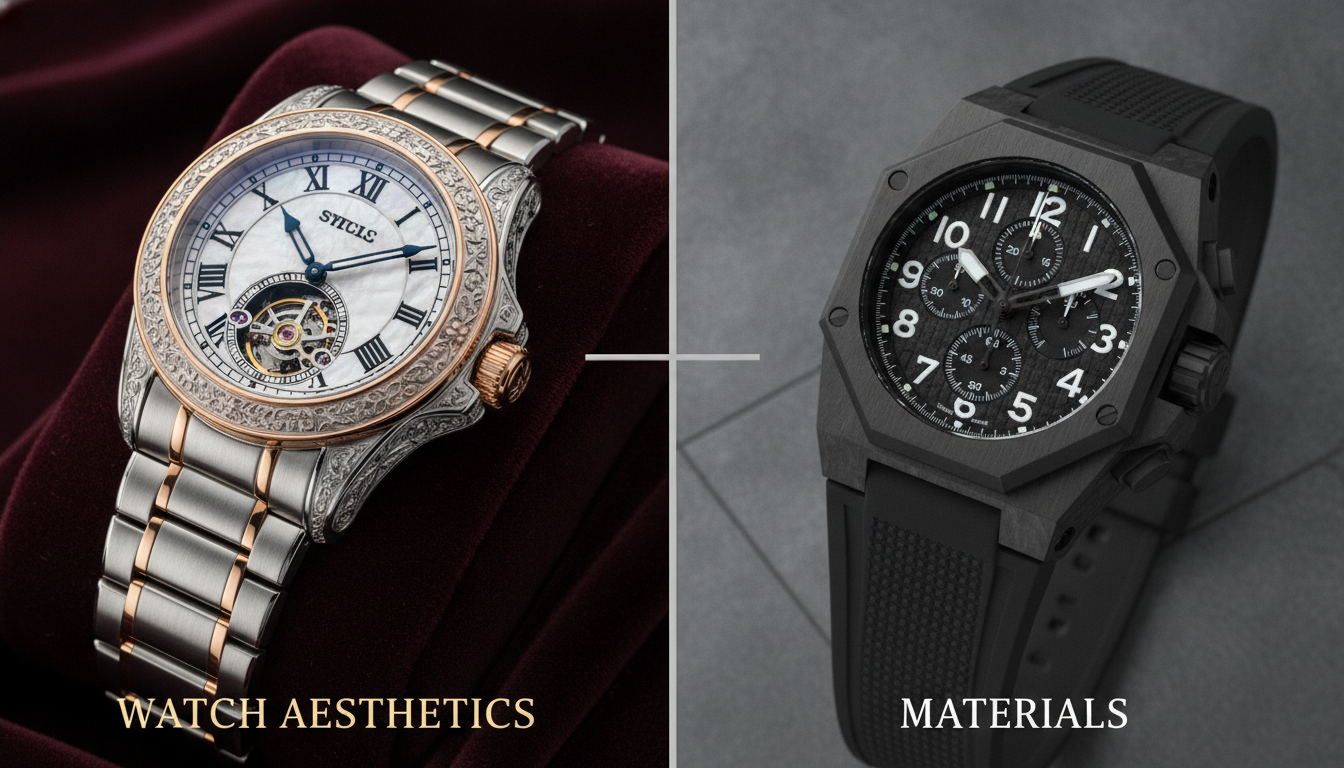
Beyond function and origin, the visual and tactile diversity of your collection speaks volumes. Imagine a wardrobe stocked solely with black suits; effective, perhaps, but devoid of personality or appropriate nuance for every social setting. The same principle applies to watches. To truly reflect your unique aesthetic and lifestyle, you must diversify by how a watch looks and feels.
Consider the interplay of case shapes. Round watches are ubiquitous, but a rectangular Cartier Tank or a tonneau-shaped Franck Muller instantly conveys a different sensibility. Each shape evokes a distinct era or design philosophy, adding depth to your wrist presence. Equally important is dial texture and color. A vibrant salmon dial or a finely granulated frosted finish offers a completely different visual experience than a standard black sunburst. These subtle variations are crucial for preventing visual monotony.
Material selection is another powerful lever for diversification. While stainless steel is the workhorse of most collections—durable, versatile, and relatively affordable—it’s just the starting point. Gold, whether yellow, rose, or white, instantly elevates a piece, signaling luxury and tradition. For a more modern, robust, and lightweight option, titanium is superb, often with a distinct matte finish. Bronze offers a unique, evolving patina that tells a story with wear, while ceramic provides extreme scratch resistance and a sleek, contemporary aesthetic. Each material carries its own weight, literally and figuratively, altering the watch's character and your experience of wearing it.
Ignoring these aesthetic and material dimensions means limiting your collection's expressive power. You might have a dive watch, a chrono, and a dress piece, but if they all look and feel too similar – all steel, all black dials, all round cases – you've missed a critical opportunity for genuine range and personal expression. True aesthetic diversification ensures your collection tells a multifaceted visual story, prepared for any style or mood.
Putting It All Together: Sample Diversified Portfolios
You can pore over market reports and analyze pie charts until exhaustion, but until you engage with actual watches—until you get hands-on—it remains mere abstraction. This isn't about esoteric stock portfolios; it’s about tangible steel, intricate gears, and what ultimately graces your wrist. Let’s explore real collections, built with intentionality.
The 'Emerging Collector' Trio
This stage marks the beginning for most. Operating without an exorbitant budget, the goal is to cultivate options and essential variety. Limiting oneself to a single brand or style inevitably leads to buyer’s remorse or, worse, profound boredom. While not high finance, the underlying principle holds: you require diverse capabilities in your arsenal.
- Your Daily Grind. A Seiko 5, in any iteration (SKX007, SRPE, or a newer Presage), embodies this. It's a Japanese workhorse, effortlessly performing daily duties and shrugging off minor knocks. An honest, reliable timepiece.
- The Beater. A G-Shock. Indestructible. Whether hiking, painting the garage, or inadvertently showering, it perseveres. Absolutely essential; every collection benefits from a dedicated "get-out-of-my-way" watch.
- Something for a Tie. For those less frequent but crucial formal occasions, consider a vintage Tissot or an Orient Bambino. These pieces offer classic, dressy aesthetics with either Swiss heritage or robust Japanese value, without straining the budget. They also serve as an excellent introduction to different movements and personal preferences.
- The Diver. A Tudor Black Bay 58 or a Pelagos. Tudor consistently delivers. It offers a robust Swiss pedigree, undeniable tool-watch credibility, and serves as an exceptional everyday timepiece.
- Your Everyday German. A Nomos Club Campus. Understated, meticulously clean, and engineered with distinct German precision. It provides a refreshing counterpoint to predominantly Swiss offerings and often sparks genuine conversation.
- A Chrono for History. A Hamilton Intra-Matic Chronograph or a well-chosen vintage Heuer. This selection connects you to the rich history of racing and embraces a compelling complication. These pieces offer significant pedigree, blending American spirit with Swiss mechanics.
- Dial Art. A Grand Seiko. This represents the pinnacle of Japanese high-end watchmaking, showcasing revolutionary Spring Drive technology and unparalleled finishing. It’s a piece of undeniable beauty that offers a distinct visual and experiential difference; the dials, in particular, are captivating.
- Iconic Design. A Cartier Tank or Santos. A square-cased watch immediately differentiates your collection. French design at its finest, these are iconic statements, not merely tool watches, and are essential for adding an element of classic, unexpected elegance.
- The Dress Watch. A Patek Philippe Calatrava or a Jaeger-LeCoultre Reverso. This is your serious dress piece: understated, supremely elegant, and imbued with pure class. Worn for the most important moments, it represents an investment in both aesthetics and legacy.
- The Go-Anywhere, Do-Anything. A Rolex GMT-Master II or a Submariner. This is the benchmark travel watch, the piece that signifies gravitas and purpose. Universally recognized and respected, it's a consistently reliable and strategic acquisition.
- German Haute Horlogerie. An A. Lange & Söhne 1815 or a Saxonia. German engineering elevated to high art. These pieces, with their hand-finished movements and intricate complications, stand in direct opposition to mass-produced Swiss luxury. They are exemplars of craft and artistry, demonstrating profound horological connoisseurship, far beyond mere ostentation.
- Audit your current rotation by strictly measuring utility; if a piece lacks a specific function, appropriate setting, or distinct aesthetic purpose in your daily life, it’s a prime candidate for liquidation.
- Look beyond the established blue-chip staples; genuine market resilience and character are often discovered in the fringes, among independent makers and historical outliers that offer superior value.
- Embrace material and design variety not merely for aesthetic pleasure, but as a calculated hedge against the inevitable evolution of your personal taste and the inherent volatility of broader market trends.
The 'Enthusiast's Core Five'
You’ve gained experience, honed your eye, and possess a more substantial budget, though still far from unrestrained. This phase is about establishing a formidable foundation, a judicious spread, because one never places all eggs in a single basket. Even Similarweb (2024) data confirms the fluid nature of market segments.
The 'Executive's Legacy Collection'
Now, the game changes. This tier transcends mere collecting, focusing on significance, enduring value, and perhaps even generational legacy. Certain pieces inherently maintain their standing. Consider it a higher-stakes portfolio—greater potential upside, greater inherent meaning—reflecting a refined appreciation.
This framework offers not theoretical financial models, but tangible watches and deliberate choices for building a collection that works. Because diversification isn't just for money. It's for watches too. Don't be a one-trick pony.
The Art of Rebalancing: Evolving Your Collection Over Time
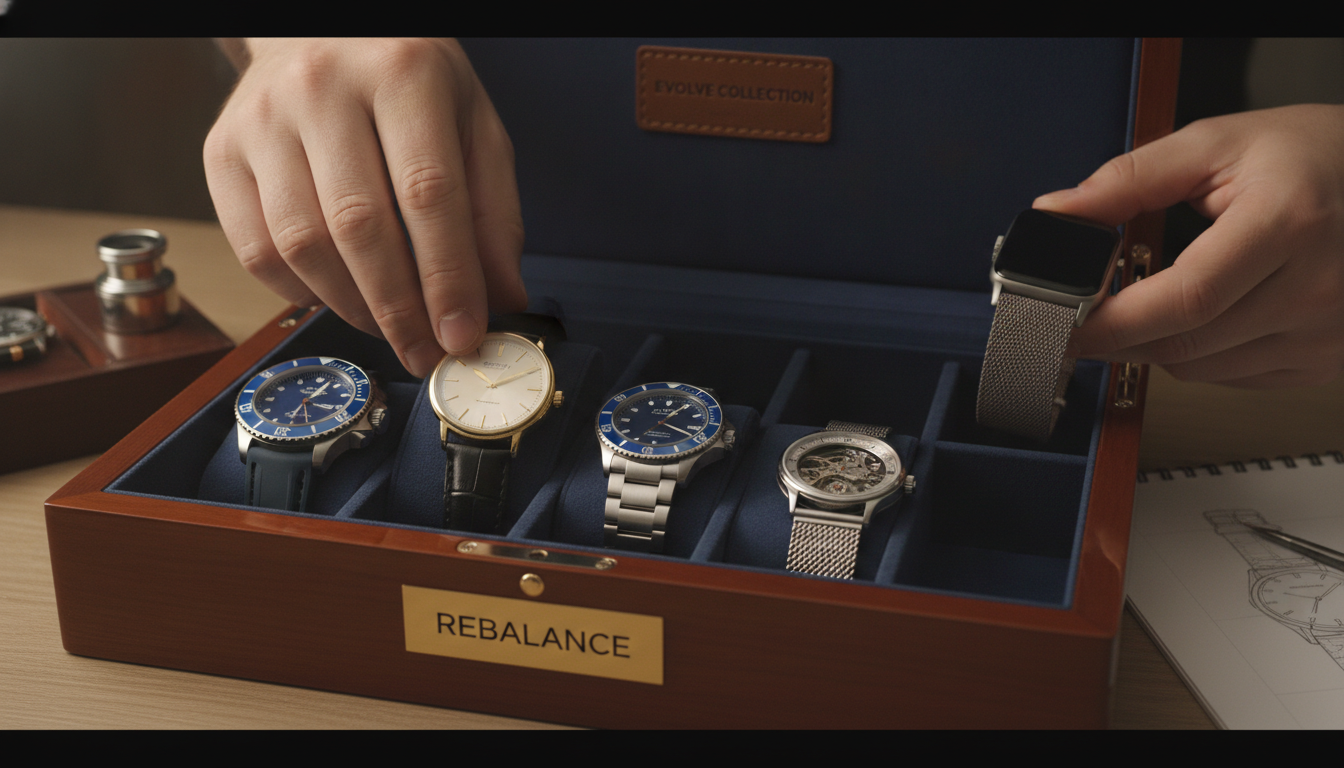
That 'grail' watch you once deemed indispensable? Chances are, it now gathers dust. This phenomenon is universal because tastes, preferences, and personal styles invariably evolve. Such shifts are an inherent, healthy part of the collector’s journey. Just as your interests from five years ago likely differ today, your collection should not remain static. It requires periodic invigoration—a real shake-up.
Engage in a critical audit of your possessions, moving beyond mere admiration. Ask yourself: 'Which of these beautiful pieces languish unworn?' Or, 'Why am I no longer reaching for this particular watch?' Identify the voids, the pieces you yearn for, and conversely, those that no longer spark joy. This brutal honesty is essential; otherwise, accumulation becomes mere clutter.
Here’s a crucial insight, something I learned the hard way: implement a 'one in, one out' policy. While challenging, this discipline forces intentional choices, keeping your collection focused and dynamic. This isn't solely about liquidating a piece to fund a new acquisition (though that is a viable strategy). It could involve trading with another collector or consolidating three seldom-worn watches into one truly exceptional piece. Even Similarweb (2024) data illustrates that savvy investors consistently adjust their positions; your watch collection, unequivocally a portfolio, should similarly evolve in tandem with your own development.
The initial honeymoon phase with any new watch inevitably concludes. That initial obsession fades, and months later, it simply exists in your box. Consequently, regular reassessment and rebalancing are vital, perhaps annually, mirroring professional financial practices. Observe the sales forums of any watch community: collectors are in constant motion, revitalizing their holdings. It is a living entity. While maintaining a rigid three-watch collection might prove unsustainable (I’ve certainly failed), the intent to curate actively is paramount. Keep your collection active, keep it exciting, or it just turns into a dusty pile of regrets.
Frequently Asked Questions
You undoubtedly have questions, and rightly so—this topic isn't straightforward. Let’s address some common misconceptions and pressing inquiries.
Over-Diversification: Is it even a thing?
Absolutely. It's a pervasive issue. Collectors often indiscriminately pursue every "shiny object," leading to an unwieldy and ultimately unfulfilling collection. This results in too many watches, each receiving insufficient wrist time. You might acquire five pieces, believing you're strategic, yet genuinely only connect with two. The remaining three languish, collecting dust and incurring insurance costs, largely unworn. Why retain them? Often, it's the misguided notion of "investment." This is a futile game; spreading yourself too thinly transforms a curated collection into a mere warehouse. Furthermore, market liquidity becomes a significant challenge when attempting to offload multiple obscure brands. Even Similarweb (2024) data indicates that fragmented, niche collections struggle to maintain value or sell efficiently compared to focused, high-quality holdings. Yes, over-diversification is a very real problem. Pick your battles, not every battle.
How many watches do you actually need?
In a literal sense, no one needs a luxury watch. However, if we're discussing a "collection" that resonates personally and serves a genuine purpose, there is no definitive magic number—be it one, three, or five. Your life, your preferences, and your specific needs are unique. Perhaps an exceptional dress watch paired with a robust diver perfectly suffices for you. Or perhaps a deep appreciation for a particular movement or brand leads you to acquire several variations. The true determinant is purpose and actual wear, not arbitrary pronouncements from online forums about "holy trinities" or other such fads. Disregard external dictates. Your wrist, your rules. Simple as that.
What's the deal with vintage pieces?
Ah, vintage. The allure of unearthing a hidden gem from the past is undeniable. Yet, for the uninitiated, this realm is a perilous minefield. Fakes are rampant, and "franken-watches"—assemblages of disparate parts—are commonplace. Locating legitimate service and authentic components for many older movements can be incredibly challenging, leading to exorbitant costs or, worse, an expensive, non-functional paperweight. While extraordinary "barn finds" do occur, they are akin to winning a lottery. You are statistically far more likely to experience disappointment. Unless you possess profound, in-depth knowledge or have a deeply trusted expert at your disposal, exercise extreme caution or avoid vintage acquisitions altogether. Don't buy the story. Buy the verifiable history.
Can diversification actually hurt value?
Absolutely. What is the benefit of owning six watches if only two genuinely appreciate or even retain their value? The remaining pieces effectively drag down the overall worth of your collection, tying up capital that could be deployed in more valuable, more liquid assets. Diversifying simply for the sake of diversification can result in a broader collection but a shallower pool of overall value. The objective isn't to thinly spread risk across every conceivable option, but to strategically concentrate on pieces with a proven track record or a clear future trajectory. Otherwise, you're merely hoarding, which is distinct from strategic diversification. Focus value, or you're just buying inventory.
The ubiquitous "perfect three-watch collection" is largely a marketing construct, designed to generate engagement rather than genuinely assist you in building a truly enjoyable and functional portfolio. Many collectors stagnate, pursuing a non-existent consensus, acquiring identical steel sports models, and then wondering why their watch box feels stagnant. Shift your focus from social media validation to optimizing for your life. A collection devoid of range is merely a pile of redundant assets.
True diversification requires the discipline to sell what you don’t wear. This is often the most challenging aspect, yet it is the sole path from being a passive consumer to becoming a deliberate, engaged collector.
You don't need another dive watch. You need a portfolio that works as diligently and intelligently as you do. If your current assembly feels bloated or misaligned, conduct a ruthless culling. Should you require an objective audit of your holdings or wish to strategically source a piece to bridge a functional gap, reach out to us at The Stellaris Collection. We manage the complexity, allowing you to maintain focus. Your watch collection is an extension of your life; ensure it's as dynamic, versatile, and purposeful as you are.
