

Watch Appraisal Guide: Understanding Value, Cost, and Profit Margins
The Stellaris Journal
$15 Rolex. You read that right. And no, I'm not talking about some flea-market knock-off or a sad, broken movement. I'm talking about what's really in that watch, at one specific point in its lifecycle. Most enthusiasts and collectors miss this crucial detail.
They see a price tag. A big one. But that number? It's not a single, immutable truth. It's a complex interplay of conflicting values: one for your insurance guy, another for an estate sale, and a whole different beast when you need to liquidate fast. Mastering which valuation applies when is your foundational lesson.
And then there's the 'profit' side of the coin. Gross. Operating. Net. Whether you're acquiring a timepiece as an investment, or even contemplating becoming a dealer (a path we strongly endorse), fluency in this financial vernacular is non-negotiable. Because the factory cost of that 'luxury' watch? It's often a mere fraction—a stark and often painful contrast—of what you see in the display case.
Forget the fluff. This isn't some 'journey into the heart of horology.' This is about cold, hard cash and knowing the true score. We're stripping down that watch price tag, exposing the margins, and showing you how to actually make smart moves in this market. For buyers. For sellers. No bullshit.
This guide is about cold, hard cash and knowing the true score.
TL;DR
Your watch's 'value' is a total mirage. Insurance value? High. But a quick sale for liquidation? Expect dirt cheap prices; it's far from simple. Experts like La Jolla Gem Appraisal understand this valuation maze.
Profit comes in three distinct types. Gross Margin is watch-only profit. Operating Margin adds costs like rent and salaries. Net Margin? What’s actually left after everything. Resources like BigTime.net and Accounting Stuff demystify this crucial financial math.
Factory cost for a fancy watch? Five to nine grand (Reddit confirms). Retail prices are often wildly inflated. R&D, brand, marketing—all contribute to the significant premium you pay; ultimately, you're buying a story.
You selling? Want more cash? Always aim to buy low. Price your watches based on market reality, not aspirational dreams. Adding verifiable value through independent appraisals and comprehensive service history significantly helps.
And you, buyer? For negotiation, ignore insurance valuation; it's practically useless. Instead, focus on the Fair Market Value (FMV)—that's your true leverage and the real, actionable number. The insurance value is merely for show (and potential claims).
It's a game. Play it smart.
Brief: Why a $15 Rolex Isn't Just a Myth
The idea of a "$15 Rolex" sounds like a joke, or perhaps the price of a component in a grey market knock-off. But the truth is far more intriguing, and it cuts straight to the heart of how we perceive value in the luxury watch market. At its most fundamental level, stripping away the branding, the marketing, and the retail markups, the intrinsic material cost of a Rolex can indeed be astonishingly low. Think about raw materials: a few ounces of steel, some sapphire crystal, and micro-components that, in isolation, cost pennies. The real magic, and the real cost, is in the engineering, the assembly, the precision, and, crucially, the brand legacy. However, when we talk about a $15 Rolex, we're considering its bare, unbranded, almost disassembled state, or perhaps its value during an extreme liquidation scenario where only scrap value remains. It's a provocative thought experiment that forces us to question the layers of perception built around a luxury item.
The true cost of a Rolex can be astonishingly low, depending on the specific point in its lifecycle you choose to measure.
What 'Worth' Really Means: The Four Pillars of Watch Valuation

In the opaque world of watch transactions, the term "worth" is anything but straightforward. It's a multi-faceted concept, shifting dramatically based on context and purpose. To truly navigate this market, whether as a buyer or seller, you must understand the four distinct pillars that define a watch's valuation, each serving a unique role and carrying different implications for your bottom line. These aren't just academic distinctions; they are critical tools for strategic decision-making.
First, there's Retail Replacement Value. This is the highest figure, typically what an insurance company would pay to replace your watch with a brand-new equivalent. It accounts for current retail prices, taxes, and sometimes even a premium for immediate availability. While comforting for policyholders, it's largely irrelevant for actual sales or negotiations. Second, Fair Market Value (FMV) represents what a willing buyer would pay a willing seller, neither under duress, in an open, competitive market. This is arguably the most practical valuation for genuine transactions, reflecting real-world supply and demand. Third, Wholesale Value is the price a dealer expects to pay for a watch, often significantly lower than FMV, as it accounts for their overheads and profit margins. Finally, Liquidation Value is the lowest tier, reflecting the price you'd get in a rapid, distress sale where speed trumps value. This is the "fire-sale" number, a stark reminder of what happens when you need cash now.
Understanding the distinct context behind each valuation pillar is crucial to navigating the watch market effectively.
Decoding Profit Margins: A Primer for Watch Professionals
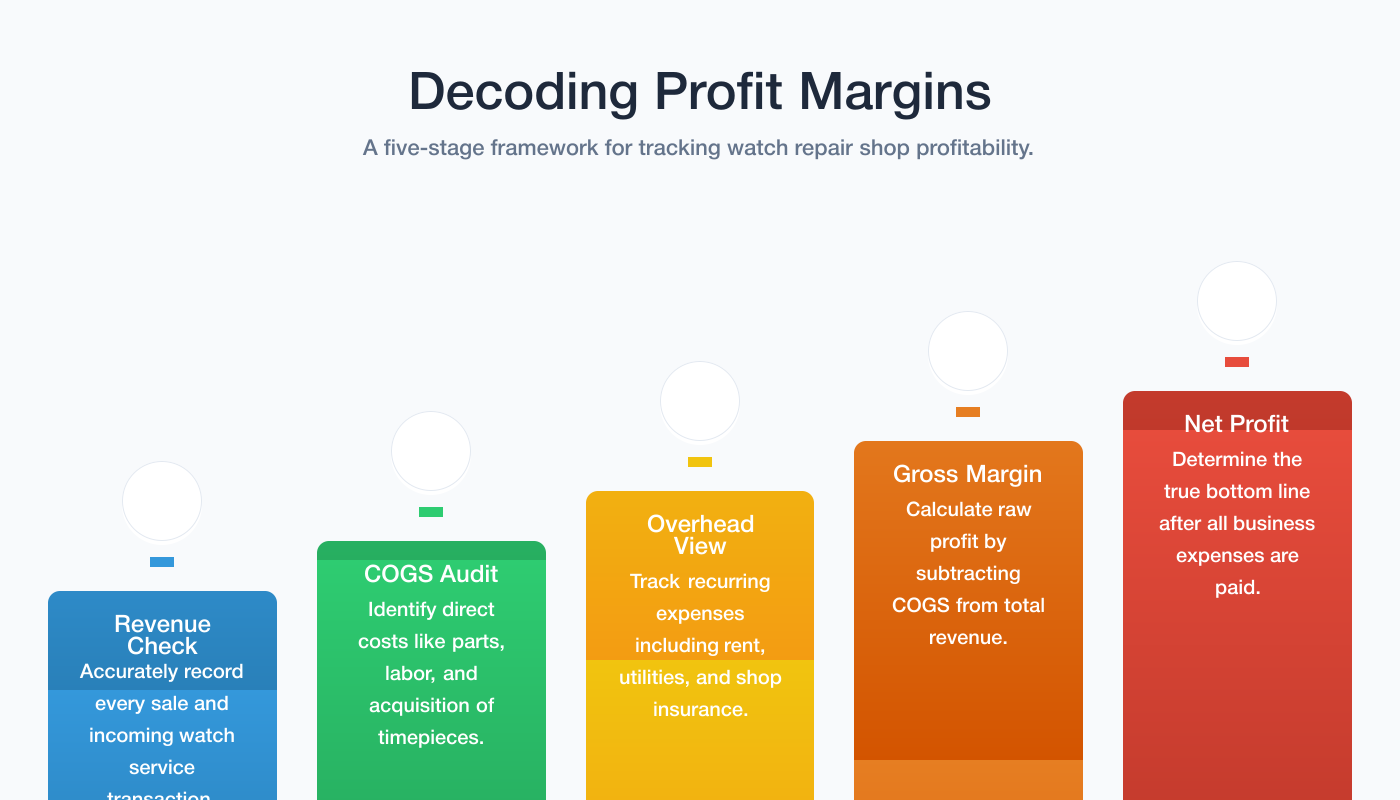
Forget the empty rhetoric of self-proclaimed gurus; margins are the true game. They represent your bread and butter, or, more critically, your potential lack thereof. You must comprehend precisely where your money is actually flowing, and more importantly, where it isn't.
The Real Talk on Margins
Look. Anyone operating (or aspiring to operate) a watch business freely discusses "profit." But what kind? There's more than one. And misunderstanding them is a direct route to rapid financial ruin, a topic often covered by resources like Investopedia. So, here's the lowdown. Straight. No fluff.
Gross Profit Margin: The First Cut
This is the simplest one: raw profit. It's just the cost of the watch itself. You buy a Daytona for seven grand. Sell it for ten. Your gross profit? Three grand. Simple arithmetic, right? And that's your (Revenue - Cost of Goods Sold) / Revenue. Generally Accepted Accounting Principles (GAAP) dissect this concept. So, for that Daytona, (10,000 - 7,000) / 10,000 = 30%. Thirty percent. Whether that's 'good' or 'bad' depends entirely on the specific timepiece and market. But it's just the start—your initial gauge for smart procurement and product viability.
But don't get too excited. Because that 30%? It must cover every other associated cost.
Operating Profit Margin: The Business Engine
Next up, we peel back the next financial layer. This margin tells you if your actual business operations are making money, before creditors and tax authorities claim their share. You take that gross profit—the three grand from the Daytona—and you then subtract all operational overheads. This includes rent, marketing expenditures (like that ineffective Instagram ad), salaries, utilities, and all those persistent overheads.
So, your gross profit minus operating expenses. Then divide that by revenue again. And that's your operating profit margin, also known as EBIT (Earnings Before Interest and Tax). As business publications like Forbes highlight, overlooking this component is a significant error. Because if your operating margin is in the gutter? Your business, the actual day-to-day grind, it's not working. You're bleeding cash. It signifies a critical, unsustainable operational flaw.
Net Profit Margin: The Bottom Line. Period.
This metric represents the unvarnished, absolute truth of your financial performance. After every single expense has been accounted for—interest on loans, taxes, and any other financial obligations—what's left? That's your net profit. It's your genuine take-home profit, or your verifiable loss.
And it's the most comprehensive measure for a reason. Because you can have a great gross margin. A decent operating margin. But then interest rates spike. Or taxes hit hard. And poof. All gone. It transparently reveals the true earnings (or losses) of the entire enterprise. Monitor this figure with unyielding vigilance, for it dictates the survival of your venture.
So, you sell that watch for $10k. Bought it for $7k. 30% gross. Maybe your operating costs eat up another $1.5k. You're left with $1.5k. And then taxes, interest... maybe another $500. You're down to a grand. A 10% net profit margin. Is this acceptable? Perhaps, but it’s entirely context-dependent. Yet, understanding the precise allocation of every dollar is the sole path to optimizing your financial health.
Here's the thing. To believe all "profit" is interchangeable is fundamentally misguided. You must differentiate between Gross, Operating, and Net margins. This isn't mere financial jargon. It's the diagnostic tool for assessing your business's true financial condition, and then, perhaps, making some astute strategic adjustments. Observe the perpetual confusion in online discussions, such as those on Vookum Instagram posts, where debates on profit per watch versus percentages invariably devolve when these foundational numbers are misunderstood.
Understand these margins, or watch your money disappear.
The Anatomy of a Luxury Watch Price Tag
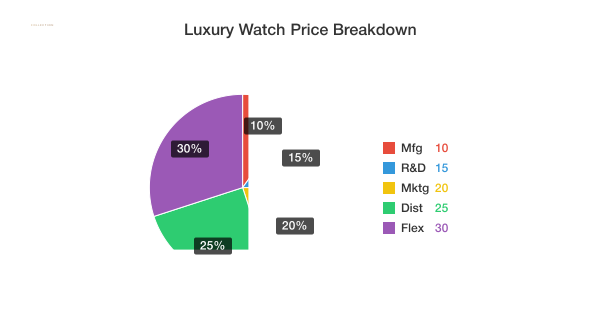
So, you're eyeing that steel sports watch, huh? The one everyone’s chasing. And you just checked the price. It's jaw-dropping, isn't it? Because you start thinking, "But it’s just steel. A bit of glass. A few gears." And that's precisely where you err, fundamentally. Because the actual cost of making that thing? The raw materials, the intricate movement components, the skilled artisan assembling it on a bench? These represent a minuscule fraction of the final cost.
I mean, look. Conversations on watchmaker forums and Reddit threads, featuring actual industry professionals, reveal that the true factory cost for a top-tier steel sports model—encompassing everything from raw components to skilled assembly labor—typically ranges between five and nine thousand dollars. This is for a timepiece that routinely retails for fifty, eighty, or even a hundred thousand dollars, a staggering disparity. Even publicly available data, like that from Similarweb (2024), underscores the profound skew in these figures. So, what accounts for the remainder of that exorbitant price tag? It's not solely profit, not in the way most consumers perceive it.
A significant portion, arguably the largest, is what we term the "flex tax," more formally known as "brand equity." It's the venerated name, the storied heritage, the compelling narratives spun around a founder's mythos or even a whimsical anecdote. That, fundamentally, is what you're truly acquiring. This entire phenomenon is a textbook example of a Veblen good. Consequently, demand paradoxically increases as the price escalates. Because it ceases to be merely about telling time, doesn't it? It transforms into a conspicuous declaration of one's ability to afford such a luxury—a powerful social signal, nothing more.
But there’s more to it than just the badge. These brands invest colossal sums—millions, sometimes even tens of millions—into Research & Development. Think about it: a new in-house movement, a genuinely fresh design? That’s years of engineering. Prototypes. Tooling. As one prominent watchmaker famously stated, developing an entirely new movement can readily consume two to five million euros. That's solely for the conceptualization and the sophisticated machinery required for its production. And who ultimately finances this? You do, through a cost amortized across every single watch they sell.
Beyond that, the pricing structure involves multiple intricate layers. The brand, naturally, takes a substantial primary cut. It then passes to a national distributor, who adds their own margin. Subsequently, the distributor sells it to your authorized dealer (AD), who must also account for their operational costs: rent, staff salaries, even those aesthetically pleasing espresso machines. With each entity claiming their share, the price relentlessly escalates. Furthermore, astronomical sums are allocated to marketing—billboards, celebrity ambassadors, and advertisements that convey little about the timepiece itself, but everything about cultivating a sense of importance.
So, the real cost? It’s a giant, complex, perfectly designed scam of perceived value, heritage storytelling, and a whole lot of people taking their cut. It's brilliant, really. For them.
What Is a 'Good' Profit Margin in the Watch Industry?
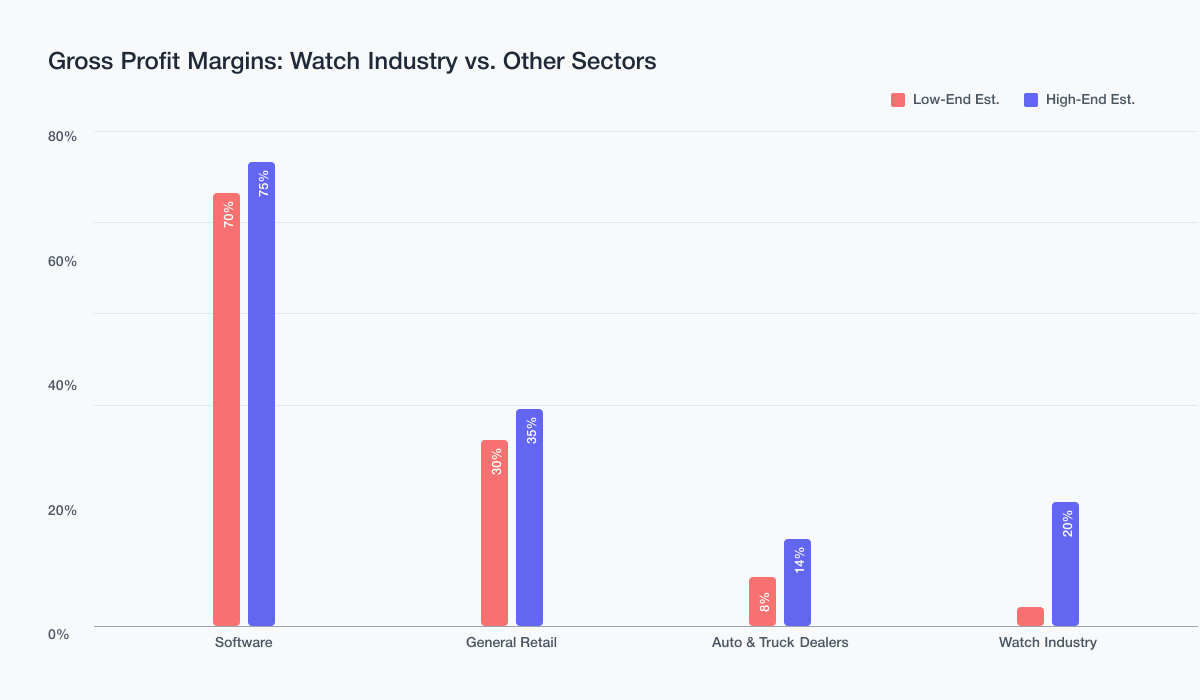
"Good" profit margin? That's akin to asking how long a piece of string is, or the number of truly honest politicians in a backroom deal. The honest truth? There isn't one. It's a dynamic and complex landscape, fluctuating wildly based on product type, sales channel, and target audience. Whether dealing with big brands, niche low-volume pieces, or the chaos of the gray market, the variables are endless.
Look, other industries? They operate by their own distinct rules. Software companies, they're printing money. NYU data, frequently cited across the retail industry, indicates they achieve gross margins nearing 72%. Seventy-two percent! Truly staggering. And general retail? Still command a respectable chunk, around 32%. However, auto and truck dealerships often hover at a meager 11%. It's an exceptionally brutal grind in that sector. So, where do luxury watches fit into this diverse financial ecosystem? (Don't hold your breath for an easy answer). It's certainly not the software industry, but it's also far from selling mass-market automobiles. Thus, the watch industry occupies a peculiar middle ground—a unique, often chaotic, beast of its own.
For brands like Rolex, forget those seemingly 'fat' percentages, precisely because demand is universal and supply, though controlled, is widely distributed among sellers. Online watch platforms are teeming with hundreds of dealers, all fiercely competing, a fact well-documented by trade journals. It's an undeniable bloodbath. Just observe the Vookum Instagram reels, where dealers vociferously lament the razor-thin margins. Sometimes, margins shrink to just a few percent, which is truly startling. As one astute user commented, "you don't make margins cuz your surrounded by 100 other dealers lol." They hit the nail on the head. However, consider this: a few percent on a $50,000 watch still translates into a substantial sum, does it not? (And trust us, it does). With astute sourcing, it's entirely possible to net five, even six thousand dollars on a single piece, particularly in the pre-owned market. Sourced correctly? Absolutely. That's precisely where the real profit lies—in the strategic hunt for inventory.
Consequently, your chosen business model fundamentally dictates your profitability. A gray market operator, moving watches by the truckload, might thrive on razor-thin margins, compensating with sheer volume. Conversely, a vintage specialist, meticulously curating rare pieces, might achieve massive margins per watch, but with significantly lower sales volume—a distinctly different, and often challenging, game.
A "good" margin in this intricate watch market isn't about hitting some arbitrary magic number; it's about making your unique business model consistently profitable and sustainable.
Five Strategies to Maximize Your Margin as a Seller

Selling luxury watches profitably requires more than just listing an item; it demands strategic thinking and a keen understanding of market dynamics. To truly maximize your margins, you need to go beyond surface-level tactics and implement robust strategies that add tangible value and reduce hidden costs.
1. Master Strategic Sourcing: Your profit is made when you buy, not when you sell. Focus on acquiring watches below market value through distress sales, private estate liquidations, or building robust dealer networks. The deeper your discount at acquisition, the larger your potential margin. Research market trends relentlessly to identify undervalued references or emerging demand.
2. Add Verifiable Value: Don't just flip; enhance. Invest in professional authentication, a full service history, or even a basic polishing by a reputable watchmaker (if appropriate for the piece). High-quality photography and compelling storytelling for each watch can also significantly elevate perceived value. A third-party appraisal from a trusted expert lends immense credibility and justifies a higher asking price.
3. Specialize and Differentiate: The broader market is a crowded race to the bottom. Carve out a niche. Become an expert in a specific brand, era (e.g., neo-vintage), or type of complication. This allows you to command premium prices due to your specialized knowledge and curated inventory, appealing to dedicated collectors willing to pay for expertise and exclusivity.
4. Optimize Operational Efficiency: Every dollar saved on overhead is a dollar added to your net profit. Run a lean operation by minimizing unnecessary expenses like excessive office space or extravagant marketing campaigns that don't yield direct results. Leverage online platforms efficiently, automate administrative tasks where possible, and streamline your shipping and handling processes to reduce costs per transaction.
5. Build Trust and Reputation: In a market rife with fakes and questionable practices, trust is your most valuable currency. Offer transparent descriptions, clear return policies, and excellent customer service. Positive reviews and word-of-mouth referrals will allow you to attract repeat buyers and justify premium pricing, as customers are willing to pay more for peace of mind and a guarantee of authenticity and reliability, a principle we uphold at The Stellaris Collection.
Maximizing your selling margin in the watch industry hinges on strategic sourcing, value addition, and precise market positioning, rather than just chasing hype.
Alright, congratulations, you've reached the critical understanding. You now grasp that "value" is an inherently fluid concept. It shifts dramatically, contingent on the interrogator and their underlying motivation. Seeking retail replacement value? That's primarily for insurance purposes. Fair Market Value? That's what a shrewd buyer will realistically pay in the open market. Liquidation value? That's fire-sale territory, a distinctly different metric entirely. Not the same thing. Ever.
Therefore, these core tenets must remain with you:
- Your timepiece possesses multiple conceptual price tags. What an insurer pays for replacement is fundamentally different from what an astute buyer will offer. Disregard this distinction at your financial peril.
The chasm between factory production cost and retail price is often immense. You are primarily paying for the brand's mystique, extensive marketing, and the compelling story* it weaves, not merely for steel and gears. (This is where the true profit margin resides, at least for the brand itself.)
Gross profit can be deceptively inflated. Operating profit accounts for crucial overheads like rent, staff wages, and even office supplies. Net profit represents the actual capital remaining after all* expenses. Only the net margin reveals the complete financial narrative.
The vast majority consistently fixate on the incorrect financial metrics. They become fixated on MSRP or anecdotal valuations from acquaintances. This approach guarantees either financial loss or significant missed opportunities.
The market doesn't care about your sentiment; it cares about data and demand.
This isn't an emotional endeavor. It's a relentless pursuit of hard, cold, market-driven numbers. Your immediate next step? Cease all speculation. Acquire actionable market intelligence. Seek an independent valuation from a professional whose incentives are not aligned with either lowballing you or artificially inflating numbers for a transaction. Locate a truly independent expert. Or, for significant assets, engage a trusted intermediary like The Stellaris Collection, who offers transparent, authenticated insights and stands by their rigorous process. This is the definitive method for safeguarding your capital and maximizing your returns.
