

Investing in Jewelry: A Guide to Materials and Brands That Hold Value
The Stellaris Journal
Let's be blunt: most of what's sold as 'investment jewelry' is a terrible financial sinkhole. You're buying air, mostly
– marketing fluff and craftsmanship costs that evaporate the moment you try to resell. On the secondary market, they don't give a damn about your 'story,' just the raw value.
Now, I know what you've heard. That Van Cleef & Arpels Alhambra necklace, for instance, can pull 113% of its retail price. Yes, it happens. But that’s the exception, not the rule (and a damn rare one at that).
This isn't some fantasy guide to pretty baubles. It's about building wearable assets. We'll cut through the hype to identify the specific materials, the few brands, and the iconic pieces that consistently hold
– or even increase
– their value over time. So you can invest wisely. Period.
Why Most Jewelry Is a Bad Investment (And Which Pieces Defy the Odds)
Stepping into most jewelry stores, you might believe you're securing an investment. Think again. That dazzling piece you just splurged on? It’s likely to shed half its value the moment it leaves the counter. A significant portion of your purchase price funnels into elaborate designs, brand prestige, and exorbitant marketing budgets
– not the intrinsic value of the materials. And the profit margins? They’re staggering.
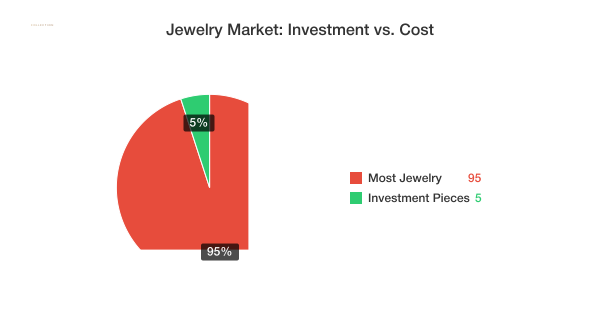
Yet, within this sprawling market, a minuscule segment of jewelry defies the norm, consistently holding
– and sometimes exceeding
– its original value. This exclusive club comprises a select few iconic pieces from a handful of elite brands. These outliers operate on a different plane, commanding a robust secondary market eager for what they offer.
Indeed, the broader jewelry market is expanding, with Knight Frank (2024) reporting a 6% increase. However, this growth isn't driven by everyday purchases; it's fueled by these high-value, highly sought-after segments. Consider a Van Cleef & Arpels Alhambra necklace, capable of reselling for an astonishing 113% of its original price, or Cartier’s Juste Un Clou bracelet at 106%. We're clearly not discussing a basic solitaire. The formula for investment-grade jewelry is clear: undeniable brand reputation, timeless design, pure materials, and consistent demand in the resale market. Most jewelry is a pure expense, but a select few pieces genuinely function as appreciating assets.
Understanding Jewelry Value: Intrinsic Worth vs. Brand Power
When you purchase jewelry, what exactly are you paying for? There's the inherent value of its materials, and then there's the prestige of its creator. These are two distinct conversations, one potentially saving you money, the other almost certainly costing you.
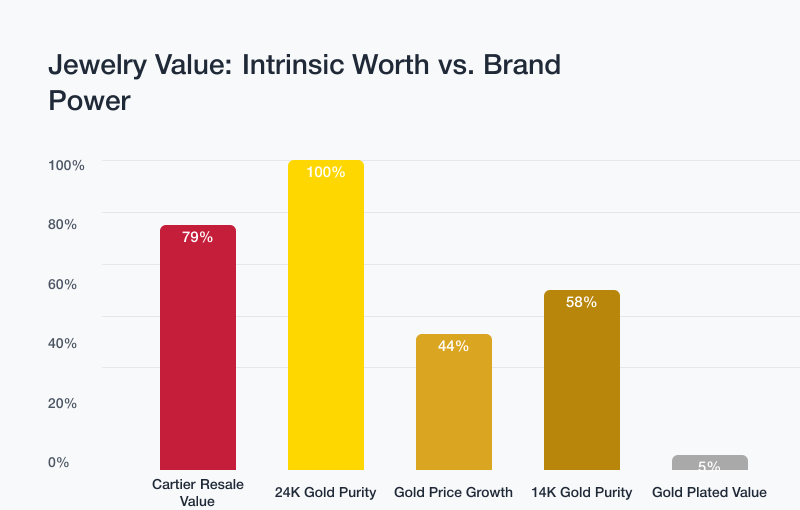
The intrinsic worth of pure precious metal is straightforward: it’s determined by purity (karats) and weight. 24k gold, for instance, is nearly 100% pure bullion, its value fluctuating directly with market trends. Notably, gold has surged by 43.73% over the past decade. In contrast, 14k gold, at a mere 58.3% purity, contains a substantial proportion of other alloys, yet buyers still often pay a significant premium. For what?
Then there's the formidable force of brand power. Consider Cartier: they're not merely selling you metal; they're selling you Cartier
—its legendary name, its rich heritage, its meticulously controlled supply chain. This potent combination allows them to consistently escalate prices year after year, a strategy that remarkably works. Rebag's Clair report reveals Cartier pieces retain an average of 79% of their value at resale. This brand equity, this powerful name, defies conventional market rules, almost cultivating a cult following. However, a quick tip-off to avoid: if a piece is stamped 'GP,' it signifies gold-plated. This denotes a super-thin, cheap layer with negligible intrinsic value. Steer clear. Genuine jewelry value is a precise fusion of quantifiable material purity and the irresistible allure of an elite brand.
The A-List: Why Cartier and Van Cleef & Arpels Dominate
So, you're looking to invest in jewelry that genuinely appreciates, or at minimum, retains its worth? Here's the unfiltered truth: your options are remarkably limited
—essentially two, maybe two and a half if you're fortunate. When it comes to pieces that consistently hold or increase in value, the list begins and ends with Cartier and Van Cleef & Arpels. Anyone suggesting otherwise is likely peddling a fantasy or entirely misinformed about the market.
Why these two? Their empires are built on icons, not just jewelry. Consider Cartier’s ‘Love’ bracelet or the ‘Juste Un Clou’. Instant recognition upon sight; that immediate identification transcends the material value. The same holds for VCA’s ‘Alhambra’ collection, with its distinct, unmistakable clover motifs. These pieces are perpetually coveted, and with demand consistently high and supply rigorously controlled, prices remain elevated and continue to climb.
Here's their secret weapon, a feat few brands can replicate: the strategic, annual escalation of retail prices. It’s a brutal yet brilliant tactic: the piece you acquired last year gains value, buoyed by the newly inflated prices on current shelves. The secondary market responds in kind, a dynamic that consistently works. A VCA Alhambra necklace, for instance, can command 113% of its original value. Cartier’s ‘Love’ bracelets typically retain 85-96% of their worth, while the 'Juste Un Clou' bracelet often reaches 106%. These figures are unequivocal.
But here's an insider tip for the Alhambra line: the five-motif bracelet often outperforms larger pieces in value retention. This is due to a lower per-motif cost, making it a more accessible entry point, thus easier to acquire and resell
—essentially, more liquid. It’s a nuanced detail, but critically important in the resale market. Cartier and VCA, specifically their iconic pieces, represent your only reliable path to investment-grade jewelry; anything else is simply a high-stakes gamble.
The Truth About Diamonds: When Are They an Investment?
Disregard the glossy advertisements. Most diamonds are unequivocally not an investment, especially not for the average consumer. This is a difficult truth to accept, particularly if you've purchased a diamond with the expectation of value retention. The 'Diamond Rule' is harsh: diamond-set pieces almost invariably incur greater losses on resale compared to their plain metal counterparts. The retail markup is exorbitant; you're paying for the sparkle, yes, but primarily for the narrative, the pervasive marketing, and an absurdly inflated margin.

Branded rings from houses like Tiffany (now under LVMH) or Harry Winston carry a premium overwhelmingly dictated by the brand name itself. A substantial portion of the price tag is pure brand equity, which largely evaporates upon leaving the store. On the resale market, Harry Winston engagement rings face significant depreciation. Consider the pavé Cartier Love bracelet, retailing at nearly $50,000 ($49,800, to be precise). Attempt to resell it, and you’d be fortunate to recoup $30,000
—a devastating loss. This is a harsh reality for many.
However, certain diamonds can indeed be a genuine investment. We're talking about rare stones: flawless, with exceptional color and significant size. These are not found at your typical mall jeweler (a place to avoid for investment pieces). Their value, while still factoring in the 4Cs (standardized by De Beers), is profoundly influenced by provenance
—its history, origin, and previous ownership. Such diamonds are acquired from specialized dealers or high-end auction houses, not in a charming blue box. If you’re making a smart diamond purchase, seek out a dedicated stone jeweler, not a luxury brand primarily selling an experience.
For most individuals, a diamond serves as a sentimental, emotional purchase, and there's absolutely nothing wrong with that. But do not delude yourself into believing it’s a financial asset, because it is not
—unless you operate in an entirely different investment sphere. Most diamonds are purchased for sentiment, not as a financial asset. True investment-grade diamonds are a rarity, defined by exceptional quality and expert trade, not the typical retail offering.
Beyond the Top Tier: Other Brands with Investment Potential
Having covered the undisputed titans of investment jewelry, let's explore other brands that occasionally perform, though without the consistent certainty of the top tier. Here, extreme selectivity is paramount.
First, Tiffany & Co.. Their investment appeal has seen a notable uptick since their acquisition by LVMH. However, discernment is crucial; focus exclusively on their iconic pieces. The Elsa Peretti Bone Cuff, for example, has demonstrated actual value appreciation, averaging 102% of its retail price according to Similarweb (2024)
—a remarkable feat. The more contemporary Lock and HardWear collections are also worth monitoring. Any generic Tiffany necklace, however, is unlikely to yield similar returns.
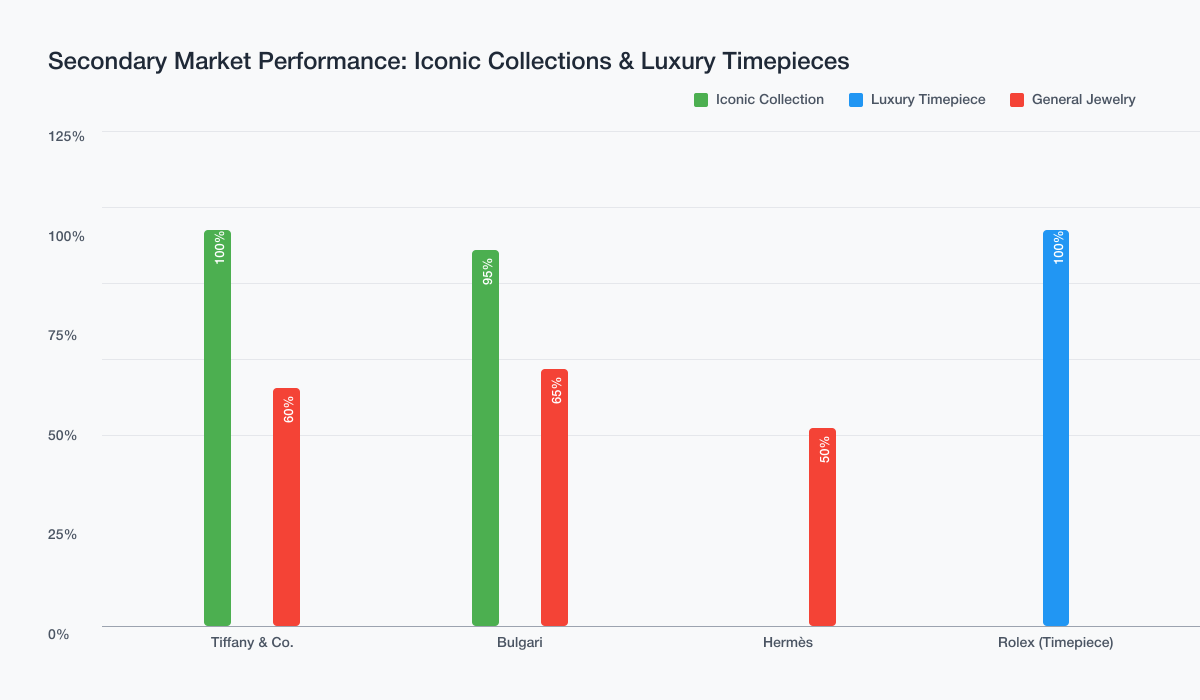
Next, Bulgari. The directive is simple: if you're considering Bulgari for investment, target the Serpenti collection
—and only the Serpenti. Its unique design, rich history, and instant recognizability ensure strong value retention. Other Bulgari pieces, however, typically do not share this advantage. Focus, or risk squandering your investment.
Then there's Hermès. Their fine jewelry performs exceptionally poorly on the resale market, often incurring losses exceeding 50%. The crucial insight here is that the true 'investment' with Hermès isn't in their jewelry; it's in engaging with their ecosystem. The jewelry serves as a strategic purchase to gain eligibility for a coveted quota bag, which is an asset. It’s a cleverly placed carrot, not a direct financial return on the jewelry itself. A peculiar dynamic, but a fundamental aspect of their strategy.
Finally, Rolex. While a timepiece, its frequent discussion within the luxury accessory market warrants its inclusion. And candidly? It stands as the highest performer on the secondary market, averaging 113% of its value, as confirmed by Similarweb (2024) data. This means you can acquire a Rolex, enjoy wearing it, and potentially profit. Remarkable, but true. When venturing beyond the absolute elite, a surgical approach is essential. Iconic collections such as Tiffany’s Bone Cuff or Bulgari’s Serpenti offer potential, but precise knowledge is critical; Rolex, however, remains the undisputed king of wearable assets.
Investment Traps: The Jewelry That Loses the Most Value
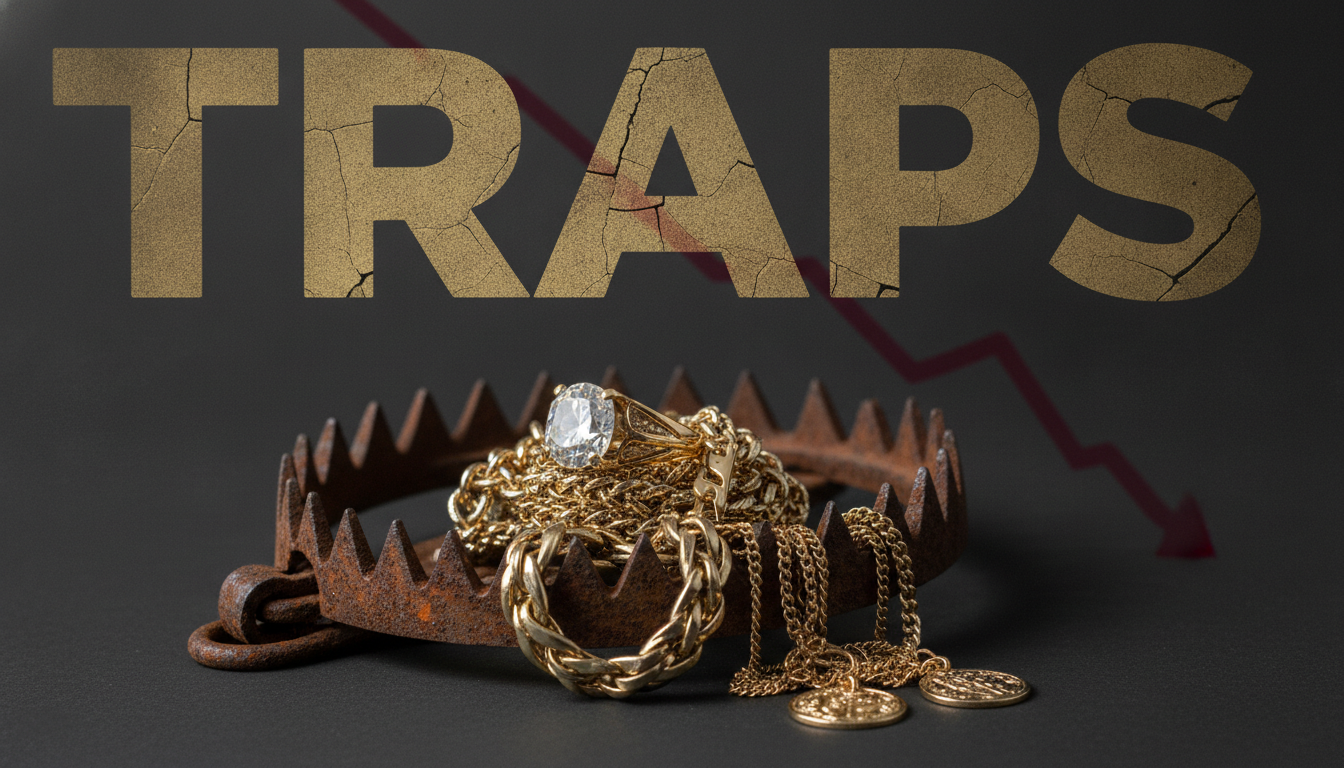
Pay close attention: this is where most individuals make significant financial missteps. If you wish to avoid substantial losses, these are the critical traps to recognize.
Firstly, disregard all fashion-centric brands like Gucci or David Yurman. While aesthetically appealing, their investment potential is abysmal. Resale values frequently plummet to 40-48% of retail price, according to Similarweb (2024)
—nearly half your capital, vanished. Their designs are driven by fleeting trends, and trends inevitably fade, often rapidly.
Next, the 'Price Rule,' which can be particularly painful. Counter-intuitively, a higher retail price rarely correlates with better value retention. In fact, it often means a greater absolute dollar loss on resale. The buyer pool for ultra-expensive pieces is minuscule, compelling sellers to drastically reduce prices to secure a buyer. It's a perverse but fundamental market dynamic.
Material quality is another critical, yet frequently overlooked, factor. Gold-plated or vermeil items possess negligible intrinsic value
—practically none. Under no circumstances should these be considered investments. They are fashion accessories: attractive, perhaps, but devoid of asset value.
Finally, the 'Category Rule.' Rings and other size-specific items are significantly more challenging to resell, as they require a precise fit for the buyer. Conversely, one-size-fits-all items like necklaces or earrings attract a broader pool of potential buyers, increasing your chances of recouping value. Rings often present a resale hurdle, and buyers prefer convenience. Avoid trend-driven purchases, steer clear of plated items, and never assume a high price tag guarantees a strong return. Jewelry defined by fleeting trends, cheap materials, or restrictive sizing represents an almost guaranteed financial misstep.
Beyond the glossy advertisements and 'forever' promises lies a stark truth: most jewelry is a retail markup trap. Here, we've meticulously cut through the hype, illuminating precisely which select pieces might, against the odds, transcend their sentimental value to become genuine assets. It is, and always has been, a game of precision.
The unequivocal takeaway? The brutal truth is this:
- That 'special' piece catching your eye? The odds are overwhelmingly high it's a depreciating asset, immediately. The market shows little regard for 'craftsmanship' unless it directly translates into sustained demand.
- A select handful of brands
- Diamonds are, for the most part, a sentimental purchase. Unless it's an exceptional stone meeting specific benchmarks for size, quality, and often verifiable provenance, avoid the term 'investment'; it will simply reveal naivete.
—Cartier, Van Cleef & Arpels
—do defy this trend. However, even within these marques, only their truly iconic, collector-coveted designs hold or gain value, not every item bearing their name.
This isn't about blind passion; it's about intelligent capital allocation
—recognizing a genuine asset and discerningly overlooking the rest.
Final thought: Enjoy your possessions. But to conflate what you love with what genuinely holds market value? That is a mistake one rarely makes twice.
Your next step: Eliminate guesswork. Before committing significant capital, or if contemplating a sale, secure an unbiased, expert valuation. A clear, transparent assessment of your current or prospective assets changes everything, swiftly providing clarity.
