

Beyond the Ticker: Unmasking the Myths of Secondary Market Pricing
The Stellaris Journal
John Bogle, the legendary founder of Vanguard, famously estimated that a staggering 99.2% of stock market activity is pure speculation. Let that sink in for a moment.
Many investors operate under the assumption that buying a share directly injects capital into a company, like your Apple stock purchase funding the next iPhone. This, however, is a pervasive and dangerous myth, an oversimplification that obscures the true mechanics of the market.
The ticker price you see often bears little resemblance to true value, and the idea that your trade directly fuels corporate innovation is fundamentally misguided. The entire market infrastructure is a complex, often opaque beast, riddled with deeply ingrained, flawed assumptions.
This isn't about the latest "game-changing" technology. This is about revealing the foundational structures that actually govern financial markets. We're about to pull back the curtain on how secondary markets really function, dismantle common myths surrounding private equity assets (spoiler: they're not always stellar investments), scrutinize the impact of massive ETFs (are they disruptive forces or simply the new normal?), and expose the internalizers —the hidden entities that price the vast majority of your retail trades.
Understanding this intricate ecosystem, far beyond the superficial ticker, is absolutely essential. It's the only way to truly navigate today's markets effectively and protect yourself from the pitfalls of misinformation and flawed conventional wisdom.
The financial markets are far more complex and speculative than common wisdom suggests, operating on assumptions that often mislead individual investors.
Brief and TL;DR
Think your stock purchase directly funds a company's innovation? You're mistaken. The reality is, most of that money simply moves from one investor's pocket to another's, bypassing the company itself. John Bogle famously stated that 99.2% of equity market activity is pure speculation, not capital formation, and he wasn't wrong.
Private equity secondaries are not mere "cast-offs." This dismissal reflects lazy or uninformed thinking. Sellers pursue liquidity for a myriad of legitimate reasons, as documented by firms like Hamilton Lane. This is a mature market, exhibiting lower return dispersion than the average PE strategy, suggesting a more predictable, less volatile investment landscape.
ETFs are not market wrecking balls; quite the opposite. They actively enhance market liquidity, making the fear-mongering largely unfounded. Primary creation/redemption activity, the only part that directly touches underlying assets, is minuscule—a DWS report found it accounts for less than 3% of daily high-yield cash trading.
The true insight, however, lies in how your retail trading price is determined. It doesn't originate directly from an exchange. Instead, it comes from "internalizers" who promise a marginally better price than the publicly quoted one. These entities handle nearly all retail trading, approximately 29% of total share volume, as highlighted by a Columbia Law School paper. This system, however, is not without significant vulnerabilities; it can be exploited and gamed, as retail prices are often disconnected from pure supply and demand dynamics.
Because simple narratives? They'll get you burned.
Why Buying Apple Stock Doesn't Fund the Next iPhone
Do you envision your small Robinhood purchase as a direct contribution to Apple's next groundbreaking device? The harsh truth is, you're not. Not even remotely.
The vast majority of stock trading occurs in secondary markets. What does that mean, exactly? It means you're simply transferring money to another investor, not to Apple itself. You are not contributing a single dime to Apple's R&D budget. Consider it akin to buying a used car: the original manufacturer has already received their funds; you're merely compensating the previous owner.
Companies do raise fresh capital for operations or R&D, but this typically happens through an Initial Public Offering (IPO) or new stock issuances. These events are rare, particularly for large, mature corporations. If a company has been publicly traded for decades, it's unlikely to be seeking new cash from individual stock purchases.
Apple serves as a prime illustration. Astonishingly, they haven’t issued new common stock since their 1980 IPO. Instead, they've spent hundreds of billions—yes, billions—repurchasing their own shares. This isn't capital formation; it's capital extraction, returning wealth to shareholders. From 2012-2023, Apple executed $627 billion in net-equity repurchases and paid out $146 billion in dividends. During the same period, their R&D expenditure amounted to roughly $180 billion. The money, clearly, isn't primarily flowing into the next iPhone's blueprint. Analysis from the Roosevelt Institute unequivocally debunks this widespread myth.
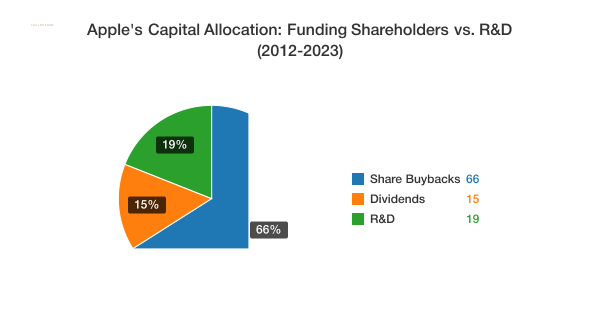
Therefore, the notion that your stock purchase directly aids a company is a fundamental conceptual error—a profound misunderstanding of market mechanics. It primarily provides liquidity for the seller, who receives cash while you acquire shares. The company, in essence, remains a passive observer. This entire system is predominantly a gigantic mechanism for shuffling existing wealth. As Adolf Berle observed decades ago, most genuine corporate investment stems from retained earnings, with new equity playing a minor role.
Because let’s be brutal: modern public secondary markets are about speculation and shareholder liquidity. Not corporate capital formation.
Debunking the Myths of Private Equity Secondaries
Let's address private equity secondaries head-on. Most individuals hold deeply flawed perceptions, swayed by conjecture and outdated narratives. It's time to reveal the unvarnished truth, which often contradicts common belief.
A secondary transaction is fundamentally straightforward: one investor (an LP) sells their existing stake in a private fund to another investor. It's not arcane financial wizardry, nor is it a fleeting phenomenon. This market has demonstrably matured and expanded significantly.
Myth 1: They’re "cast-offs." This is unequivocally false. Sellers seek liquidity for a multitude of strategic reasons, including portfolio rebalancing, regulatory compliance, or simply freeing up capital. It does not inherently imply asset underperformance. The quality spectrum of secondary assets is broad, and critically, secondary funds often exhibit lower return dispersion compared to other PE strategies. This points to more mature, predictable underlying assets, a fact extensively detailed in Hamilton Lane's "The Truth About Secondaries" report.
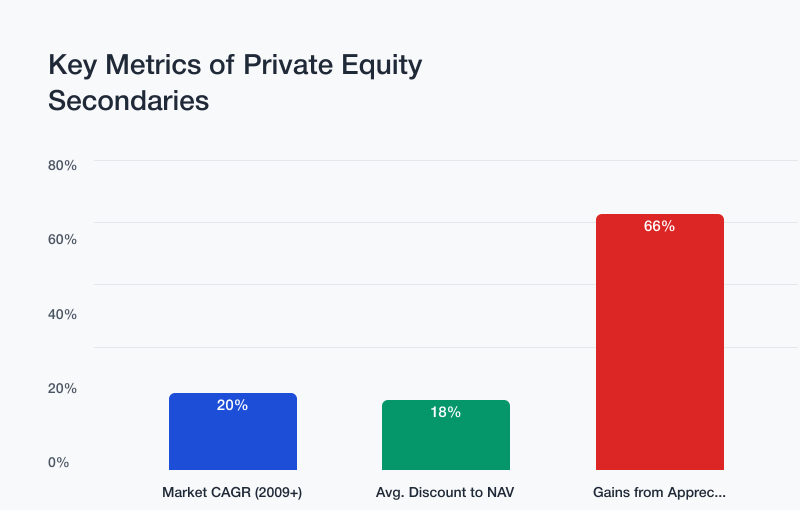
Myth 2: They’re a temporary trend. This sentiment has persisted for years, yet the market has grown at an astounding CAGR of over 20% since 2009. This is not a transient fad; it's a permanent, indispensable tool for portfolio management in increasingly illiquid private markets. The ability to transact existing positions is now fundamental to the private investment landscape, and this market is here to stay.
Myth 3: The discounts aren’t "real" value. This claim is baseless. A discount to Net Asset Value (NAV) represents a tangible, immediate unrealized gain and provides a crucial downside cushion. With target closing discounts typically averaging 15-20%, this is concrete value, not illusory money. Hamilton Lane's case studies frequently showcase real-world examples of acquisitions at substantial discounts, such as 24%. While underlying asset performance remains vital (approximately two-thirds of secondary gains still derive from post-purchase appreciation), that initial discount offers a significant head start.
Dismiss the uninformed chatter. This market is a robust, sophisticated segment of the financial world.
The private equity secondary market is no longer a niche, but a strategic, permanent part of managing big money portfolios.
ETFs: Market Wrecking Balls or Liquidity Engines?
There's persistent chatter—whispers, even—that ETFs are market wrecking balls, distorting prices and poised to destabilize the entire financial system. Having witnessed numerous market cycles, I can discern genuine threats from unfounded fears. My assessment: these anxieties are largely unfounded.
Much of the apprehension surrounding ETFs stems from a misunderstanding of their trading mechanics. The vast majority of ETF activity doesn't involve the underlying securities within the fund. Instead, it's secondary market trading: investors like you, me, or a large fund manager simply exchanging existing ETF shares. Your sale of an ETF share does not necessitate the buying or selling of underlying Apple or Microsoft stock. This secondary market activity accounts for the overwhelming bulk of transactions, with an average 7.7x turnover ratio compared to primary market activity. Consequently, most ETF trades have zero direct impact on the underlying companies.

When ETFs do interact with underlying securities, it occurs in the primary market through "creation and redemption" by Authorized Participants (APs). This process involves converting a basket of stocks into ETF shares or vice-versa. This activity is remarkably small, a mere blip on the radar, yet it's crucial because it consistently adds liquidity, rather than subtracting it. Consider high-yield bonds: primary ETF trading represents less than 3% of the daily cash trading volume in those actual bonds, according to FINRA trace data. In many opaque markets, ETFs offer an efficient way to trade a diversified basket where sourcing individual bonds would be a logistical nightmare.
The concern that ETFs force stocks to move in lockstep, escalating correlations, is also largely unsubstantiated. U.S. ETF assets quadrupled from approximately $1 trillion to $4 trillion, a monumental surge. Yet, during this same period, S&P 500 inter-stock correlations actually trended downward. The data contradicts the fear-mongering directly.
Furthermore, in times of extreme market stress, ETFs often become indispensable for price discovery. Recall 2015, when the Greek stock market was entirely shut down for over a month. Trading of Greek stocks was impossible. Yet, Greek ETFs continued to trade in the U.S., providing crucial, real-time price signals when their underlying market was inert. The same phenomenon was observed with Egypt. This isn't the behavior of a market wrecking ball; it's a vital, additive layer of liquidity and a lifeline, as confirmed by DWS Research reports.
Here's the thing: ETFs aren't some dark, distorting force. They're a structural improvement, adding vital liquidity and price discovery, especially when you need it most.
How Your 'Retail Price' Is Really Set: Inside the World of Internalizers
Do you believe your stock order zips directly to the NYSE or NASDAQ, meeting another order to establish a fair market price? That's the widely promulgated narrative. However, the cold, hard truth is that for the vast majority of your trades, this simply isn't what happens.
Over 90% of marketable retail orders never reach a public exchange. Instead, they are routed entirely off-exchange to entities known as "internalizers" or wholesalers, such as Citadel Securities or Virtu Financial. These firms constitute the true market for your retail orders, operating in a fundamentally different game.
Why do brokers like Robinhood or TD Ameritrade send your orders to these wholesalers? The answer is straightforward: money. Internalizers compensate brokers through what's termed 'Payment for Order Flow' (PFOF). Your broker isn't merely providing a service; they're profiting from your trade before it even executes. This means your order routing decision is often driven less by market efficiency and more by which internalizer offers the highest payment to your broker. This practice is clearly documented in SEC Rule 606 reports from major brokers.
In exchange for this consistent flow of retail orders, internalizers promise a marginal 'price improvement'—typically a fraction of a cent better than the National Best Bid and Offer (NBBO), the public price you assume you're receiving. This slight edge is how they justify the system to retail investors.
The business model thrives because retail orders are considered "uninformed." Unlike institutional or high-frequency trading firms, individual retail investors' trades pose lower risk for the internalizer to fill. Analysis, including the Columbia Law School paper 'Manipulating Citadel', indicates that 'adverse-selection costs' for retail orders are a remarkable 71% lower at these wholesalers compared to public exchanges. Less risk for them translates directly into greater profit.
The consequence is clear: your execution price is not forged on an open exchange. It's a derived, benchmarked figure determined off-exchange. This system is enormous, with internalizers executing an astonishing 29% of all U.S. share volume, totaling $41 trillion in transactions in 2021, according to FINRA and CBOE data. While you may perceive yourself trading in a transparent marketplace, you are, in reality, operating within a sophisticated, opaque side-street where your price is a meticulously calculated outcome.
Your actual execution price? It's a number cooked up in a private kitchen, benchmarked to the public market, but never truly of it.
The Dark Side: Exploiting the System to Manipulate Prices

You now understand internalizers and the concept of "price improvement." While seemingly beneficial, this entire system, built on benchmarking against the public NBBO, harbors a critical vulnerability. This weak point is actively exploited by sophisticated players who manipulate prices for their own gain, often at the market maker's expense.
The public NBBO, serving as the benchmark, can be influenced—even artificially fabricated. This is known as 'quote-based' manipulation. The mechanism is as follows: a trader, often utilizing a 'helper' or 'dirty' account, places a minuscule, non-bona fide order on an exchange, just enough to momentarily nudge the NBBO. This brief flicker creates an artificial shift. Immediately thereafter, they execute a significantly larger trade through their 'winner' or 'clean' account with an internalizer, capitalizing on that new, artificially shifted price. This generates profit from a tiny, engineered move. The SEC has successfully prosecuted individuals for such schemes, notably in cases like SEC v. Taub, confirming its illegality and prevalence.
Then there's 'trade-based' manipulation, a more intricate method. A trader executes a series of small, seemingly innocuous trades on an exchange, gradually pushing the NBBO in a specific direction, thereby feigning a genuine trend. Once the price is sufficiently distorted, they execute a much larger series of trades with an internalizer—but in the opposite direction—profiting from the temporary price dislocation. A single trader employing this tactic can accrue tens of millions in profits annually, a testament to the system's exploitation.
These strategies are unequivocally illegal. Section 9(a)(2) of the Securities Exchange Act of 1934 expressly prohibits transactions intended to induce others to buy or sell. The SEC has pursued numerous enforcement actions against traders for these quote-based and trade-based schemes, as detailed in analyses like 'Manipulating Citadel' and EBSCO overviews. The core implication is that your "retail price" can be distorted, influenced by factors beyond genuine supply and demand for the stock. This is not organic price formation; it's a calculated market chess game with loaded dice.
The societal cost extends beyond market makers being gamed. It fuels an arms race, diverting immense capital and resources into both manipulative activities and the efforts to detect and prevent them. Crucially, it erodes overall market liquidity and undermines the market's fairness and trustworthiness.
So, that price you see? It's not always pure. It can be a target, manipulated by clever players using the system against itself.
Bottom line: the idealized portrayal of secondary markets is, for most retail investors, a complete fantasy. You are not directly funding corporate growth. Your trade, the one you believe supports an innovative tech company, largely constitutes a transfer of chips between other speculators. This entire system is meticulously orchestrated, and you must internalize this truth: the market is not a charitable endeavor.
Here’s the critical summary:
- Your Apple share purchase does not fund the next iPhone. It's a direct exchange with another speculator, a purely secondary action, and largely a zero-sum game for the parties involved.
- Private equity "secondaries" are frequently institutions divesting assets they are eager to offload. These are not always pristine investments. Therefore, rigorous due diligence is not merely a formality; it is an absolute lifeline.
- And your concept of retail price discovery? That's a pleasant fiction. Internalizers execute the majority of trades, acting as an intermediary between you and the actual market, effectively setting your spread. The house, inevitably, always wins. Navigating this reality requires deeper financial education.
ETFs are far from passive baskets. They are colossal liquidity engines that move markets. In some instances, they become* the market, driving flows independent of underlying fundamentals. To ignore this dynamic is to court significant peril.
This is not a market for the easily swayed or the passively hopeful. It is a profoundly complex mechanism, designed for the truly informed—those who commit to looking behind the curtain. For curated insights into navigating this complexity, resources like The Stellaris Collection can be invaluable.
So, what should your next step be? Discard the hype. Begin to understand the intricate plumbing and the actual mechanics of how markets operate. If you’re serious about preserving—and growing—your capital, operate from informed skepticism, not some naive hope. Always identify who genuinely profits from your participation. Hint: it's rarely the one with the least understanding.
