

Secondary Luxury Watch Market: Q3 2026 Outlook
The Stellaris Journal
They called it a bubble. A fad. Yet here we stand, facing a $25 billion powerhouse. The secondary luxury watch market isn't merely grown; it has profoundly matured. After the froth of 'stupid money' evaporated in 2023-2024—and good riddance to it, frankly—the landscape stabilized in 2025. Now? It's an entirely new game. Brands are actively involved. Collectors are sharper and more discerning. And if it isn't a certified blue-chip, you already know the drill. While macroeconomic headwinds pose real challenges, the market's foundations are stronger than ever. This isn't about speculative hype; it's about hard data and real numbers. For Q3 2026, we're shedding the fairy tales to focus on what truly matters: Rolex, Patek, and AP asserting their dominance, how Certified Pre-Owned (CPO) programs are becoming a market takeover, and where genuine value can be found beyond the usual suspects.
This isn't a return to the past; it's the dawn of a more sophisticated, data-driven luxury watch ecosystem.
Brief: The Secondary Market's New Equilibrium
So, you thought the secondary watch market imploded, right? After its dizzying tumble in 2023-2024? Most did. But you were mistaken. It stabilized. A genuine shocker. The WatchCharts Overall Market Index actually registered a nearly 5% gain in 2025. Not a bubble, then; merely a correction. A brutal one, yes, but a correction nonetheless. Today, it's unmistakably a 'winner-takes-all' arena. Four titans—Rolex, Patek Philippe, Audemars Piguet, and Richard Mille—command nearly half the primary market's value, exerting unparalleled influence over the secondary segment. Their control over supply directly dictates market sentiment.
Perhaps the most significant shift, however, is the widespread emergence of brand-managed Certified Pre-Owned (CPO) programs. These initiatives are proliferating, bringing unprecedented transparency and price stability. Rolex CPO, for instance, accepts watches as new as two years old—a decisive move. While blue-chip models remain central, astute collectors are now eyeing high-horology independents and resurgent heritage brands like Cartier. Be mindful of persistent currency volatility and the potential for 'luxury fatigue' in late 2026; these factors could introduce new complexities.
This isn't just some speculative craze anymore. The secondary market has matured into a robust, indispensable ecosystem, demanding acute understanding from all participants.
Market Analysis: From Correction to Consolidation
Recall 2023 and 2024? That period was pure pandemonium. The market plummeted, with watch prices, particularly for hyped models, enduring a brutal battering. A 'sharp correction,' they called it, and you witnessed it unfold. But then, the descent halted. Prices bottomed out, and throughout 2025, they not only held steady but began a gradual ascent. The WatchCharts Overall Market Index confirms this trajectory. This is now a $25 billion industry—yes, twenty-five billion. It's no longer solely the domain of established players; it's a crucial entry point for smart new collectors unable to acquire desired pieces at retail or facing prohibitive costs.

What fueled this evolution? External economic pressures played a significant role. A robust Swiss Franc, for instance, pushed up primary market prices, which continue their upward climb. Patek Philippe, for example, increased retail prices by over 22% in 2025—a staggering leap. Consequently, discerning buyers are increasingly turning to the pre-owned market in search of perceived value or a more accessible entry point, as boutique prices become untenable for many. While Swiss watch export volumes declined by 6.6% in 2025, the value of these exports remained high. This 'premiumization' signifies fewer watches sold, but at significantly higher price points.
The market today is undeniably polarized. Top-tier brands operate in their own orbit, their values consistently appreciating. The mid-tier, however, faces an uphill battle, proving difficult to move. This widening chasm is driven by sustained demand for 'hot' models among affluent buyers.
Here's the critical insight: This isn't merely about manufactured scarcity anymore; it's a sophisticated, rule-driven market that demands comprehensive understanding.
The Power Players: How Four Brands Shape the Market
Let's be unequivocally clear: this is their game, and you're merely playing within its confines. Rolex, Patek Philippe, Audemars Piguet (AP), and Richard Mille—these four brands wield absolute control, dominating the narrative. They command nearly half of the entire market value and, astonishingly, an estimated 76% of all industry operating profit. This isn't a market; it's a monarchy, a 'winner-takes-all' dynamic that unequivocally shapes every facet of the secondary market.
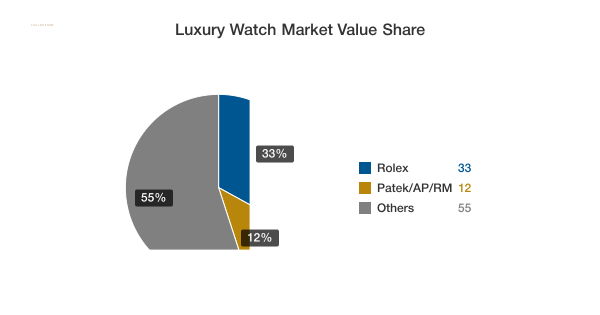
Rolex stands as the undeniable anchor, the behemoth, reportedly holding around 33% market share. Its Certified Pre-Owned (CPO) program transcends mere initiative; it establishes the industry standard, dictating what a 'certified' pre-owned watch truly signifies. When Rolex sets a precedent, the rest of the industry invariably follows suit.
However, the investment profiles diverge wildly. For unparalleled liquidity—a watch you can convert to cash swiftly when needed—a Rolex Submariner remains the gold standard, akin to currency. A Patek Philippe Nautilus or Aquanaut, conversely, might command two or even three times its retail price, representing a monumental premium. Yet, selling these requires patience for the discerning buyer, as they transcend mere timepieces to become potent status symbols, accompanying their exorbitant price tags. The same holds true for AP and Richard Mille; these watches aren't about mere timekeeping but about a profound statement.
Their strategy hinges on a trifecta: manufactured scarcity, unassailable brand equity, and an iron grip on distribution. They don't just sell watches; they meticulously control the narrative, the volume of output, and the allocation of each piece. This isn't accidental; it's a precisely orchestrated strategy that underpins and sustains their exceptionally high secondary market valuations. To participate effectively, you must understand their elaborate game. Because it is their game, and they play it with ruthless precision.
Ultimately, these few 'blue-chip' companies aren't just crafting timepieces; they are meticulously engineering the very rules of your luxury watch investment landscape, and their influence can be ignored only at your peril.
The CPO Revolution: How Brands Are Taking Control
Here's the stark reality: The secondary watch market is no longer entirely yours. This phenomenon of brand-led CPO programs represents the most significant structural upheaval we've witnessed, period. Brands are systematically reclaiming control. The shift in power from independent dealers directly to the major houses is palpable. 'Pre-owned' is evolving beyond a simple transaction; it's becoming a formally recognized asset class.
Rolex, predictably, is leading the charge—or, depending on your perspective, disrupting the status quo. Their CPO program isn't just an initiative; it's the undisputed benchmark, conferring legitimacy and establishing a crucial price floor for virtually every model. The accelerated two-year eligibility rule (a shift from three, as indicated by Similarweb (2024) data on accelerating influence) propels this dominance further, granting brands earlier control.
Could Audemars Piguet (AP) afford to remain on the sidelines? Unthinkable. Their anticipated CPO launch in 2026 is a critical event. Will it succeed in stabilizing Royal Oak prices much like Rolex has done for its icons? It's a highly probable objective.
For consumers, the advertised 'benefits' are clear: authenticity guarantees, comprehensive warranties, and a trusted source. This reassurance is particularly valuable for new entrants or those wary of counterfeit risks (a legitimate concern in this complex market). CPO instills a sense of security, mitigating significant transactional risk. However, this peace of mind comes with a caveat: you're ultimately paying their price.
The true narrative, however, lies with the grey market operators and independent dealers. They are facing unprecedented pressure. Once the exclusive conduits for many coveted pieces, they now compete directly with the watchmakers themselves—a brutal new paradigm. While brands have been slow to fully embrace direct online retail, CPO offers a controlled, strategic pathway to exert influence. This isn't merely a trend; it's a fundamental, irreversible power shift where brands are not just selling watches, but actively curating and certifying scarcity.
Beyond the Blue-Chips: Finding Value and Growth
The mantra is ubiquitous: Rolex, Patek, AP—the 'Big Three,' perhaps with Richard Mille. But this perspective is narrow, often lazy, and invariably expensive. The astute collector, therefore, looks beyond the clamor of blue-chips to discover genuine growth and personal satisfaction. Collecting transcends merely pursuing the same sought-after timepieces as everyone else.
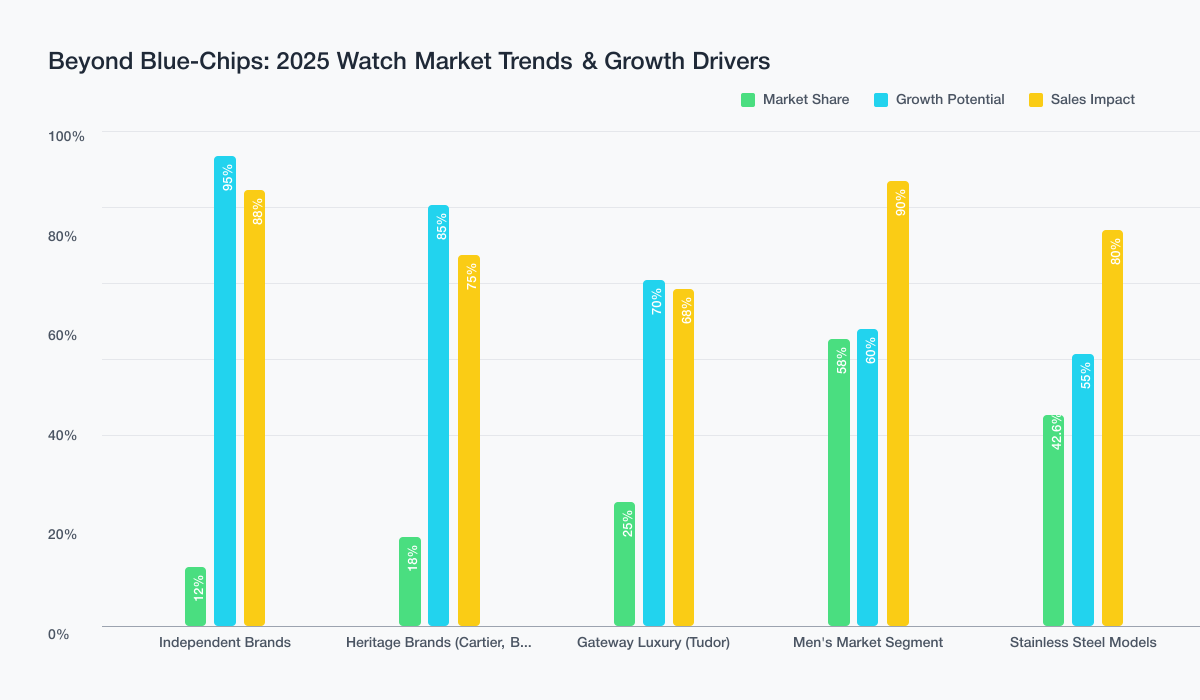
Consider the independents. F.P. Journe, for instance, has achieved phenomenal auction results, ranking as the third-highest brand by sales total in 2025 (behind only Patek and Rolex, per industry figures). This extraordinary performance underscores that true scarcity and unparalleled craftsmanship remain potent value drivers, irrespective of marketing hype; it's about the intrinsic essence of the watch.
Heritage brands are also experiencing a remarkable resurgence. Cartier, for example, has staged an astonishing comeback, demonstrating that strong design DNA is paramount. Its secondary market gains in 2025 placed it among the top five—a testament to revisiting and celebrating its rich archives.
Then there's the 'gateway luxury' segment, exemplified by Tudor. These are solid, value-driven watches with a robust secondary market presence. Buyers seek quality timepieces that retain their value should they decide to sell. Tudor consistently delivers on this front, often representing a financially intelligent acquisition.
While stainless steel sports models remain in demand, a discernible shift is occurring. There's a burgeoning appreciation for vintage-inspired designs and alternative materials, moving beyond the traditional gold and steel. Consumers are seeking differentiation, something genuinely interesting. The men’s category constitutes nearly 60% of the market (58% precisely), with stainless steel accounting for 42.60% of that. However, the boundaries are blurring, and options are expanding. Breguet’s GPHG win in 2025 served as a significant signal—a powerful return to contemporary relevance. Do not limit your vision to the usual suspects; the market's breadth is far greater than commonly perceived. You just have to cultivate the insight to discover the true gems beyond the obvious.
Outlook and Risks: What to Watch in H2 2026
Alright, let's frame the situation for Q3 2026. The market is undeniably mature, distinctly polarized, and increasingly transparent. Whether you're a collector or an investor, a disciplined strategy is paramount.
For the Novice: Your safest bet lies with CPO programs or a thoroughly vetted, trustworthy dealer. Focus on benchmark models like a Rolex Datejust or an Omega Speedmaster. Prioritize immaculate documentation and verifiable condition; these factors are immensely critical. Avoid shortcuts.
For the Collector/Investor: Monitor the auction market diligently. This is where the true indicators for independents and resurgent brands emerge. Identify undervalued pieces before they become mainstream. Early entry is key.
For Executives: You must track brand CPO programs with relentless scrutiny—their pricing strategies, and the tangible impact of digital platforms on pre-owned retail foot traffic. These dynamics are reshaping the entire landscape.
However, it's not all smooth sailing. Significant risks persist. The enduring strength of the Swiss Franc continues to impede exports. A potential economic slowdown in China poses a threat, as the fast-growing Asia-Pacific market remains susceptible to volatility. And the proliferation of sophisticated counterfeits remains a persistent challenge, particularly in developing countries (though the US maintains its position as the top market for new watches, providing a robust foundation for pre-owned). Therefore, proceed with caution and vigilance. This market demands unwavering discernment and an absolute intolerance for anything less than verifiable truth.
The secondary luxury watch market is no longer the Wild West. Q3 2026 is far from a free-for-all; it's a meticulously calculated chess game where the brands themselves are deploying their own pieces. The tumultuous period of '23 and '24? A necessary purge, leaving behind a leaner, more formidable entity. But do not confuse 'leaner' with 'easy money.' The speculative frenzy has evaporated, and frankly, good riddance.
Here's the unvarnished truth for anyone genuinely engaged:
- The titans—Rolex, Patek, AP—now unilaterally dictate the terms. Their CPO initiatives are not mere programs; they are formidable market control mechanisms, creating an unbreachable moat.
- The speculative bubble has definitively burst. We are left with a bifurcated market: the 'blue-chips' are anchoring their ground, while every other piece demands rigorous scrutiny to justify its price point. The era of chasing fleeting fads is over.
- Intuition is no longer sufficient. You require hard data, irrefutable provenance, and a sober grasp of actual demand, uncorrupted by forum chatter or influencer noise. This applies equally to both buyers and sellers.
So, where does this leave us? Cautiously optimistic, provided you possess the requisite expertise. While many will undoubtedly continue to pursue fleeting trends, for serious players, the game is now profoundly clearer: less hype, more verifiable substance.
What's the imperative moving forward? Cut through the noise. Obtain precise, data-backed valuations. Whether offloading a piece or contemplating an acquisition, trust is no longer a bonus—it is the absolute minimum requirement. You need a partner who comprehends this new reality, someone who delivers certainty, anchored by rigorous authentication and transparent execution, especially when navigating top-tier pieces. This is the sole pathway to successful navigation, leaving no room for guesswork.
In this transformed landscape, informed strategic action, not speculative gambling, will define success.
