

Understanding the F.P. Journe Resale Market: A Guide to Valuation
The Stellaris Journal
You want to talk about watches? Fine. Let's talk F.P. Journe. And not the soft-focus, aspirational garbage you usually read. Look, an early Tourbillon Souverain just cleared eight goddamn million dollars at auction. Eight million. For a wristwatch. If that doesn't snap you awake, you're dead.
So, what gives? Why does a brand churning out barely a thousand watches annually
— Patek, for comparison, puts seventy thousand pieces into the wild
— demand prices that make your eyes water? It's not mainstream hype. Never was. It's a wholly different beast, this F.P. Journe market. Driven by real scarcity, sure. But more importantly, by undeniable horological genius and a deeply informed collector base.
This guide cuts through the noise and breaks down exactly what drives F.P. Journe value in the secondary market, focusing on the only factors that matter.
The Foundation of Value: Scarcity and Artisanal Mastery
Forget everything you think you know about luxury watches. Most of it’s marketing garbage. But Journe? That’s different. It’s a cult, sure, but it’s a cult built on something real. And it starts with a simple phrase: 'Invenit et Fecit' (Invented and Made). You see it on every dial. It’s not just some fancy motto; it’s the religion here. Every single component and design choice is executed in-house, under one roof. That is quality control you simply won't find anywhere else.
This commitment is rare, and they control the output with surgical precision. They don’t churn these things out; they deliberately limit production to ensure every single cog meets François-Paul's standards. It’s a fundamental decision that makes them incredibly hard to acquire. Scarcity isn't accidental here; it's by design. This isn't just a watch; it's a statement against mass production.
Now, consider the 'Brass Period' (1999–2004). Collectors go wild for these, and for good reason. Before the transition to 18k rose gold movements, these early pieces were crafted with brass. Christie's and collector guides consistently highlight the premium on these early models. They show where it all started, offering a direct link to the man’s earliest, purest vision. It is the horological equivalent of finding a band’s first demo tape.
This vertical integration—doing it all themselves, from the tiny movements to the cases and dials—imbues each watch with something you can feel. It is authentic. You aren't just buying a brand; you are buying a piece of one man's vision, and that vision doesn't come cheap.
A Hierarchy of Desirability: Key F.P. Journe Models and Their Market Standing
You know why Journe watches are a thing, but you need to know which ones actually matter. Make no mistake: not all models are created equal. You might think every watch with "Journe" on the dial is a golden ticket, but you need to distinguish between the heavy hitters and the standard production pieces.
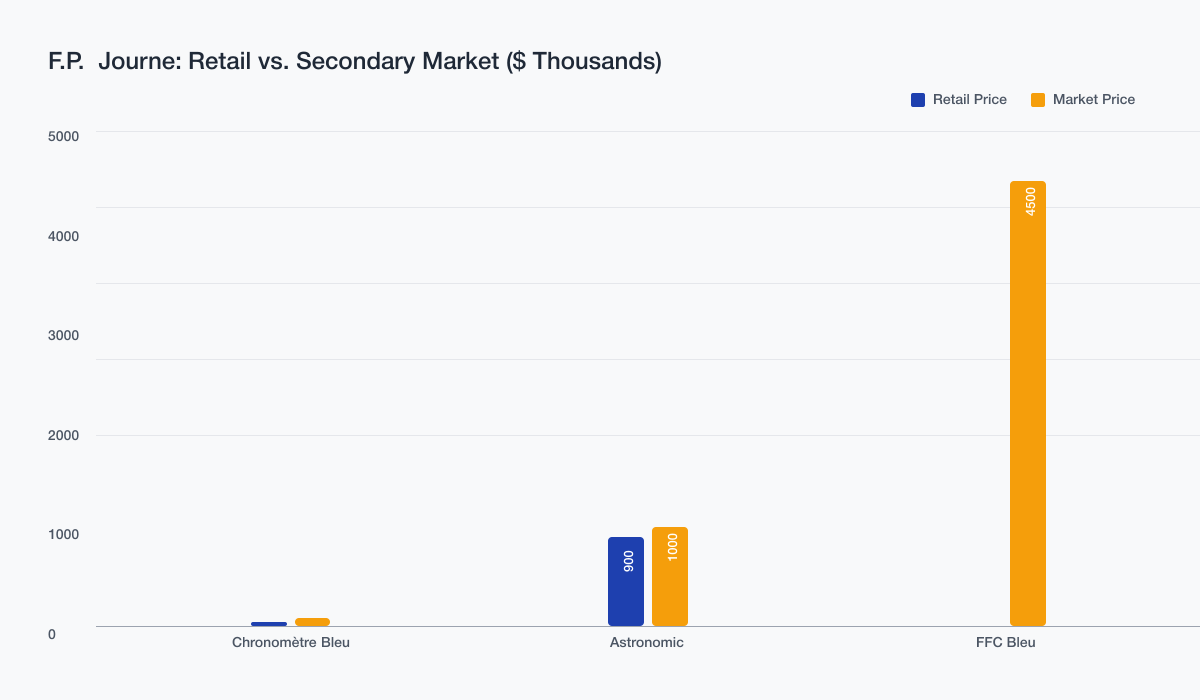
Some models are pure milestones—technical flexing on a level most brands only dream of. The Chronomètre à Résonance and the Tourbillon Souverain are the cornerstones. If you track the auctions at Phillips or Sotheby’s, these two consistently fetch the highest prices. They are the enduring proof of the brand's power.
Then there is the oddball, the cult classic: the Chronomètre Bleu. With that tantalum case and striking blue dial, the demand is insane. It is a time-only watch, but it trades for over double its original retail price. Dealer sites often list them between $75,000 and $90,000, despite an original retail closer to $37,400. It is an expensive entry point, but it remains one of the most liquid assets in the brand's catalog.
The Élégante collection, while battery-powered, shouldn't be slept on either. Its innovative electromechanical movement is still a pure Journe design, and it has seen significant value appreciation. However, the absolute pinnacle remains the ultra-complex pieces like the Astronomic Souveraine, which can trade north of a million dollars on the secondary market. If you’re playing at the very top of the market, you’re looking for complexity, extreme rarity, and those one-off collaborations like the FFC Bleu.
The Four Pillars of Individual Watch Valuation
You’re trying to sell or buy an F.P. Journe. You’re looking at an online listing, thinking, "It's a Journe, so it's worth a fortune." That is a dangerous assumption. There is a deep mess of details you need to navigate.
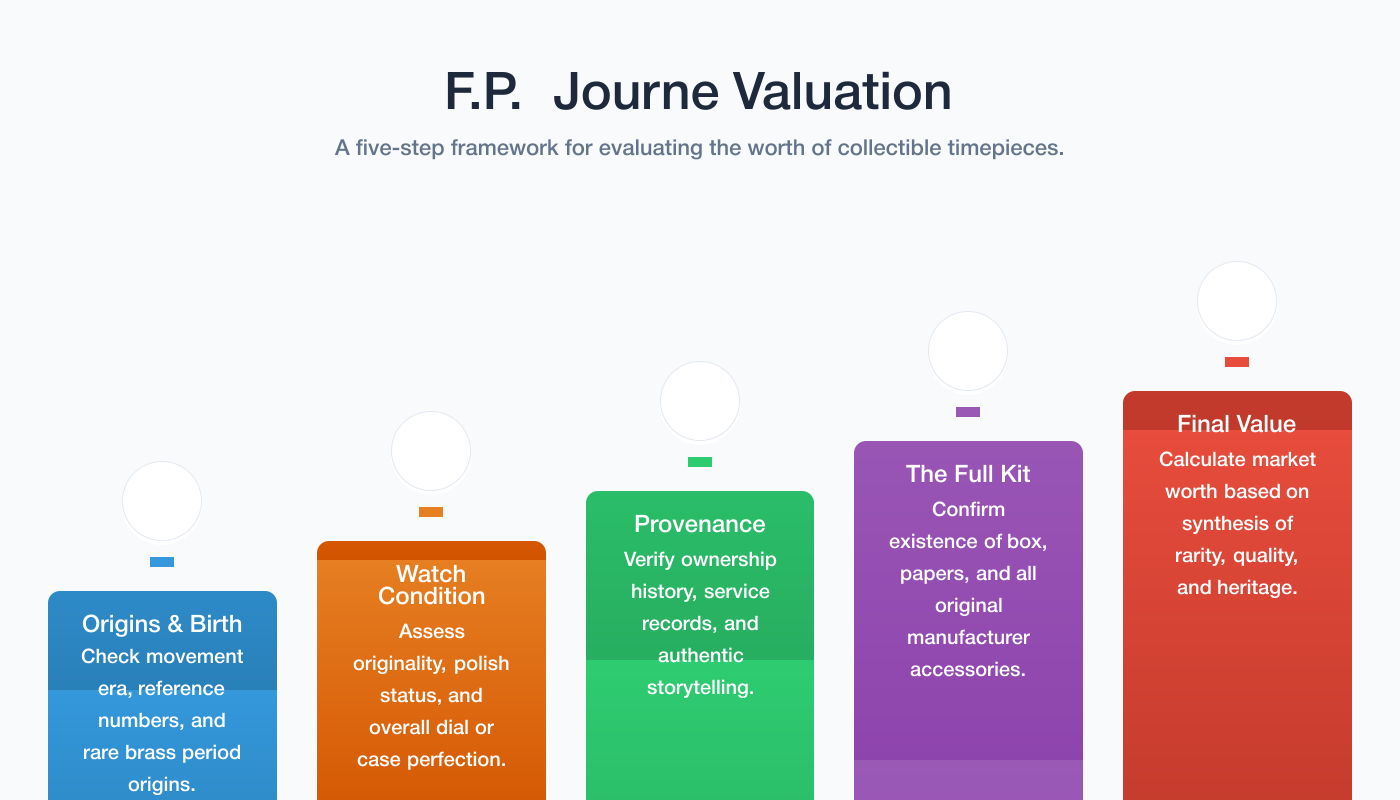
Pillar One: The Specifics of Birth. It’s not just a model; it’s a reference. Was it produced during the "Brass Period" (1999–2004)? Those movements were brass before the transition, making them rare and highly coveted. Is it a "souscription" piece? These are the baseline for serious collectors. If you don't know the specific reference and production year, you are just guessing.
Pillar Two: Condition. This is critical. Collectors crave "original." An unpolished case with sharp, defined edges is the holy grail. A watch that looks like it just came out of the workshop, even if it’s decades old, commands a significant premium. If it’s been buffed like a cheap shoe, you’ve lost a chunk of value instantly.
Pillar Three: Provenance. Does it have its original box and papers? Those bits of paper are the watch's birth certificate. They prove legitimacy and care. Selling a pre-owned watch without its full kit means you are leaving serious money on the table.
Pillar Four: Documentation. This is the completeness of the provenance. Did it come with the booklet? The certificate? The original accessories? Missing items knock a percentage off your asking price. Auction results consistently show that pieces with a full, documented history perform better than "loose" watches.
The value of an F.P. Journe isn't some magic number; it's a precise calculation based on its heritage, its history, and its untouched beauty.
Market Dynamics: Collectors, Speculators, and Controversy
The Journe market isn't just some polite gathering of wealthy enthusiasts; it’s a swirling, sometimes volatile mess of passion and greed.
You have the real collectors—the bedrock—who anchor the market. They appreciate the insane craft, they know the details, and they hold onto their pieces long-term. But lately, speculators and investors have crashed the party, viewing watches as an "asset class" that outperforms the S&P 500. While this has driven prices up, it has also introduced volatility.
Then there is the talk about large resellers potentially "cornering the market" on certain models, which creates anxiety about artificial price inflation. It makes it harder for the average collector to get in. Furthermore, the market has had to contend with non-financial variables, including controversy surrounding François-Paul Journe himself, which has led some collectors to liquidate their holdings on ethical grounds.
Yet, there is still significant institutional belief. Chanel’s purchase of a 20% stake in 2018 provided a massive corporate vote of confidence. It is not all doom and gloom; it is just complicated.
The Journe market isn't just about watches; it's a battleground of passion, profit, and messy human drama, where value can shift for reasons no algorithm would ever predict.
Frequently Asked Questions
Got questions? Good. Because everyone does. This stuff isn't simple.
Do Journe watches hold their value?
Totally. They are rare, and the demand is high. But it is not a blanket guarantee—it depends entirely on the model and the era.
Why is the 'Brass Period' so valuable?
That’s the real "OG" stuff from 1999 to 2004. These early pieces were the formative years when Journe was building fewer than 1,000 pieces a year. The brass movements are historically significant and super scarce, creating a massive premium.
Is Journe a good investment?
Many have done unbelievably well, often outperforming traditional stocks. However, viewing it purely as an asset is how people get burned. The ones who succeed love the watches first; the money is secondary.
How many watches does Journe make per year?
The answer is about 1,000 mechanical pieces annually. That scarcity is a huge driver of value, keeping supply tight and demand high.
You want a Journe? Know your stuff, because without the details, you're just another mark in a very expensive, very unforgiving market.
*
Forget the glossy brochures. With F.P. Journe, you’re not buying hype. You’re buying a bottleneck of genius. The market knows it, and that knowledge separates the savvy from the suckers.
Here’s the straight dope:
It’s a game of genuine, painful scarcity. Journe makes watches, sure, but he makes few* watches. Hand-built. That — not some fancy campaign — drives the demand.
- Model specifics aren’t footnotes here. They’re the whole story for pricing. Early brass movements, specific metals, dial variations, even a forgotten detail. Pay attention.
- The market itself is deep, informed, and ruthless. You either understand the subtle differences, the provenance, and the minute historical shifts, or you pay the stupid tax. Simple as that.
It's not about trends with these pieces; it’s about a stubborn adherence to something singular. So, what's your next move? Don't guess. Not with numbers like these. If you're serious about acquiring a Journe—or liquidating one—you need someone who cuts through the noise. This isn't a hobby for winging it.
