

Audemars Piguet Royal Oak Liquidity: An Owner’s Guide to Market Value
The Stellaris Journal
You want a steel Audemars Piguet Royal Oak? The 15510ST, for instance. MSRP claims $28,500. But the street price? Forget that; you're looking at $42,000 to $50,000, easy. That isn't a glitch in the system—it is the system.
A Royal Oak is not just a watch; it is a high-stakes asset. Navigating this market requires understanding specific dynamics, reference hierarchy, and asset retention strategies. This isn't about passion or heritage; it is about cold, hard numbers and making smart capital allocations. We are going to break down the factors driving value and provide the roadmap for buying, holding, and selling one of the most liquid luxury items on the planet.
Owning a Royal Oak is not merely a purchase; it is a high-stakes entry into a closed, high-liquidity asset market.
Brief and TL;DR
The Audemars Piguet Royal Oak’s market value is intentionally engineered to exceed its retail price, driven by manufactured scarcity and a tightly controlled boutique-only sales model. For prospective owners, the key is understanding the asset hierarchy: the “Jumbo” Extra-Thin (16202ST) is the prime investment-grade piece, while the Selfwinding (15510ST) is more of a high-value commodity. Acquiring one involves a strategic choice between the long, uncertain waitlist at a boutique or paying a steep premium on the secondary market for immediate access. Successfully exiting your position requires pristine condition, complete documentation, and leveraging a trusted platform with transparent market data to maximize your return.
The Royal Oak market is defined by manufactured scarcity and a closed-loop distribution model that dictates all pricing.
Understanding the Royal Oak Market: Scarcity by Design
Gérald Genta created the Royal Oak in 1972, proving that stainless steel could carry a luxury price tag. However, the design is not the reason you are struggling to acquire one today. The issue is the supply chokehold.

Stop looking for "value" in technical specifications and start looking at the balance sheet. Audemars Piguet is family-owned, meaning they do not report to public shareholders and are not forced to inflate volume to satisfy quarterly earnings. They cap production at roughly 50,000 to 57,000 units across all lines. Compared to mass-market luxury, this is a starvation diet for the market.
The real shift occurred when they dismantled their authorized dealer network in favor of a boutique-only model. Third-party dealers previously allowed anyone with capital to purchase; boutiques, however, are gatekeepers. You are not a customer; you are a prospect being interviewed for the privilege of handing over your money. If you spend time on forums, you will see the recurring narrative: individuals with clean credit and liquid capital being told they have not been "chosen."
Even Similarweb (2024) data indicates that demand for these pieces remains relentless, yet inventory stays locked. The secondary market price is not just hype; it is a premium tax paid by those without a direct line to an AP manager.
The market value is a direct result of manufacturing control, as AP created a perpetual supply drought that keeps the secondary market permanently overheated.
Decoding Royal Oak Value: The Key Financial Drivers
Not all Royal Oaks are created equal. Value is a function of specific, quantifiable variables that separate the blue-chip assets from the rest of the catalog.
- Reference Hierarchy: The 16202ST “Jumbo” is the apex asset due to its direct lineage to the 1972 original. It consistently commands the highest premiums. The 15510ST is the modern workhorse; it holds value well above retail but is produced in higher quantities, making it more of a trading commodity.
- Material and Dial: While steel is the icon, precious metals and novel materials like ceramic introduce different value propositions. Dial color is critical; boutique-exclusive blue dials (marked “Bleu Nuit, Nuage 50”) and limited-run green or salmon dials carry significant premiums.
- Condition and Provenance: A “full set”—box, warranty papers, and all original links—is the baseline for maximum value. Condition is paramount; unpolished cases with sharp bevels are more desirable than watches that have been rounded by careless servicing. A documented service history from Audemars Piguet adds a layer of verifiable authenticity.
- Prepare the Asset: Assemble the full set: original box, warranty card, booklets, and any extra links. This is non-negotiable for achieving a top-tier price. A recent service from AP can be a strong selling point, but calculate whether the cost will be recouped in the final sale price.
- Know Your Numbers: Use data-driven platforms to understand the current market valuation for your specific reference. Prices fluctuate, so real-time data is essential. Do not rely on forum opinions or outdated listings.
- Choose Your Exit: You can sell to a dealer for a quick, guaranteed price, or consign with a specialist for a potentially higher return over time. Selling privately offers the best margin but carries the highest risk. Using a trusted platform that provides robust authentication is the safest route.
- The MSRP is a fantasy. You are engaging with a secondary market reality where the 15510ST flips for $40,000 to $50,000. That delta is the point.
- Not every Royal Oak is a winner. The Jumbo is a constant, but the 15510ST requires careful tracking of reference values to avoid holding the bag.
- You do not just buy one; you strategize. Retail access is a long shot for most. The secondary market is where you operate, provided you prioritize authenticity and valuation over emotion.
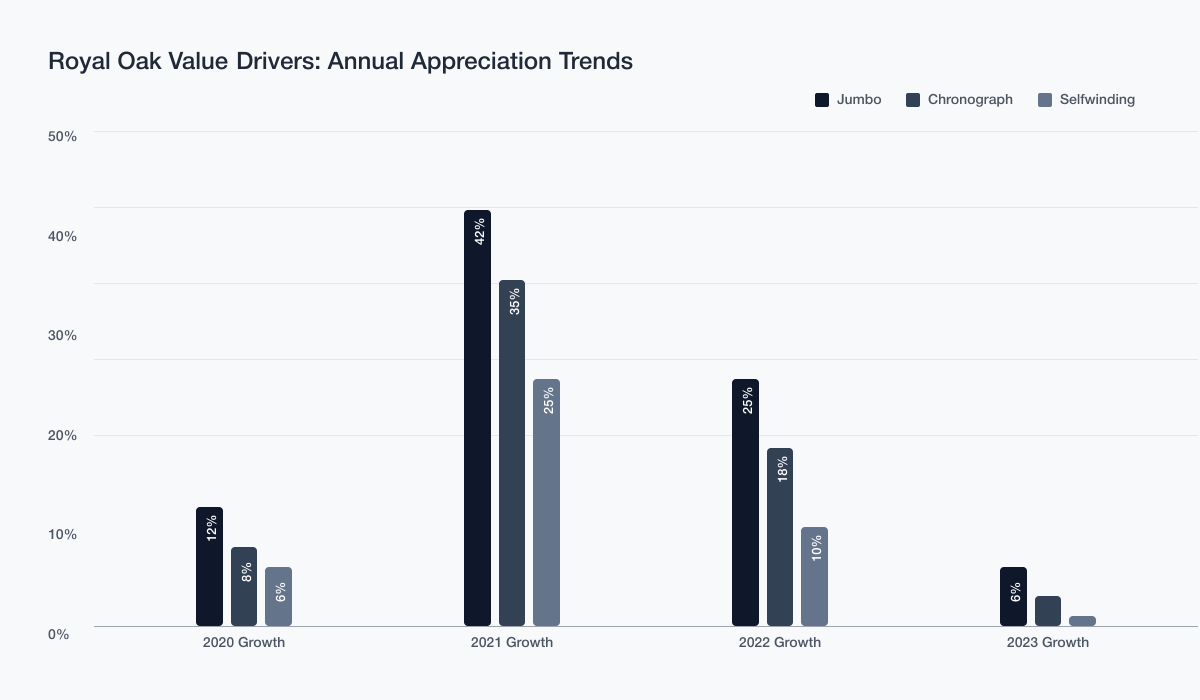
True value in the Royal Oak market is driven by production caps and an artificial, strategic restriction of retail access.
Jumbo vs. Selfwinding: A Head-to-Head Value Analysis
You are looking at a Royal Oak because you want to park significant capital, not just buy a watch. You need to distinguish between a functional purchase and a shrewd financial play.
The "Jumbo" Extra-Thin, the 16202ST, is the original deal. It carries the 1972 lineage, measuring just 8.1mm thick with no seconds hand to distract from the Petite Tapisserie dial. Collectors prioritize this history. The market reflects this; you are looking at a secondary market value of $70,000 to $85,000. The 2022 update, featuring the Caliber 7121 in-house movement, only solidified its status as a generational asset.
Conversely, the Selfwinding 41mm (the 15510ST) is a modern, practical daily wearer. It is thicker at 10.4mm, features a central seconds hand, a 70-hour power reserve, and a Grande Tapisserie dial. While it is a solid timepiece, it does not hold the "legend" status of the Jumbo. It serves as an entry point, not an investment goldmine. You will see the 15510ST floating on the secondary market between $42,000 and $50,000.
If you want a daily beater, the 41mm is sufficient. But if you are thinking long-term—if you want something that builds equity—there is only one choice.
The Jumbo 16202ST remains the strategic choice for long-term equity, while the 15510ST functions primarily as a daily-wear commodity.
The Two Paths to Ownership: The Retail Game vs. Secondary Market
You want a Royal Oak. There are two paths to ownership, and neither is simple. One is a long, drawn-out endurance test; the other is a high-cost, high-speed transaction.
The Boutique Hustle: A Test of Endurance (And Your Wallet)
The boutique model is designed to "curate relationships." This is code for spending money on inventory you do not want to build the "purchase history" required to be considered for the watch you actually desire. This retail strategy is a modern form of gatekeeping.
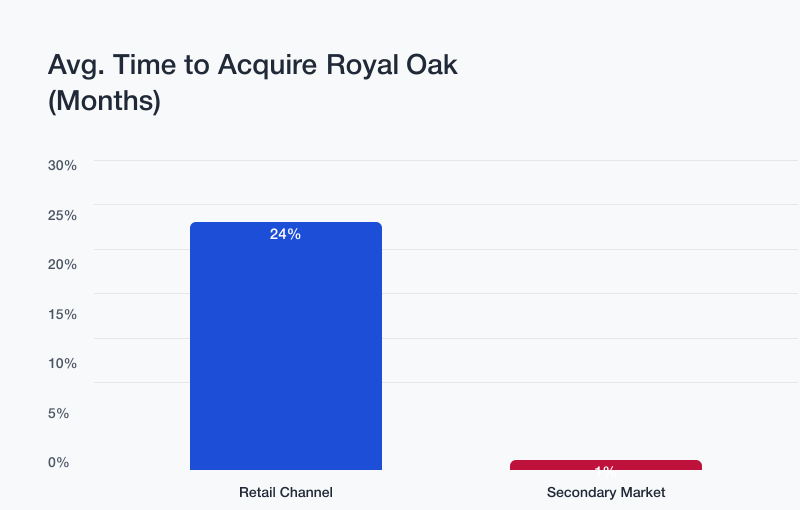
You are forced to buy "entry pieces"—often Code 11.59s or Offshores—to stay on an opaque, internal list. We are talking 12 to 24 months of waiting for a 15510ST, with no guarantee of success. It is a massive gamble with your time and capital.
The Secondary Market: Pay to Play, But Play Now
The secondary market is a "wild west," but it provides liquidity and speed. You see it, you buy it. There are no gatekeepers, no manufactured relationships, and no multi-year waiting lists. You pay a premium—sometimes 30% to 70% above MSRP—but you acquire the asset immediately. As market analysis indicates, intense market interest drives these prices, proving that demand far outstrips AP's output.
While the boutique path is a gauntlet of manufactured exclusivity, the secondary market is a premium-priced route that buys you time and certainty.
Maximizing Your Return: A Practical Guide to Selling Your Royal Oak

Selling your Royal Oak is about converting a tangible asset back into liquid capital. To do this effectively, you need a clear strategy.
Selling a Royal Oak requires navigating market liquidity, verifying provenance, and understanding the specific, data-driven appetite of the secondary buyer.
Frequently Asked Questions
Still a smart buy, these Royal Oaks?
The steel models remain strong, as evidenced by consistent price floors. However, you must avoid obscure references and stick to the core models that maintain high liquidity.
Can I just walk into a boutique and snag one?
It is statistically improbable. Supply is constrained by low annual production totals, and demand is globally high. Unless you possess substantial, existing connections, the retail route is effectively closed.
And the service costs? Am I going to cry?
Yes. You are maintaining a precision instrument. AP's service costs are substantial, but they are mandatory to preserve the asset's function and, ultimately, its value.
The Royal Oak remains a secure, high-liquidity asset, but success requires navigating artificial scarcity through strategic, long-term acquisition planning.
So, what is the bottom line? This isn't a lottery ticket; it is a strategy. You either play the game, or you get played. The 15510ST is not a rare bird; it is a product of manufactured scarcity, and that premium is baked into the business model.
Here is what you need to understand:
This is a liquid asset with a heartbeat. Markets shift, but the fundamentals of supply and demand remain constant.
Do not guess with six-figure assets; you need data, verification, and a reputable counterparty to avoid learning the hard way.
