

Rolex vs. Audemars Piguet: A Market Liquidity and Volatility Comparison
The Stellaris Journal
Forget what your buddy at the country club chirps about. Just because a watch costs a house down payment doesn't mean it behaves the same way when real money's on the line. A Rolex isn't an Audemars Piguet. Not for your portfolio.
People lump them together. "Investment grade," they say. Bullshit. The name on the dial? That's just the gloss. What actually defines how your capital performs (or tanks)? Market structure. Production scale. And the sheer, brutal reality of how fast you can liquidate it when things get tight.
We're stripping away the brand hype and focusing on the messy mechanics of the secondary market. This isn't about heritage. It's Rolex versus Audemars Piguet, specifically on liquidity and volatility. What truly matters if you're buying, selling, or just trying to protect your assets. Real data, straight talk. No fluff.
Production Scale and Philosophy: The Great Divide
You wanna know why Rolex feels like a currency and AP feels like a lottery ticket? It’s simple, really. Production numbers. And the mindset that drives 'em. We're talking two totally different games here. Not even close.
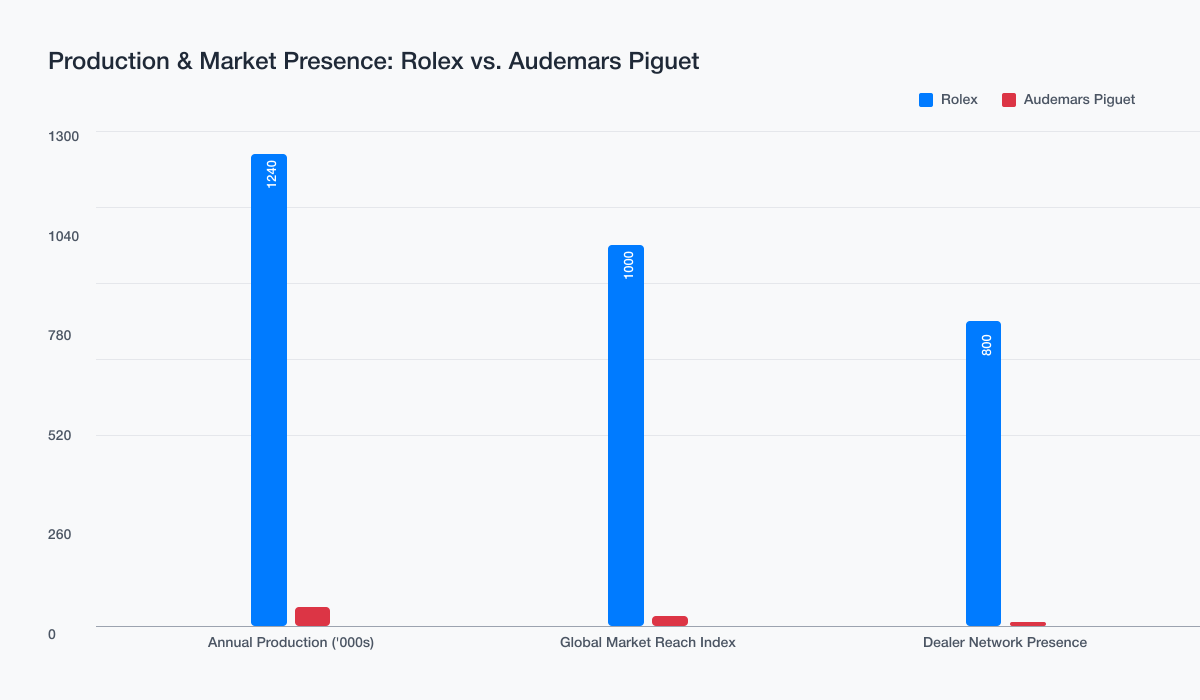
Look, Rolex isn’t just a watch brand. It’s an industrial titan. A goddamn machine. They crank out an insane 1.24 million watches every single year. Just think about that. That volume isn't an accident. No, that’s a deliberate strategy. Because of it, you see Rolex everywhere. On wrists, in shop windows, hawked online. And that broad ownership base? It creates a deep, sturdy market. A market that supports itself.
Audemars Piguet? They're artisans. Craftspeople. Maybe even artists. And that's fine. But it means they're only putting out around 50,000 watches annually. Maybe a bit more, maybe a bit less, but still, it's a tiny sliver compared to Rolex. And that low number? It builds extreme exclusivity. Artificial scarcity, some might say. But it works for their niche.
So, their philosophies diverge. Rolex is about "perfective evolution." They find something that works. Then they make it a tiny bit better. Every year. No crazy stunts. Just durable, reliable tool watches, incrementally improved. Year after year. But AP? They’re all about "artistic rebellion." Pushing the boundaries. Avant-garde designs that make you scratch your head (or open your wallet). Complex, 'haute horlogerie' movements. And because it's a family-owned outfit (unlike Rolex, which is a trust, a whole other animal), they get to keep that singular, artist-driven vision. It's wild, frankly.
And yet, this massive production gap, this 25-to-1 ratio, it changes everything. It dictates availability. Rolex has a global dealer network. You can find them. AP? Good luck. You’re looking at exclusive AP Houses and a handful of boutiques. So, of course, the secondary market behaves completely differently for each. It's not rocket science. It's just simple supply and demand, scaled up to luxury watch levels. You want to understand these brands? You look at how many watches they make. It's the first, last, and only number you need to know.
The output volume isn’t a footnote; it's the entire goddamn story. It dictates everything, from how you buy a watch to what you can sell it for, and when.
Secondary Market Liquidity: Rolex’s Structural Resilience
Everyone talks about "investment watches." But what's an investment if you can't actually sell the damn thing when you need to? Or if you lose a fortune just trying to offload it? That’s where liquidity comes in. It’s how easy it is to move an asset without tanking its price. And look, Rolex? They run laps around everyone else in this department. Seriously.
Think of Rolex as the blue-chip stock of the watch world. The one your grandpa told you to buy. Because models like the Submariner, the GMT-Master II, the Daytona
– these aren't just watches. They're like little engines, constantly transacting. Across global dealer networks. Around the clock. All the time, ensuring what we call "price discovery." You know exactly what it's worth, pretty much. All the time. This constant churn, this high volume? It creates tighter bid-ask spreads. You know, that difference between what someone will pay and what someone will sell for. Less gap means less money lost when you buy or sell.
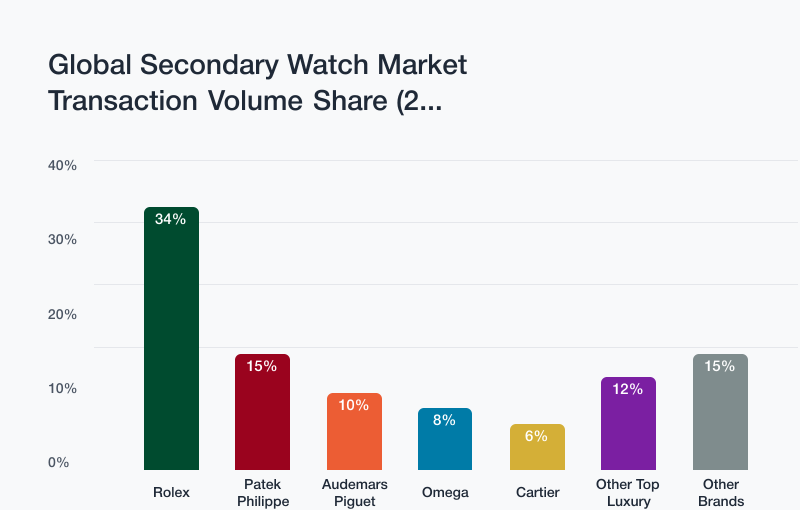
And the demand for these things? It’s just… broad. Crazy broad. From people getting their first "real" watch to seasoned collectors eyeing a rare Daytona. That wide appeal means there's always support. At every price point. So, a sudden price collapse? Unlikely. Not impossible, but unlikely. Because someone, somewhere, is always looking for a Sub. Or a Datejust. Even Similarweb (2024) shows that Rolex leads the secondary market, gobbling up a staggering 34.2% of global transaction volume. That’s not a fluke. That's structural.
Reddit comments, the real talk, they get it too. There's a stable 'grey market' for new pieces, sure. But then there’s the wider private sale market, which is also huge. Good Times Luxury analysis, they highlight how these frequent transactions underpin that price stability. And yet, Rolex isn't just relying on the gray market. No, they're smart. Their Certified Pre-Owned (CPO) program? Sales tripled in 2024, hitting $300 million, ECI Jewelers says. That's Rolex itself stepping in, further cementing official liquidity. It's a powerhouse, a self-fulfilling prophecy of market stability. Just try to argue with that. You can't.
Owning a popular steel Rolex isn't just owning a watch; it's damn near holding a universally accepted currency. You can move it. Fast. And usually for what you think it's worth.
Volatility & Concentration Risk: The Audemars Piguet Gamble
So, you like playing with fire? Good. Let's talk AP. Because if Rolex is your stable blue-chip, Audemars Piguet? That’s your high-stakes bet. Your speculative play. And it’s mostly down to one thing: the Royal Oak. And its beefed-up brother, the Offshore. Their secondary market value? It's overwhelmingly, disastrously concentrated in those two families. And that's a problem. A big one.

When demand for these specific models surges, prices can just go absolutely parabolic. Crazy spikes. But when sentiment cools, when tastes shift, even a little bit? The lack of buyers at those inflated price tiers means a cliff. A sharp, rapid retracement. It's a brutal drop. And because the transaction volume for AP is so much thinner than Rolex’s, a few sales (or a lack of sales) can swing the market price. Wildly. It amplifies everything. Good Times Luxury calls this model concentration risk. And they're right. It’s exactly that.
This all means AP’s financial perception, its market health, it’s tied to a single design aesthetic. The Royal Oak. From 1972, that steel Royal Oak was priced 15 times higher than a steel Rolex Submariner. Think about that for a second. That wasn't just luxury; that was high-risk, high-reward DNA from day one. And it hasn't changed. Hodinkee notes that Royal Oak demand cycles can whip faster than broader luxury watch benchmarks. Just because people think something is hot, doesn’t mean it stays that way.
Rolex, they’ve got a whole army of iconic lines: Submariner, Daytona, Datejust, GMT-Master II, Explorer. All selling. All with their own demand. But AP? It's the Royal Oak show, and everyone else is just a bit player. This isn’t a diversified asset, not by a long shot. Morgan Stanley data even showed AP’s secondary prices dropping 7.3% in 2024. Ouch. Rolex only fell 5%. It's not just a number. It's the cost of putting all your eggs in one very angular, very expensive basket. You want the big wins? You gotta take the big risks.
Audemars Piguet is a high-wire act, a concentrated bet on a single, iconic design. You might get rich. Or you might just get burned. Welcome to the gamble.
Performance in Market Downturns: A Tale of Two Tiers
Look, when the market takes a dump, you see who's wearing iron shoes and who's wearing glass slippers. We’ve seen a cooling period, 2023 into 2024. And it's ugly. But not equally ugly for everyone.

Rolex? They demonstrated slower, more gradual price drops. A slow bleed, not a gush. And why? Because people still want them. Always have. There's this huge pool of entry-level buyers, you know? The ones just getting into this game. Plus, that global brand familiarity is insane. It sets a floor. A hard, solid floor. Even Similarweb (2024) shows that. But it's just the way it works.
Audemars Piguet? Different story. They took a faster, harder hit after that wild 2022 peak. A real punch to the gut. And because those watches cost a fortune to get into, the buyer pool thins out fast with every dip. So, prices fall faster. It makes sense, doesn't it? Less demand at ridiculous prices means fewer buyers. And that means a steeper drop. Good Times Luxury talks about this, how the higher-end always feels it first.
Yeah, Rolex prices hit a 4-year low. Crazy, I know. But here's the thing: they're only 3% below January 2021 levels. Think about that. Not bad for a supposed "bubble burst," right? AP prices, on the other hand, while still up 28% from that same January 2021, are at a 3.5-year low. That’s a sharper fall from their peak. A much sharper fall. Just look at the data; Morgan Stanley & WatchCharts reported Rolex prices down 5% year-on-year in 2024, but AP? They slid 7.3%. Because the money for those brands over ten grand, they struggled. A lot. Reddit threads were full of people freaking out about the "bubble bursting." It was real.
So, this liquidity depth—it’s everything. It changes how fast prices sink. And it affects how fast they can climb back up. Rolex usually wins that fight. Every single time.
Roleex weathers the storm with a slow, steady drip. AP often gets caught in a flash flood.
Strategic Portfolio Implications for Collectors and Investors
No single watch is right for everyone. And anyone telling you different? They’re selling something. You need to look at your game. What are you trying to do? Are you just starting? Trying to preserve wealth? Or are you looking for some crazy high-risk, high-reward plays? Because the brand you pick changes everything.

For the New Enthusiast: Don't Mess Up Your First Move
You’re new? Want your first serious watch? Rolex. Hands down. Don't even think twice. It's the most sensible first major purchase. Its value stays put, mostly. And the liquidity? Unmatched. So, if you ever need to sell, you can. Fast. Plus, everyone knows a Rolex. It’s a secure foundation. Lower financial risk. ECI Jewelers says it. I say it. Because it’s true. Don't go trying to be fancy too soon.
For the Seasoned Collector: Balance Your Bets
You've been around the block a few times. You know the drill. A smart portfolio usually has both. Rolex models, they’re your anchor. Your steady, liquid workhorse. They keep things stable. And then an AP? That’s your fine art. Your higher-growth, maybe even a bit risky, position. But you pick it carefully. Finding the right balance is key, and exploring a diverse inventory like the one at The Stellaris Collection can provide valuable perspective. Good Times Luxury talks about balancing. And you should. It's about having that predictable base, so you can afford to take a swing with something rarer. Maybe even trade four lesser watches for one Patek, like they debate on Reddit. It’s a mindset.
For the Pure Investor: Risk On, Risk Off
This is where it gets interesting. And dangerous. Your choice really depends on how much risk you can stomach. Rolex? Low volatility. Predictable value retention. It's for capital preservation. Slow and steady. Like a bond, almost. AP? High volatility. Way higher. It's for capital appreciation. For trying to hit a home run. But you better know the market inside and out. And your timing? Needs to be perfect. Or you’ll get burned. Fast. Because an AP entry price starts around $25,000, while a Rolex is more like $6,000. Big difference.
And think about owning the damn thing. Rolex has this massive global service network. You can get it fixed almost anywhere. AP? More exclusive. Boutique experience. But that means it's often more expensive to service, and it can take forever. Because those movements are works of art, not just workhorses. So, choose wisely.
Your goals dictate the watch. Don't buy a race car when you need a truck. Or vice versa.
Frequently Asked Questions
Resale value: Which one's better?
Rolex. Mostly. It’s more stable, more predictable. Across the whole line. Because everyone wants one. But look, some really specific, rare AP models? They can give you insane returns. Percentage-wise, sometimes way higher. So, it's not a simple answer. But for consistency? Rolex. Every day. G&G Timepieces backs that up.
Is the watch 'bubble' bursting?
Nah. Not really. It’s correcting. And normalizing. After 2022, things got totally out of control. So, this isn't a burst. It’s just the market shaking out all the crazy speculative buyers. The ones who thought they could just flip watches for a quick buck. The air’s gone out. Reddit calls it the "COVID bubble," and they're not wrong. It’s just going back to how things used to be. More or less.
Is Audemars Piguet more prestigious than Rolex?
Depends who you ask. The horology experts, the actual collectors—they'll often say AP. It's part of the 'Holy Trinity,' right? Insane craftsmanship. Niche. For the general public, though? Your neighbor, your boss, that guy at the bar? Rolex. No question. It’s the symbol. Everyone knows a Rolex. Diamond Source NYC talks about that general recognition. It’s just different kinds of prestige.
Which is better for everyday wear?
Rolex. No contest. They’re built like tanks. Tool watches. Meant to be used. They can take a beating. And getting them serviced is relatively easy. APs? Beautiful. Artistic. But delicate. And expensive. So, you're not going to beat it up daily. Treat an AP like a piece of art, because that’s what it is. Rolex movements are workhorses. AP movements are show ponies.
It always comes down to mass appeal versus niche appeal, doesn't it? Go figure.
Forget the romance. We just stripped away the gloss on Rolex and Audemars Piguet. It’s not about "heritage" or "craftsmanship" anymore; it’s about what your cash does in the real world. This isn't a beauty contest. It's an autopsy of market mechanics.
Here’s the thing, plain and simple:
- Rolex isn't exciting, no. But it’s a goddamn bulldozer when it comes to market access. Its production volume, that ubiquitous brand recognition
- Audemars Piguet? A high-wire act, pure adrenaline. Lower production, fewer models actually carrying the weight. When demand is white-hot, it screams. But when it cools, and it always does (remember the last dip?), it plummets faster than most owners care to admit. That's concentration risk, right there.
- Market downturns are the acid test. Rolex typically hunkers down, holds its value, often recovers quicker because the floor is just so much wider. AP, with its thinner demand base and speculative froth, can bleed value faster than a careless collector’s bank account. It’s a different game entirely: less floor, more cliff edge.
– that’s its structural resilience. You can move a Rolex. Always could.
If you’re betting the farm, understand the odds, not just the brand story. Your wallet deserves that much.
And look, don't just take my word for it. Go check the numbers yourself. But more importantly, before you get sucked into another hype cycle, talk to someone who understands actual market liquidity and historical data, not just what some Instagram guru parrots. Someone who moves these pieces daily, without the usual charades. That's how you make smart plays. That's how you secure what you've got. For more data-driven analysis and to explore investment-grade timepieces, visit The Stellaris Collection.
