

Natural vs. Lab-Grown Diamonds: A Guide to Resale Value
The Stellaris Journal
Buying a diamond? Most people focus solely on the immediate cost, overlooking its future worth. This oversight is a significant mistake.
Here's the stark truth: most diamonds are poor investments. The advent of lab-grown diamonds further complicates the resale market, making the landscape for future value even more challenging.
Today, you're faced with two distinct categories: natural, earth-mined stones and those meticulously crafted in a lab. While both shine brilliantly and are marketed as "diamonds," their financial trajectories diverge dramatically.
This discussion isn't about sentiment, romance, or ethical appeals. We're stripping away the marketing veneer to discuss cold, hard cash – specifically, what you can realistically expect to recover when you decide to sell that stone. We'll lay out the facts, no fluff, just numbers.
Your diamond purchase is a financial transaction, and ignoring its future value is a costly error.
TL;DR
You want the unvarnished truth about your diamond's future worth? Here's the essential takeaway: you're purchasing a luxury good, never an investment, so dismiss that notion immediately.
Natural diamonds retain some value—perhaps 20% to 60% in optimal cases, particularly for exceptional pieces. This limited retention stems from their perceived rarity and an established secondary market. However, even a 50% loss on a $29,500 natural diamond represents a substantial financial hit, far outweighing a complete loss on a significantly cheaper lab-grown alternative, as Forbes has noted.
For lab-grown diamonds, expect a minimal return of perhaps 10% to 30%, if any. Their unlimited supply and continually decreasing production costs mean today's purchase rapidly depreciates to near-zero resale value. Buyers typically prioritize size and appearance at a lower cost, often acknowledging and accepting the lack of resale potential, a sentiment frequently echoed by Reddit users who value the significant upfront savings (70-90%).
Regardless of whether it's natural or lab-grown, factors like the 4Cs (cut, color, clarity) and provenance influence initial value, but ultimately, you are acquiring a depreciating asset.
Don't expect your diamond to generate financial returns; it's a beautiful adornment, not a financial instrument.
Natural Diamonds: The Economics of Rarity and Tradition
Why do natural diamonds retain any value at all? It's not enchantment, but a strategic blend of geology, historic marketing, and genuine scarcity. These aren't creations we can replicate in a lab; they are products of billions of years of geological processes, inherently finite and thus subject to the fundamental principles of supply and demand.
Furthermore, centuries of established commerce have cultivated a robust secondary market. A sophisticated ecosystem of jewelers, auction houses, and private collectors actively trades pre-owned natural diamonds, ensuring a degree of liquidity—the ability to convert the asset back into cash. Industry voices like By Bonnie Jewelry consistently emphasize that this rarity and stable market are crucial for maintaining their tradability.
Tradition plays an equally significant role. Decades of powerful marketing campaigns have cemented natural diamonds as the quintessential symbols of love, commitment, and enduring heirlooms. This deeply ingrained cultural narrative continues to fuel demand, with Forbes underscoring the enduring power of tradition and "heirloom perception" in driving consumer desire for pieces with history and meaning.
Finally, recognized certifications from institutions like GIA and AGS provide vital verification of quality, fostering trust in both original and secondary markets. A legitimate certificate assures buyers of authenticity and attributes, significantly aiding the resale process, a point often highlighted by GemJewelersCo when discussing the importance of heirloom sentiment and geological rarity.
Thus, the enduring value of natural diamonds is a complex interplay of ancient origins, historical promotion, a functional resale infrastructure, and verified authenticity, enabling them to retain a larger portion of their initial value compared to lab-grown alternatives.
Ultimately, natural diamonds hold value because of a cocktail of actual scarcity, a fully-baked resale system, and deeply embedded cultural stories.
Lab-Grown Diamonds: The Economics of Technology and Supply
Many smart buyers are drawn to the allure of lab-grown diamonds (LGDs) due to their undeniably attractive prices. While they offer immediate value in terms of size and sparkle, it's crucial to understand that you're acquiring a rapidly evolving technological product, not a traditional investment.
The fundamental issue with LGDs is their lack of genuine rarity. Unlike their natural counterparts, lab-grown diamonds can be produced in virtually unlimited quantities, undermining the scarcity premium that historically drives diamond value. As By Bonnie Jewelry aptly notes, "As production expands, prices naturally decline. This impacts the secondary market," a simple economic truth with profound implications.
Advancements in production technology—like HPHT and CVD methods—are continually making LGDs cheaper and faster to create. This means the lab-grown diamond you purchase today will likely cost less to manufacture a year from now. While many buyers embrace this reality, prioritizing a beautiful stone within their budget over future resale, as observed in various online communities, it underscores their commodity status.
The secondary market for LGDs is, consequently, severely underdeveloped. Traditional jewelers and resale channels, which readily engage with natural diamonds, largely avoid lab-grown stones because they can simply procure new ones more cost-effectively directly from manufacturers. Attempting to resell an LGD often yields minimal, if any, return. Forbes highlights that LGDs are 70% to 90% cheaper than natural diamonds, with prices dropping significantly (e.g., 16.64% last year by StoneAlgo), a downward trend expected to continue.
The value of a lab-grown diamond lies in its immediate aesthetic appeal and affordability, functioning more like a shiny new gadget than a rare antique.
The Real Financial Equation: Absolute Loss vs. Percentage Retained
While natural diamonds may retain a higher percentage of their value compared to lab-grown stones, focusing solely on percentages can be a deceptive distraction. The crucial metric is the absolute cash loss—the actual dollars that exit your wallet permanently.
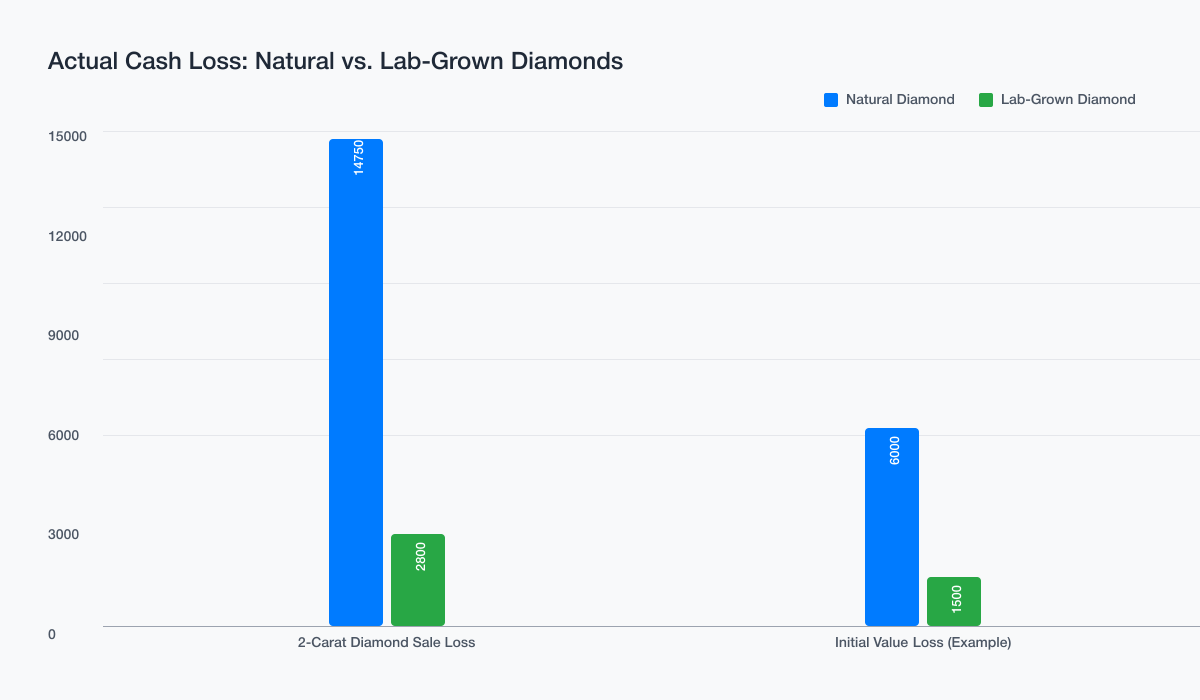
Consider a 2-carat natural diamond purchased for $29,500. Even if you're fortunate enough to recover 50% upon resale, you've still incurred a substantial loss of $14,750. This is a significant sum, far more than mere pocket change.
Now, contrast this with a comparable 2-carat lab-grown diamond, costing perhaps $2,800. If its resale value drops to zero—a complete 100% loss—your actual financial hit is $2,800.
Comparing these scenarios, a 50% loss on the natural diamond results in a $14,750 depletion, whereas a 100% loss on the lab-grown stone amounts to only $2,800. As Forbes succinctly puts it, "losing 50% on a $29,500 2-carat mined diamond is much more than losing 100% on a comparable $2,800 lab-grown stone." The difference in actual cash loss is nearly fivefold.
This recontextualizes the discussion from "investment" to "cost of ownership." What is the true financial expenditure once that "bling" has run its course? GemJewelersCo provocatively suggests that a 100% loss on a lab diamond can be less financially painful. Natural diamonds typically depreciate 30-60% the moment they leave the store, with entities like Fire & Brilliance observing that pawn shops acquire them at a mere fraction of the original price, highlighting immediate, significant depreciation. The percentage game often masks the much larger dollar figure you ultimately forfeit.
Forget percentages; instead, count your actual dollars, because the true loss is the cash you will never see again.
Frequently Asked Questions
Q: Are lab diamonds fake?
A: No, absolutely not. Lab-grown diamonds are chemically, physically, and optically identical to natural diamonds. The Federal Trade Commission (FTC) guidelines unequivocally confirm their status as real diamonds, merely grown in a controlled laboratory environment.
Q: Are lab diamonds similar to cubic zirconia (CZ)?
A: This is a critical distinction: absolutely not. Cubic zirconia is a simulant—a synthetic material that mimics the appearance of a diamond but possesses none of its intrinsic properties. Lab diamonds, conversely, are actual diamonds, a fact that Varniya and other experts clearly delineate, preventing the common misconception where buyers are defrauded believing they've purchased a diamond when it's merely CZ.
Q: Can a jeweler easily tell the difference between a natural and lab diamond?
A: Not without specialized equipment. A standard jeweler's loupe or even the naked eye is insufficient. Jewelers require specific tools designed to detect unique growth patterns or trace elements characteristic of either natural formation or laboratory synthesis. Therefore, visual detection by the casual observer is virtually impossible.
Q: Is there still a social stigma associated with lab-grown diamonds?
A: The stigma is rapidly diminishing, particularly among younger generations. Modern consumers increasingly prioritize factors like value, ethical sourcing, and personalized preferences over outdated traditions. As the resale market for natural diamonds continues to shift, the social acceptance of lab-grown diamonds is quickly expanding.
Q: What is the recommended approach for purchasing a lab-grown diamond?
A: The best approach is to be well-informed and pragmatic. Establish a clear budget, identify your desired size and sparkle, and embrace the reality that you are acquiring a stunning stone at an exceptional price. Enjoy its beauty for what it is—a magnificent adornment—without the misconception of it being a financial investment. For a curated selection of high-quality options, you can explore offerings like those at www.thestellariscollection.com.
Know the facts about lab-grown diamonds to make a confident and budget-conscious choice.
Alright, let's conclude with absolute clarity. The data unequivocally demonstrates that a diamond purchase is a significant financial decision, one that directly impacts your pocket, regardless of any sentimental attachments. True value must be assessed with open, realistic eyes.
In summary, the key distinctions are:
Natural Diamonds: While never an appreciating asset, they retain some* value—typically 20-60%—due to established secondary markets, perceived scarcity, and deep-seated traditions, offering a tangible albeit depreciated return.
- Lab-Grown Diamonds: These are commodities with negligible resale value, often fetching only 10-30% on a rare good day. Their unlimited supply and falling production costs cement their status as consumer goods designed for immediate enjoyment, not future liquidity.
Absolute Dollar Loss: Crucially, the actual cash loss on an expensive natural diamond can significantly exceed* the entire purchase price of a comparable lab-grown stone, even with a higher percentage retention for the natural. Both are luxury goods, neither is an investment.
Your ultimate choice should align with your priorities: budget, desired size, or symbolic significance. However, it's vital not to confuse emotional value with sound financial judgment.
Arm yourself with facts and resist marketing hype from any source. For substantial purchases where retained value is a consideration, seek expert guidance that prioritizes market liquidity and verifiable numbers over aesthetics. When you're ready to choose, consider exploring trusted vendors like The Stellaris Collection to make an informed decision.
Your diamond purchase is a financial decision, so prioritize real market understanding over sentimental illusions.
