

Rolex Market Trends 2026: An Investor's and Collector's Guide
The Stellaris Journal
Forget the speculative frenzy of 2022
that ship has sailed. The Rolex secondary market is up a respectable 7.9% year-over-year as of Q1 2026, according to WatchCharts. However, this is not a rising tide that lifts all boats; it is a choppy, selective landscape where the "buy any steel sports watch" strategy is officially dead. The easy money has evaporated, replaced by a 2026 environment where success demands research, precision, and a deep understanding of intrinsic value.
The 2026 market demands a shift in strategy: move away from broad speculation and toward precise, data-driven acquisitions.
TL;DR
The bubble popped. And good riddance. We are no longer in the 2022 fever dream. We are in a stable, selective growth phase
up 7.9% year-over-year, according to WatchCharts (March 2026).
Stainless steel sports models are still winning. The Daytona, GMT-Master II, and Submariner remain the heavy hitters. High demand meets limited supply. It
s a classic squeeze. But don
t assume everything is rising. Precious metal models are following the commodity markets. Take the olive dial Day-Date. It jumped from ~$51k to $59k. Why? Because the gold market is driving the price, not just hype.
Value is strictly in the details. You need the box, the papers, and the original links. If you are missing these, you are losing equity. It is that simple. And watch for the rumor mill. When the street talks about discontinuing the GMT-Master II 'Pepsi,' prices swing $1k to $2k instantly. Pair that with the 4-9% retail price hikes from January 2026, and you have a market that actually moves for those paying attention.
The 2026 Rolex market rewards informed, specific choices over broad speculation. Stop betting on the brand. Start betting on the serial number.
Decoding the Numbers: The Post-Hype Rolex Market in 2026
Remember March 2022? Everyone with a checkbook thought they were a watch dealer. The ChronoPulse index hit an artificial peak, and then the inevitable correction kicked in. It wasn't a crash; it was a reality check.
We
ve seen prices stabilize since mid-2023. The chaos of the 2021 hype wave is dead. If you look at the long-term data, a 28% price increase from May 2020 to May 2025 looks like a fantastic return. But do not get blinded by the five-year average.
The market has hit a wall. Between April 2025 and April 2026, we only saw a ~2% increase. That is the "new normal." The days of buying a GMT and flipping it for a 30% profit in a month are gone. If you are looking for explosive, get-rich-quick returns, you are looking at the wrong asset class.
So, how does Rolex stack up against the rest of the room? It is a mixed bag. Patek Philippe is up 16.2%, showing massive strength. Audemars Piguet is barely breathing at 3.4%. Rolex sits at 7.9%.

It isn't the highest performer, but it is the most liquid. The data shows brand-specific dynamics are in play. Patek is playing a prestige game. AP is fighting to keep its hype alive. Rolex is just doing what Rolex does: sitting in the middle, remaining the industry anchor.
You need to understand that the volatility is gone. It has been replaced by a market that demands patience. The data doesn't lie. It suggests a more predictable, functional environment. It is less fun for speculators, but it is much safer for everyone else.
While explosive volatility has subsided, Rolex has solidified its position as the industry's most liquid anchor, favoring the patient collector over the short-term speculator.
The Winners' Circle: Which Rolex Models Are Outperforming?
Forget the hype train. Most people buying Rolex today are chasing shadows, but the data tells a different story. And if you look at the raw numbers, the stainless steel sports models are still the only ones worth holding for the long haul.
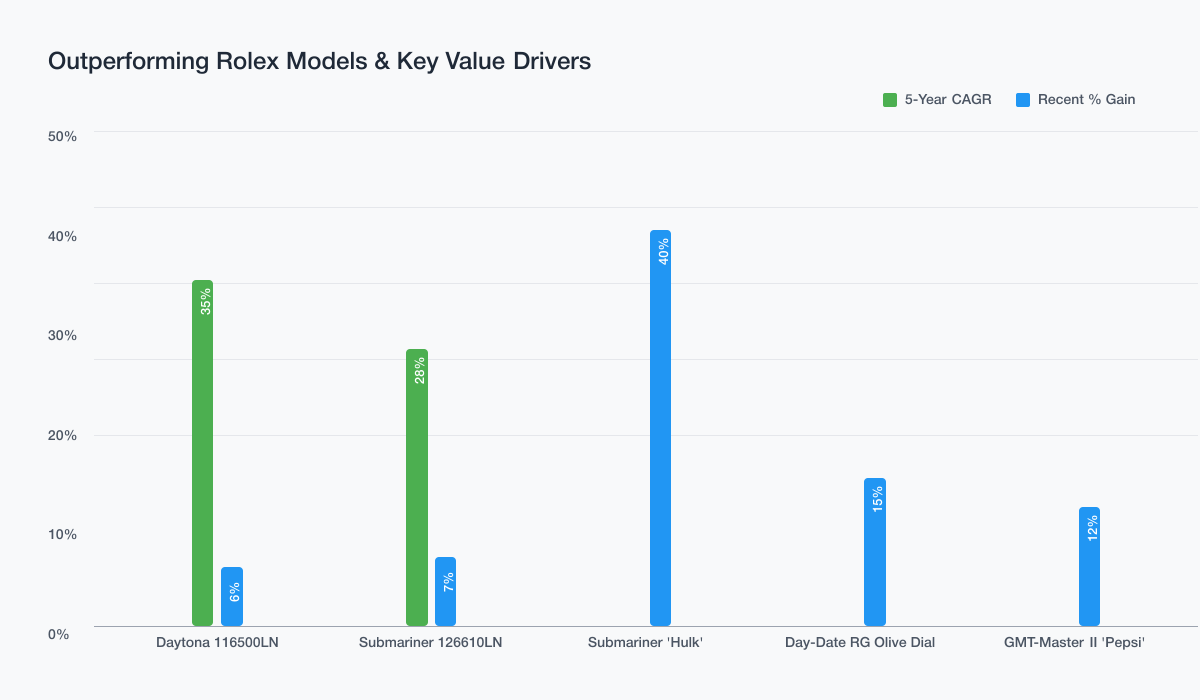
But you have to be precise. The Daytona 116500LN is a monster, posting a 35% five-year CAGR. It isn't just a watch; it's a financial instrument. So is the Submariner 126610LN, sitting comfortably with a 28% five-year CAGR. Even Similarweb (2024) shows that market interest remains hyper-focused here, and for good reason. It
s liquid. It
s reliable. It
s the cash equivalent of the watch world.
Yet, don't ignore the speculators. The GMT-Master II 'Pepsi' (126710BLRO) proves that sentiment drives value as much as craftsmanship. Every time a rumor hits the forums claiming it
s getting discontinued, the price spikes. Because scarcity
real or imagined
moves the needle faster than anything else.
And then there
s the gold market. Precious metals are acting as a hedge. The rose gold Day-Date with an olive dial? It ripped up over 15% in a blink. Why? Because gold prices aren't waiting for the watch market to catch up. They forced the move.
You also have the "ghosts." Models that aren't even made anymore are suddenly royalty. The Submariner 'Hulk' is the perfect example. It hasn't been in the catalog since 2020, but it
s up 40%. It
s a cult classic.
But watch out for the weird surges. Sometimes a specific configuration, like the Rhodium Diamond Dial Datejust 41, just catches fire without a logical reason. Is it a trend? Maybe. Or maybe people just got bored of the steel sports craze. Either way, keep your eyes on the data. The Daytona 'Panda' 116500LN didn't wait for permission to jump from $33.5k to $35.5k in a few months. And the Submariner Date 126610LN? It climbed from $14.5k to over $15.5k in less than a quarter.
Scarcity and iconic status are no longer just buzzwords; they are the fundamental drivers keeping your portfolio green in an unpredictable market.
*
Beyond the Reference Number: Critical Factors Driving Rolex Value
Stop obsessing over the dial color for a second. If you
re buying a Rolex, you
re buying a mechanical asset, and in a mature 2026 market, the story of that specific watch matters more than the model name stamped on the tag.

Because here is the truth: a "full set" is non-negotiable. If you are missing the box, papers, or that little warranty card, you are leaving money on the table. And the gap is getting wider. Buyers are smarter now (finally). They aren't settling for loose watches unless the discount is massive.
Then there is the condition. A "perfect" watch with a polished case is worth less than a "used" watch with sharp factory lines. Over-polishing is a sin. It destroys the geometry of the case, and collectors know it. Once those lines are soft, they never come back.
But pay attention to the tech. The move to Cerachrom bezels was a game changer. They are 70% more durable than the old aluminum stuff, and the market rewards that reliability. You want a watch that doesn't look like it went through a blender after three years of wear.
Also, consider the aesthetics. Green dials like the 'Hulk' are printing money. So are unique materials like meteorite dials. These aren't just pretty faces; they are differentiators in a sea of sameness.
And if you
re looking at customizations, tread carefully. A professional, high-end job can bump resale value by 25-40%. It adds a level of exclusivity that the factory doesn't offer. But if it
s amateur hour
bad parts, sloppy work
you
ve essentially torched your investment. You
ve taken a liquid asset and turned it into a paperweight.
In a quality-driven market, the combination of pristine condition, complete documentation, and original provenance determines whether you are holding a lasting asset or a depreciating liability.
*
Frequently Asked Questions About the 2026 Rolex Market
What
s the smartest play for an investment piece right now?
Stick to the classics that move volume. Stainless steel sports references like the Daytona and the Submariner are the heavy hitters. With 5-year CAGRs sitting between 22% and 35%, they outperform most other asset classes.
Is it actually a good time to pull the trigger?
Yes. The 2022 speculative froth is long gone, and the market is finally rational. You aren't fighting a crowd of day traders anymore. It
s a buyer
s market for those who know what they
re looking for.
How bad was the price hike in January?
Rolex bumped US retail prices by 4-9%. That puts an immediate floor under the secondary market. If retail goes up, your inventory gets a tailwind.
How does Rolex stack up against other big names?
It
s the king of liquidity. It posted 7.9% growth over the last year. Sure, Patek Philippe crushed it at 16.2%, but Audemars Piguet is struggling, crawling at just 3.4%. Rolex is the safe, steady bet.
What happens if I start swapping parts or getting creative with the dial?
Proceed with caution. If it
s professional-grade work, you can see a 25-40% premium. But if you start messing with the authenticity or using low-quality parts, you
re killing the watch
s value. Don't ruin a good thing.
The current Rolex landscape is rational and buyer-friendly, provided you prioritize liquidity and proven models over passing trends.
*
Bottom line: The market's not a casino anymore. That 2022 fever dream? Long gone. What we
ve got now is a grown-up game. A real market, not just pure speculation. But don
t confuse "stable" with "boring"
there's still money to be made. Or lost, if you're not paying attention.
Here's the rub for 2026:
- The free ride ended; welcome to selective growth. We
- Stainless steel sports models still run the show
- Value? It's all in the details now. A full set, perfect condition, original parts. That
re talking a modest 7.9% uptick. Not your grandad's easy money; you gotta pick your spots.
Daytonas, GMTs, Submariners. They always do. But don't sleep on precious metal, like the olive Day-Date; commodity prices drive those. Gold's not going anywhere.
s what fetches a premium. (Anything less is just a project.) Discontinuation whispers and annual retail hikes? Real market movers. Keep an ear to the ground.
Want a Rolex? A smart buy? Your approach needs a brain. Focus on the watch, not Instagram hype. Get objective. Understand why certain references hold sway.
So, where does that leave you? Not standing around, I hope. Because frankly, the window for dumb money purchases is shut. Get smart. Know what you
re buying, why you
re buying it. And if you need a straight shooter to cut through the noise
someone who
s seen it all
talk to the pros who understand provenance and pricing, not just pushing a sale.
The era of the speculative 'fever dream' is over, and the time for savvy, data-backed acquisition has arrived.
