

Audemars Piguet Values: A Data-Driven Analysis of Scarcity and Demand
The Stellaris Journal
Okay, Q2 2025 has wrapped, and the data is in. Audemars Piguet watches averaged a brutal 41.2% premium over retail. That isn't just hype; that is tangible capital appreciation.
But if you believe this performance is driven solely by "scarcity," you are mistaken. The market has matured, and today's buyer requires structural liquidity, hard data, and clear metrics. The era of simply waiting for a watch is over.
We are moving past the rumors. This analysis isn't about chasing market sentiment; it is about identifying the drivers of AP value for the long term. We are cutting through the noise to determine which models matter, how AP is positioning itself, and where the real advantage lies for collectors and investors.
By analyzing the mechanics of the Audemars Piguet market, you can transition from speculative buying to calculated asset management.
Why Audemars Piguet's Value is More Than Just Hype: The TL;DR
Let
in dispense with the fairy tales. The watch market is not driven by prestige; it is driven by numbers. If you believe Audemars Piguet is riding on pure hype, you are analyzing the wrong spreadsheets. Data from Q2 2025 confirms an average 41.2% value retention above retail, representing cold, hard liquidity.
The narrative used to be exclusively about scarcity. That is outdated. Similarweb (2024) indicates a clear shift toward structural liquidity. It is not about the quantity of watches in the vault; it is about the velocity of the asset. Models like the Royal Oak 15500ST and 16202ST are dominating because they move; they function as the blue-chip stocks of the watch world, supported by a deep buyer pool that prevents the floor from dropping out.
However, the game has rules. Blue dials are fetching an 18% premium. Missing the original box or papers? Expect a 12.4% penalty immediately. The brand is also bracing for a 2026 strategic reset, moving away from the "steel sports watch" cult of personality toward genuine design evolution. Collectors are no longer buying myths; they are buying assets.
Stop emotional buying; if you are not tracking dial variance and documentation completeness, you are not an investor
iyou are a mark.
Understanding Audemars Piguet's Foundational Value
The high valuation of AP watches is not a random occurrence; it is built on granite. Founded in 1875 in Le Brassus, Switzerland, the company earned its place as part of the "Holy Trinity" of Swiss watchmaking. This title was not a participation trophy; it was earned through an unwavering commitment to quality and horological achievement, including the first minute-repeating movement in 1892.
The paradigm shift occurred in 1972 with the Royal Oak. Before this, luxury was synonymous with dressy, delicate timepieces. AP challenged that by dropping a stainless steel sports watch, creating a shockwave that defined the modern high-end daily wearer.
Today, production is strictly capped at approximately 50,000 units per year. This exclusivity is by design. Hodinkee has frequently highlighted how these tight production numbers solidify value. The brand successfully bridges the gap between heritage and modern cultural influence, evidenced by their presence in the collections of global icons. Because of their history, innovation, and limited production, the brand remains immovable.
AP
i s value is not accidental; it is a ruthless, carefully constructed empire.
The AP Secondary Market: Where Data Defines Value
Forget the rumors. The smart money ignores "grail" narratives. Success in this market is defined by movement and structural liquidity
ithe ability for an asset to change hands without volatility. The only metrics that matter are turnover and transaction velocity.
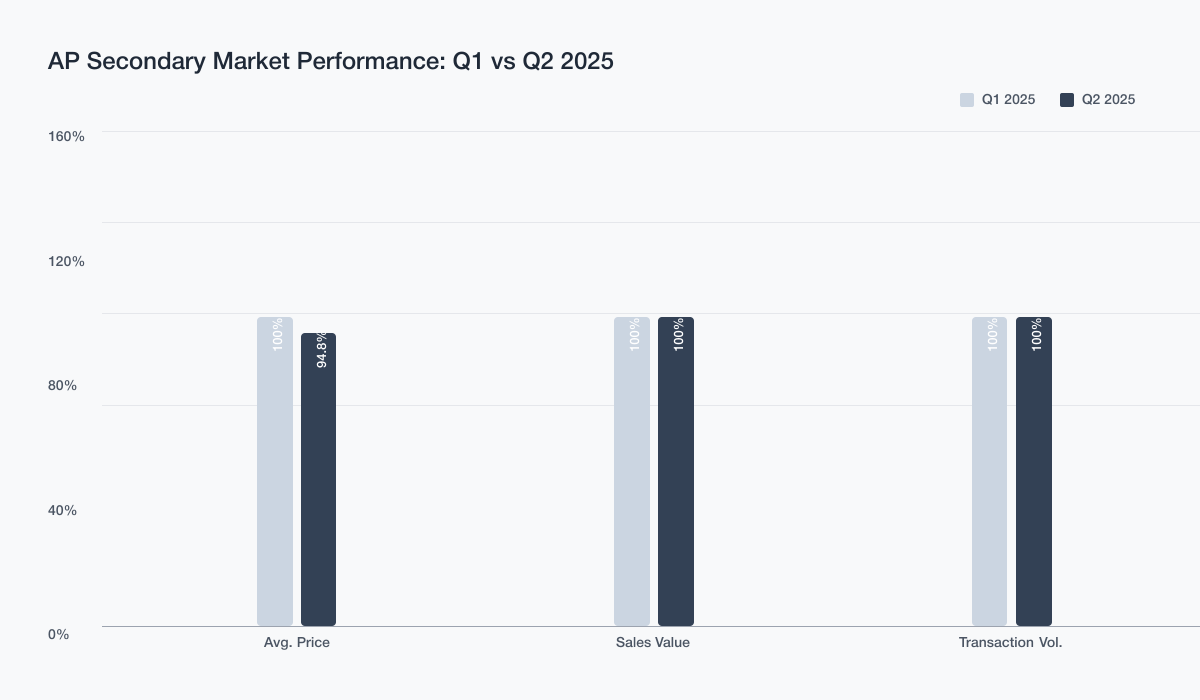
The market has shifted. Relying on vague notions of "scarcity" is a novice error. Real market health is measured by consistent demand, not isolated bids. The Royal Oak remains the primary driver of this market, accounting for 52.6% of secondary AP sales. While Code 11.59 models are available, they do not possess the same liquidity.
We observed a 5.2% average secondary price dip from Q1 to Q2 2025, which Morgan Stanley (2024) classified as a market correction. However, total aggregated sales value jumped 46.2%, and EveryWatch data shows that transaction volume increased by 46.7% quarter-over-quarter. Real collectors are returning to the market, and they are buying fast. The Royal Oak 15450ST, for example, frequently clears the market in fourteen days.
Liquidity and turnover are not fancy words; they are the pulse of the market, and they prove that real-world transaction speed is the only demand signal that matters.
The Audemars Piguet Scarcity Strategy: Myth vs. Reality
AP's scarcity is not an accidental by-product; it is a cold, hard business strategy. They do not fail to meet demand; they control it. Limiting production to roughly 1,200 Royal Oak Jumbos annually out of their 50,000-unit total is a gate, not a bottleneck.
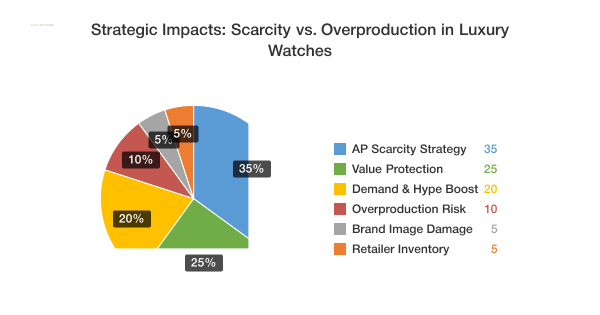
This is a strategic decision rather than an inability to scale. Historical data from the Richemont group, who once had to spend 250 million euros to buy back unsold inventory, serves as a warning against overproduction. AP learned that lesson well: overproduction is brand poison.
They operate on the philosophy of "one less watch than there is demand for." This maintains the fire and ensures their timepieces hold value. Similarweb (2024) data confirms that scarcity drives engagement and search interest. When even Rolex had to cut production in 2009
ia fact noted by Morgan Stanley
iit reinforced that managing supply is the primary tool for price stability.
AP
i s scarcity is a calculated operational constraint, not a production failure, which protects your long-term asset value.
What Drives an AP's Premium? A Quantifiable Guide
Stop looking at the sticker price; the only metric that matters is what the market is actually paying, which fluctuates based on specific variables.

Dial Dynamics
Color is a value multiplier. On the Royal Oak 15500ST, a blue dial commands an 18% premium over other configurations. Similarweb (2024) confirms that search volume heavily favors classic blue, establishing it as a reliable, recurring pattern in market appetite.
Material and Rarity
Ceramics change the equation. The ref. 26579CE perpetual calendar, for instance, often trades at nearly double its retail value due to manufacturing complexity and limited output. EveryWatch data indicates that liquidity on these references is aggressive.
The "Full Set" Premium
This is where value is lost. Across the secondary market, a complete set
ioriginal box and papers
iadds an average of 12.4% to the final transaction price.
Vintage Gravitas
Provenance is a distinct asset class. The vintage Royal Oak 5402ST 'A-series' is a blue-chip asset, often clearing $100,000 at auction. However, the market is flooded with "Franken-watches," meaning only authentic, untouched specimens retain this floor.
Focus exclusively on the raw data points
idial color, set completeness, and provenance
ibecause if the watch lacks these, the market will not pay the premium.
The 2026 Reset: AP's Strategy for a New Market Reality

The era of unchecked hype has ended. While Royal Oak prices are finding a new floor, the market has matured, and Similarweb (2024) confirms the frantic search for "investment" pieces is cooling. AP is planning a 2026 reset, and it will be an aggressive pivot.
The strategy involves shifting focus away from volume toward deeper refinements in case geometry and bracelet articulation. To feel premium again, AP must move beyond the "steel sports watch" and lean into ceramics, titanium, and hybrid composites. They have noted Rolex
i s success with titanium and are adjusting accordingly.
The most significant shift is the move toward a decentralized production model. AP is choosing to win prestige battles rather than volume battles. They intend to own the top of the pyramid. The era of buying anything with a tapisserie dial is done. Investors must look toward experimental materials and complex composites where actual future value resides.
If you are holding a mass-market Royal Oak, watch the 2026 releases closely, as the market is shifting from brand-general demand to specific, high-complexity asset appreciation.
Actionable Insights for the Modern AP Collector
For the entry-level investor, the 15500ST remains the standard for liquidity. Ensure you acquire the full set, as the 12.4% premium on box and papers is non-negotiable. For the veteran, shift your focus from asking prices to turnover rates. Liquidity is the new metric; the ability to exit a position at a fair price is the hallmark of a serious watch investment.
Keep a close eye on ceramic models. Similarweb (2024) data suggests they are a key growth area, potentially offering higher yields than standard steel configurations. Meanwhile, the 2026 reset represents a critical case study for the entire luxury sector
ican a brand successfully innovate while maintaining exclusivity?
The 41.2% value retention is not a permanent guarantee. You must buy for the market of tomorrow, not the FOMO of yesterday.
True market value is defined by velocity; focus your capital on assets that demonstrate both historical provenance and rapid secondary market movement.
*
The numbers are clear. The average 41.2% premium in Q2 is not a mystical force; it is structural liquidity driven by transparent metrics. Scarcity is not an accident
iit is a calculated output. Your position is directly linked to quantifiable attributes: specific models, market depth, and the ability to exit the trade.
The era of merely coveting an AP is over; the era of understanding its true market mechanism has arrived. Stop guessing. Get the data. Know the dynamics. If you are serious about this asset class, you need clear-eyed analysis, not wishful thinking.
If you want to master this market, stop chasing the hype and start tracking the liquidity. A curated collection built on these principles is the ultimate goal.
