

Luxury Market Trends 2026: Navigating Volatility and Redefining Value
The Stellaris Journal
You've probably seen the numbers, but are you really looking? Mass-market beauty, up 4% in the first half of 2025. Not bad. But its fancier cousin, "prestige" beauty? Just 2%. That’s not a blip; it's a flashing red light for anyone stuck in the mushy middle.
The market's splitting, plain and simple. Two distinct lanes are emerging: rock-solid value or something so absurdly exclusive it almost hurts. (And don't even get me started on the brands trying to be both
– that’s a total clown show.) Consumers are smartening up. Economic squeeze, certainly. But also, they are now critically thinking about what they're buying—what works, what's truly worth it.
This isn't some abstract trend. This is the new rulebook for 2026. Decisiveness is the new differentiator. Pick a side. And commit. Or watch your "prestige" evaporate.
TL;DR
So, you want to know about luxury in 2026? Here's the deal: forget what you knew. The market has fundamentally shifted, splitting into clear extremes. You have the highly effective, value-driven offerings (which, surprisingly, work) and the ultra-expensive, no-questions-asked luxury. There’s virtually nothing compelling in between. That middle market, the "prestige" segment? It’s simply stuck, and it’s dying fast.
Your customers are no longer a monolithic group. Not really. You have the insulated affluent who barely notice inflation, and then the astute consumers playing high-low strategies (and often winning). But there's also new money emerging, big money, from unexpected places. Asia, the Middle East, Japan—these are the new hot spots.
And product? Nobody wants fleeting trends anymore. People are buying actual investments: jewelry, real pieces that hold value. Ready-to-wear, that flash-in-the-pan stuff, is a significant risk because consumer demand has changed. Furthermore, AI and resale are no longer side projects; they are becoming the backbone of the industry. It's a foundational shift.
So, what's the imperative? Pick a lane. Seriously. Make a choice. Either go full-on, no-compromise luxury, or commit to pure, honest value. The fuzzy middle? It’s a trap, a money pit. Ambiguity is what gets you killed in this market. The market rewards clarity and punishes indecisiveness, forcing brands to choose between extreme luxury and proven value. Mass-market beauty grew 4% against a meager 2% for prestige in H1 2025. That's a clear indicator. Even Similarweb (2026) shows the shift, with 63% of customers now defining luxury by craftsmanship and longevity. They know what they want.
Pick a side. Or prepare to get swallowed.
The Great Bifurcation: Why the Middle Market is Disappearing
Here's the ugly truth. That sweet spot you thought you had, the 'accessible luxury' thing? It’s gone. Poof. Because people are just smarter now. They got squeezed during the pandemic (didn't we all?). So, you can be sure every dollar is being scrutinized, and for good reason. They want proof, real results, or an experience so exceptional it justifies the price tag. Nothing less.
And what happens when consumers get smart? They either opt for cheap and effective, or they go full-bore luxury. But nothing in the middle. Not much, anyway. So, look at the numbers. Mass-market products? They’re not just holding their own; they’re winning, capturing all the savvy shoppers who recognize a good deal.
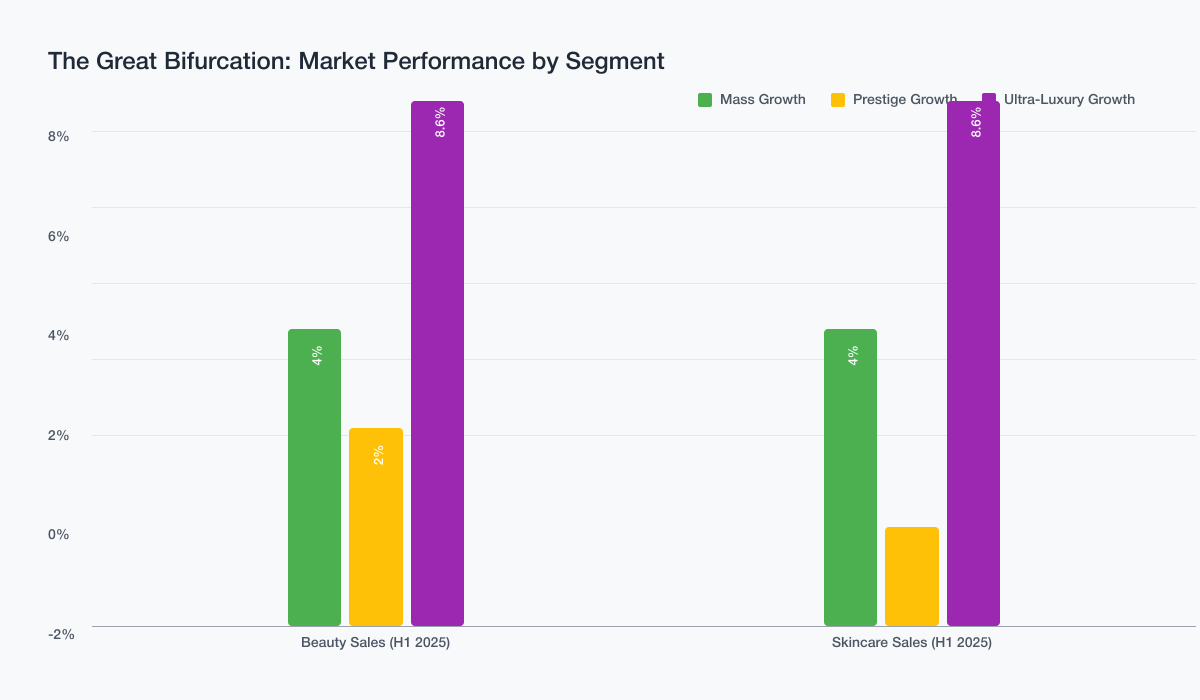
Circana (H1 2025) told us this months ago: mass beauty shot up 4%, but prestige beauty only managed a miserable 2%. And skincare? Mass skincare sales jumped 4%, while prestige skincare actually declined by 1%. You read that right: down.
But here’s the kicker. The real luxury market, the ultra-luxury segment? Still bulletproof. Absolutely. Because the truly rich are largely unaffected by macroeconomic turbulence. Luxury skincare, for instance, didn’t just grow; it surged a solid 8.6% year-on-year between 2024 and 2025 (The Business Research Company). That's a hell of a gap, isn't it? A chasm.
So, the 'accessible luxury' pitch? It’s simply not compelling anymore. Nobody's buying it. Consumers have figured it out. They either find a "dupe"—a knockoff that works just as well for a fraction of the price—or they save up, waiting for the real deal, the actual luxury item. No more buying something because it feels kind of fancy. That’s wasted money. People aren't fools.
And this isn't just about lipstick or fancy creams. This polarization is everywhere, even in health. If it’s an over-the-counter product, people want one of two things: either a super-premium, science-backed solution that actually works (and costs a bomb), or the cheapest thing that gets the job done. But that mid-tier health product—the one that’s not quite luxury, not quite budget—Kline’s market tracking shows it's simply getting squeezed. And it's not going to get better. The concept of 'accessible luxury' is losing its relevance as consumers decisively move towards the poles of either proven value or unapologetic opulence. This isn't a trend; this is just how it is now.
The middle market is dead. Get over it.
Decoding the Modern Luxury Buyer: Three Personas Driving Growth
You think you know your luxury buyer? You probably don't. And that’s a problem. Because success in 2026 doesn't come from some vague idea of "the luxury consumer." That's a myth, a generic concept. Instead, it’s about understanding distinct tribes, real people with different wallets and different mindsets. You've got to tailor everything: your products, your advertising, how you communicate with them. If you don’t, you're just yelling into the void.
Here’s the thing. There are three main types, three distinct personas. And you need to know them, every one.
First up, you've got the Insulated Affluent. These individuals are typically older, often from the silver generation. They own a significant portion of the wealth in places like the US and Europe—over 70% of disposable wealth in mature Western markets, according to CXG. They’re not just old money; they're smart. They buy what they want, when they want it, and they expect the best, no questions asked, no haggling. They simply don't feel the economic pinch everyone else does. For them, it’s about heritage, enduring quality, and status that isn’t trying too hard. They want their known brands, their trusted pieces. And price? It’s not the first question; it’s almost irrelevant. They just want it to be right. And if it is, they'll pay, easily. Fitch Solutions has shown us how resilient ultra-luxury brands are; that’s these buyers’ world, their playground.
Then there’s the Mix-and-Match Shopper. This is a big one, a really significant segment. And they are incredibly savvy. These consumers don’t buy luxury everything. No. They’ll get their face cream from the drugstore (if it works) and wear a designer jacket with jeans from Target. It's true. They demand proof of efficacy for most things—why wouldn’t they? But they’ll save, they’ll plan, and then they'll splurge on that one incredibly expensive watch or that killer bag—that strategic luxury item. They understand the difference between a real investment and merely something expensive. Freethebirds.com has discussed this. It’s not about the label everywhere; it's about value, real value. For them, every purchase is a decision, a trade-off. They’re not aspirational consumers in the old sense; they’re skeptical, very skeptical. They won’t pay a high price without a clear, compelling justification.
And finally, the New-Wave Wealth Holders. Forget your grandpa’s luxury market; this isn’t it. These are the younger, ultra-high-net-worth individuals, and they’re emerging everywhere: India, Southeast Asia, the Middle East. They’re not waiting to inherit; they’re making their own money, and a lot of it. But their idea of luxury is different. It’s not always about tradition or heritage. Sometimes it’s about newness, about experiences, about being first, or about something that connects to their specific culture and values. They move fast, they influence fast, and they’re not tied to the old guard. They’re charting their own course, and that means new brands, new designers, new tech—all of it.
Success in 2026 hinges on moving beyond broad demographics to engage with the specific values and behaviors of distinct consumer tribes. Know your customer. Or watch someone else take their money.
Shifting Horizons: The New Geographic Power Centers of Luxury
Forget the old map. Seriously. That quaint idea that the U.S., Europe, and China are still the only games in town? That's just comfort food for executives too scared to look up. They’re anchors, sure. But anchors don't push you forward; they hold you steady. And sometimes, they drag. Look, the S\&P 500 and U.S. luxury demand? They're practically roommates, with an 87% correlation. Safe. Stable. But boring. Because aggressive growth? That's happening somewhere else.
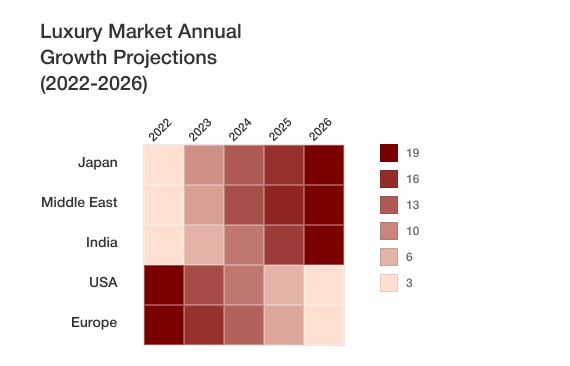
It's a crazy shift, actually. You think you know where the money is, but you don't. Or you didn't. Deloitte spells it out. The real engines by 2026? Japan, the Middle East, India. They're not just whispers anymore. Japan is projected at a wild 19.0% growth. The Middle East is right behind it at 17.9%. And India? Pulling up strong with 11.9%. So. Are you going to ignore that? Or are you going to chase it? Kearney calls Japan and Southeast Asia "outperformers." Big time. You find younger, high-earning professionals there, building fortunes and spending them. Japan, too, has this incredible domestic demand, plus their equity markets are buzzing—good for business.
Meanwhile, Europe? It’s basically hoping tourists from North America and the Middle East show up. Fragile. That's the word. And it's not a strong word, is it? So, if your brand is still planning everything based on some rigid, global calendar, you’re in serious trouble. Utterly. You need to be agile, regional—like, yesterday. Because the future of luxury growth? It's decentralized, spread all over the place. And you better understand what makes those local people tick, or you’ll just be another brand selling last year's vision in next year's market.
Adapt. Or get left in the dust.
Investment vs. Indulgence: Which Product Categories Are Winning?
People are getting smarter. Or maybe just poorer. Either way, they’re not buying thoughtlessly anymore. And the way they spend their money? It’s split, a real dichotomy.
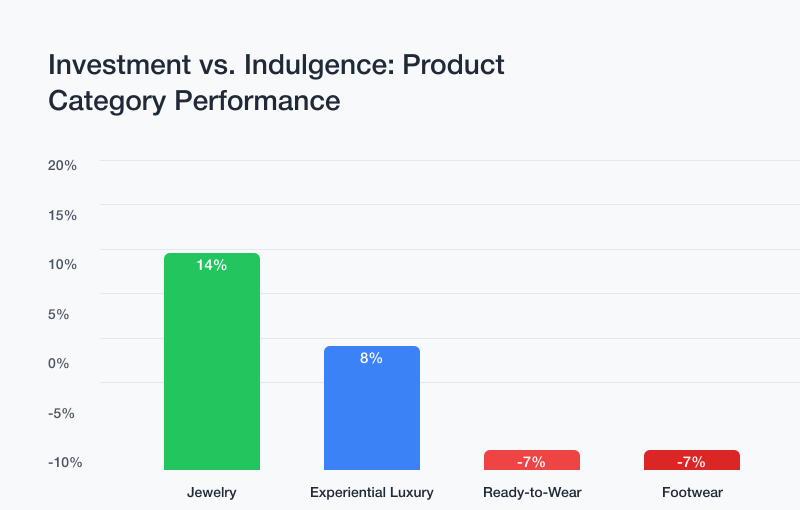
What’s flying off shelves? Jewelry. Absolutely crushing it, with 6% to 14% growth. That's a huge swing. And you know why? Because it feels like an investment, a safe bet—something that holds its value, maybe even grows it. Timeless, tangible pieces are exactly what people want when the economy feels like a clown car teetering on a cliff.
But ready-to-wear? Footwear? They’re getting hammered, down 5% to 7%. Because prices are up. Priorities are shifting. Why buy another expensive jacket when your savings account looks nervous? So, people are choosing value—stuff that lasts, not just another fleeting fashion trend. And then there's experiential luxury. Wow. That’s an 8% compound annual growth through 2028. People want to live, not just own things. They want the trip, the private dinner, the extraordinary adventure. Deloitte's survey found luxury travel to be the top growth segment for 36.2% of executives. And they know.
So, what does that tell you? You need to fix your product mix. Get real about it. Stop pushing stuff that nobody needs or wants to pay exorbitant prices for. Focus on high intrinsic value, longevity, things that don't just sit in a closet. Or, make the experience so exceptional they can't say no. Because right now, consumers are prioritizing things that last, or things they can truly feel. Anything else is just noise.
Give them real value. Or they walk.
From Experiment to Essential: AI and Circularity as New Infrastructure
Alright, the "AI will save us all" hype? Yeah, I rolled my eyes too, for a while. But here’s the thing. It’s not an experiment anymore, not for anyone serious. It’s infrastructure. A non-negotiable.

Look, investment in technology, specifically AI, is projected to grow 16.2% annually over the next decade, according to Kearney. And it’s not because people suddenly love robots. It’s because it’s becoming essential. You use it, or you get left behind. Simple as that.
And what are the smart brands doing? They're using AI to actually get their supply chain to behave: real-time orchestration, predicting demand so they're not drowning in unsold stock. Forty-one point two percent of luxury companies are already actively deploying GenAI in specific areas. They've moved past the "exploration" phase. They're building. They're applying. And it's working.
Then there's circularity. Another one that felt like a "nice-to-have" forever. Now? It’s part of the deal. Consumers expect it. Sixty-eight point three percent of companies now offer repair services. Because people want their expensive stuff to last, to be fixed. And 53.8% are running certified pre-owned programs. Why? Because 63% of consumers aren't defining luxury by a big, flashy logo anymore. They want craftsmanship, longevity, a piece with a story, even if it's a second act. It's about trust. And it’s about making things last. So, this isn't some side project anymore. It’s core business. You integrate the tech. You build in the sustainability. And you do it now.
Because the future of luxury demands it.
*
So, here we are. The dust settled, didn’t it? This isn’t some abstract trend report. It’s the playbook for what’s real in 2026. The market’s done with wishy-washy. You either deliver undeniable substance or true scarcity. Anything else? A slow bleed.
What’s clear now, for anyone paying attention:
- The middle? Gone. Dead. Brands that tried to be 'premium accessible' are learning that consumers aren't fooled. They either want a deal that hits hard on utility, or they want something so rare, so bespoke, it’s beyond price comparison. No more hiding in the gray.
- Your customer isn’t who you thought. They’re fragmented, savvy, and financially sharp. Whether they're building an investment portfolio on their wrist or buying smart for daily life, they expect transparency. They expect value. And they certainly don't need your curated 'story.'
Infrastructure isn't optional anymore. AI isn't an experiment; it’s how you optimize. Circularity isn't just for PR; it's how you manage assets, enhance value, and actually own* your product lifecycle. Get on board, or get out.
It’s not complicated. Hard, maybe. But clear. The market rewards conviction now.
Bottom line: The game isn't about being seen anymore. It's about being known. Authenticity. Unwavering clarity on what you offer. This isn't just about strategy; it’s about survival.
So, if you’re serious about high-value assets—identifying them, liquidating them, or acquiring them—know your real value in this recalibrated market. That's the first step to decisive action.
