

Lab-Grown Diamonds in 2026: A Market Analysis of Price, Value, and Perception
The Stellaris Journal
Alright, let's talk diamonds. Specifically, the lab-grown kind.
Their prices? Down a staggering 96% from their peak. That's not merely a drop; it's a monumental collapse, fundamentally rewriting the rules of the entire diamond market.
Today, over 45% of all US engagement rings feature lab-grown diamonds. Pause and consider the profound implications of that shift.
This isn just a passing trend; it's a permanent market bifurcation. On one side, you have lab-grown stones essentially technological products. Beautiful, undoubtedly, but they depreciate with the speed of a new iPhone. On the other, natural diamonds represent true heritage, geological rarity, and a historical ability to retain value. Usually.
This critical divergence forces a new question: Do you opt for a larger, more affordable stone that will likely be worth less next year? Or do you choose a smaller, pricier counterpart that might actually preserve its worth? This is no longer a rhetorical exercise; it's a pressing decision for consumers.
This analysis aims to cut through the industry's noise and sentimentality. We offer no fluff, just rigorous data on price, intrinsic value, and the evolving perception of what a diamond truly represents. We're here to articulate the new reality, because failing to grasp it now means you risk significant financial missteps.
The 2026 Diamond Market: Technology vs. Tradition
Here's the harsh truth: You might have once believed diamonds were simple, perhaps even a stable investment. That perception is now utterly laughable. The market has bifurcated dramatically, splitting into two distinct paradigms: one driven by advanced technology and ephemeral newness, the other by ancient, geological permanence.
This isn't a gradual evolution; it's a seismic shift. Consider this: a 1.5-carat lab-grown diamond has seen its price plummet by an astonishing 96% from its 2018 peak. Ninety-six percent. This figure unequivocally declares that for this segment, scarcity is no longer a factor. And this redefinition has profoundly reshaped everything.
Look around. Lab-grown diamonds, or LGDs, are ubiquitous. They now adorn over 45% of U.S. engagement rings. Nearly half. This represents an undeniable, monumental shift in consumer preference or perhaps, more accurately, in consumer willingness to pay. After all, who would decline a compelling deal?
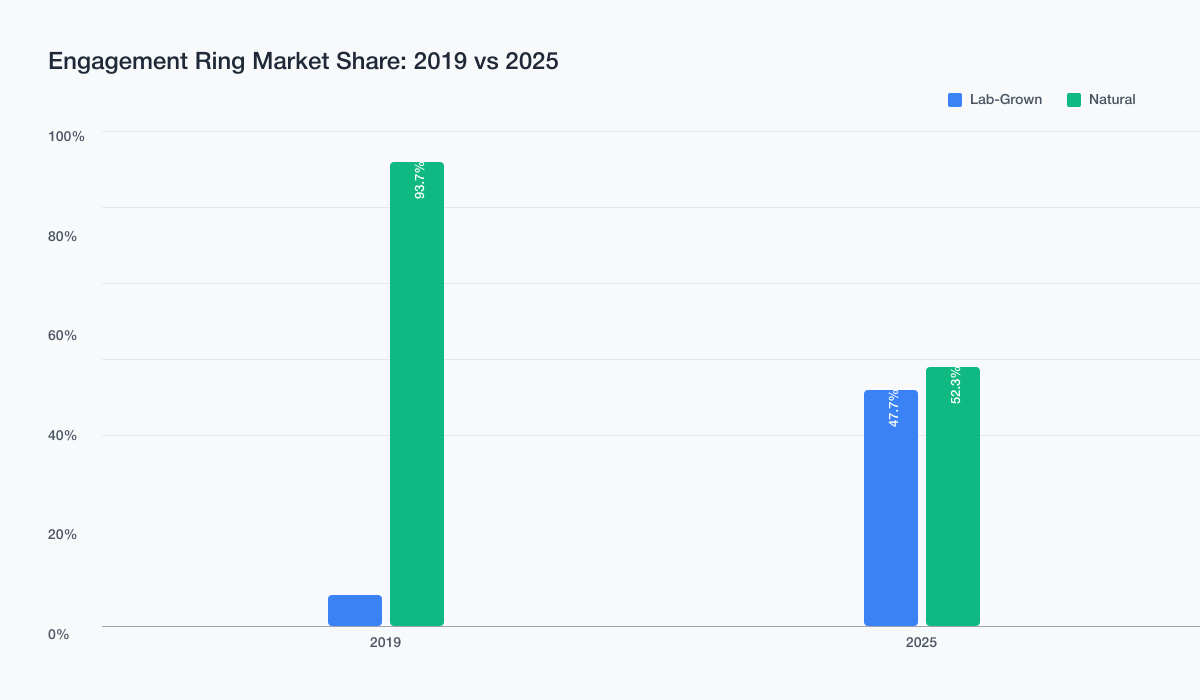
As you contemplate a purchase or sale, the fundamental question now confronts you: Is an LGD a shrewd acquisition, offering dazzling sparkle without the premium? Or is it a rapidly depreciating asset, losing value faster than an unprofitable startup? Natural diamonds, in contrast, retain their intrinsic heritage, their profound geological narrative. Data from Similarweb (2024) illustrates this upheaval: the LGD engagement ring market share surged from 6.3% in 2019 to an estimated 47.7% in 2025. Consequently, the average engagement ring price dipped from $6,000 in 2021 to $5,200 in 2024, largely due to LGDs. This isn't just about diamonds; it's about re-evaluating what "value" fundamentally means.
The diamond market has fractured into two distinct entities: one functions as a modern technological product, the other as an enduring relic of history.
Behind the Price Collapse: Understanding the LGD Economy

So, you're asking, "What's driving this?" Right? How can something so visually perfect lose its intrinsic worth so rapidly? The answer isn't complex; it's industrial manufacturing, plain and simple though its market implications are anything but.
Lab-grown diamonds are, at their core, manufactured products. They emerge from factories that continually optimize, accelerate, and reduce costs. Nations like China and India, in particular, are scaling production at an unprecedented rate. Their Chemical Vapor Deposition (CVD) and High-Pressure, High-Temperature (HPHT) methods have achieved remarkable efficiencies, leading to a massive surge in supply. More diamonds. Abundantly available, globally.
This isn't an anomaly or a market crash, as some anxious voices might claim. No, this is the inherent lifecycle of technology. Consider your smartphone or any electronic gadget: value peaks at launch, then embarks on a swift, predictable decline. A newer, better, cheaper-to-produce version is always on the horizon. This trajectory precisely describes the LGD market. They conform to this technological depreciation curve, unequivocally.
Wholesale insights confirm this trend. Reports from industry insiders indicate that some LGDs are trading as low as $80-$105 per carat. Eighty dollars. Per carat. This price point is perilously close to the actual manufacturing cost. By mid-2025, this reality was undeniable. Similarweb (2024) data reveals a stark contrast: LGDs are projected to cost 73% less than natural diamonds on average in 2026. This monumental gap has widened from a 26.6% difference in 2019 to 72.8% today. Therefore, this isn't a market in crisis. It's a market that has finally recognized a manufactured good for what it is: a commodity. And it behaves accordingly, every single time.
You are not acquiring a rarity; you are purchasing a technological product, and its value trajectory is consistently downward.
Resale vs. Retention: The 2026 Diamond Investment Reality
Let's discuss tangible wealth your wealth. You've acquired a diamond; what happens next? This is the critical juncture where many consumers face harsh realities. Crucially, "appraisal value" (the figure for insurance purposes) bears no resemblance to "resale value." Understanding this distinction is paramount, or you risk significant disappointment.
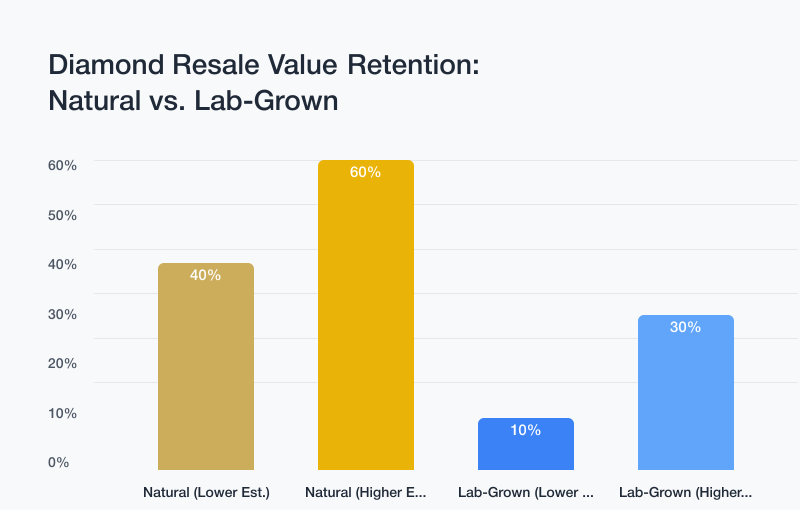
Natural diamonds, while not flawless (nothing is), still exhibit significant value retention. Historically, they tend to preserve between 40% and 60% of their original retail price on the secondary market. While not a windfall or a bond, it represents a meaningful long-term store of value a potential legacy piece. A $10,000 purchase might realistically yield $4,000-$6,000 over time, assuming you find a buyer.
Lab-grown diamonds, however? That's an entirely different, far less forgiving, scenario. You're looking at resale values that might, optimistically, range from 10% to 30% of your initial investment. And that's if you're fortunate enough to find a willing buyer. Why would a retailer repurchase a used LGD from you when they can source a brand-new, impeccably flawless stone directly from a lab faster, and at a lower cost? For them, it's sound business; for you, it's a sobering loss.
The Gemological Institute of America (GIA), the industry's authoritative body, cemented this distinction in late 2025. They officially discontinued the use of the traditional 4Cs (cut, color, clarity, carat) for LGDs, replacing them with broader "Premium" or "Standard" categories. This move unequivocally declared, "These are not natural diamonds. They are manufactured goods, operating in a fundamentally different league." This decision profoundly impacted anyone attempting to resell an LGD, as GIA certification the gold standard for protecting the secondary market value of natural diamonds tells a vastly different story for its lab-grown counterparts.
So, if you seek the unvarnished truth: Never conflate a dazzling purchase with a sound financial investment.
A natural diamond is an asset you may eventually bequeath. A lab-grown diamond is a beautiful item you bought for personal enjoyment, whose market value diminishes significantly the moment it leaves the store.
Bigger, Bolder, Better: How LGDs Are Changing Consumer Tastes
Here's the undeniable impact: Lab-grown diamonds have irrevocably disrupted the industry, completely transforming consumer behavior. You, the consumer, are now acquiring significantly larger, more dazzling stones than ever before. The reason is simple: accessibility.
Gone are the days of compromise, of settling for a minuscule diamond. Prior to the LGD revolution, choices were severely limited. Now, consumers are confidently embracing extravagance, channeling their savings into substantial, truly impressive diamonds. The average LGD center stone size continues its upward trajectory; starting at approximately 1.31 carats in 2019 (a modest size, frankly), it has surged to an estimated 2.45 carats by 2025. This represents an astonishing 87% increase, offering unparalleled carat-for-dollar value. The desire for a larger, more impactful stone is now fully realizable.
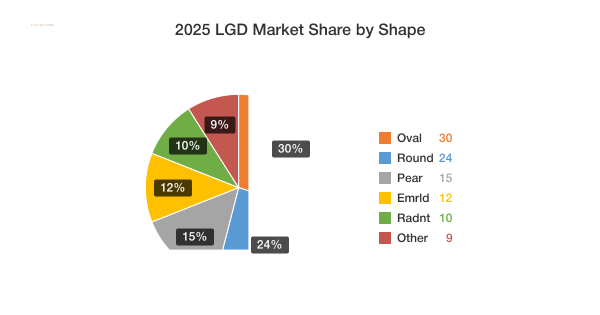
Beyond mere size, diamond shapes are undergoing a renaissance. Oval cuts, remarkably, have become the dominant preference in 2025, surpassing traditional rounds. Once the default, rounds constituted 53.8% of LGD sales in 2020, but plummeted to 24.3% by 2025. This indicates a growing appetite for individuality and unique aesthetics, unconstrained by historical pricing pressures.
And the quality? It's extraordinary. Consumers are consistently obtaining colorless range (accounting for 85.9% of LGDs sold in 2025) with VVS clarity. Stones that were prohibitively expensive demanding a substantial down payment on a home just a few years ago are now genuinely attainable. Millennial buyers are nearing a 50/50 split between natural and lab-grown engagement rings, while a remarkable two-thirds of Gen Z consumers are opting for LGDs. They recognize the inherent value proposition and prioritize maximum sparkle.
This paradigm shift extends beyond engagement rings. The concept of "everyday luxury" has materialized. Diamonds are no longer exclusively once-in-a-lifetime, aspirational purchases. Consider tennis bracelets: accounting for a mere 3.5% of sales in 2020, they soared to 11.9% by 2025, a staggering 240% increase. Similarweb (2024) data confirms this accelerating trend. Wearing a diamond tennis bracelet to the grocery store is now a casual, unexceptional statement of personal style.
\\The clear message is this: LGDs are more than an alternative; they represent a consumer rebellion, empowering you with choice to acquire exactly what you desire bigger, better, and uniquely yours.\\
*
A Buyer's Framework: Choosing Between a Legacy Asset and a Lifestyle Luxury

Alright, you're confronting a diamond purchase, and two distinct paths lie before you. This isn't a matter of right or wrong; it's about you your desires, your true needs from this significant acquisition. First, unequivocally define your primary objective: Are you pursuing a "Legacy Asset" or a "Lifestyle Luxury"? Be brutally honest with yourself.
\\Choose Natural if \\* The narrative holds significance. The ancient, geological rarity, forged over eons, is paramount. You view the diamond as a long-term store of value, something to be passed down an heirloom, a tangible investment for future generations, rather than a fleeting accessory for today. These pieces historically retain approximately 50-60% of their original retail price, making them a real, albeit illiquid, asset. However, you are paying a premium for that profound story and history, meaning less physical carat weight for your dollar.
\\Choose Lab-Grown if \\ Your priority is the largest, most brilliant, and most stunning sparkle you can acquire right now. You perceive this as a powerful symbol for the present moment* something undeniably beautiful and eye-catching without decimating your financial reserves. Consider the cost: a 1-carat LGD might be around $1,000, while its natural counterpart could be $4,000 or more. That $3,000+ difference could fund a dream vacation, contribute to a down payment, or simply remain in your account. LGDs liberate capital, allowing you to invest in experiences and life itself.
- Consider the "Semi-Mount Strategy." This approach offers sophisticated financial prudence. The prices of precious metals like gold and platinum are consistently appreciating; they are enduring commodities with inherent value. Therefore, invest in an exquisitely crafted setting perhaps platinum or 18K gold, meticulously handcrafted. This setting functions as a financial hedge, holding its own intrinsic value. Then, you can choose to place any stone you desire within it, be it LGD or natural. The setting itself, in this scenario, represents the true, intelligent investment.
- What about the "realness" factor?
- Do they hold value?
- Can anyone visually distinguish them?
- Why are LGDs so much more affordable?
- Should I choose an LGD for an engagement ring?
- Dispense with the fairy tale. Lab-grown diamonds are unequivocally an industrial manufacturing output, not a geological marvel. Their value trajectory mirrors that of high-tech electronics: acquire it, enjoy it, then observe its inevitable depreciation. You are purchasing a lifestyle accessory, a statement of fashion. There is nothing inherently wrong with this, but it must never be mistaken for an investment.
- Natural diamonds, extracted from the Earth, have fundamentally repositioned themselves. They are now truly geologic relics, defined by their inherent scarcity. This profound rarity their finite supply is the bedrock supporting their capacity for value retention. This represents a heritage play, a legitimate store of wealth, contingent upon discerning selection.
\\Ultimately, the decision isn't about which diamond is inherently "superior." It's a profound reflection of your values the Earth's ancient narrative versus technology's brilliant triumph. Your budget and priorities are the definitive arbiters, and that, fundamentally, is all that matters.\\
*
Frequently Asked Questions
They are entirely real. Chemically, physically, and optically, they are identical to mined diamonds. Consider it akin to comparing ice from a modern freezer to ice from an ancient glacier same material, merely a different origin story.
No, not in the way natural diamonds do. LGDs are technological products. You acquire them for enjoyment and beauty, knowing their value trajectory mirrors electronics. Like a new iPhone, it's captivating today but will depreciate significantly. Your purchase is for aesthetic pleasure, not financial investment.
Absolutely not. Neither your unaided eye nor mine can discern the difference. Only highly specialized gemological equipment can definitively identify their origin. Rest assured, no one will be able to tell without specific tools.
Primarily, it's a matter of supply and demand. We possess the capacity to manufacture them in abundance, and increased production inherently drives prices down. This fundamental economic principle explains why you can acquire a substantially larger diamond for a fraction of the cost.
That decision is ultimately yours. Consider current trends: two-thirds of Gen Z consumers are opting for LGDs, while millennials are split almost 50/50. If your desire is a magnificent, sparkling testament to your love, and you prefer to allocate the significant savings toward other life goals perhaps a down payment on a home then yes, absolutely go for it. It is, undeniably, a stunning diamond.
Understand this: The traditional rules have been rewritten. Disregard outdated advice. Clarify your desires, identify your priorities, and make your choice with confidence. Because tomorrow, the market dynamics may well shift anew.
Alright, let
s definitively cut through the lingering noise. What confronts us in 2026 is not merely a shifted market; it is a permanently fractured one. The industry's old guard, still clinging to narratives of "forever," is profoundly out of touch. The new reality is stark, uncompromising, and firmly established.
Here's the unvarnished truth:
Your decision is no longer a simple "diamond versus diamond" comparison. It has evolved into a strategic choice between acquiring a "consumer good" or an "asset class." You must determine whether your priority is a large, dazzling display for immediate gratification or a tangible item capable of preserving its value over decades. Critically, comprehend this fundamental distinction before* committing your capital.
The diamond market isn't merely bifurcated; it is profoundly stratified. This is not a fleeting trend; it is the enduring, new operational environment.
Therefore, what is your next step? Cease speculation. Demand accurate, unadulterated data. For anyone engaging with high-value assets, whether in acquisition or liquidation, your supreme priority must be absolute transparency and an objective, unfiltered understanding of current market dynamics.
