

Inside a Curated Pre-Owned Watch Inventory and Its Filter
The Stellaris Journal
Most pre-owned watch inventories are catalogs. They list whatever has passed authentication, and they let the buyer do the rest. That model is honest, and it works for a certain kind of buyer. The pieces on this site are not a catalog. They are the output of an editorial filter, and that filter is the spine of the inventory.
What follows is the documented logic behind what makes it onto the Watches collection page, what does not, and why the absence of certain pieces is as intentional as the presence of others. This is written for buyers and sellers who want to know, before they inquire, whether the way the collection is built matches the way they want to buy or sell.
A curated pre-owned inventory is not a longer list. It is a shorter one, with a reason attached to every line.
TL;DR
- The inventory is the result of a documented filter, not a catalog of what has been authenticated.
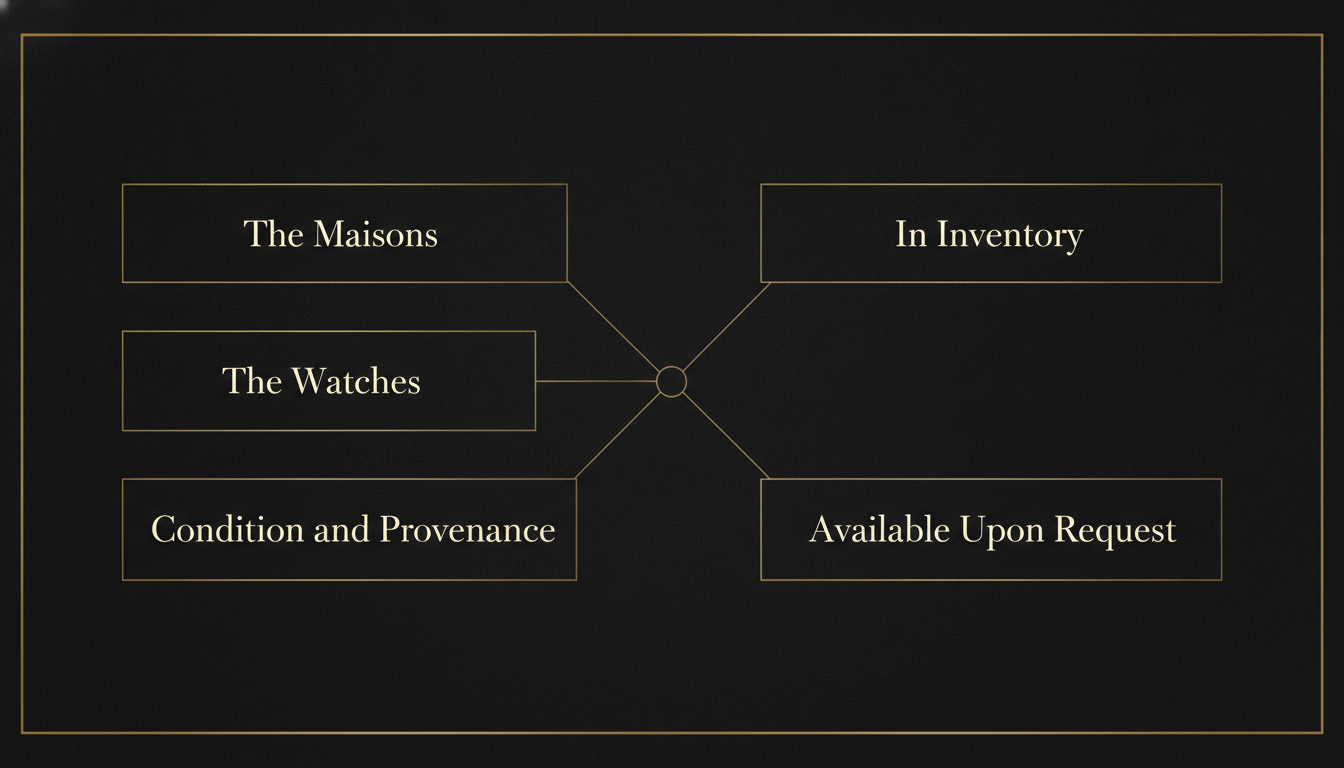
- The filter has three gates. The maison, the watch itself, and the example's condition and provenance.
- Every acquired piece is independently authenticated on arrival, undergoes a multi-point inspection, and is re-verified before shipment, per the authenticity guarantee.
- Pricing is transparent and market-based. The same filter that excludes weak pieces also excludes weak pricing.
- "Available Upon Request" extends the same filter through vetted partners, with the same inspection on delivery.
- The inventory is explicit about what it does not carry.
An Inventory Is Not a Catalog
A catalog lists everything an authenticator has signed off on. An editorial inventory lists only the pieces that have survived a series of deliberate choices. The distinction matters because catalogs tend to expand as supply grows, and editorial inventories tend to resist that pressure.
Pre-owned watch platforms differ in how openly they publish their editorial logic. Many do not publish it at all. The catalog is the only artifact the reader sees. This site does the opposite. The collection description names the maisons and the criteria in plain language. Pieces are chosen because they represent exceptional design, mechanical significance, or enduring collector appeal, and the result is "a focused inventory defined by quality, rarity, and taste rather than sheer volume." That sentence is the filter, described in advance.
The filter has three gates. A watch has to pass all three before it is listed, whether it is physically on the shelf or sourced through a partner.
Gate One: The Maisons
The first decision is not about a watch. It is about a brand. The collection is built around a defined set of maisons. Rolex, Audemars Piguet, Patek Philippe, Vacheron Constantin, F.P. Journe, and Richard Mille form the core. A supporting list, also published, includes A. Lange & Söhne, Breguet, Cartier, Hublot, Panerai, IWC, Tudor, Breitling, MB&F, Omega, and Zenith.
What the listed maisons share is horological substance with a public track record. They sit at different points on the spectrum. Vacheron Constantin has been in continuous operation since 1755, which gives its references a documented historical lineage newer maisons cannot replicate. F.P. Journe is a young independent manufacture that designs and builds its own movements under the motto Invenit et Fecit and produces roughly 800 to 1,000 watches a year, which gives its references a structural scarcity most established brands no longer have. The two sit at opposite ends of the spectrum, and both qualify for the same reason. The maison stands behind the watch, and the watch stands behind the maison.
What is not on the list is just as deliberate. Fashion-luxury houses without in-house movement capability are out, even where the watches are technically accurate and well marketed. Brands whose secondary market is dominated by short-cycle hype rather than documented collector demand are out. Emerging microbrands without several years of documented production are out, not because they lack merit, but because the filter asks for evidence over time, and most new entrants have not had it yet.
A maison on this list has earned the right to be evaluated piece by piece. A maison that is not on the list is filtered out before the piece-level work begins.
Gate Two: The Watches
The second gate is the watch itself. Three documented criteria apply: exceptional design, mechanical significance, and enduring collector appeal. The order is intentional.

Exceptional design is the easiest gate to identify and the hardest to justify in writing. It is what separates the references that age quietly into relevance from the ones that age into irrelevance. A Royal Oak does not look like a Nautilus, and both share a visual logic that holds up twenty years after they are sold. A Cartier Tank does not look like a Patek Calatrava, and both share the same restraint. The watches that pass this gate are the ones whose proportions, dial typography, and case geometry would still make sense if no one had ever marketed them.
Mechanical significance is more concrete. It covers in-house movement manufacture, hand-finishing visible through a display caseback, and complications of recognized horological weight. Perpetual calendars, minute repeaters, chronographs with isolated mechanisms, tourbillons with documented chronometric intent. A reader who wants the technical framework will find it in the guide to watch movement types. The narrower point in this context is that the filter asks whether the movement itself justifies the case it sits in. A watch whose movement is a third-party ébauche fails the gate, regardless of how prestigious the dial looks.
Enduring collector appeal is the criterion that protects a buyer ten years after the purchase. A reference passes when collectors have continued to want it across market cycles, when secondary market liquidity is documented rather than assumed, and when the design and movement together give the piece a reason to be remembered once the hype around the brand has moved on. Pieces that fail this test are the ones whose relevance depends on a single moment of cultural attention. The references that pass it do not need that moment in the first place.
For the visual side of that argument, the case for classic watch design walks through legibility, proportion, and proportion-led restraint as the structural reasons some designs outlast trends. It is the aesthetic counterpart of the mechanical gate.
Gate Three: Condition, Provenance, and Authentication
The third gate is where many pieces that passed the first two are quietly turned down. This is where the inventory earns or loses the right to call itself curated.
Authentication, condition, and provenance fail for separate reasons, and the filter treats them separately.
Authentication is the procedural checkpoint. Per the authenticity guarantee, every acquired piece is independently authenticated on arrival, undergoes a multi-point inspection, and is re-verified before shipment. The inspection lives inside the workflow rather than sitting as a final step, because a counterfeit or a misrepresented reference has no useful place in an editorial inventory even when it would pass the design and movement gates on paper.
Condition is the visible gate. Pre-owned is not a euphemism for "as is." The filter asks for cases with original brushing and polishing, dials without re-lume or refinishing, bracelets with stretch within their age and reference, and movements that keep time within their published chronometric tolerances. Pieces that fail condition are turned down even where the reference itself would have qualified. A Daytona with a redone dial is not sold as a Daytona. It is not listed at all.
Provenance is the documentary gate. Original papers, service history, single or documented prior ownership, and a verifiable chain of custody all matter. A piece with documented history is materially more attractive than the same reference without one, and the published price reflects that. A piece with an unverifiable history is not automatically refused, but it is harder to place in an inventory whose pricing is published rather than negotiated.
The third gate is where most pieces are turned down. The first two gates ask whether the watch is worth carrying. The third gate asks whether this particular example is.
Pricing, Sourcing, and What This Inventory Leaves Out
Pricing is treated as part of the editorial logic, not as a separate commercial concern. Transparent, market-based pricing is built into every listing that shows a published number. Pieces sourced on request carry a deposit structure rather than a quoted price, and the final figure is set only after the specific watch has been inspected and confirmed. What pricing is not: a pricing guarantee, a buy-low promise, or an investment forecast. Pieces can lose value after sale, just as they can gain it. What transparent pricing does is keep the editorial logic honest. A filter that publishes what it carries but does not publish what it charges for the pieces it carries gives the reader no way to evaluate the inventory on its own terms.
The "Available Upon Request" channel sits inside the same filter rather than next to it. Watches that are physically in inventory show a price and can ship once payment has cleared, with insured domestic or international delivery coordinated through the order. Watches marked Available Upon Request are not currently on the shelf but can be sourced through vetted partners. A 10% refundable deposit initiates the search, the buyer reviews and approves the specific watch before the balance is collected, and if the requested piece cannot be sourced to spec within a stated window the deposit is returned in full.
The distinction is operational, not editorial. The same three gates apply to both paths. The inspection on delivery applies the third gate to pieces that could not be inspected in person before they were committed to the buyer. The filter is the constant. The location of the watch at the moment of inquiry is the variable.
A few exclusions are explicit. The inventory does not list fashion-luxury houses without independent movement capability. It does not list brands whose secondary market is driven primarily by short-cycle hype rather than documented collector demand. It does not list microbrands without several years of documented production. It does not list references whose value depends on a single cultural moment rather than on design and movement. It does not list pieces with re-lumed dials, refinished cases, or replaced parts that affect originality. It does not perform watch servicing, repair, or standalone authentication work outside the acquisition workflow. That last point is worth restating. The filter is built around acquisition and resale, not service. Pieces already in a buyer's collection are supported with provenance documentation through the contact line, but the inspection workflow applies to inventory coming in, not to pieces already on someone else's wrist.
For buyers and sellers whose decision criteria align with what is described here, contact starts a conversation. For everyone else, a different dealer is probably a better answer than this one. The filter is meant to be self-selecting.
---
A shorter inventory with a published filter is a different object from a longer catalog without one. The point of writing the criteria down is not to defend the choices the filter makes. It is to give the reader a way to evaluate the inventory on its own terms before asking what is available. The filter will turn down more pieces than it accepts. That is how editorial logic is supposed to work.
