

How an Independent Watchmaker Earns a Place in Our Inventory
The Stellaris Journal
The independent corner of haute horlogerie has moved from the fringes of the collector market into a serious conversation in its own right. Auction results, dedicated fairs, and the rising visibility of ateliers once known only to a small circle have changed how collectors think about what belongs in a considered timepiece collection. The question we hear most often from clients, however, is simpler than all of that: how does an independent watchmaker earn a place in our inventory? What does it actually take for a small atelier, often producing only a few hundred watches a year, to clear the bar alongside a Patek Philippe or a Vacheron Constantin?
This piece walks through the editorial logic we apply, the practical constraints we work within, and the categories of evidence we look for before a piece from an independent maker is offered through The Stellaris Collection. It is not an exhaustive rubric, because we are not the only curator with a point of view. It is, however, the framework that has shaped every independent piece we have chosen to handle.
A Brief Summary
For clients weighing an independent watchmaker against a major maison, the decision often comes down to three questions: what does the piece contribute that a large-volume manufacture cannot, how do we know it is what the maker says it is, and why does it deserve a place in a curated catalog rather than a generic resale listing.
The short version of our answer:
- The category. Independent watchmakers, in the sense used here, are small ateliers producing dozens to a few hundred pieces a year, often AHCI-affiliated, distinct from large privately held manufactures like Rolex.
- The criteria. Every piece we list is weighed against documented standards: exceptional design, mechanical significance, or enduring collector appeal. Independents are evaluated by the same bar, applied with judgment calibrated to small-scale work.
- The authentication. Every piece is independently authenticated before publication, with particular attention to paperwork and finishing inconsistencies that are more common with smaller ateliers.
- The conversation. Independent pieces are typically acquired through direct expert contact rather than self-service browsing, with transparent pricing and insured shipping throughout.
A Short Note on What "Independent" Means
The phrase "independent watchmaker" carries two distinct meanings in the watch world, and they are not interchangeable. The first refers to large manufacturing operations that sit outside the major luxury groups, firms such as Rolex or the former standalone operations that still answer to a private owner rather than a publicly traded parent. These companies run industrial-scale production, often in the tens of thousands of pieces per year, and operate global retail and service networks. They are sometimes called "independent watch brands" for that reason.
The second meaning, and the one relevant to this article, refers to small ateliers and individual watchmakers whose output is measured in dozens or low hundreds of pieces annually. They design, prototype, finish, and assemble within a tightly held team. Many belong to the Académie Horlogère des Créateurs Indépendants (AHCI), the Zurich-based association founded in 1985 by Svend Andersen and Vincent Calabrese, which admits members only after a multi-year candidacy, public exhibitions, and unanimous approval from existing members.
When we speak of independent watchmakers in our inventory, we mean the second category. Names like F.P. Journe, Richard Mille, Philippe Dufour, Kari Voutilainen, H. Moser & Cie., Laurent Ferrier, Greubel Forsey, MB&F, and De Bethune form part of this landscape, though not all of them operate at the same scale. F.P. Journe, for instance, is widely reported to produce somewhere in the range of 900 to 1,000 watches per year. Richard Mille, larger by comparison, was producing on the order of 4,800 pieces per year by 2018 according to publicly available figures. Both still sit well outside the volumes handled by the major maisons. The point is not size alone, but the kind of work the smaller scale makes possible.
The Editorial Bar We Apply
Every timepiece that passes through our catalog, whether from a major maison or an independent atelier, is weighed against three criteria documented in our selection framework: exceptional design, mechanical significance, or enduring collector appeal. These criteria were not written with independents in mind specifically. They apply to everything we list. The reason independents get discussed separately is that the way those criteria manifest in a small atelier is materially different from how they appear in a major house.
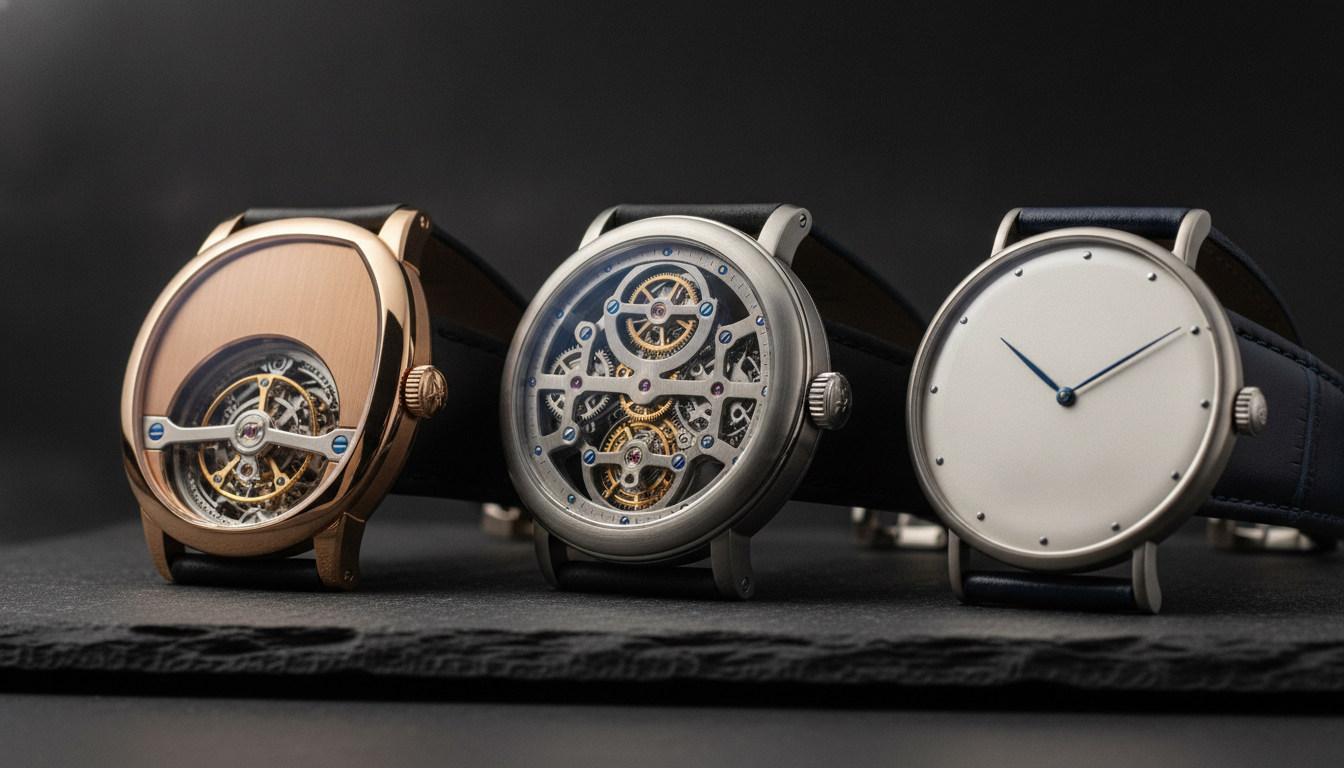
Exceptional design for a Patek Philippe or an Audemars Piguet often means refinement of an established code, a Calatrava that quietly perfects a dress watch, or a Royal Oak that has evolved over decades while keeping its visual signature intact. Exceptional design in an independent context is more often something genuinely unprecedented: a movement architecture that no one has tried before, a case material used in a way no one else has attempted, or a way of displaying time that breaks the visual grammar of horology. That difference is not better or worse. It just requires a different kind of judgment to assess.
Mechanical significance, the second criterion, plays to independents in a particularly strong way. The entire premise of independent horology is that small teams can attempt complications and constructions that would be commercially impractical for a manufacturer producing tens of thousands of pieces a year. F.P. Journe's early Chronomètre à Résonance work introduced the constant-force remontoir into a wristwatch. Greubel Forsey built the inclined double tourbillon to address gravitational effects on rate in a way that demanded an artisanal approach to construction. These are not marketing claims. They are documented technical contributions that the broader watch community has examined and, in many cases, adopted as reference points.
The third criterion, enduring collector appeal, is the hardest to evaluate and the one we treat with the most caution. Popularity at auction is not the same thing as lasting collector relevance. A watch that performed well because of a single celebrity association or a press cycle can lose that lift quickly. We look for pieces where the interest has shown durability across cycles, where secondary market behavior reflects genuine collector demand rather than short-term speculation, and where the maker's broader body of work supports the case.
A related input is production discipline. Independents vary widely in how they manage output. Some publish explicit annual figures. Others decline to share numbers but signal discipline through waiting lists and allocation policies. A maker who expands production rapidly to chase demand is making a different kind of statement than one who holds output steady at a level the workshop can actually sustain. The first is not automatically wrong, and the second is not automatically correct, but they have different implications for long-term collector relevance. A workshop that commits to a stable annual output is also committing to a long-term relationship with the collectors who buy its work, because those collectors know the supply curve will not change dramatically under their feet. We treat this as one of several inputs, not a tiebreaker: discipline without technical substance does not earn a place, and technical substance without discipline creates a different kind of risk. The strongest case is when both are present.
Provenance and the Authentication Question
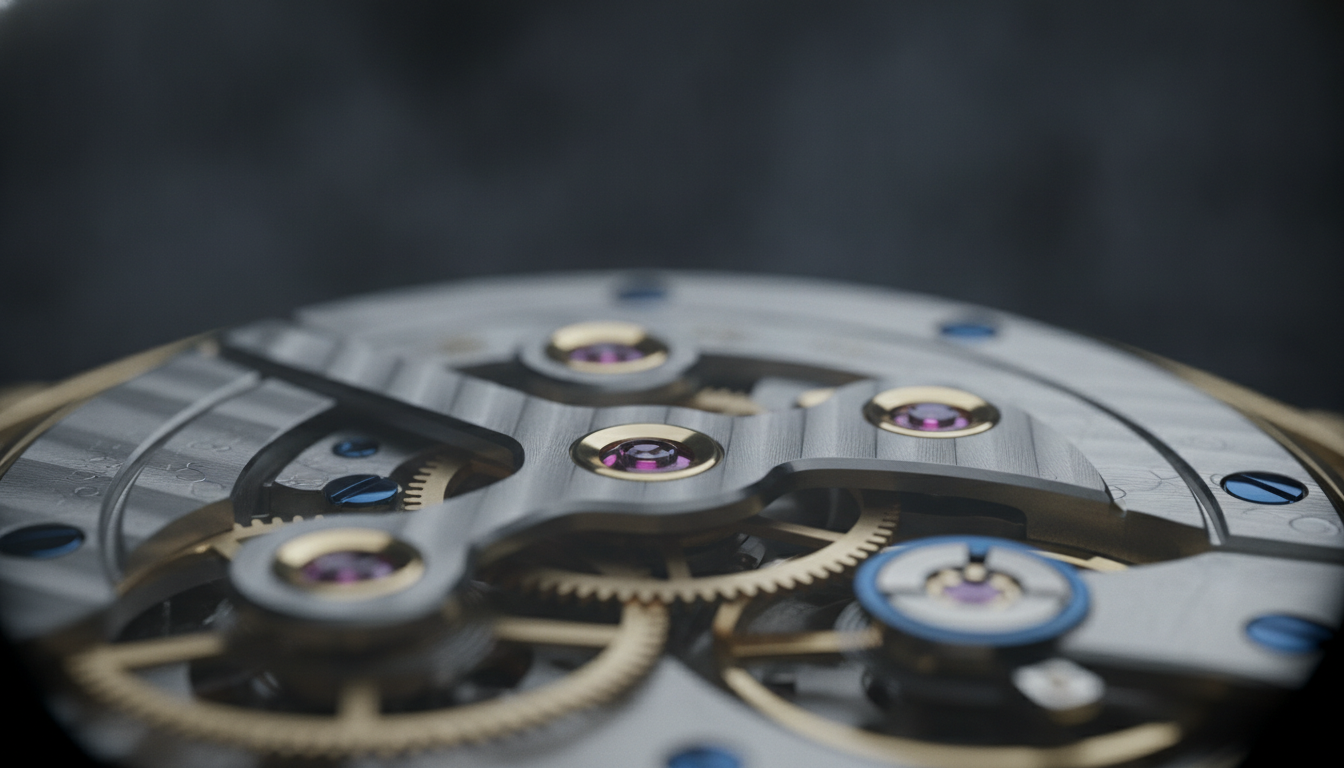
Authentication is the area where independents require more work than major maisons, not less. The reason is straightforward: a Rolex Submariner or a Patek Philippe Nautilus has a long-established secondary market infrastructure, model-specific reference numbers recognized by every service center, and a depth of public technical knowledge that makes forgeries comparatively easy to identify. A 50-piece limited edition from a small independent may have no equivalent paper trail in the broader market.
This matters for us because our 100% authenticity guarantee applies with the same force to a F.P. Journe Centigraphe as it does to a Daytona. Every timepiece we list, regardless of maker, goes through independent authentication before it reaches the published inventory. We do not assume that provenance paperwork alone settles the question, because with smaller ateliers the paperwork itself can be inconsistent. A workshop producing only a few dozen or a few hundred watches a year does not generate the same volume of service and archive records as a manufacture producing tens of thousands, which is what makes the inspection step more, not less, important.
What we look for, in practical terms, is alignment across multiple signals: the documentation a maker provides, the condition and finishing of the movement under inspection, the case construction details, and the historical behavior of the specific reference. When a piece does not align across those signals, it does not enter our inventory. We do not list pieces where we have unresolved questions about authenticity, because the cost of getting it wrong falls on the next owner, not on us.
For the major independents we handle, F.P. Journe and Richard Mille included, the secondary market has matured enough that independent authentication houses have built real expertise. That does not remove our responsibility to inspect each piece individually. It does mean the baseline is higher and our process has more reference points to work from.
How an Independent Becomes Available Through Us
Our inventory moves through two paths. The first is direct acquisition from collectors who have decided to part with a piece, a process we run through our sell and trade service. The second is sourcing through established channels in the secondary market, where independents appear with less regularity than the major maisons do.
Independent pieces, by their nature, reach us less often than Rolex or Patek Philippe references. That scarcity is part of what makes them interesting to clients who collect them, and it is part of what makes them difficult to keep in continuous inventory. When a F.P. Journe Centigraphe or a Richard Mille RM 30-01 becomes available through our sourcing, we list it under the same concierge-level process that applies to any other piece in our catalog: direct expert contact from inquiry to delivery, transparent pricing, and insured domestic and international shipping. The mechanics of the transaction do not change because the maker is independent.
What does change is the conversation we have with a client about the specific piece. Independents often require more context. A client considering a F.P. Journe for the first time benefits from understanding the difference between a brass-movement earlier example and a later movement, or why a specific complication matters within the maker's body of work. That is part of what the concierge process is built to handle, and it is one of the reasons clients who collect independents tend to work closely with a single point of contact rather than browsing a self-service listing.
What We Decline to Carry
It is worth saying out loud that not every independent watchmaker fits our catalog. The selection framework applies in both directions. A piece that fails the criteria for exceptional design, mechanical significance, or enduring collector appeal does not enter the published inventory, regardless of how visible the maker is. We have passed on pieces that other dealers list without hesitation, and we have listed pieces that took longer to source precisely because they came from small ateliers with limited secondary market presence.
The honest version of how an independent watchmaker earns a place in our inventory is that the process is slower, the authentication work is more detailed, and the editorial judgment required is more granular than it is for a major maison. That is the trade. In return, the work that makes it through tends to be the kind of piece that holds a client's attention long after the purchase, which is, in the end, the only test we really care about.
A Practical Note for Clients Considering an Independent
For clients who have not collected an independent piece before, the most useful starting point is the same as it would be for any high-value acquisition: work with a single expert contact, ask for documentation of the authentication process, and make sure the pricing is presented transparently rather than left to negotiation. Our concierge team is available by phone at (213) 444-0926 for exactly these conversations. Independents reward careful collecting, and the conversations that lead to good acquisitions tend to be unhurried ones.
If you are considering a specific piece, a specific maker, or a specific complication, the right next step is a direct conversation rather than a passive browse. That is true whether the maker in question is one of the well-known independents like F.P. Journe or Richard Mille, or a smaller atelier you have only just discovered.
