

Curated Watch Catalogs vs Open Marketplaces Explained
The Stellaris Journal
The word "curated" gets used loosely. It shows up on watch storefronts, marketplace landing pages, and boutique sites that range from a single owner-operator to a global e-commerce operation. A small catalog is sometimes called curated because it is small. A broad catalog is sometimes called curated because someone, somewhere, decided which categories to feature. The word is doing different work in each case, and buyers are often left to infer what it actually means.
There is a more concrete distinction worth naming: who decides what gets listed, against what criteria, with what discretion, and what the buyer can rely on as a result. That distinction is what separates a curated watch catalog from an unfiltered marketplace listing, and it is more useful than the size of either inventory.
What "Curated" Actually Means in a Watch Catalog
In retail, curation refers to the deliberate selection and presentation of inventory against defined criteria, applied by people who are responsible for the outcome. A platform that hosts any seller who meets its onboarding checks is not curating watches; it is operating an open marketplace with an authentication layer. The two ideas get blurred because both can produce a page full of luxury timepieces, but they organize supply differently.
The functional difference is the editorial decision. An open marketplace prioritizes breadth and liquidity. Any seller who clears the platform's identity and payment checks can list a watch. The platform then layers services such as payment escrow, dispute resolution, and in some cases third-party authentication on top of that listing. According to the eBay Authenticity Guarantee program, for example, eligible watches priced at $2,000 or more are inspected at an authentication center before shipment, with category experts performing a multi-point inspection to verify authenticity and condition. That is a real service, applied selectively, to listings the platform did not originate.
A curated catalog treats selection as the primary act. The question is not who applied to list a watch, but whether the watch meets an internal standard for inclusion. The criteria may include condition, originality, completeness of papers and accessories, mechanical significance, and the relevance of the reference to the rest of the inventory. A piece that does not meet the criteria is not listed, regardless of whether the seller is qualified. The catalog's identity comes from those repeated decisions over time, not from the volume of listings.
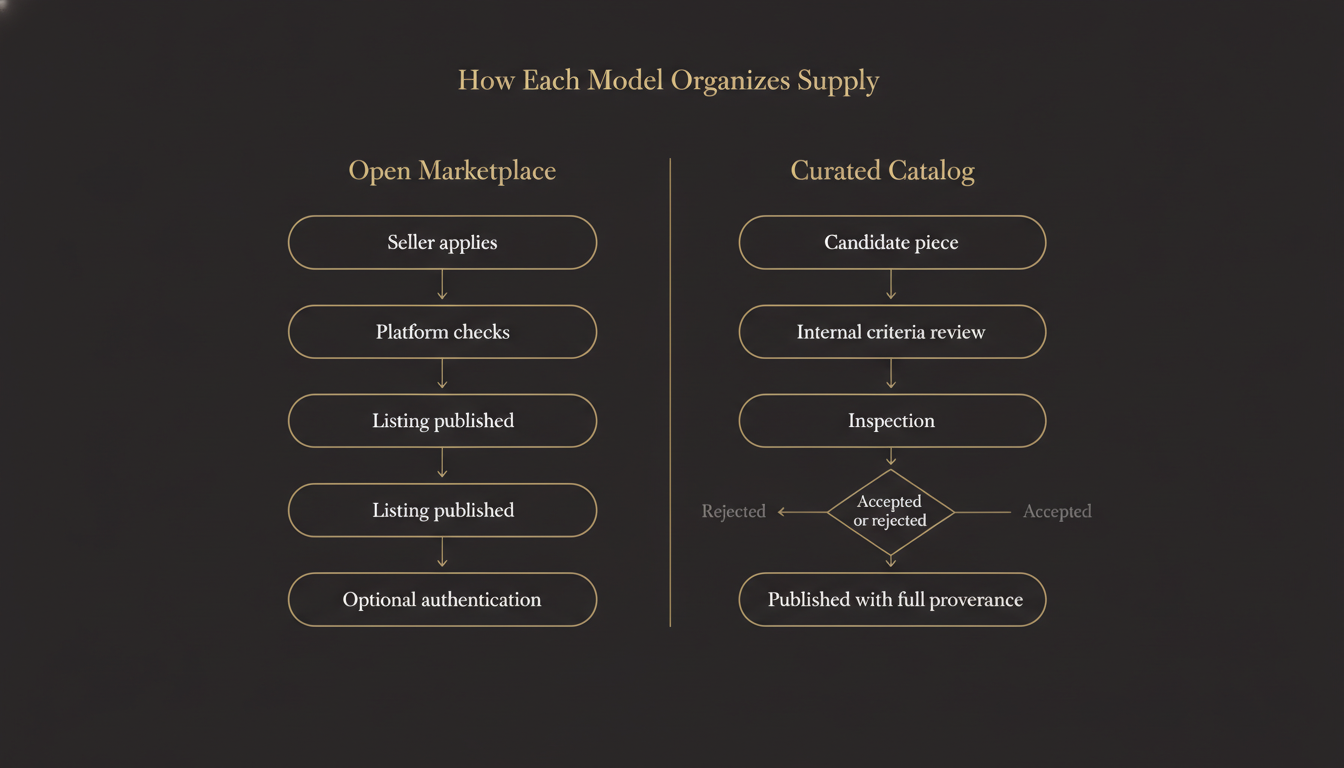
Two practical consequences follow. First, a curated catalog has fewer pieces than an open marketplace of comparable size, because rejection is built into the model. Second, a curated catalog carries more per-listing information, because the curator is responsible for what is shown, what is omitted, and what is verified. Neither outcome is automatic; both depend on whether curation is actually being practiced.
How an Unfiltered Marketplace Organizes Supply
Unfiltered marketplaces do not lack standards. They apply different ones. The standards usually govern the seller, the transaction, and the dispute process, not the inventory itself. Chrono24, for example, requires commercial dealers and private sellers to pass identity checks and provides a Buyer Protection program that holds payment in escrow (14 days for purchases from professional dealers, 7 days for private sellers) and supports returns if a watch arrives not as described. In April 2024, Chrono24 also introduced a "Certified" authentication program in which vetted watchmakers inspect each timepiece against a checklist that includes a serial-number theft check, a functionality check with the case back opened, an authenticity check, and a review of included box and papers. The program applies to watches priced above €1,000, with certification available either pre-listing at no charge to the buyer or after purchase through a certification center for a €199 fee.
These are real services. They address the parts of a transaction a single seller cannot easily police on their own. They do not, however, mean the marketplace selected the watch. The marketplace selected the seller, and then conditionally added inspection to the listing.
The strength of this model is breadth. Multiple sellers expose a buyer to more references, dial variants, production periods, conditions, geographies, and price points than any single dealer typically holds at one time. Search and alert tools make comparison fast. For a buyer who already knows exactly what reference, configuration, and production window they want, an unfiltered marketplace can shorten the search.
The weakness is that the listing's quality reflects the seller. Photographs may or may not show the exact watch. Condition descriptions use the seller's own vocabulary. Completeness varies. Returns are handled against the seller's published terms, sometimes in another country, sometimes through the platform's process and sometimes directly. The marketplace's guarantees apply within specific eligibility rules; a watch purchased using an offline payment method, for instance, is not eligible for eBay's Authenticity Guarantee.
Where Curation Actually Shows Up in a Listing
Once the difference between editorial selection and platform-mediated access is clear, four practical areas tend to separate a curated catalog from an unfiltered listing in ways a buyer can verify.
Authentication depth. Both models can claim authentication. A curated catalog should be able to describe what was inspected, by whom, and against what standard. An unfiltered marketplace can usually point to the authentication service in general terms, with eligibility conditions and exclusions attached. The presence of an authenticity guarantee matters less than its scope and how it is documented per piece.
Condition grading. A curated catalog typically assigns condition against an internal rubric and shows the exact piece. Photographs are of the watch being sold, not a representative example. An unfiltered listing shows what the seller submitted; the buyer relies on the platform's dispute process if the description and the watch do not match. This is one of the more common sources of friction reported in marketplace buying guides, where condition grading, included accessories, and seller quality are described as variable across listings.
Provenance and completeness. A curated catalog tends to state explicitly what is included: original box, papers, service records, original purchase documentation, warranty status. The statement can be checked against the photographs. An unfiltered listing inherits whatever the seller provides; if the original box is missing, that fact may appear as a line item, an omission, or a description of the watch as "complete set" without specifying what that means in that particular case.
After-sale responsibility. A curated catalog usually names one counterparty for questions about authenticity, condition discrepancy, service intervals, missing accessories, shipping loss, or returns. An unfiltered marketplace distributes these roles across the seller, the platform, the authentication partner, the payment processor, and the carrier. The transaction map is more complex, and the buyer has to identify which party owns each issue. Our own authenticity guarantee, for instance, rests on a documented sequence: each piece is authenticated on arrival, inspected, and reverified before shipment, with a 100% authenticity guarantee attached to every listing.
None of these differences is a value judgment. They are structural. A buyer who needs breadth and is comfortable evaluating individual sellers benefits from an unfiltered marketplace. A buyer who wants one accountable party and consistent per-listing evidence benefits from a curated catalog.
Where Each Model Makes Sense
The two models are not in competition. They serve different stages of the same purchase.
For discovery and comparison, an unfiltered marketplace is useful. It surfaces multiple examples of the same reference, showing how price varies with condition, completeness, production year, and bracelet type. It also surfaces discontinued references and limited editions that no single dealer will hold at the moment a buyer is searching. The breadth itself has informational value; a buyer who sees ten examples of a particular reference learns more about that reference than from any single listing.
For final selection and closing, a curated catalog is useful. The buyer has narrowed the search, identified a specific configuration, and now needs the listed piece to match the listing, the accessories to be present and original, and the after-sale responsibility to be clear. At this stage, breadth is less important than precision.
The common error is using one model where the other is appropriate. Buyers who treat an unfiltered marketplace as if it were a curated catalog end up doing their own inspection of every listing, which the marketplace is not necessarily designed to support. Buyers who treat a curated catalog as if it were a discovery tool give up the comparison data they would have found elsewhere. The right sequence is marketplace first, curated catalog second, with the transition happening once the reference and configuration are settled.
It is also worth noting what curation does not do. Curation does not guarantee a watch is original in every component, that the manufacturer's warranty remains active, that service has been performed recently, or that the price is below market. A curated catalog can be wrong about a piece, can overprice a piece, or can include pieces that do not suit a particular buyer. Curation organizes selection; it does not replace judgment.
How to Read a Catalog Without Being Misled
The word "curated" tells a buyer very little on its own. A few questions tend to surface whether the curation is real or merely a label.
Ask what was inspected and by whom. A real curator can name the inspection points and the person or service responsible. A label-only claim cannot.
Ask whether the photographs show the exact watch. Curated catalogs usually publish exact-watch photography with consistent lighting and background. Marketplaces inherit seller photography, which varies.
Ask what is included and what is not. A curated listing typically states papers, box, service records, and warranty status explicitly. The absence of a clear statement is itself information.
Ask what happens after payment. Identify who handles authenticity disputes, condition discrepancies, returns, and shipping loss. If the answer involves several parties, that is the transaction's actual structure.
Ask why this piece was chosen. A real curator can usually answer it: a specific dial variant, a mechanical configuration, a service interval, a production period. The answer is rarely "because the seller listed it."
A small catalog with consistent answers to these questions is more curated than a large catalog that cannot answer them. Curation is not a size. It is a repeated set of decisions, applied to each piece in front of the buyer, with the curator accepting responsibility for the outcome.
The marketplace and the curated catalog will continue to coexist. They organize supply differently and serve different parts of a purchase. The buyer's task is to know which part of the purchase they are in, and to choose the model that matches it.
