

How to Tell if a Cartier Watch Is Real: 5 Checks
The Stellaris Journal
No single visual detail or serial-number result can prove that a Cartier watch is real. Start by identifying the exact model, reference, and likely era. Then test whether the physical watch, identifiers, documents, seller evidence, and professional findings agree.
A failure in one area is a reason to pause. Agreement across several independent checks increases confidence, but it does not turn a photograph checklist into a guarantee. Some questions can be screened externally. Others require the watch to be examined by Cartier or an appropriately qualified watchmaker.
The Short Answer: Use Several Independent Checks
Cartier has produced watches with very different shapes, materials, movements, dials, crowns, bracelets, and caseback layouts. A Tank, Santos, Panthère, Ballon Bleu, vintage watch, and current-production piece cannot be judged by one universal list of “Cartier tells.”
A responsible buyer review uses five checks:
1. Establish the exact reference and era.
2. Compare physical details with that reference.
3. Read the serial, reference, and caseback together.
4. Match papers, provenance, seller evidence, and transaction terms.
5. Escalate internal or conflicting questions to qualified examination.
These checks help screen a watch before purchase. They do not authorize a buyer to open the case or perform service work. The aim is to identify what agrees, what conflicts, and which conclusion still needs specialist evidence.
Keep authenticity separate from originality and condition. A genuine Cartier can contain a later service component. It can be polished, worn, modified, or missing its original papers. Those facts affect the description and buying decision, but they do not all answer the same question.
Record the outcome of each check in plain language. “Consistent with the represented reference from the available external evidence” is different from “authenticated after internal examination.” “Card matches the visible identifier” is different from “Cartier confirmed the document.” Precise wording prevents a preliminary observation from becoming a stronger claim as it passes from seller to buyer.
Check 1: Identify the Exact Cartier Reference and Era

Begin with the seller’s full representation of the watch:
- collection or model name;
- reference number where available;
- case material and size;
- dial configuration;
- movement type;
- bracelet, strap, and clasp;
- approximate production period; and
- included box, card, receipt, and service material.
- Are you seeing photographs of the actual watch?
- Are condition, refinishing, service replacements, and aftermarket changes disclosed?
- Are the box, card, booklets, links, straps, and service records itemized?
- Who owns the description and stands behind it in writing?
- Who receives payment, and what protection applies to the selected payment path?
- What inspection, return, shipping, and delivery terms apply?
- the purchase is high value and evidence is incomplete;
- physical details conflict with the represented reference;
- movement identity or internal condition matters;
- the watch is vintage or complicated;
- modification, recasing, or component substitution is suspected;
- the seller cannot explain an identifier or document conflict; or
- the seller resists a reasonable inspection condition.
Compare that representation with Cartier’s current product material, archived reference information where available, original literature, or another reliable reference-specific source. Do not compare a vintage example with details taken from a current watch that happens to share the same family name.
This matters because familiar surface details are not universal. Roman numerals, blue hands, a blue cabochon-style crown, a hidden dial signature, exposed bezel screws, and particular bracelet construction can be correct on some references and irrelevant or different on others.
The reference check should create a model-specific expectation, not a verdict. If the watch differs, ask whether the variation is documented, period-correct, a genuine service replacement, an aftermarket modification, or unexplained.
Use photographs of the actual watch. Request the front, case sides, crown, caseback, bracelet or strap, clasp, and any identifying marks. Stock images can establish the intended design, but they cannot describe the condition or components of the watch being sold.
The Stellaris Cartier collection provides a relevant place to review current offerings. A live Cartier Santos WSSA0047 listing, for example, should be assessed against that exact reference rather than a generic idea of a Santos.
Check 2: Compare Model-Specific Physical Details
Once the reference is established, examine how the actual watch agrees with it. Use the complete pattern rather than allowing one familiar cue to dominate.
Case and finishing
Compare shape, proportions, bezel, lugs, crown position, caseback construction, and the relationship between polished and brushed surfaces. Poor geometry or finishing can be a warning, but wear and refinishing can also change edges and reflections. The comparison should account for the watch’s age and disclosed condition.
Dial, hands, and crystal
Check the layout, printing, minute track, date or complication placement, hand style, and how those elements relate to the known reference. A copied logo or hidden signature does not authenticate the rest of the watch. The absence of a detail promoted in an online checklist is not proof of a fake if the exact reference was not expected to have it.
Crown, bracelet, strap, and clasp
A blue cabochon-style crown is strongly associated with many Cartier designs, but not every reference uses the same material, setting, or crown form. Bracelets, screws, quick-change systems, straps, and clasps also vary. Compare them with reference-specific information and ask whether any component is a later replacement.
Weight and movement
Weight depends on case size, metal, movement, bracelet, and configuration. It can support a controlled comparison, not decide authenticity by itself. Movement identity and internal condition may require opening the watch, which should be left to someone with the correct competence, tools, and authority.
Sophisticated counterfeits can reproduce visible cues, while genuine vintage or serviced watches can depart from a modern online checklist. Physical details are strongest when several independent observations agree with the exact reference and documented history.
Check 3: Read the Serial, Reference, and Caseback Together
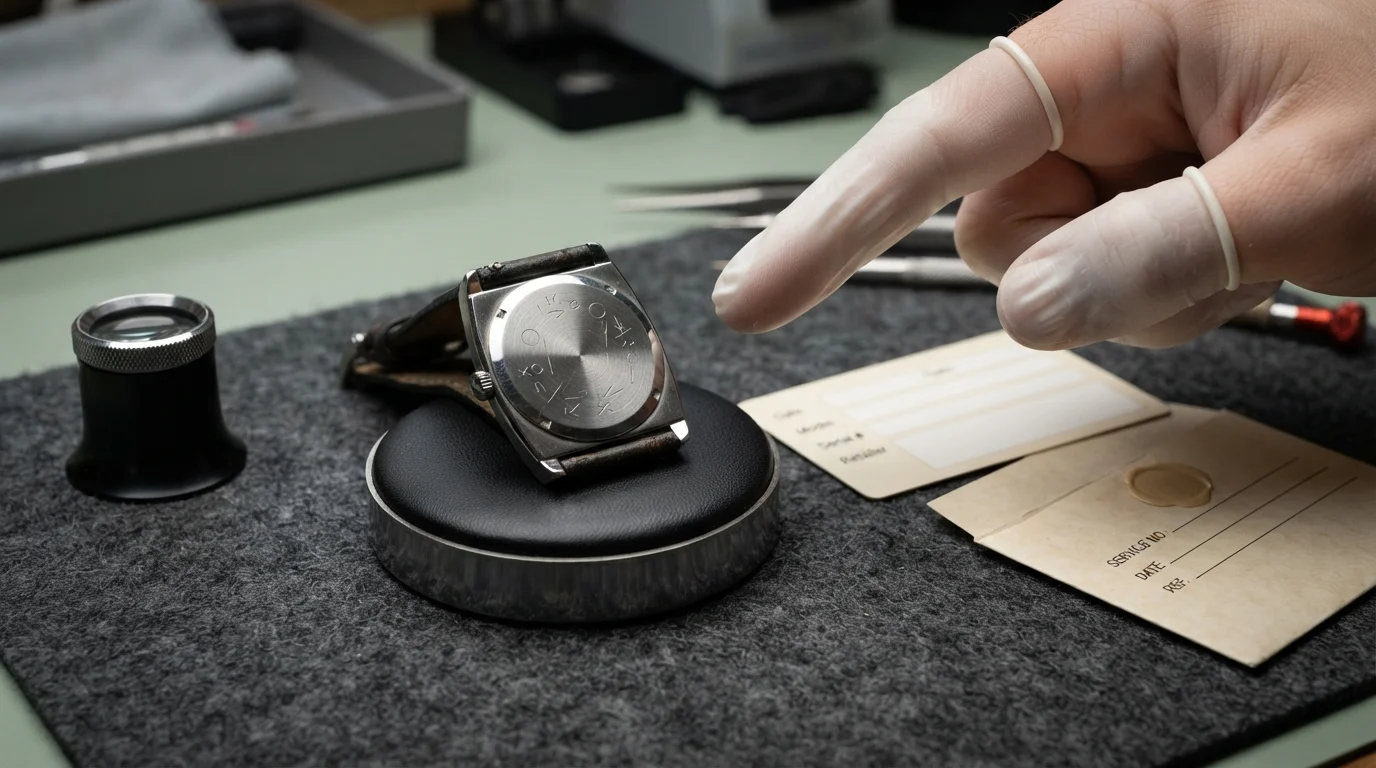
Cartier’s official regional information says a watch’s serial number is used for Cartier Care registration and appears on the warranty card and caseback. That makes the number useful, but not conclusive.
Review four things:
1. Legibility: Is the identifier intact, or has it been removed, altered, or obscured?
2. Consistency: Does the caseback identifier agree with the supplied card and other records?
3. Association: Is the represented model, material, and configuration plausible for the reference information?
4. Context: Does the date, seller account, and service history form a coherent record?
A number recognized during Cartier Care registration may show that a record exists. It does not prove that the physical watch carrying the number is genuine or that every current component is correct. A number can be copied, a card can be paired with another watch, and a genuine case can contain later or modified components.
The reverse is also important. A number that does not register should trigger investigation, but it is not enough to diagnose every vintage watch, altered caseback, regional record, or data-entry issue. Confirm the scope of the result rather than inventing an explanation.
Cartier Care is not a public authentication certificate or a complete serial-number lookup service. Stolen-watch screening is also a separate task. A watch can pass a record-consistency check while still requiring physical authentication and ownership due diligence.
Check 4: Verify Papers, Provenance, Seller, and Transaction
Documents should connect to the watch and remain within their defined scope. Match the caseback information with the warranty card, receipt, service records, stated history, and included accessories where applicable.
Box and papers can support an original sale, later service, or chain of ownership. They do not prove present condition, every component’s originality, or the identity of the complete watch by themselves. A Cartier without its original papers can still be genuine, while a complete-looking set can be assembled around the wrong watch.
Review the seller and transaction with the same care:
The Stellaris FAQ says listings use actual-watch photographs, identify included accessories, provide condition information, and include an authenticity guarantee. Stellaris is an independent dealer, not a Cartier-authorized distributor. Its guarantee and Cartier’s manufacturer warranty or service records are different forms of evidence.
Seller reputation helps assess accountability, but it does not authenticate the physical watch. Likewise, an attractive price should not encourage a buyer to skip unresolved evidence or move payment outside the written transaction process.
Ask how a discrepancy will be handled before paying. If the watch arrives with an accessory missing, a material condition difference, or a component not disclosed in the listing, the written terms should explain the available remedy and deadline. Save the listing, photographs, invoice, and relevant correspondence so the delivered watch can be compared with the approved representation.
Check 5: Know When Professional Examination Is Required
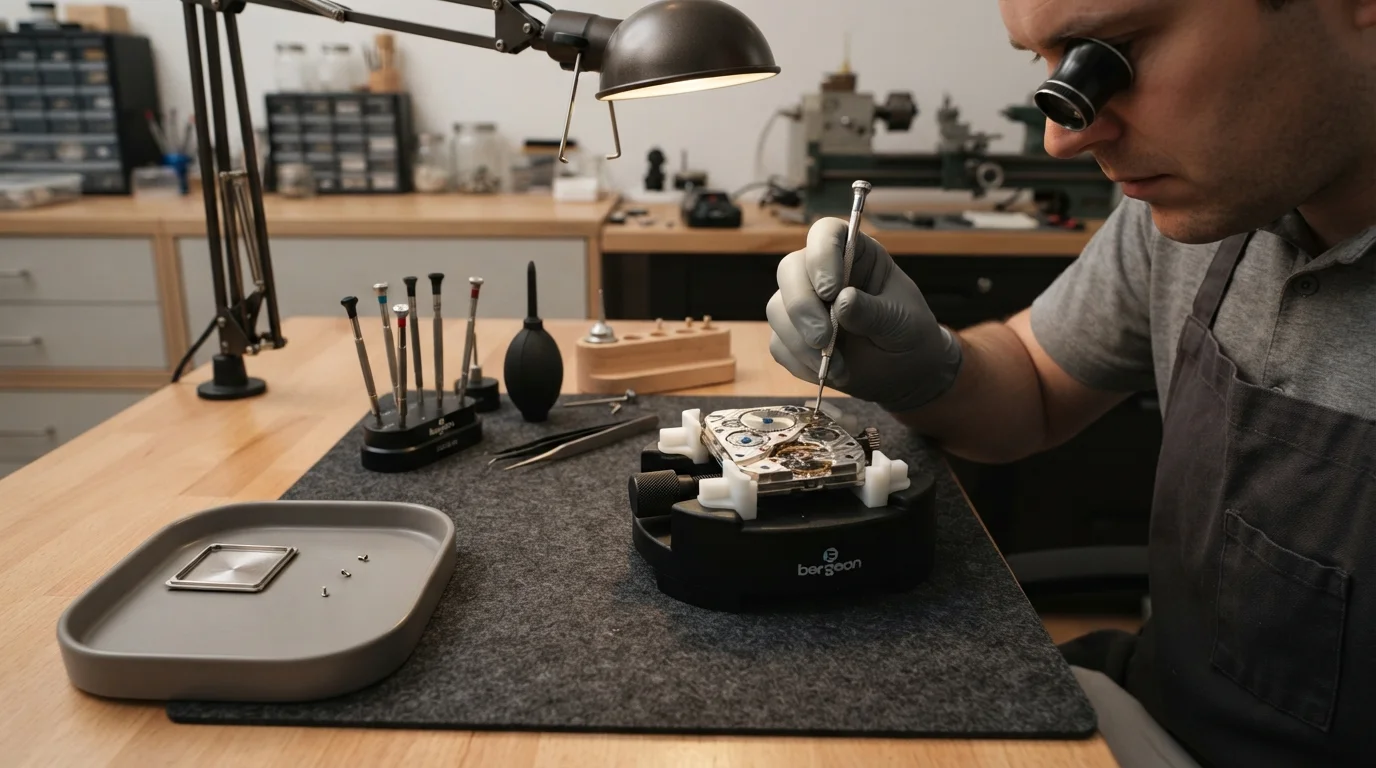
Arrange qualified examination when:
Cartier’s conditions of service state that only authentic Cartier products are eligible for service and explain that a submitted watch may be opened for diagnosis. Cartier also notes that vintage and complicated watches can require a more specialized manufacturer-level assessment.
That service boundary must be described carefully. Service eligibility or the use of authentic replacement components during a Cartier service does not prove that every component remains original to the watch’s first sale. A service receipt also does not establish the entire earlier history.
Confirm what the available Cartier or qualified independent examination will actually address. Authentication, movement condition, water resistance, originality, service needs, and valuation are separate questions. Do not assume one appointment supplies every conclusion.
The examiner should also receive the seller’s complete representation, not only the bare watch. Provide the claimed reference, photographs, card, service documents, disclosed replacement parts, and the questions that caused concern. A narrow, documented question produces a more useful answer than asking whether the watch “looks right.” If the professional cannot resolve a material conflict without manufacturer records, preserve that limitation.
Request a written record that identifies the watch, the access permitted, the evidence reviewed, the findings reached, and the limits of the work. A verbal opinion may guide the next step, but it is difficult to connect to the invoice or dispute later. The record should distinguish direct observation from seller-supplied history and state any function or component that was not examined.
Cartier’s watchmaking care information is the appropriate starting point for official service context. Never open a watch at home to complete an online checklist. An unnecessary case opening can introduce damage, contamination, or water-resistance risk without producing a reliable answer.
A Pre-Owned Cartier Buyer Checklist
Before paying, confirm:
1. The exact model, reference, material, size, movement type, and likely era are established.
2. External details were compared with the correct reference, not a generic Cartier checklist.
3. The serial, reference, caseback, card, and service records were reviewed together.
4. Actual-watch photographs and itemized included accessories are available.
5. Condition, refinishing, replacement components, and modifications are disclosed.
6. Seller identity, payment path, return, inspection, shipping, and delivery terms are in writing.
7. Professional examination is arranged for any unresolved internal, vintage, high-value, or conflicting question.
Can a Cartier serial number prove authenticity?
No. It can support identification and record matching, but it must agree with the physical watch and other evidence. A copied or plausible number does not authenticate the complete watch.
Does Cartier Care registration prove a watch is real?
Registration may associate a serial with a Cartier record. It is not a public authenticity certificate, a condition report, or proof that every component is correct.
Do all Cartier watches have a blue cabochon or secret signature?
No universal detail should be assumed. Features vary by collection, reference, and era. Compare the actual watch with appropriate reference-specific information.
Can Cartier authenticate a pre-owned watch?
Cartier publishes service and diagnostic conditions, including authentic-product eligibility. Confirm directly what a service location can assess for the exact watch and region. Do not assume every boutique offers a walk-in authentication opinion.
Are box and papers enough?
No. They can support identity, sale, service, and provenance claims, but they do not replace examination of the current watch, seller, and transaction.
The purpose of these checks is not to create certainty from surface details. It is to make every material conclusion traceable and to stop when the evidence calls for a qualified answer.
