

Fair Market Value: Understanding Secondary Luxury Pricing Data
The Stellaris Journal
The global market for used luxury goods isn’t just big; it’s poised to hit nearly $100 billion by 2034, growing three times faster than new luxury retail. This significant shift signals that what was once merely "pre-owned" is now a full-blown asset class. Your grandmother’s vintage brooch, for instance, is no longer just sentimental; it holds tangible equity.
Whether you're buying, selling, or simply curating a collection of high-end watches or bags, understanding its real value is paramount. Vague estimates are for amateurs; a hard, data-backed number is essential. Navigating this complex landscape without precise information is akin to flying blind.
Fair market value is no longer a fancy term; it's a detailed calculation, factoring in brand status, condition, rarity, and real-time demand. This article aims to demystify this process, empowering you to make informed, strategic decisions. Navigating this dynamic landscape demands precise valuation, not guesswork.
The Resale Revolution: A Market Three Times Faster Than Retail
Challenge your preconceptions about luxury, especially concerning where the real growth is happening. The secondary market isn't just catching up to traditional retail; it's decisively outpacing it. This resale phenomenon boasts an impressive 10.7% compound annual growth rate, while the primary luxury market lags at a mere 4.5%. This isn't a gap; it's a chasm.
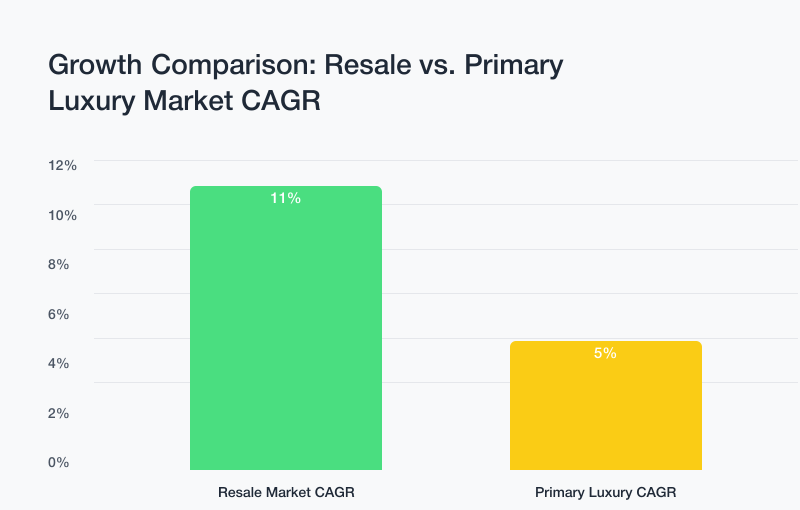
This isn't a transient blip but a fundamental structural shift. The drivers are multifaceted: growing awareness of sustainability (or at least the appearance of it), a desire for greater value, and smarter entry points into high-end goods. Crucially, Millennials and Gen Z, now comprising over 45% of the total luxury market, embrace pre-owned items, often preferring them for their fiscal prudence.
Online platforms have been the true catalyst for this market's expansion, dominating with over 71.3% of revenue. They democratized access, moving transactions beyond opaque backroom deals. Furthermore, when the economy faced recent instability, these platforms paradoxically saw increased listings as individuals liquidated assets, underscoring the market's resilience.
Significant capital has taken notice, with over $4.2 billion in venture capital pouring into this sector since 2019. This isn't merely a trend; it's a formidable industry directly competing with and influencing the primary market. So, you can either get with it, or get left behind. Your call.
---
Deconstructing Value: The Four Pillars of Secondary Market Pricing
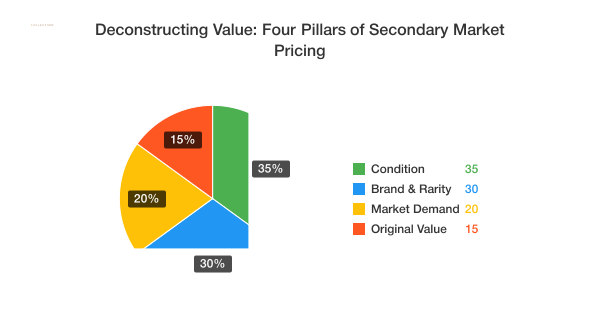
To truly understand the worth of a pre-owned luxury item, one must look beyond original retail prices. A complex, yet predictable, ecosystem dictates value. Ignoring these four fundamental drivers means you're simply guessing.
Brand & Model Desirability
This pillar is both obvious and profound. Certain brands inherently retain value better than others, and within those brands, specific models reign supreme. Handbags, representing the largest segment at 28.4% of the market, are dominated by Hermès, Chanel, and Louis Vuitton. However, it's not every bag, but rather iconic models that are highly coveted and often unobtainable new. Similarly, watches, accounting for 21.6% of the market, feature select models trading at staggering premiums, ranging from 30% to up to 180% above retail. A brand's reputation, heritage, and scarcity are all woven into its desirability, ensuring that strong equity translates into sustained or even increased value. So, yes, brand matters. A lot. But model, even more.
Physical Condition
Locating the right brand and model is only half the battle; if its condition is subpar, your selling price will suffer dramatically. Condition is paramount, extending beyond mere superficial wear to encompass the material's integrity. Damaged or faded Hermès leathers, for example, can instantly plummet an item's value. Crucially, accessories like the original box, dust bag, and accompanying papers are vital. They serve as provenance, demonstrating meticulous care, which builds trust and, consequently, value. Conversely, their absence or poor state can result in significant discounts. Buyers demand immaculate, or near-immaculate, items and are prepared to pay a premium for them. So, treat your stuff well. Keep the damn box.
Rarity
Here lies the crucible of demand: scarcity. Limited editions and discontinued, popular models consistently command premium prices. Items with unique provenance—such as celebrity ownership or a compelling history—also fetch significant premiums. This isn't about simply finding a piece; it's about acquiring the piece—a hard-to-find, unique item that can no longer be purchased new. Whether it was a special production run, a viral collaboration, or an item no longer manufactured, such scarcity drives prices upward. Collectors actively seek these unicorns and are willing to invest heavily. If it’s rare, and people want it, you just won the lottery.
Current Market Demand
Market demand is a fluid, dynamic force; value is never static. Fluctuations are driven by fashion trends (what's "in" one season is "out" the next), influencer endorsements (or condemnations), and broader economic conditions. During economic downturns, increased liquidations can lead to price dips, while periods of affluence fuel purchasing and drive prices up. Staying informed requires constant vigilance and, more effectively, reliance on real-time market data to understand what's genuinely selling and at what price. The market dictates the price, not your personal attachment or an outdated retail tag. This market is a beast. Always moving. Always changing. Stay sharp, or you’ll get burned.
---
From Accessory to Asset: When Luxury Outperforms the Market
The notion of luxury items as mere accessories for display is antiquated. For discerning individuals, these pieces are robust assets, often outperforming traditional investments.

Data unequivocally supports this: specific luxury watches, like a Rolex Daytona (a trend even Similarweb (2024) data validates) or a Patek Philippe Nautilus, and certain Hermès Birkin bags, are not merely holding value but appreciating significantly. Over the past decade, some pieces have generated an impressive 8% to 22% annual appreciation in the secondary market. This isn't a hobby; it's a verifiable return on investment.
Consequently, the buyer demographic now includes data-driven investors who track price trends with the same scrutiny as the S&P 500. The market has responded by providing the necessary tools: platforms like The RealReal publish resale reports, and Chrono24 delivers real-time pricing data. This transparency moves valuation beyond whispered secrets into the public domain.
The enhanced trust factor is transformative. Buyers now possess verifiable information regarding authenticity, current worth, and historical performance, making decisions structured and formalized rather than speculative. This isn’t just bling anymore; it’s a balance sheet item. Pay attention.
---
The Tech Effect: How AI and Blockchain Are Forging a Transparent Market
For decades, the luxury resale market was plagued by counterfeits, eroding trust and stifling legitimate transactions. Buyers feared acquiring fakes, and sellers faced buyer skepticism. This era of uncertainty is finally being dismantled by technological innovation.

Artificial Intelligence, particularly advanced image recognition, now authenticates items with astonishing accuracy, often surpassing human experts. These AI systems achieve authentication rates exceeding 99.1%, significantly mitigating the threat of counterfeits. The most formidable barrier to trust is steadily being dismantled.
Blockchain technology introduces an immutable, permanent record of ownership. Each transfer of an item is recorded on a secure digital ledger, eliminating the possibility of falsification or deletion. This streamlines verification, providing a transparent, verifiable history for every luxury piece.
The next evolutionary leap is the Digital Product Passport (DPP), which embeds an item’s complete lifecycle—materials, repairs, and ownership changes—directly within the product itself. Chloé’s ongoing pilot program demonstrates its feasibility, and consumers are eager for its widespread adoption, with approximately 70% demanding such authentication for enhanced confidence. Technology isn't just making it easier to buy; it's making it trustworthy. And that's priceless.
---
Frequently Asked Questions (FAQs)
Which product categories have the best resale value?
Bags and watches consistently dominate, proving to be the most reliable categories for sustained value year after year.
How do luxury brands feel about the resale market?
Initially resistant, many luxury brands are now strategically embracing the resale market. They recognize it as a powerful channel for customer acquisition and engagement. Prominent examples include Kering's investment in Vestiaire Collective and Richemont's acquisition of Watchfinder, demonstrating a clear shift from opposition to integration.
Is it better to sell on a consignment platform or a peer-to-peer marketplace?
Your choice depends on your priorities. Consignment platforms offer convenience, reduced hassle, and mitigated risk, handling the entire selling process in exchange for a commission. Peer-to-peer marketplaces allow you to retain a larger share of the profit but require more personal effort in managing listings and buyer interactions.
What is the biggest challenge for the resale market?
Counterfeits remain the persistent challenge. Fakes are increasingly sophisticated, and scaling the expertise required for accurate authentication remains an ongoing arms race for the industry.
Navigating these nuances with insight ensures you maximize both value and peace of mind.
---
So, what are you waiting for? The data is available. The technology is here.
The days of valuing pre-owned timepieces or jewelry based on "gut feeling" are obsolete. The secondary market has evolved into a legitimate asset class, demanding a rigorous, data-driven approach to valuation. You are not merely acquiring a luxury item; you are managing capital that necessitates meticulous tracking.
Consider these critical realities:
- The emotional trade is dying. Successful participants treat these items as equities, not mere accessories. If secondary market liquidity data cannot justify a purchase price, you are overpaying.
- Information asymmetry is disappearing. The days of buying based on "vibes" or vague dealer promises are officially over. Pricing is now anchored in measurable demand, comprehensive condition reports, and irrefutable scarcity metrics.
- Speed is the primary metric of value. Identifying fast-moving items is crucial. Slow-moving inventory acts as a silent tax on your capital, irrespective of the brand name.
Market data is impartial; it does not account for personal attachment or speculative hopes. You must engage with accurate information, or you risk becoming liquidity for a more informed player.
If you are ready to move beyond speculation, connect with our team at The Stellaris Collection. We don't guess. We provide concrete, risk-adjusted pricing strategies to help you manage your luxury assets with actual precision. In this sophisticated market, data-driven decisions separate astute investors from mere enthusiasts.
