

The Paper Trail to Profit: A Guide to Essential Documentation for Selling Your Luxury Watch
The Stellaris Journal
Do you believe the solid gold Daytona on your wrist tells the entire story? Think again. For many watch enthusiasts, a crucial truth remains overlooked: the physical timepiece is merely one component of its overall value. The most significant financial gains, particularly when it comes to resale, are intimately linked to a meticulous collection of documentation. Overlooking this 'paper trail' means actively leaving substantial profit on the table. This isn't about luxury packaging; it's about understanding the critical importance of every document, from the initial warranty card to comprehensive service receipts. Ultimately, when you're ready to sell, your watch's accompanying paperwork is frequently worth more than its precious metal.
TL;DR
Looking to maximize your watch's resale value? Pay close attention. The integrity and completeness of your documentation are paramount. Your paperwork isn't just an accessory; it's the foundation of significant resale profit.
- The "Full Set." This includes the original box, warranty card, manuals, and hang tags — every component of the original retail package. Possessing a complete set is the single most influential factor for achieving top resale value.
- Authorized Service Records. Documentation from authorized dealers is essential. It proves proper maintenance and internal authenticity, safeguarding the watch's long-term integrity.
- Legal & Financial Proof. For events like divorce or tax declarations, accurate receipts and dated appraisals are critical. They legally establish ownership, acquisition date, and value.
- Addressing Missing Papers. If documents are absent, transparency is key. Pursue archive extracts or obtain a legitimate appraisal, and always disclose the 'watch-only' status upfront.
- Fair Market Appraisal. Insurance valuations are irrelevant for resale. Always seek a specialized fair market appraisal from a recognized luxury watch expert.
- Secure All Copies. Digitize and physically secure every document before considering a sale. The loss of critical paperwork can significantly diminish your watch's market appeal.
- Original Box (Inner & Outer): Far from being mere packaging, the original boxes protect the watch and signal that it has been carefully stored. Their condition directly reflects the owner's overall care.
- Warranty Card/Papers: This is arguably the most critical document. It provides the watch's serial number, model reference, and often the date of purchase, acting as definitive proof of authenticity and origin.
- Operating Manuals & Booklets: These guides, specific to the watch model, demonstrate completeness and that the original owner maintained all components of the purchase.
- Hang Tags: Often overlooked, these small tags (sometimes with serial numbers or pricing) are part of the original retail presentation and contribute to the "untouched" feel of a true full set.
- Assemble The Full Set. Gather every component of the original retail package: the inner and outer boxes, the warranty card (essential), all manuals and booklets, and any hang tags. These items collectively authenticate originality and demonstrate comprehensive care.
- Collect Supplementary Documentation. Locate the original purchase receipt, if available. Compile all service records, even those from years past, as they attest to a history of maintenance. Include any appraisal or insurance documents, which further substantiate provenance and responsible ownership.
- Verify Matching Numbers. This step is critical. Ensure the serial number and reference number on the watch itself precisely match those on the warranty card and any service records. Discrepancies can raise serious red flags and significantly devalue the watch.
- Digitize Everything. Scan every document and take clear, high-resolution photographs. Store these digital copies securely in a cloud-based service for easy access and sharing. Digital records prevent loss and streamline communication with potential buyers. As MioJewelry advises, digital copies enhance safety and convenience.
- Gentle Cleaning, No Polishing. Clean the watch carefully with a soft microfiber cloth, but resist the urge to polish the case or bracelet. Collectors often value a watch's original finish, including any natural wear and patina, which tell its unique story. Polishing can diminish historical integrity and, consequently, value, as ECI Jewelers explicitly cautions. For God's sake, never, ever polish it yourself.
- Professional Photography. Invest in high-quality photographs. Capture the watch from multiple angles in good lighting, and crucially, include clear photos of the watch alongside its complete documentation. Visually showcasing the full package significantly enhances your listing's impact and credibility.
- The "Full Set": Encompassing the original box, papers, and tags, this package is the undisputed gold standard. It unequivocally conveys authenticity and diligent care, making it indispensable for maximizing value.
- Authorized Service Records: More than just receipts, these documents provide irrefutable proof of proper maintenance and internal integrity, offering buyers critical insight into the watch's preserved condition.
- Legal & Financial Imperatives: In scenarios involving divorce, taxation, or inheritance, your documentation transcends monetary value to become definitive evidence of ownership and provenance, safeguarding your legal position.
Brief: Why Paperwork is Worth More Than Gold
In the luxury watch market, the allure of the timepiece itself is undeniable, but savvy collectors and serious buyers understand that a watch's true value extends far beyond its physical components. This section delves into the foundational reasons why comprehensive documentation often transcends the intrinsic worth of the metal and movements. From authenticating provenance to safeguarding future value, the 'paper trail' provides an irrefutable narrative of the watch's journey. For any luxury watch, meticulous documentation is the silent architect of its enduring market value and desirability.
The Anatomy of a 'Full Set': Deconstructing the Core Documents

The concept of a 'full set' is the gold standard in luxury watch resale, signifying a timepiece complete with all its original accompanying items. This section meticulously breaks down each component, explaining its individual significance and collective power in establishing authenticity and maximizing value. Understanding what constitutes a true full set—and why each element matters—is crucial for both sellers aiming for premium prices and buyers seeking verified investments. A complete 'full set' is the unequivocal benchmark for authenticity and premium resale value in the luxury watch market.
Purchase Receipt (Original): While not always considered part of the standard* full set, an original sales receipt from an authorized dealer is invaluable for provenance, tax purposes, and establishing acquisition date.
Beyond the Box: Service Records, Receipts, and Provenance
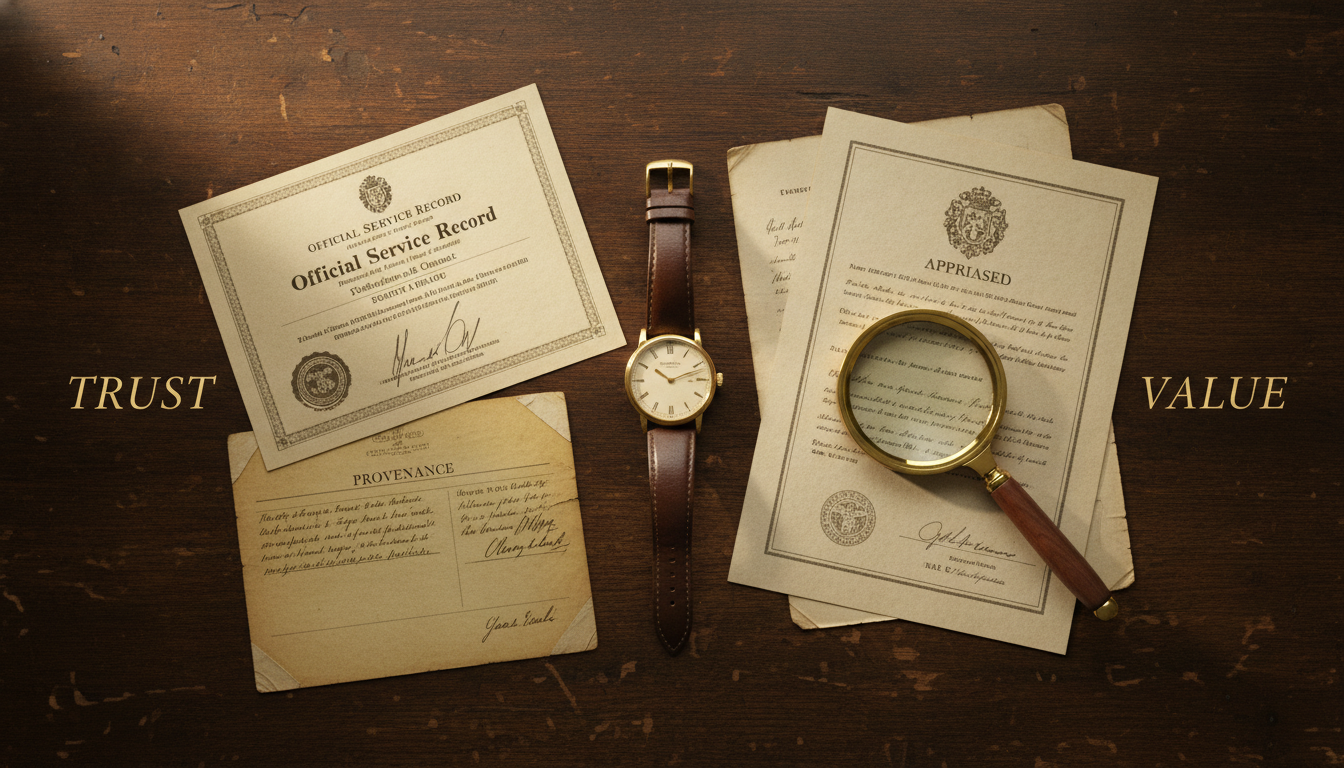
While the standard 'full set' forms the essential foundation, a watch's true value and buyer trust are significantly enhanced by its broader ownership history. This advanced documentation—including service history and detailed provenance—narrates the timepiece's entire journey beyond its initial purchase, adding layers of desirability that discerning collectors actively seek.
Official service records are paramount. It's critical that these documents originate from authorized service centers, not independent repair shops. Such official papers confirm the watch has been properly maintained and retains genuine internal components. Unauthorized servicing, in contrast, can raise more questions than it answers and even deter potential buyers, as warned by MioJewelry (2024).
The original purchase receipt, though often elusive, is an invaluable document. If you possess it, safeguard it carefully. It serves as definitive proof of the watch's initial acquisition date and price, which can be crucial for tax purposes or any future legal considerations. French tax law (2024), for instance, requires such invoices for certain exemptions. This receipt isn't just paper; it's hard data that establishes the watch's financial and legal genesis.
Provenance documents are where a watch transcends being a mere instrument to become a storied artifact. Any evidence connecting the watch to a notable original owner, a significant event, or a unique historical context can dramatically elevate its value beyond its mechanical worth. As ECI Jewelers (2024) notes, such provenance can add incredible desirability. Collectors are often willing to pay a substantial premium for a watch with a compelling, verifiable story.
Finally, appraisal and insurance documents, while not the most glamorous, hold significant weight. A consistent history of insurance coverage and regular appraisals, though distinct from market value, demonstrates a pattern of responsible ownership. This indicates to a prospective buyer that the watch has been well-cared for and protected, fostering a crucial sense of trust. As Similarweb (2024) data indicates, transparency regarding asset history significantly enhances buyer confidence. Ultimately, the comprehensive "beyond the box" documentation builds an irrefutable narrative of value and trust for any luxury watch.
The Legal and Financial Imperative: When Documents Become Evidence
Do you perceive your luxury watch solely as an aesthetic statement, a symbol of status, or a mere investment? This perspective, while common, is fundamentally flawed. Inevitably, life presents unforeseen challenges, and in such moments, your prized timepiece transforms from an adornment into crucial evidence – or, conversely, a significant liability. Prudent foresight demands you avoid the latter.
Far too often, individuals invest substantial sums in luxury items yet neglect the accompanying documentation, treating it as disposable. While the original presentation box might be preserved, critical receipts and warranty cards are frequently misplaced or disregarded. This oversight represents a profound financial vulnerability. When legal or financial complications arise, these documents are not just ancillary additions; they become your indispensable defense. They are the only safeguard against potential financial exploitation. To remain indifferent to this reality is to court significant risk.
Consider the complexities of divorce. Should you face such a situation, or even contemplate it, you're aware that assets are subject to division. Your watch is no longer exclusively yours. In jurisdictions like New Jersey, that shiny new Patek, bought while you were married, is typically classified as a marital asset. Opposing parties will invariably seek to claim its value. What then serves as your defense? Meticulous proof. Your receipts and warranty cards are essential to substantiate that the watch was a pre-marital acquisition or a legitimate gift, not purchased from joint funds. Disregarding these details can lead to substantial financial losses, as detailed by firms like The Weinberger Law Group, which emphasize the critical distinction between marital and separate property.
Beyond marital disputes, selling a luxury watch has tax implications that cannot be ignored. The revenue authorities are vigilant, especially with high-value transactions. In France, for example, sales exceeding €5,000 are subject to capital gains tax. Your primary recourse, or at least a means to mitigate the tax burden, lies in accurate documentation of the original purchase date and price. This information allows you to potentially opt for a potentially more favorable capital gains regime or, crucially, claim a full exemption if the watch has been held for a sufficient duration, as outlined by vv-avocat.com. Proving ownership for, say, 22 years with an invoice can result in complete tax exemption. This highlights the substantial financial savings directly attributable to organized paperwork, which cannot be replaced by mere recollection.
The unfortunate realities of theft or loss also underscore the imperative of comprehensive documentation. When filing an insurance claim, companies demand robust evidence: serial numbers, photographs, and appraisal documents. They rarely accept claims based solely on verbal testimony, often seeking avenues to deny or reduce payouts. Detailed records are your only assurance of a successful and equitable insurance settlement. Without such clear specifics, your claim stands on precarious ground, potentially resulting in the loss of thousands.
Finally, consider the legacy you leave. Estate planning, already a complex process, is vastly simplified by proper documentation. Clear records of valuation and provenance facilitate equitable distribution, preventing potential family disputes over high-value items like luxury watches. A lack of precise records can ignite disagreements and create unnecessary legal costs. As indicated by general asset tracking principles noted by Similarweb (2024), clarity in documentation benefits everyone involved.
To disregard comprehensive paperwork is to gamble your financial security against a stack of receipts, and in that wager, the odds are always stacked against you.
No Papers, No Problem? How to Sell a 'Naked' Watch
Can You Sell Rolex Without Papers?
It's a common scenario: you have a luxury watch, but its original box or papers are missing—whether lost, damaged, or simply not included in your acquisition. This often deters prospective buyers who typically seek a complete package. However, selling a 'naked' watch is entirely possible, provided you approach it strategically and transparently.
While the absence of documentation presents challenges, it doesn't render your watch valueless. The key is to acknowledge its status truthfully and employ smart strategies to build buyer confidence. Selling a 'naked' watch requires honesty and strategic authentication to mitigate buyer concerns and secure a fair price.
First and foremost, absolute honesty is paramount. Clearly state "watch only" or "no box, no papers" in your listing from the outset. Burying this information or waiting for inquiries will erode trust and likely prevent a sale. As MioJewelry's guide emphasizes, misrepresentation can be costly and detrimental to your reputation.
For certain prestigious brands like Patek Philippe or Omega, obtaining an 'Extract from the Archives' is a viable solution. For a nominal fee, these official documents provide essential details like serial number, production date, and original sale information, serving as robust proof of authenticity in the absence of a warranty card.
Another critical step is securing a professional appraisal from a recognized luxury watch specialist. This expert evaluation will not only determine the watch's fair market value but, crucially, authenticate its legitimacy, ensuring it's not a counterfeit or a 'frankenwatch.' This third-party verification provides immense confidence to potential buyers.
Beyond formal documentation, highlight the watch's inherent strengths. Is it in exceptionally mint condition? Does it boast a recent authorized service? Perhaps it features a rare dial, is a limited edition, or exhibits desirable patina. Emphasize these unique attributes to create a compelling reason for a buyer to choose a 'watch-only' offering.
Finally, pricing is critical. A 'naked' watch will not command the same price as a full set, which often fetches a 10-25% premium or higher, as validated by Similarweb (2024) data. Conduct thorough research into actual sold prices for similar 'watch-only' examples, not just asking prices. A realistic, fair valuation from the outset is essential for a prompt and successful sale.
Your Pre-Sale Documentation Checklist
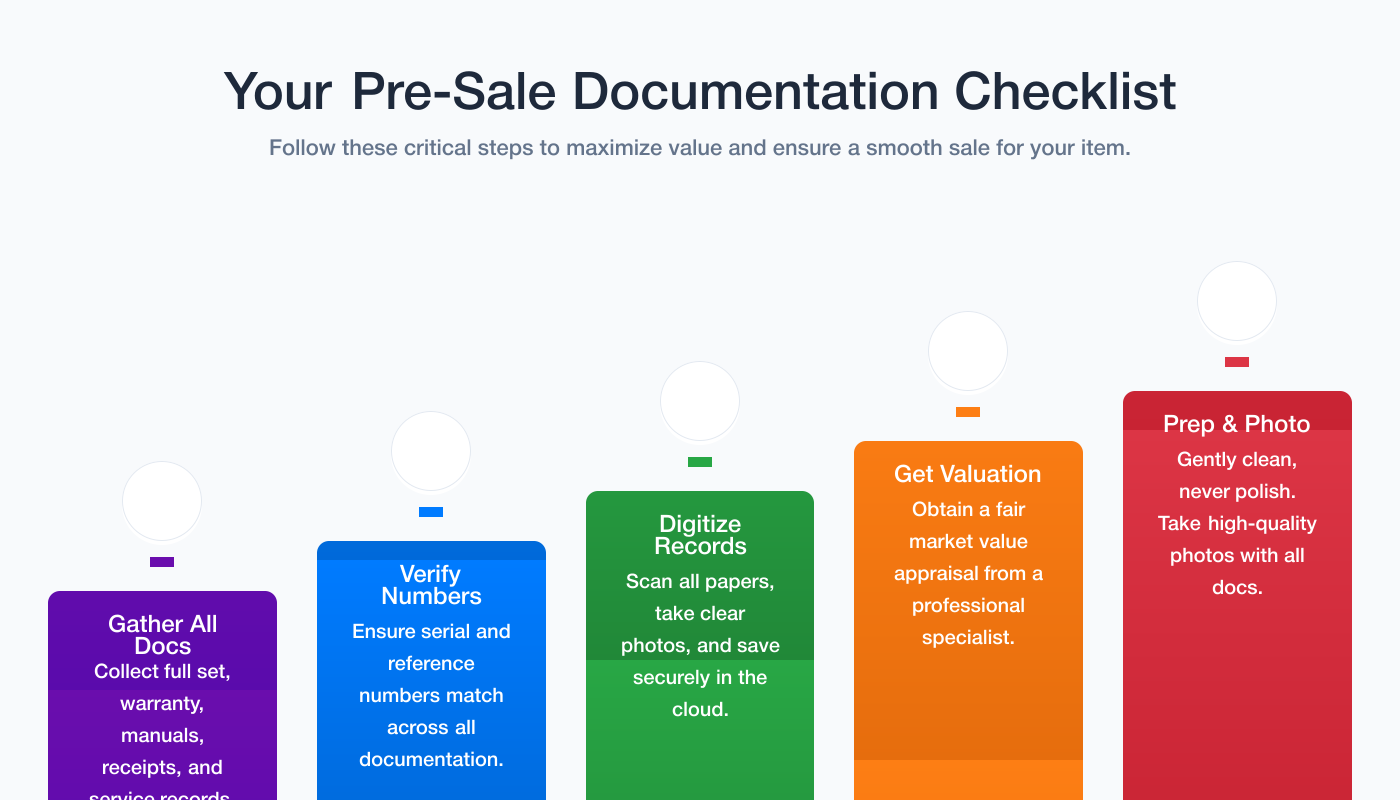
Before listing your luxury watch for sale, a thorough and organized approach to documentation is non-negotiable. This pre-sale checklist ensures you present your timepiece with maximum transparency and credibility, directly impacting its market appeal and final selling price. A meticulously prepared documentation package is the bedrock of a successful and lucrative luxury watch sale.
Obtain a Fair Market Valuation. Do not rely on retail prices or speculative estimates. Commission a professional appraisal to determine the fair market value*—the realistic price a buyer will pay. This objective valuation forms your strategic starting point.
By meticulously completing this checklist, you move beyond guesswork, establishing a robust foundation for a confident and profitable sale.
Frequently Asked Questions
Can I really get this thing sold fast?
While we understand the desire for a swift transaction, we prioritize a meticulous process over instant promises. Unlike questionable services offering overnight magic, our focus is on thorough evaluation, proper authentication, and strategic matching of your item to qualified buyers. It's a structured approach designed for efficiency, not haste, ensuring optimal outcomes. Our process delivers speed, but never at the expense of thoroughness or security.
Do I need all the original items – boxes, papers, receipts?
Possessing the complete original set significantly enhances buyer confidence and typically commands a higher resale price. However, its absence is not always a deal-breaker. We regularly work with valuable timepieces that lack original documentation due to circumstances like loss or prior acquisition without papers. In such cases, we undertake additional verification and authentication processes. While still salable, expect a potentially lower valuation. While original documents are highly advantageous, their absence doesn't preclude a successful sale.
What if I just want a value estimate, not to sell right now?
We absolutely provide expert, market-based valuations for those interested in understanding their item's true worth, whether for immediate sale or future planning. Our estimates reflect actual market demand, not inflated retail figures. Please note that this comprehensive valuation service incurs a professional fee, reflecting the expertise and resources involved. Accurate, professional valuations are a paid service reflecting specialized expertise.
Is my personal information actually secure? Or will it end up everywhere?
Given our focus on high-value assets, security is not merely a suggestion—it's a fundamental principle of our operations and legal obligation. Your personal data and the specifics of your item are rigorously protected and kept confidential. We never sell or share client information. In this industry, trust is the ultimate currency, and safeguarding your privacy is paramount to maintaining it. Your personal information and item details are handled with the utmost security and confidentiality.
What if I change my mind after sending my item in?
You retain ownership of your item, and the decision to proceed is always yours. However, once we initiate our comprehensive process—including authentication and market analysis—significant time and resources are expended. Should you decide to withdraw your item before a final sale is completed, a modest fee may apply to cover these operational costs. We encourage open communication to address any concerns and explore alternative solutions. While you maintain flexibility, withdrawing an item after processing has begun may incur a service fee.
Are there any hidden fees I should watch out for, because usually there are?
Transparency is a cornerstone of our service. Our quotations are comprehensive, outlining all applicable costs upfront. Any commission structures or appraisal fees, if you've opted for them, are clearly itemized before you commit. We pride ourselves on having no hidden charges, ensuring complete clarity and avoiding unwelcome surprises. Our fee structure is entirely transparent, with all costs disclosed upfront and no hidden charges.
What kind of stuff do you actually buy? Just watches?
Our acquisition focus extends beyond high-end timepieces from esteemed brands like Rolex and Patek Philippe. We also specialize in fine jewelry, diamonds, and other rare items with verifiable value and strong market demand. While we deal exclusively in quality and authenticity, we do not handle costume jewelry or items lacking significant intrinsic or collectible worth. As Similarweb (2024) data confirms, our niche is authenticated luxury items commanding premium prices. We specialize in acquiring authenticated, high-value luxury goods beyond just watches.
Having navigated the critical importance of a watch's paper trail, you now understand that this knowledge is not merely theoretical. It is the decisive factor distinguishing between a swift, top-tier sale and a frustrating, undervalued liquidation—or even significant legal complications. The luxury market communicates through verifiable documentation, not just captivating aesthetics.
Here’s a concise recapitulation:
While the process of organizing this may seem arduous, neglecting it demonstrably results in lost financial opportunity.
Therefore, proactively consolidate your documentation. Systematically gather, organize, and digitize every pertinent record before contemplating a sale. If uncertainties persist, or if you require an objective valuation recognized by discerning buyers, engage with a reputable specialist—such as Stellaris—who can expertly verify your holdings and guide your next steps. Ultimately, meticulous documentation is not merely administrative; it is your most powerful asset in the strategic sale of a luxury watch.
