

A Strategic Guide to Watch Inventory Liquidation: A Case Study
The Stellaris Journal
The luxury watch e-commerce market is projected to hit an astounding $58 billion by 2035. Sounds like a boom, right? An unparalleled opportunity. But every boom carries the risk of a bust, or, more accurately, an overstock crisis. And when your meticulously curated inventory starts drowning in a sea of diminishing demand, you've got a problem. A monumental one.
This isn't merely about offloading product at rock-bottom prices. It's a intricate, high-stakes ballet with significant legal and financial ramifications. Botch it, and you'll irrevocably crater your brand reputation and future prospects. Do it right, and you don’t just cut losses—you save face. You save your future. This isn't theoretical fluff; it's a raw look at business survival.
We're diving deep into the complexities: Administration versus liquidation. Understanding the role of your administrator. The true, brutal valuation of a watch when the company is sinking. And critically, we'll explore strategies beyond the conventional "fire sale." Because smarter avenues exist—ways to transform a financial quagmire into something genuinely beneficial, even a powerful marketing channel. So, pay close attention.
The High-Stakes World of Watch Inventory Management
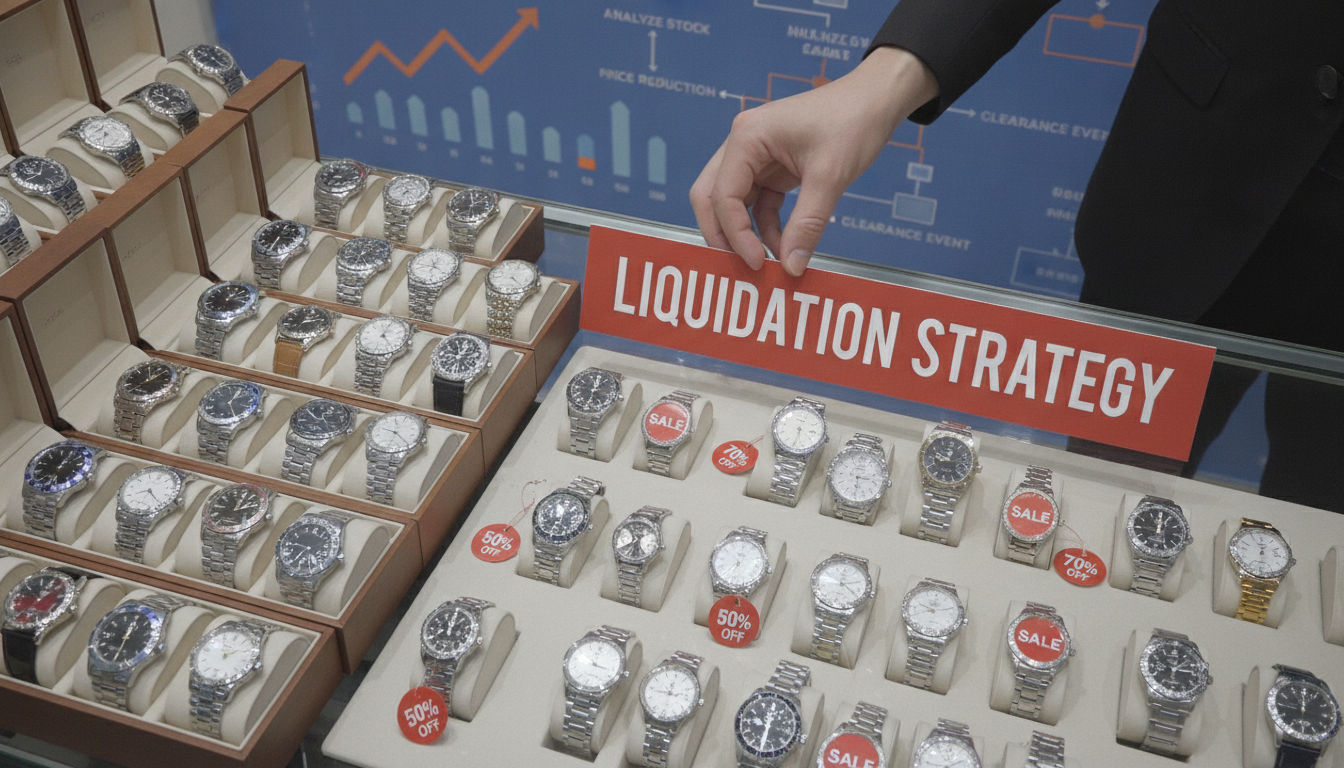
The watch market isn't just ticking along; it's exploding. Specifically, the luxury watch e-commerce sector is forecast by Opensignal to surge from $22.3 billion this year to nearly $58.6 billion by 2035. That's a staggering sum of money. Online watch stores, in particular, are expanding at an aggressive rate of about 10% annually. Clearly, opportunity is knocking louder than ever.
Yet, this very opportunity often sows the seeds of trouble. Greed can be a powerful motivator. Witnessing these growth figures, businesses aggressively increase their stock, diversify models, and engage in "aggressive purchasing." Why wouldn't they? The market is red-hot. But then, the market shifts. Or your meticulously crafted sales forecast—your bet—misses the mark. Suddenly, you're not just sitting on inventory; you're buried under a mountain of extremely expensive, unsellable assets.
This isn't abstract theory. Companies fold, rapidly. Consider Judian Travel Technology, a high-profile joint venture between Didi and Li Auto. Despite substantial backing, it filed for bankruptcy liquidation because market dynamics unpredictably flipped (Law.asia). One moment you're building an empire, the next you're watching it crumble. This is the very real mess you desperately want to avoid.
Because if you cannot move that excess stock, it will bleed your company dry through colossal financial losses. Your brand perception deteriorates, looking desperate and damaging your hard-earned reputation. Suppliers and creditors begin to call relentlessly, and sleepless nights become the norm. It's an untenable position. So, managing that inventory isn't just about profit; it's about survival. You need a clean exit strategy, a way to sell off the junk without setting the whole damn thing on fire.
The Legal Crossroads: Choosing Between Administration and Liquidation
Your company finds itself in a deep financial hole. Naturally, you begin to explore options. Is a rescue mission viable? Or is it time to cut losses and shutter operations entirely? This isn't merely a casual business decision; it's a complex legal and operational undertaking that demands careful consideration.
Administration: The "Rescue Me" Plan
The term "administration" often conjures images of corporate rescue, and that's precisely the underlying intent. As outlined in the Insolvency Act 1986, it's a formal insolvency procedure—a legal "pause button." The primary objective, as emphasized by Myerson Webinar, is to save the company, or at least achieve a better outcome for creditors than a straightforward winding-up process would allow.
Administration vs Liquidation: What's the difference?
However, administration is no magic wand. You can't simply declare "Admin!" and expect problems to vanish. Stringent legal tests must be met. Is the company genuinely unable to pay its debts? This is paramount, assessed via the cash flow test (can you pay bills as they fall due?) or the balance sheet test (do liabilities outweigh assets?), as covered in Section 123. Crucially, is there a realistic chance that this "rescue" effort will actually succeed? You need a solid shot at achieving the stated purpose, otherwise, you're merely wasting valuable time and resources.
Liquidation: The Final Stop
Then there's liquidation. This process isn't about rescue; it signifies the end. The final chapter. It involves systematically winding up the company's affairs, selling off all available assets, and distributing the residual proceeds to creditors. There is no going back; it's a terminal process. Often, liquidation represents the legally safer route, preventing the perpetuation of false hope or the costly prolongation of an unsalvageable situation.
In some cases, the path to liquidation is starkly evident. There might be no conceivable way to save the business, or insufficient funds to even initiate an administration process. Furthermore—and this occurs more frequently than one might imagine—allegations of director misconduct might necessitate a thorough investigation, making liquidation the clear and direct path. It offers a clean break, or at least as clean as such situations ever get.
The "Pre-Pack" Maneuver (And Why It’s Tricky)
You might encounter the concept of a 'pre-pack' administration. This seemingly clever strategy involves negotiating the sale of the company's assets before formally entering administration, creating a perception of seamless restart. However, this maneuver operates under intense scrutiny. Stringent transparency rules, specifically SIP 16, exist to protect creditors. Without scrupulous adherence to these guidelines, a pre-pack can easily appear to be an unfair backdoor deal. Every single step must be impeccably above board.
Making the Call
Here's the critical point: the decision between administration and liquidation is not driven by commercial preference or what "feels" right. It must be a legally defensible choice. You are required to substantiate it, demonstrating that you met all statutory tests and genuinely believed your chosen path offered the optimal outcome for creditors. As the Myerson Webinar emphasizes, meticulous documentation of every decision is non-negotiable. Fail to do so, and you may find yourself explaining your rationale to a judge.
Therefore, you must meticulously assess the company's standing, its financial realities, and the precise legal framework. Only then can you make the definitive call. Because picking the wrong path isn't just bad for business; it's a legal minefield. And it might just land you in hot water.
The Administrator's Playbook: A Blueprint for Orderly Liquidation
Do you envision liquidation as merely a chaotic fire sale—a desperate dump of assets? Think again. It's a high-stakes, intricate operation that demands the precision of a professional. Most people picture some amateur trying to sell office desks on Craigslist. But a true administrator? They are surgeons of solvency, or perhaps more accurately, highly disciplined bouncers. Their role is to contain the chaos, by necessity. Take the Judian Travel Technology debacle; it was a textbook train wreck. Yet, a sharp administrator transformed it into something almost... clean. So, what does "good" look like in this arena? Here's the essential drill.

The Grunt Work: Executor, First Responder
Alright, first things first. When a business collapses, the administrator steps in like a SWAT team (minus the weaponry, typically). Their immediate task is to secure everything: all assets, every single document. Swift action is crucial, because if assets aren't secured immediately, they can disappear or be compromised. Without them, you're left with nothing but air. In the Judian case, the administrator had to delve deep to identify precisely what remained. It wasn't a fancy "delve" but plain, arduous detective work—digging in to locate any surviving capital. This isn't about paperwork; it's about holding the line.
The Talker: Mediator, The Unthanked Therapist
Next comes the particularly challenging part: creditors. There will be many of them, acting like a pack of hounds, and usually, they are justifiably furious. The administrator assumes the unenviable role of the go-between, often becoming the unwitting punching bag. Yet, they must communicate, and crucially, they must listen. Judian, with debts owed to nearly 100 suppliers, presented a monumental challenge in mediating with such a large, agitated group. Establishing clear communication channels is vital, because ignoring them is a direct path to even greater problems. The goal is to bring everyone onto the same page (or at least into the same book), even when they are reluctant. This is an incredibly tough gig, as highlighted by Law.asia. It requires constant, draining effort.
The Watchman: Guardian, The Paranoid Keeper
But the role extends beyond mere communication; it encompasses absolute transparency, especially when all eyes are watching (and they always are). The administrator must openly disclose every action and the rationale behind it. Updates are frequent and comprehensive. The court, creditors, and other stakeholders are constantly scrutinizing every decision. This scrutiny should be embraced, not avoided. Hiding information erodes trust, and in the volatile environment of liquidation, trust is as scarce and precious as gold dust—it is everything. The high-profile Judian case underscored this; the administrator had to operate with unimpeachable honesty, or the entire process would have collapsed.
The Hustler: Maximizing Value, Not Just Selling Cheap
Now, concerning the sale of assets. This is far from a casual garage sale. You don't simply dump assets for pennies; that's an amateur mistake. The overarching objective is always to maximize recovery, even when it feels like assets are worthless. In Judian's case, the approach was exemplary: multiple public auctions were conducted, not just one or two. Why? To attract broader attention, to drive up prices, and to achieve genuine market value, not just a quick, low-ball cash out. Law.asia confirmed this strategic brilliance. Every additional dollar recovered reduces the losses for creditors and simplifies the process in the long run. This is the entire point of skilled administration.
This isn't just about closing a business; it's about closing it without a bloodbath.
Valuing Assets Under Pressure: A Realistic Recovery Analysis
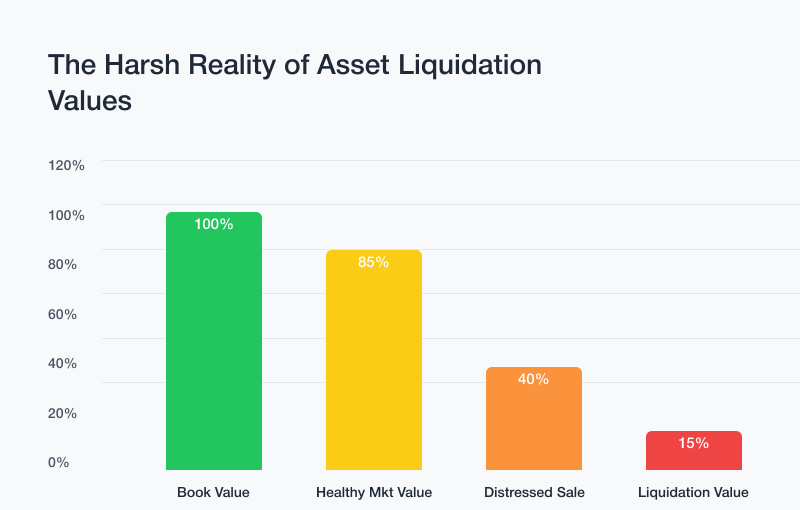
So, the company is defunct. Now what? You're tasked with liquidating its remains. But whatever you do, do not consult the book value. That number on the balance sheet is a phantom, a pure fabrication in the context of a fire sale, a concept well-understood in asset valuation. In such scenarios, everything becomes drastically cheaper—significantly below perceived worth. This isn't retail; it's salvage. Consider NUO Therapeutics (SEC.gov), a Chapter 7 case that served as a brutal reality check for all involved. If you truly want to understand the realistic recovery, discard the ledgers and tune into the harsh realities of the market. So, forget what the books say; what's left is often a fraction, not a fortune.
What's Really Left: The Hard Truth
Let's dissect the remaining assets, because not all are created equal. And the vast majority of them will incur a severe beating in terms of value.
- Cold Hard Cash. Actual cash on hand or Certificates of Deposit (CDs)? Excellent. These will likely recover close to 100% of their value, if not all. That's straightforward. But rarely is there a substantial amount of it.
- Money Owed (Accounts Receivable). Customers owe you money. But will they honor those debts now that your company is defunct? Some will, most likely. But certainly not all. Expect perhaps a 75% to 85% recovery. Collection challenges are very real, making this a frustrating process, but it's undoubtedly better than nothing.
- The Stuff (Inventory). This is where it becomes highly unpredictable. If you're selling specialized watch parts to another watchmaker, you might achieve a respectable 75% recovery. Not terrible. However, if it's a pile of generic widgets that no one wants anymore, expect a brutal fire sale. Perhaps a meager 25% of its original worth. Pitiful, yet a harsh reality. It's a genuine toss-up.
- The Tools (Equipment). Do you possess advanced watchmaking tools or production machinery? Again, recovery depends. Can another operational business utilize it? If so, you could see anywhere from 25% to 75%. If it's proprietary, outdated junk designed for a now-defunct process, recovery will be zero or near zero. It's a bitter pill to swallow, but often true.
- The Ideas (Intangible Assets). Brands, technology, customer lists—these are typically the first assets to lose significant value. Their worth often plummets to nothing. In truly exceptional scenarios, perhaps a 50% recovery is possible, but that is exceedingly rare. Honestly, most times, these assets are just smoke; they dissipate when the underlying business does. Do not count on significant recovery here.
- Future Buyers. And the benefits extend further. A remarkable 83% of these discovery customers report subsequently purchasing the exact same products at full price. You heard correctly. That initial "discounted" sale has effectively acquired a new, full-price customer. This isn't a loss; it's a highly effective customer acquisition tool.
- Marketing Gold. These specialized platforms aren't just moving your products. Oh no. They are collecting invaluable data via proprietary data engines. They possess granular insights into who buys what, when, and why. Demographics, cart contents, category performance—you receive actionable feedback, real feedback. This is marketing gold. Genuinely.
- That initial fork in the road, administration versus straight liquidation? It's not semantics. It's the difference between a controlled descent and a freefall. Get it wrong, and you’ll bleed capital, brand value, and trust.
- Your administrator isn’t just a glorified accountant. They’re the architect of your exit strategy. Their playbook, their decisions, determine how much value (and sanity) you retain. Choose some bozo, and you deserve what you get.
- And no, liquidation doesn't have to be a desperate fire sale. If you're clever, if you really think it through, you can actually use the process to reinforce brand positioning, even generate goodwill. Zero ad spend. That’s the goal.
And here's the ultimate kicker: from whatever gross proceeds you manage to generate, you then must pay those performing the difficult work: trustee fees, wind-down expenses, and various administrative costs. Consequently, what actually remains for the creditors is even less—a significantly smaller sum. SEC.gov explicitly outlines this reality. It's a mathematical problem with numerous subtractions.
Beyond the Fire Sale: Turning Liquidation into a Marketing Channel
You're saddled with excess stock. It happens. The traditional approach? Dump it, inevitably trashing your brand in the process. But there's a new paradigm emerging. Most perceive liquidation as an undeniable loss, a desperate race to the bottom. However, astute strategists are discovering an entirely different path—a way to actually win. Consider Martie (SpoilerAlert.com), a company that doesn't just sell discounted goods; they leverage that inventory to acquire new customers. Sounds counterintuitive, right? It's time to discard the old playbook, because this isn't merely about offloading inventory. It's about strategic intelligence.

The New Play: Discount as Discovery
Traditional liquidation is inherently messy. It demands price slashing, which in turn devalues your brand. But what if selling that excess inventory could actively bolster your brand? Modern e-commerce platforms are achieving precisely that; they're flipping the script entirely, a key theme in modern retail trends. Liquidation is no longer perceived as a failure, but as an opportunity—for consumers to discover new brands. And demonstrably, it works, as SpoilerAlert.com illustrates.
Discovery Engine. Here's a compelling insight: 60% of customers utilizing platforms like Martie actively seek out new* brands, not just discounted products. Your excess inventory thus transforms into a powerful discovery tool. Pretty ingenious, isn't it?
So, not only do you recover some costs on inventory that would otherwise languish, but you also attract new, high-intent customers, and gain critical marketing intelligence. This isn't a magic trick; it's smart business, and it fundamentally alters the entire game.
Stop viewing leftover products as mere dead weight. Instead, perceive them as an incredibly cost-effective method to bring new customers through the door. Seek out a partner who understands this paradigm—a platform capable of transforming your perceived "trash" into genuine treasure, or at least into valuable new business. Get moving. This isn't about clearing shelves; it's about building your next customer base, one discounted item at a time.
Alright, listen up. The watch business? It's volatile. One day you're stacking Patek, the next you're staring down an overstock spreadsheet that could bankrupt you. This whole 'liquidation' thing, it’s rarely about grace. It's about damage control. But damage control doesn't mean scorched earth.
Here’s what you actually need to remember:
This entire mess is ugly. No one wants to be here. But approaching it with a cold, strategic mind? That's your only path out with any dignity left.
So, you’ve got dead stock? Don't sit on it hoping for a miracle. Talk to someone who understands the real market, who can actually move high-value assets with integrity and transparency. Someone like Stellaris. They deal in facts, not fairy tales. Because time (and inventory) waits for no one.
