

Rolex Service and Originality: What Can Change?
The Stellaris Journal
Use Rolex’s official service locator to find an Official Rolex Jeweler or Service Center. Rolex currently recommends service approximately every ten years, depending on the model and how the watch is used. The watch is examined first, and an estimate is supplied for approval.
A complete Rolex service may replace components that no longer meet Rolex specifications with genuine parts and refinish the case and metal bracelet. The watch can therefore be authentic and correctly Rolex-serviced without every component remaining factory-original to that individual watch. If vintage originality matters, state the conservation goal and review proposed work before authorization.
Rolex Service: The Short Answer and Current Official Facts
The safest starting point is the official Rolex service-center locator. A local watchmaker may provide valuable independent service, but work outside the Rolex network should not be described as official Rolex service.
Current official boundaries, verified July 2026:
| Question | Official answer boundary |
| -------------- | -------------------------------------------------------------------------------------------------- |
| Where? | An Official Rolex Jeweler or Service Center listed by Rolex |
| Interval? | Approximately ten years, depending on model and real-life usage |
| Cost? | A watch-specific estimate after examination |
| Time? | A complete overhaul takes a minimum of four to six weeks, depending on condition |
| Parts? | Components outside Rolex specifications may be replaced with genuine Rolex parts |
| Finish? | Rolex describes case and metal-bracelet refinishing during complete service |
| Documentation? | A Rolex Service Card and two-year international service guarantee follow a full authorized service |
These are general current statements, not a fixed quote for every watch. A complicated, damaged, vintage, or historically significant piece may require a different path. Parts availability, diagnosis, necessary work, and completion time depend on the watch.
Contact the listed receiving location before sending the watch. Confirm the intake method, shipping or hand-delivery instructions, insurance responsibilities, and documents required for the specific region. Do not send a high-value watch based on an address copied from an unrelated directory or old forum post.
Ask whether the proposed work is a complete service, a limited repair, warranty work, restoration, or another scoped intervention. “Sent to Rolex” is not enough information for a later buyer to understand what happened.
What Happens During a Complete Rolex Service
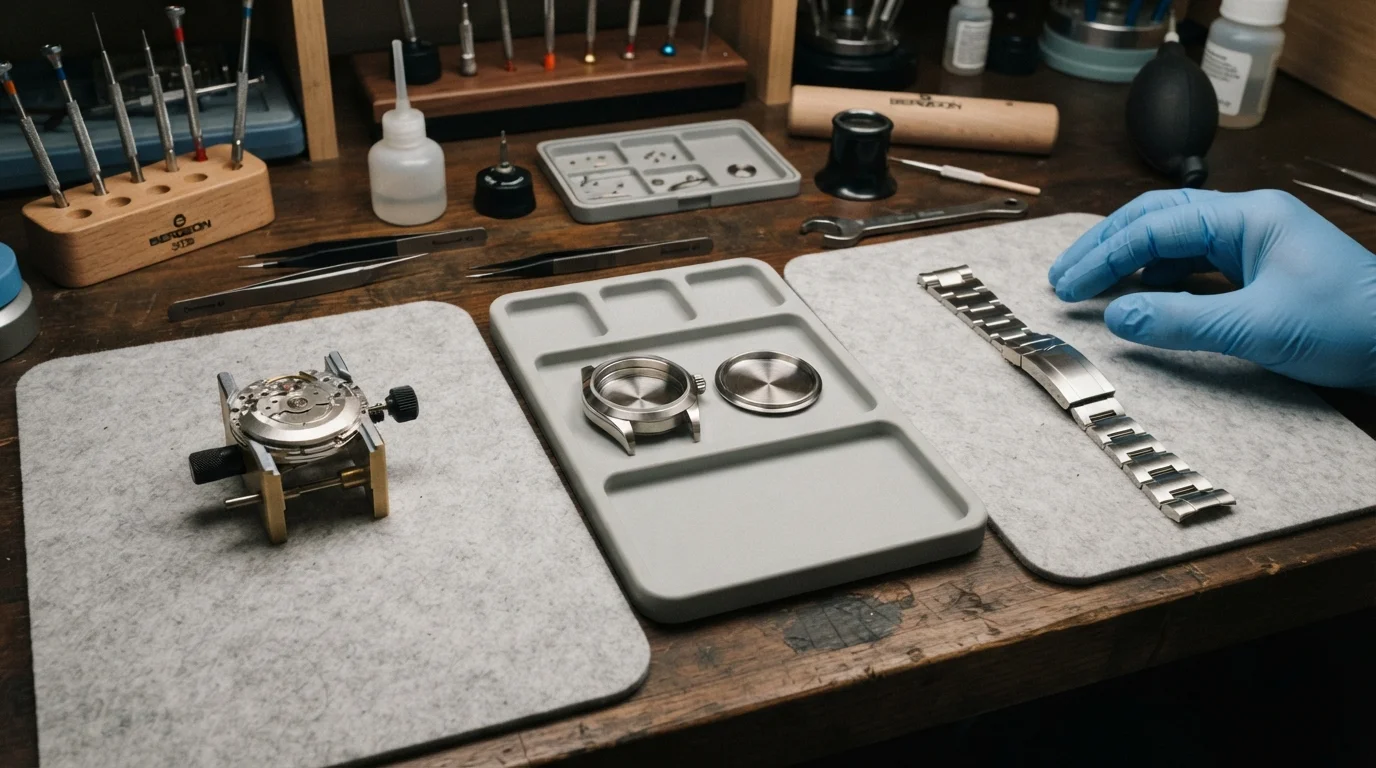
Rolex’s care and service information describes a structured process.
Examination and estimate
The watch is assessed and the work required is documented in an estimate for approval. This is the stage to state conservation priorities and ask which operations are necessary, recommended, optional, or unavailable for that specific watch.
Movement service
The movement is removed, dismantled, and its components are examined. Rolex describes cleaning, replacement of components that do not meet functional or aesthetic specifications, lubrication, reassembly, and adjustment.
Case and bracelet work
The case and metal bracelet follow a separate path. Rolex’s published complete-service process includes refinishing and replacement of seals before the watch is reassembled.
Testing and return
Rolex describes checks for waterproofness, precision, power reserve, and functions. A full service through an authorized center returns with service documentation and a protective presentation element.
The separation of work paths matters. A watch can receive movement components, exterior components, refinishing, and seals within one complete service. “Mechanically serviced” and “complete Rolex service” should not be assumed to mean the same thing without the estimate and invoice.
The published process is designed around Rolex’s current functional and aesthetic specifications. A collector’s wish to preserve a worn but original dial, hands, bezel, or case finish is a related but different objective. Raise it before approving the estimate, not after the work is complete.
Approval should be traceable. Keep the original estimate, any revised estimate issued after disassembly, written questions, and the final invoice. If additional work is discovered, compare the new proposal with the original authorization before agreeing. A verbal summary can be useful, but it should not replace the watch-specific record when component history matters.
Which Parts or Finishes May Change
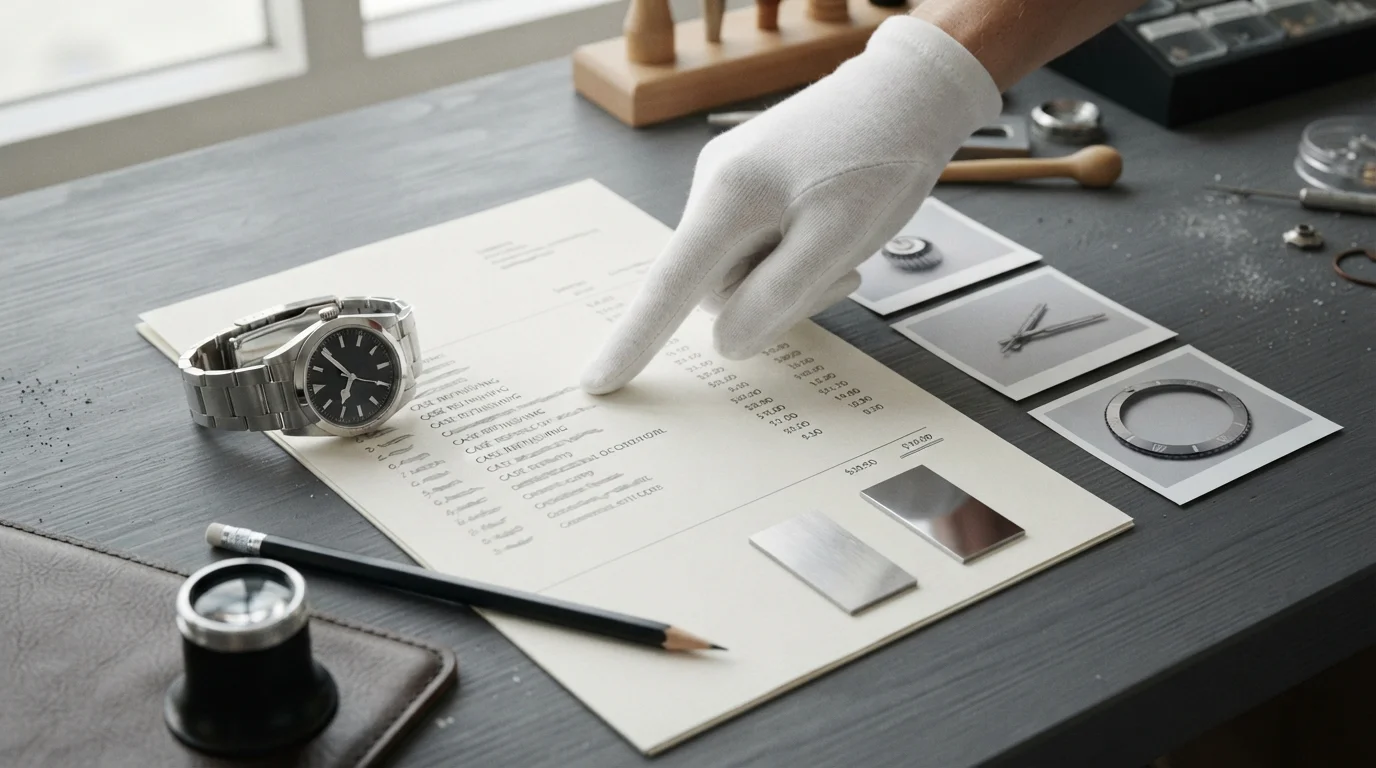
During a complete service, Rolex says components outside its specifications are replaced with genuine Rolex parts. The exact list depends on the examination and approved work.
Potential movement work may involve worn or damaged components needed for function. Exterior work can involve a crown, crystal, bezel element, dial, hands, bracelet component, or another part where replacement is proposed for the specific watch. Do not assume that every service replaces these items, or that every proposed item can be declined.
Rolex also describes refinishing the case and metal bracelet during complete service. Refinishing can reduce scratches and restore the intended finish, but it may change surface condition and case geometry that an originality-sensitive collector values.
Before authorization, ask for line-item clarity:
- Which parts are required for the watch to meet Rolex specifications?
- Which exterior or cosmetic components are proposed for replacement?
- Will the case or bracelet be refinished?
- Are any operations optional for this watch?
- Which conservation request can be accommodated?
- What will the final invoice identify?
- provider and service location;
- watch reference or identifying information;
- date of intake and completion;
- recommended work;
- approved or declined work where documented;
- replaced components;
- refinishing or restoration;
- tests performed; and
- service-guarantee scope.
- Authentic Rolex: the watch and represented components are genuine within the scope of the examination.
- Rolex-serviced: an authorized Rolex provider performed the work documented in the record.
- Genuine service replacement: Rolex supplied a later genuine component during service.
- Factory-original to this watch: the component is represented as the one installed when this individual watch originally left production.
- documented original to the watch;
- documented genuine Rolex service replacement;
- period-correct replacement without proven original association;
- aftermarket or modified;
- consistent but historically unproven; or
- unknown.
- use the official locator;
- record the exact reference and current condition;
- state originality and conservation priorities;
- read the estimate line by line;
- ask which replacements and refinishing are required, proposed, optional, or unavailable;
- avoid assuming old parts will be returned; and
- retain the final documents and updated photographs.
- verify the provider and service date;
- match the Service Card, estimate, and invoice to the watch;
- identify replaced components and refinishing;
- separate genuine service parts from factory-original parts;
- review present condition and any work after the documented service;
- identify gaps in the earlier history; and
- compare the written listing with the delivered watch.
The reviewed official pages do not support a universal promise that every replaced part will be returned or that every recommended operation can be declined. Do not build a purchase decision around that assumption. Ask the receiving center what applies to the exact watch before approval.
Record the watch before service with neutral photographs of the dial, hands, case, bezel, crown, bracelet, clasp, and included accessories. Those images do not overrule the service record, but they help document visible changes and prevent a later description from relying on memory.
What the Rolex Service Card and Estimate Prove
A Rolex Service Card confirms that the identified watch received a full service through a Rolex Authorized Service Center and accompanies a two-year international service guarantee under Rolex’s terms.
The estimate and final invoice can supply more detail. Read them together:
An estimate shows what was proposed. It does not prove every line was completed. The final invoice shows the work recorded at completion, but a broad package label may still require Rolex’s current definition of that service.
Match the documents to the physical watch. Preserve watch-specific identifiers while redacting unrelated names, addresses, payment details, or other private information when documents are shared.
Do not expand the card’s scope. It does not reconstruct every event before service, prove that all components were original at intake, or guarantee that nothing changed after the watch left the service network. It is also not a lifetime guarantee or a promise about future value.
A successful service and service guarantee are meaningful. They answer the maintenance work and warranty questions defined by Rolex. They should not be converted into a separate historical claim the documents do not make.
Consider a hypothetical watch with a Service Card and invoice documenting a complete service, replacement crown and crystal, and case refinishing. Those records support the authorized work and current service guarantee. They do not establish that the dial and hands were original at intake, that no earlier independent work occurred, or that the watch remained unchanged after service. The correct description carries both the documented facts and those limits.
Authentic, Rolex-Serviced, and Factory-Original Are Different
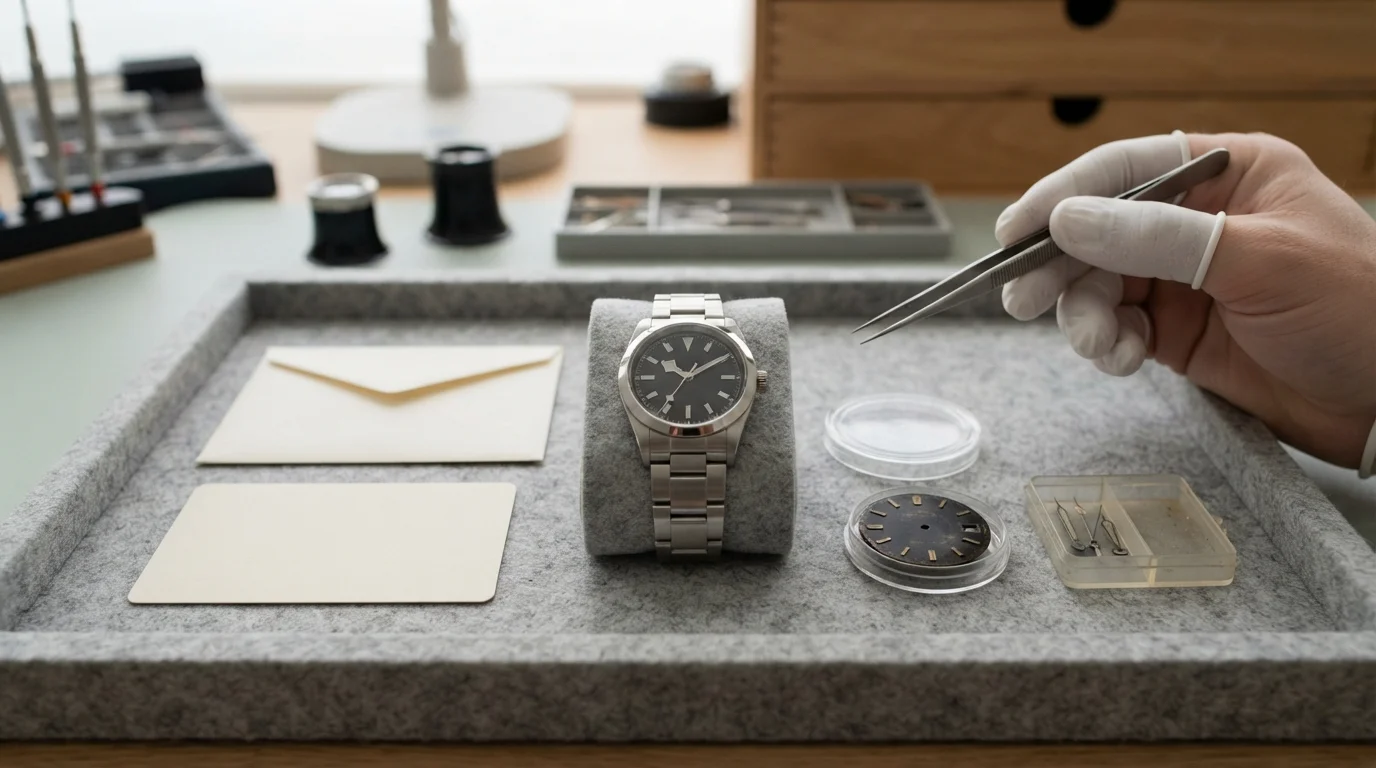
Several descriptions can be true at the same time:
A later genuine dial can be authentic without being original to the watch. The same applies to hands, crown, crystal, bezel, bracelet, or movement components. The distinction is especially material for vintage references, but it should remain accurate for modern watches too.
Add condition and completeness as separate conclusions. A watch may be authentic, recently serviced, polished, and missing its original papers. Another may retain stronger original components but need mechanical work. Neither service status nor originality alone describes the entire purchase.
Classify material components where evidence allows:
Avoid “all original except service parts.” Name the known parts and preserve uncertainty where the record does not answer.
This wording also protects a properly serviced watch from being described unfairly. A genuine Rolex replacement part is not automatically counterfeit or aftermarket. The issue is historical continuity, not whether authorized maintenance was legitimate. Buyers can then decide whether reliable daily use, preserved original configuration, or a balance of both matters most.
The official Rolex Certified Pre-Owned process has its own authentication and original-configuration checks for eligible watches sold through participating Official Rolex Retailers. A Service Card from prior maintenance and an RCPO certification are not interchangeable documents.
Vintage Rolex Service and the Restoration Atelier
Vintage service requires a clearer statement of priorities because reliable function and preserved historical configuration may pull in different directions.
Rolex’s World Service history describes parts and labor availability for at least 35 years after a watch leaves the catalogue. It also describes a Geneva Restoration Atelier for exceptional historic watches, where historical research and period techniques may be used and components may be restored or recreated.
That does not mean every older watch qualifies for restoration or follows the same path. Ask which service route applies after Rolex examines the specific watch.
Before submitting an originality-sensitive watch:
1. Photograph the current configuration and condition.
2. Record which dial, hands, bezel, crown, crystal, bracelet, and clasp are represented as original, service, replacement, or unknown.
3. State the preservation goal in writing.
4. Ask how essential functional work will affect those components.
5. Review proposed replacement and refinishing before authorization.
6. Retain the estimate, final invoice, Service Card, and post-service photographs.
Avoid universal advice such as “never polish.” Refinishing may be unwanted for one historically significant example and acceptable for a modern daily-wear watch. The decision should reflect the exact watch, its condition, the proposed work, and the owner’s documented priorities.
A restored historical watch can be authentic, significant, and correctly represented. It should not be described as untouched. Likewise, declining cosmetic work does not prove that the watch was unpolished before the current service.
For a vintage purchase, compare pre-service photographs, the estimate, final invoice, post-service photographs, and current watch. If the represented original dial or case finish materially affects the purchase, ask which evidence supports that continuity. A Restoration Atelier document may describe specialized work, but eligibility and scope must come from Rolex for that exact watch.
The record should follow the watch after service. Keep copies of the intake photographs, approved estimate, revisions, final invoice, Service Card, returned-item information where applicable, and post-service photographs together. If the watch is later sold, describe the documented work and remaining unknowns rather than reducing the history to “factory serviced.” A buyer can then distinguish authorized maintenance, current condition, component originality, and any later intervention. This also prevents a Service Card from being separated from the watch-specific explanation that gives it meaning.
Rolex Service and Originality Checklist for Owners and Buyers
Before authorizing service:
Before buying a serviced Rolex:
The Stellaris FAQ says listings use actual-watch photographs, identify included items, provide condition information, and include an authenticity guarantee. Stellaris is independent and not Rolex-authorized. For a specific watch, use the contact page to request the service documents and component history being represented.
How often should a Rolex be serviced?
Rolex currently recommends approximately every ten years, depending on the model and real-life usage. Treat this as guidance, not a deadline that overrides the watch’s condition or model-specific needs.
How much does Rolex service cost?
There is no responsible universal price. Rolex examines the watch and supplies a watch-specific estimate for approval.
How long does Rolex service take?
Rolex says a complete overhaul takes a minimum of four to six weeks, depending on condition. Complex, damaged, vintage, or restoration work may follow a different timeline.
Does Rolex service replace parts?
It can. Rolex states that components outside its functional or aesthetic specifications are replaced with genuine Rolex parts during complete service.
Does the Service Card prove authenticity or originality?
It confirms a full authorized service and the associated service guarantee. It is not by itself a certificate that every current component is factory-original or that no changes occurred later.
Can a Rolex be polished during service?
Rolex’s published complete-service process includes refinishing the case and metal bracelet. Originality-sensitive owners should clarify the proposed work before approval.
