

Grey Market Dealer vs. Watch Broker and Concierge
The Stellaris Journal
A grey-market watch is a genuine watch sold outside the manufacturer's authorized distribution channel. In the United States, the spelling “gray market” is also common. The term is not another word for counterfeit, but it does not authenticate the exact watch offered by a particular seller.
An authorized dealer sells within a brand-authorized network. An independent or grey-market dealer usually sells as the principal from its own or consigned inventory. A broker connects or represents parties. A concierge describes a service scope and may act as a dealer, broker, buyer's agent, or some combination.
Before funds move, identify in writing who owns the watch, who is the seller of record, who receives payment, how each party is compensated, who takes custody and inspects the exact piece, whose warranty or guarantee applies, and who handles returns, delivery, and a dispute.
Grey Market Watches: The Short Answer
U.S. Customs and Border Protection describes gray-market goods as genuine branded goods obtained from one market and imported into another without the trademark owner's consent. That government boundary helps distinguish distribution status from counterfeiting, but the legal treatment of a particular import depends on the goods, marks, jurisdiction, and transaction.
For watch buyers, “grey market” usually means the watch reached the seller outside the manufacturer's authorized retail path. The category can include new, unworn, or pre-owned inventory. It does not answer whether the watch is stolen, altered, correctly described, covered by a manufacturer warranty, or lawfully imported. Those are separate questions.
The provider's title is equally incomplete:
- An authorized dealer has a current relationship with the manufacturer for the relevant brand and market.
- An independent dealer buys, consigns, or sources watches and generally sells on its own invoice.
- A broker may represent a buyer, represent a seller, introduce both parties, or arrange a deal without owning the watch.
- A concierge may advise, source, inspect, sell, negotiate, coordinate delivery, or simply provide client service.
- A marketplace facilitates a transaction under platform rules that vary by item, seller, payment path, and service.
None of those labels is a quality grade. The right question is what the business will do for this exact watch and which obligations appear in the contract.
Authorized, Grey-Market, Pre-Owned, and Counterfeit Are Not Synonyms
An authorized new watch normally comes through a manufacturer-approved retailer. The brand's written warranty and sale conditions determine coverage. Authorization is brand-specific and current-status dependent. A retailer authorized for one maker or country is not automatically authorized for every brand or transaction.
A grey-market watch can be genuine and new or unworn, but it was sold outside the authorized distribution channel for that transaction. Its manufacturer-warranty status cannot be inferred from the label alone. Check the brand's current terms, warranty card or digital status, original sale circumstances, region, and service rules.
Rolex provides a useful brand-specific example. Its buying FAQ says new genuine Rolex watches are sold exclusively by Official Rolex Jewelers, and its guarantee operates under stated conditions. That is Rolex policy, not a universal rule for every watchmaker.
Pre-owned describes prior ownership or use. A pre-owned watch can be sold by an authorized program, an independent dealer, a marketplace seller, an auction house, or a private collector. It is not automatically grey market merely because it is used.
Certified pre-owned also needs an issuer. Rolex's Certified Pre-Owned program is an authorized brand program with its own eligibility, checks, guarantee, and retailer network. A dealer's in-house “certified” label may represent a different process and promise. Ask who certifies, what was examined, and what remedy applies.
Counterfeit means non-genuine. A stolen watch may be genuine but unlawfully possessed. An altered watch may combine genuine, service, aftermarket, or counterfeit parts. A misdescribed watch may be genuine yet represented with the wrong condition, history, or accessories. These risks can appear in any unverified transaction, so channel status does not replace exact-watch due diligence.
Avoid legal absolutes. Grey-market commerce is not automatically illegal, and the category is not automatically free of import, trademark, tax, warranty, or consumer-law issues. Obtain advice appropriate to the actual route and jurisdiction when those questions are material.
Dealer, Broker, Concierge, Marketplace, and Private Seller Roles
Begin with the seller of record. That is the person or business named on the invoice and responsible under the sale terms. Then ask whether another provider represents the buyer, represents the seller, represents both with consent, or only makes an introduction.
A principal dealer may own the watch, hold it on consignment, or acquire it after receiving a request. A broker may never receive the watch or the buyer's funds. A concierge might take custody and manage the complete transaction, or it might only coordinate communication. A marketplace can process payment and offer a defined protection while leaving the underlying sale with an independent third-party seller.
The following table maps questions, not guaranteed category traits:
| Issue | Authorized dealer | Independent or grey-market dealer | Broker | Concierge | Buyer verification |
| --- | --- | --- | --- | --- | --- |
| Inventory owner | Dealer or authorized network, depending on terms | Dealer, consignor, or source | Often another seller | Dealer, source, or third party | Who owns the exact watch now? |
| Seller of record | Usually the dealer | Usually the dealer, but confirm | May be broker or introduced seller | Depends on actual role | Whose invoice controls? |
| Representation | Principal seller | Principal seller or consignee | Buyer, seller, both, or introducer | Adviser, agent, dealer, or combined | Whom does each party represent? |
| Compensation | Retail margin and disclosed fees | Spread, margin, consignment, or fees | Commission, fee, or spread | Deposit, fee, commission, spread, or combination | What is paid by each side? |
| Manufacturer relationship | Current brand authorization for stated scope | Independent of the brand | Usually independent | Depends on provider | Verify in the brand's directory |
| Physical custody | Common, but verify exact availability | May be in stock, consigned, or sourced | May never hold the watch | May receive, inspect, and ship | Who handles the exact piece, and when? |
| Authentication | Brand/retailer or stated process | Dealer, third party, manufacturer, or combination | May rely on another party | May coordinate or perform stated review | Who examined what, and whose conclusion applies? |
| Warranty or guarantee | Manufacturer and/or retailer terms | Manufacturer status plus seller terms | Depends on seller and broker contract | Depends on actual seller and service | Identify issuer, coverage, exclusions, and claim route |
| Returns and delivery | Dealer's written terms | Dealer's written terms | May belong to introduced seller | May be managed or passed through | Who approves returns and owns shipping problems? |

Private sellers add another model. The owner may provide direct history and a competitive price, but there may be no business guarantee, standardized inspection, or ordinary return right. Confirm identity, title, payment, inspection, handoff, and written description without assuming platform or consumer protections apply.
If the provider's role changes during sourcing, update the agreement. A business that begins as the buyer's agent and later becomes the principal seller may have different compensation, disclosure, custody, and warranty obligations.
Compare Price, Availability, Fees, and Conflicts
Grey-market watches are not always cheaper. The same reference can trade below, near, or above authorized retail depending on current supply, demand, condition, production period, configuration, completeness, service history, and timing. Compare the actual watch and total transaction, not a percentage quoted for the category.
Availability also varies. An authorized retailer may have a watch available, accept an expression of interest, or have no allocation. An independent dealer may hold the reference, source it from another owner, or advertise availability that still requires confirmation. Do not convert one brand, model, store, or buyer's experience into a universal waitlist rule.
Compensation can include:
- a retail spread or dealer margin;
- a stated buyer or sourcing fee;
- a seller commission or consignment percentage;
- a refundable or non-refundable deposit;
- payment, currency, shipping, customs, or service charges; or
- compensation from more than one party.
Ask for the complete amount and payment sequence. A search deposit differs from full payment for an identified watch. Establish when a fee is earned, whether it is credited to purchase, what happens if no suitable watch appears, which event makes it non-refundable, and whether the quoted amount includes taxes, duties, coverage, and delivery.
Conflicts should be visible. If a provider shows its own inventory alongside external watches, ask whether its compensation changes by source. A buyer's agent should disclose seller-side compensation. A seller's representative should not be assumed to negotiate for the buyer. Dual representation requires clear consent and a written explanation of how pricing and confidential information are handled.
Compare total landed cost using the exact reference, condition, components, accessories, provenance, service needs, transaction protections, and date. A lower sticker price paired with weak returns, unclear warranty, undisclosed fees, or a watch requiring immediate service may not be the lower-cost transaction.
Warranty, Authentication, Custody, Returns, and Delivery
A manufacturer warranty, seller guarantee, service contract, return policy, and payment-dispute right are separate protections. The FTC's warranty guidance recommends reading what is covered, for how long, what is excluded, and how service is obtained. Identify the issuer of each promise rather than merging them into “warranty included.”
For the exact watch, ask:
- Does the provider physically possess it now?
- Are the photographs current and of that piece?
- Who inspected it, when, and at what level?
- Does the conclusion cover authenticity only, or also originality, condition, function, and completeness?
- Which service, replacement, modification, or refinishing history is known?
- Which questions remain unresolved or require manufacturer review?
Papers and numbers support specific facts but do not authenticate every component. A genuine watch may contain later service parts or have condition that differs from a listing. A provider that never takes custody can still arrange a legitimate sale, but the buyer should not be told that the provider physically inspected the piece.
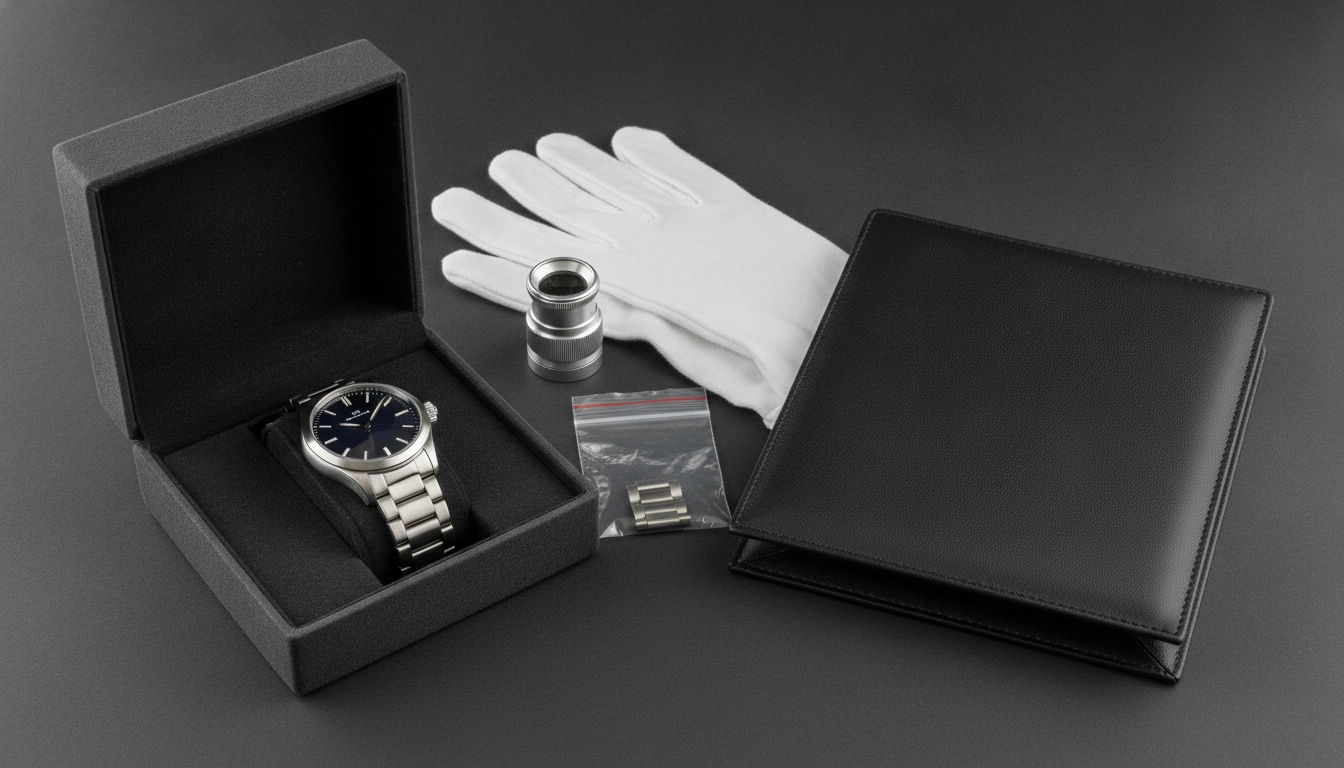
The invoice should identify the seller, exact watch, price, included items, condition disclosures, warranty or guarantee, and applicable terms. Confirm the inspection or return window, exclusions, authorization process, fees, return condition, and who arranges covered return shipping.
Delivery responsibility must also be assigned. Establish who packages and dispatches the watch, what coverage applies, which signature or identification is required, who may receive it, and who handles loss, damage, or a discrepancy. Declared value is not automatically insurance. The detailed packing and coverage task belongs in a separate watch-shipping checklist.
How Stellaris's Published Sourcing Model Works
The Stellaris Collection identifies itself as an independent dealer, not an authorized retailer for the brands it carries. Its FAQ distinguishes watches physically in inventory from those marked Available Upon Request.
For an Available Upon Request watch, the FAQ currently describes a sourcing request based on the desired reference, budget, and condition. It says Stellaris uses a network of dealers and private collectors, begins the search with a 10% refundable sourcing deposit, and presents the specific qualifying watch for client approval before collecting the remaining balance. Buyers should confirm the current timing and refund language for their request because the live site terms control.
The same page says watches are authenticated on arrival, receive a multi-point inspection, and are reverified before shipment. It says listings use photographs of the actual item and specify included accessories. Stellaris describes its prices as reflecting current market conditions, condition, completeness, and provenance.
These are Stellaris commitments. They do not create a manufacturer warranty or prove affiliation with a brand. Manufacturer papers, service records, and any remaining manufacturer coverage keep their separate scope.
Before starting a request, put the acceptable reference, material, dial, production range where relevant, condition, component history, accessory set, budget, deposit, approval step, payment, delivery, and inspection terms in writing. If a different example of the same reference is later proposed, treat it as a new exact-watch approval.
Which Watch-Buying Channel Fits This Transaction?
Choose by the task and contract, not by a universal ranking.
- Authorized new retail may fit when brand-channel provenance and the manufacturer's new-watch experience matter, subject to actual availability and written terms.
- Authorized certified pre-owned may fit when a brand-operated pre-owned program covers the desired reference under its stated eligibility and guarantee.
- Independent dealer inventory may fit when immediate secondary-market availability, direct seller accountability, and a defined dealer guarantee are important.
- Brokerage may fit when the parties or exact watch are already known and the buyer needs a limited introduction, representation, or negotiation service.
- Concierge sourcing may fit when the buyer needs help defining criteria, comparing multiple sources, coordinating inspection, or managing delivery.
- Marketplace or private sale may fit when selection or direct access matters and the buyer can verify the specific seller, item, payment, protection, and inspection path.
Before committing, answer this final checklist:
1. Who owns the watch, and who is the seller of record?
2. Whom does each provider represent?
3. How is every party paid, and which amounts are refundable?
4. Who receives funds and issues the invoice?
5. Who has physical custody before delivery?
6. Who examines the exact watch, and what does the conclusion cover?
7. Which manufacturer warranty, seller guarantee, service contract, or return right applies?
8. Who packages, covers, ships, and monitors delivery?
9. Who resolves a description, condition, authenticity, loss, or damage problem?
10. Which material facts remain unknown?
Are grey-market watches genuine? The category refers to genuine goods outside an authorized distribution path, but the exact watch still requires verification.
Are grey-market watches illegal? Not automatically. The legal position depends on the transaction, goods, marks, import route, tax treatment, and jurisdiction.
Do they have a manufacturer warranty? Sometimes. The brand's current written terms and the watch's actual status control.
Are they always cheaper? No. Prices can sit below, near, or above authorized retail.
What is the difference between a dealer and a broker? A dealer generally sells as principal. A broker generally connects or represents parties, but the contract must confirm the actual role.
What does a watch concierge do? There is no universal scope. It may include advice, sourcing, negotiation, inspection coordination, custody, delivery, or after-sale support.
For a specific Stellaris transaction, use the contact page to confirm the exact watch, seller role, deposit, price, evidence, guarantee, delivery, and inspection terms before proceeding.
