

Frankenwatch Guide: How to Spot Non-Original Parts
The Stellaris Journal
A Frankenwatch is an informal, usually critical collector term for a watch assembled in a configuration that did not leave the factory that way, often with parts from different watches, references, periods, or sources. The term has no single manufacturer-issued definition, so usage varies.
The practical buyer question is more precise: does the present configuration agree with a documented reference and production context, and has every material difference been represented accurately? A factory-original part, a genuine later service part, a mismatched genuine part, an aftermarket part, and a counterfeit part are different categories. No photograph, ageing difference, serial number, or single component can prove the watch's complete history.
What Is a Frankenwatch?
Collectors commonly use “Frankenwatch” for a watch assembled from components that were not originally fitted together. Examples can include a genuine case paired with a dial from another reference, a movement assembled from incompatible or untraceable donors, or a replica base fitted with some genuine parts.
The label alone is not a diagnosis. Some people apply it to almost any non-original configuration. Others reserve it for materially incompatible mixtures or deceptive sales. A disclosed custom watch may be intentionally modified without being presented as factory-original. A properly documented service replacement may be later than the watch without creating the mixed configuration collectors usually mean.
Seller intent is also separate from the physical evidence. A mismatched component can be observed or supported without proving who installed it, when it was installed, or whether an earlier owner intended to deceive. Accusing someone of fraud requires evidence beyond the object itself.
For a buyer, harm usually arises when three things diverge:
- the configuration described in the listing;
- the components and history supported by the available evidence; and
- the price and terms accepted on the strength of that description.
- manufacturer product and service pages;
- official manuals and dated catalogues;
- manufacturer archive or extract services where available;
- period advertisements and price lists;
- authorized service estimates and invoices;
- well-documented specialist scholarship, auction records, and prior sale photographs.
- Is this dial documented for the reference, market, and period?
- Do the hands and luminous material make sense with that dial?
- Does the bracelet, clasp, or strap fit the represented configuration?
- Is the bezel correct for the variant?
- Is the stated calibre appropriate?
- Does a recorded service or restoration explain the difference?
- Who supplied and installed the component?
- Is it named in an estimate, invoice, or service record?
- Is it correct for the reference and current manufacturer standard?
- Was an original component retained or returned?
- Did the work change appearance, function, water resistance, or collectibility?
- Was the change disclosed before the transaction?
- Documented fact: a record from an identified issuer describes a component or event.
- Present observation: the fitted bracelet carries a particular reference, or the dial shows visible refinishing.
- Attribution or expert assessment: a qualified source identifies a part as consistent with a period or service type.
- Inference or unknown: a component may have changed during an undocumented interval, but the event cannot be established.
A mixed watch sold openly as a custom project presents one decision. The same watch described as an untouched factory example presents another. Component-specific disclosure is more useful than arguing over a disputed label.
Original, Service, Mismatched, Aftermarket, or Counterfeit?
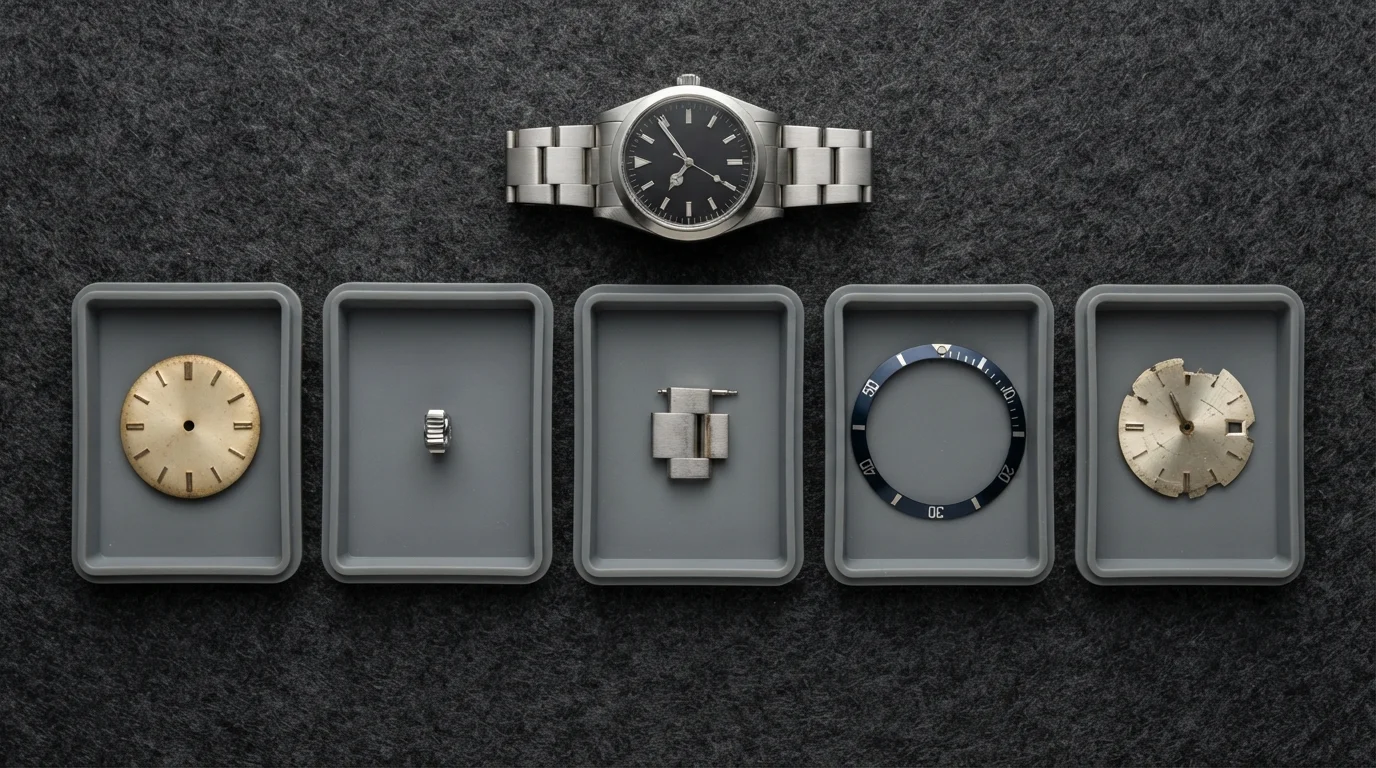
“Original,” “genuine,” and “correct” are not synonyms. Describe each component according to what the evidence supports.
Factory-original component means a part fitted to that individual watch when produced. Establishing this may require manufacturer records, dated images, service history, or reference-level expertise. A part that looks old is not necessarily original to the watch.
Genuine service component means a later part supplied through the manufacturer or its authorized network. It can be authentic to the brand and correct for the reference without being original to the individual watch.
Mismatched genuine component means a genuine part associated with another reference, production period, or watch. A dial, bracelet, clasp, bezel, or movement may be authentic to the maker but inconsistent with the offered watch.
Aftermarket component means a part made outside the manufacturer's authorized supply. This category includes openly decorative straps and bezels as well as components designed to imitate a factory part. Its material importance depends on what the part is, how it affects function, and how it is disclosed.
Counterfeit component means a non-genuine part presented or marked to imitate the manufacturer's product. That is different from an unbranded third-party strap or a disclosed custom insert. A watch can also contain both genuine and counterfeit components, which is why one authentic part cannot authenticate the whole.
Use component-level language. “The watch is authentic” does not answer whether its dial was refinished, whether its bracelet is original to the case, or whether a service crown was installed later. “All visible components appear consistent with the reference” is narrower than “every component is original to this watch.”
The categories can affect buyers differently. A documented service dial may suit someone prioritizing legibility and manufacturer support, while a collector seeking original surfaces may value it differently. An aftermarket strap is often reversible. An undisclosed aftermarket case or movement part is a more fundamental issue. There is no responsible universal discount for “non-original.”
Start With the Exact Reference and Production Context
Component review needs a baseline. Identify the complete reference, represented production period, case material, dial, calibre, bracelet or strap, and complication before deciding what appears correct.
Then compare the offered watch with sources appropriate to that exact version:
These sources do not carry equal weight. A current product page may omit an earlier production variation. An auction listing can preserve useful images but is not automatically a factory record. A forum discussion may identify a question without proving the answer. Keep the source and date attached to each comparison.
Mid-run changes and market variations make universal checklists unreliable. Dial printing, luminous material, hands, crowns, crystals, bezels, bracelets, clasps, movements, and number locations can change across generations. A component correct for an early watch can be wrong for a later one, while a documented service part can look visibly newer than everything around it.
Turn the baseline into specific questions:
An apparent mismatch is a lead, not a verdict. It may reflect authorized service, independent repair, restoration, customization, or an inaccurate listing. Resolve the conflict before repeating a factory-original claim.
Inspect Component Consistency Without Calling It Proof
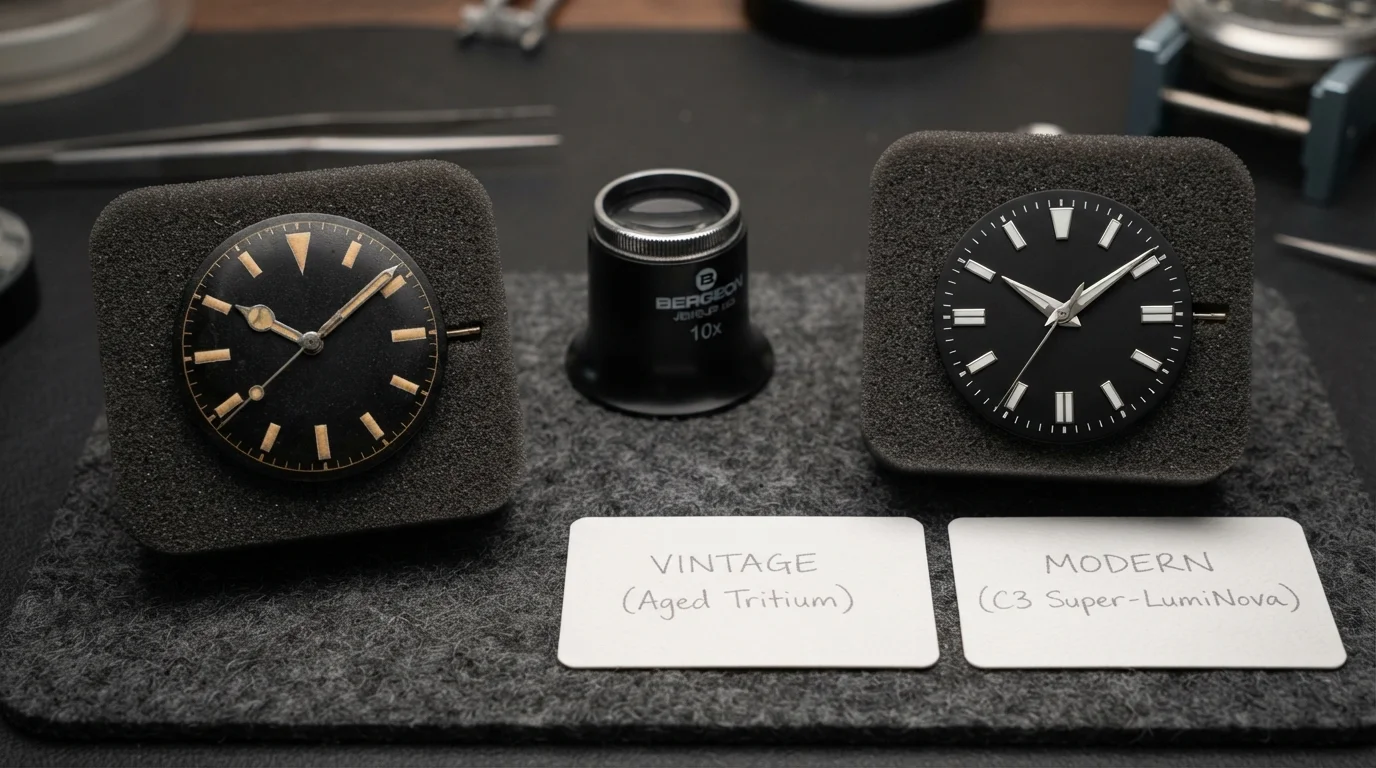
Actual-watch photographs can reveal condition and guide follow-up. They cannot show every interior surface, establish every date, or prove who installed a part.
Dial and hands
Compare the layout, indices, date display, hand shape, dial text, colour, and luminous material with reliable examples of the exact reference and period. A difference in ageing between dial and hands may suggest replacement or restoration, but service history, light, camera processing, storage, and material composition can produce different appearances.
Terms such as “original dial,” “service dial,” “refinished,” and “relumed” make distinct claims. Ask what observation or record supports the chosen term. Attractive patina is not proof of factory originality, and a clean dial is not proof of replacement.
Case, bezel, crown, and crystal
Review case geometry, engraving condition, refinishing disclosure, dents, bezel type, crown configuration, and crystal. Polishing can alter a genuine case. A replacement crystal or crown may be genuine service, aftermarket, or unresolved. Weight tests, water-droplet tricks, and one engraving photograph cannot settle the category.
Bracelet, strap, and clasp
Confirm exactly what is included and whether a bracelet, end link, clasp, or strap is described as original. Different wear can result from replacement, rotation, storage, or repair. A lightly worn bracelet on an older case is a question to research, not a verdict by itself.
Movement
The stated calibre and functions should agree with the reference. Internal review may be needed for a high-value conclusion, but opening a watch is not a casual buyer test. Patek Philippe's watch-authenticity FAQ says accessing its case and movement numbers through caseback removal belongs with an Authorized Retailer or Authorized Service Center. The proper boundary depends on the watch and the expertise required.
Ask a qualified examiner to identify what was actually inspected, provide useful images or measurements where appropriate, state the findings, and disclose limitations. A one-line “authentic” statement does not answer a component-history question.
Why Authorized Service Does Not Automatically Create a Frankenwatch
Mechanical watches need maintenance. Manufacturers may replace components that no longer meet functional, safety, or aesthetic requirements. A later genuine replacement changes originality, but it does not automatically make the complete watch counterfeit or a Frankenwatch.
Rolex says in its service FAQ that components that do not meet its specifications are replaced with genuine Rolex parts during service. A watch returned from authorized service can therefore contain a genuine component installed after the original sale.
Patek Philippe's restoration guidance describes a preservation-oriented approach for historic watches. That emphasis does not establish that every serviced watch retains every component fitted at production. The actual estimate, invoice, returned parts policy, archive evidence, and present examination still matter.
For any service replacement, ask:
A modern watch with a documented genuine replacement crown is different from a vintage watch marketed as untouched while carrying an undisclosed later dial. Both may contain genuine brand parts. Only the available history and current evidence can establish the narrower claim.
This distinction also prevents a genuine service component from being mislabeled as fake. “Original to this watch,” “genuine later service,” and “manufacturer-correct current replacement” can all be accurate in different circumstances. Choose the description that the record supports.
Build a Component History From Records and Present Evidence
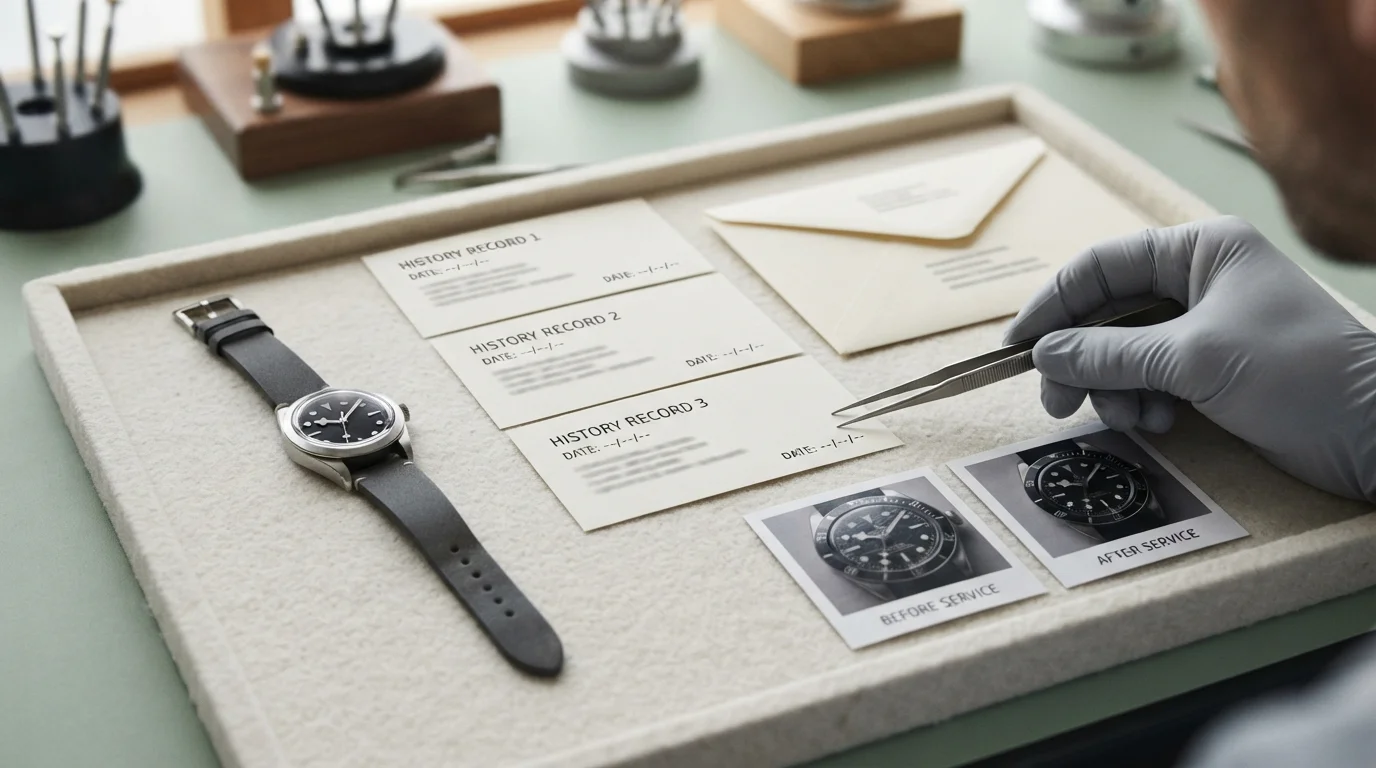
Treat component history as a chronology rather than a yes-or-no certificate:
1. What configuration is documented at production or first sale?
2. Which service, repair, restoration, or customization events are recorded?
3. Which components were replaced, refinished, or retained?
4. What configuration is present now?
5. Which periods and interventions remain unknown?
An original certificate can support initial identity or configuration. A service invoice can describe specific work. An archive extract may transcribe manufacturer records. Prior dated photographs can show an earlier state. None automatically proves that every component fitted today left the factory on the watch.
Separate four kinds of statement:
“No known replacement parts” describes the limits of the seller's information. It does not mean “all parts are factory-original.” “Matching serial” can connect a case and document where the source is reliable, but it cannot establish the history of every dial, hand, bracelet, or movement component.
When original records are missing, combine what remains without manufacturing certainty. Authorized service records, earlier listing images, ownership documents, manufacturer archives, and a current qualified report may create a useful account. State the gaps openly.
The examiner's scope matters. A visual review can describe visible components. A manufacturer service center may reach different conclusions through its records and internal access. A specialist may have deep reference knowledge without being authorized by the brand. Identify the source and scope rather than merging all assessments into one claim.
Frankenwatch Buyer Checklist and Disclosure Questions
Before payment, ask the seller:
1. What exact reference, period, material, dial, movement, and bracelet or strap are represented?
2. Are the photographs of the actual watch and every included accessory?
3. Is the watch described as authentic, factory-original, manufacturer-correct, serviced, restored, customized, or some combination?
4. Which service, replacement, refinished, relumed, mismatched, or aftermarket parts are known?
5. What manufacturer, service, archive, or prior-sale records support those statements?
6. Which findings come from current observation, and which are inferred?
7. Does an internal question require an authorized or qualified examination?
8. How does the known configuration affect condition, use, collectibility, and price?
9. What remains unknown?
10. What inspection and return terms apply after delivery?
The Stellaris Collection says in its FAQ that listings show the actual watch and included accessories, and that watches undergo arrival authentication, multi-point inspection, and pre-shipment reverification. Those public commitments support asking for exact-watch and included-item information. They do not prove that every watch is opened, that a private serial database exists, or that one fixed internal procedure applies to every reference.
Stellaris is an independent dealer and is not affiliated with or authorized by the brands it sells. Its guarantee is a dealer commitment. Manufacturer records and authorized evaluations retain the scope assigned by their issuers.
Common questions
Is every serviced watch a Frankenwatch?
No. A documented, correct genuine service replacement is later and non-original to the individual watch, but it does not automatically create the mixed configuration usually associated with the term.
Can a Frankenwatch use genuine parts?
Yes. Genuine parts from different watches, periods, or references can form a configuration that never left the factory that way.
Is a disclosed custom watch a Frankenwatch?
Usage varies. Some collectors may apply the label, while others distinguish disclosed customization from a misleading factory-original claim. The component description matters more than the label.
Can photos prove that a watch is all original?
No. They can document visible condition and identify questions. Complete component history may require records, reference expertise, and appropriate internal examination.
Does a matching serial settle component history?
No. An identifier can support identity within its scope. It does not establish the history of every replaceable component.
The goal is not to reject every serviced or modified watch. It is to understand the actual configuration, know which conclusions are supported, and price the watch accordingly. For a specific listing, use the Stellaris contact page to ask for the component and record information available for that individual piece.
