Authentication for Limited Editions: Why Scarcity Changes the Standard
The Stellaris Journal
Authentication for Limited Editions: Why Scarcity Changes the Verification Standard
The Stellaris Journal
Limited edition watches sit at the top of every collector's wish list for a reason: they are scarce, and that scarcity is precisely what drives their appeal. It is also, somewhat counterintuitively, what makes them harder, not easier, to authenticate. The same conditions that make a 170-piece Patek Philippe Nautilus "Tiffany Blue" Ref. 5711 worth millions are the conditions that complicate verification: fewer reference points, thinner documentation markets, and higher financial stakes that draw out the most sophisticated counterfeiting operations in the industry. The verification standard for limited editions is not the same as the standard for standard production. It is higher, more layered, and less forgiving of shortcuts.
Limited editions demand a different verification framework, one built for scarcity rather than scale.
TL;DR
Limited edition authentication is harder, not easier, than standard production verification. Key points for collectors and buyers:
- Lower production volume means fewer public reference points for comparison and more opportunity for the same case to be "recycled" in counterfeit narratives.
- Higher resale premiums create a stronger financial incentive for counterfeiters, including those operating sophisticated "super clone" operations.
- Standard authentication checks (weight, finishing, movement) remain necessary, but are insufficient on their own for limited editions.
- Provenance documents (papers, certificates, archive extracts) are harder to validate because they are scarcer, more frequently swapped, and easier to fake convincingly.
- Buyers should expect a multi-point inspection process, including movement analysis, edition-number verification, and where possible, archive confirmation from the original manufacturer.
The Scarcity Paradox: Why "Rare" Means Harder to Verify
It is tempting to assume that a rare watch is easier to authenticate because there are fewer of them in circulation. The opposite is true. A reference produced in the tens of thousands has an enormous public footprint: thousands of collectors have handled one, hundreds of dealers have sold one, movement variants are well-documented, and any small deviation from spec is quickly noticed. A reference limited to 50, 100, or 170 pieces has a much smaller public footprint, and that thinness of data is itself a verification problem.
The Robb Report coverage noted that the model was limited to just 170 pieces at $52,635 retail, with proceeds from one auction piece benefiting The Nature Conservancy. When secondary market prices for the same reference crossed into seven figures, the financial gap between "obvious fake" and "convincing counterfeit" widened dramatically. Counterfeiters invest proportionally. A watch that sells for $50,000+ on the secondary market justifies far more sophisticated replication than a $5,000 piece, and that investment shows up in weight tolerance, finishing precision, and material accuracy.
This is the scarcity paradox: the same conditions that create collector value (limited supply, intense demand, premium pricing) simultaneously degrade the conditions for verification (less reference data, higher counterfeit investment, thinner documentation markets).
Scarcity does not protect a watch from forgery; it draws forgery toward it.
The Counterfeiter's Math: Why Limited Editions Are Prime Targets
Counterfeiting is a business. Counterfeiters target pieces where the cost of replication can be recouped through secondary market sales. Limited editions meet every threshold for a prime target: high price, low supply, intense demand, and an audience willing to transact quickly to secure the piece.
The Richard Mille case is instructive. According to a LuxeDetect authentication guide, Richard Mille produces roughly 5,000 watches per year across the entire catalog, with base models like the RM 11-03 retailing around $200,000 and limited pieces like the RM 50-03 at $1 million or more. The same guide notes that secondary market prices for sought-after references can run two to five times retail. The combination of extreme price, low absolute production, and high cultural visibility makes the brand what LuxeDetect calls "the single most profitable fake target in watchmaking."
The pattern repeats across maisons. The Audemars Piguet Royal Oak in limited configurations, including anniversary editions and boutique exclusives, appears with notable frequency in authentication guides like the one published by Second Movement, which notes that limited editions often carry elaborate caseback imagery or script that must be examined for legibility, depth, and spacing. Patek Philippe's limited Nautilus and Calatrava references, and Vacheron Constantin's overseas limited pieces, follow the same logic.
The practical implication is simple. Limited editions sit in the highest tier of counterfeit investment, which means the fakes are correspondingly better. Visual inspection alone is insufficient, and on certain pieces, the visual gap between a "super clone" and the genuine article has narrowed to the point where even experienced dealers admit they cannot tell them apart by eye.
When the financial incentive to counterfeit is highest, the counterfeit itself is hardest to spot.
Beyond the Standard Checklist: Markers That Only Exist on Limited Editions
Standard authentication protocols still apply. Weight, finishing, movement architecture, and material composition remain the foundation, and these checks have been covered in detail in our Genuine vs. Counterfeit authentication guide and in external authentication resources. Limited editions add a second layer of markers that standard-production pieces do not require.
Edition Numbers and Engravings
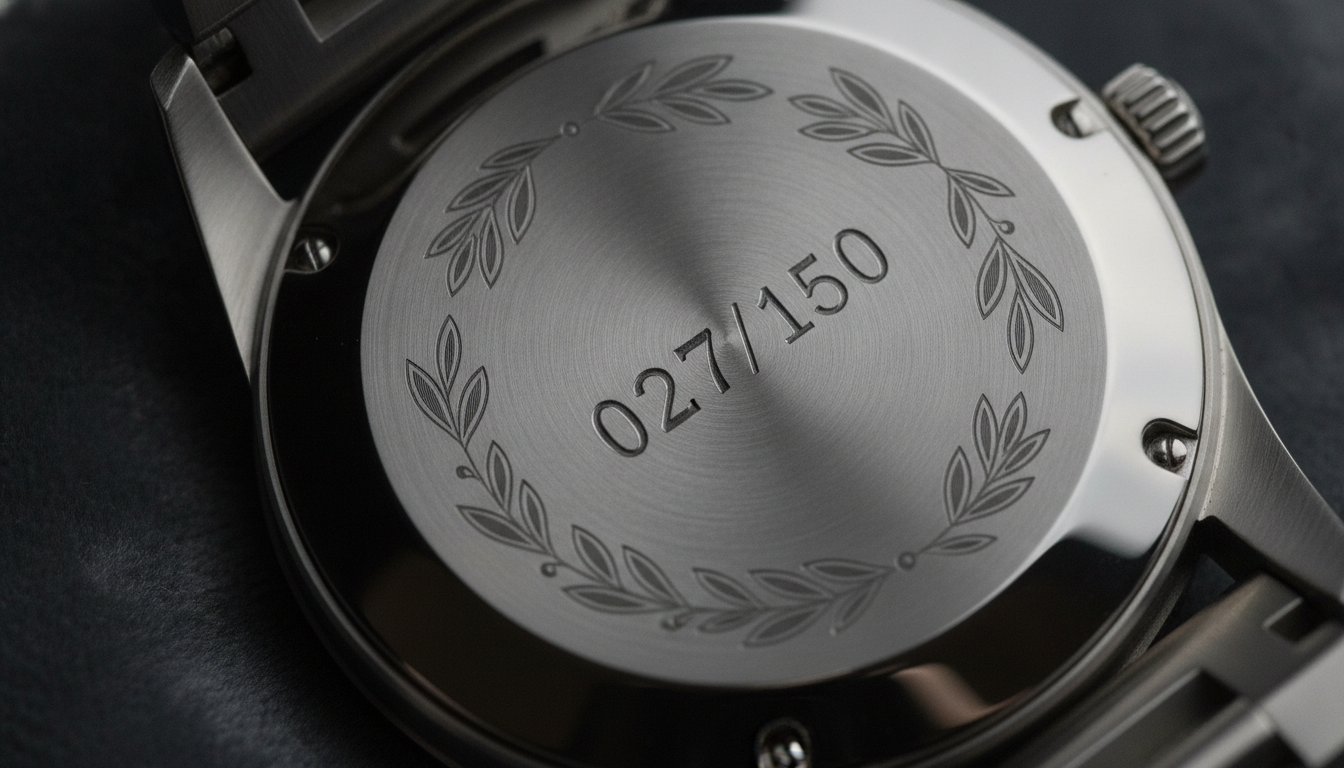
Limited production runs almost always carry an engraved or stamped edition number, frequently on the caseback, lug, or movement plate. Authentication steps for limited pieces include confirming that the format of that number matches known conventions for the reference, that the engraving depth and font weight are consistent with genuine examples, and that the sequence falls within the documented production run. A "1 of 50" engraving on a reference known to have been produced in 25 examples is an immediate red flag.
Engravings extend beyond edition numbers. Anniversary editions carry commemorative text; boutique exclusives carry retailer signatures; collaborative pieces carry partner marks. Each of these is a verification point and a counterfeit target.
Material and Complication Specifics
Limited editions frequently use materials, finishes, or complications not found in standard production. A blue-dial limited Patek, a sapphire-set anniversary AP, or a titanium-cased Richard Mille limited edition introduces verification variables that differ from the standard catalog. For Richard Mille, the LuxeDetect guide emphasizes proprietary materials including Carbon TPT, NTPT carbon, and grade 5 titanium, which have specific gravities and visual characteristics that differ materially from the stainless steel typically used in fakes. The same guide notes that a genuine RM 11-03 in titanium weighs 38 to 42 grams without strap, while most fakes weigh between 120 and 160 grams, an immediate and conclusive tell. These material-specific tells are exactly the kind of verification point that does not exist on standard production models in the same form.
Caliber and Configuration Match
Limited configurations sometimes use specific movement variants reserved for those references. Confirming that the caliber, the component layout, the jewel count, and the finishing match manufacturer documentation for that exact reference is part of the verification standard. Generic authentication routines that confirm a movement is "genuine Patek Philippe" or "genuine Audemars Piguet" are not enough; the movement must match the specific limited edition.
The verification standard for limited editions begins where the standard checklist ends.
Provenance Becomes Harder, Not Easier: The Paper Trail Problem
A common assumption is that limited editions come with more, and more detailed, documentation. Sometimes this is true. Many maisons issue archive extracts or certificates of authenticity on request, and brands like Patek Philippe, Jaeger-LeCoultre, and Vacheron Constantin maintain heritage services that produce original technical details, delivery dates, and original configuration data for timepieces in their archives.
But the paper trail also has well-known weaknesses, and these weaknesses are more pronounced on limited editions.
First, documentation can be missing on legitimate pieces. Long-time collectors, estates, and original owners frequently lose, separate, or never receive original papers. A limited edition without papers is not automatically suspect, but it does require deeper physical verification to compensate.
Second, documentation can be convincingly faked. Counterfeiters reproduce warranty cards, archive extract templates, and service certificates. Per authentication research compiled by Affordables Swiss Watches, documentation is treated as supporting evidence, not as a foundation, because both real-and-paperless and fake-with-papers scenarios occur regularly in the secondary market.
Third, on limited editions specifically, the documentation itself becomes a higher-value target. A box and papers set for a 100-piece Patek Philippe limited edition can carry a substantial premium over the watch alone, which creates an incentive for swap-and-return fraud and for standalone document forgery.
The correct posture for limited edition papers is healthy skepticism. They are useful, and they are worth requesting through manufacturer heritage services where possible. They are not, on their own, proof of authenticity.
On a limited edition, papers are evidence worth requesting and worth questioning in equal measure.
How Authentication Differs in Practice for Low-Production Pieces
For standard production references, authentication routines are well-rehearsed, well-documented, and broadly available. Reference databases exist. Authorized service networks can be consulted. Comparable examples turn over in dealer inventory frequently. The verification process is faster because the public and industry footprint is larger.
For limited editions, several of these shortcuts are unavailable. The reference may not appear in the secondary market for years at a time. Authorized service centers may have limited experience with the specific configuration. The set of comparables available to the authenticator is smaller, often by an order of magnitude. This is why the Gray & Sons authentication protocol for limited edition Richard Mille notes explicitly that rare and limited models "may require additional authentication steps and extended evaluation periods." Standard timelines do not apply.
A practical authentication approach for limited editions typically includes:
- A multi-point physical inspection covering case, crystal, dial, hands, crown, and movement.
- Edition-number verification against documented production records for the reference.
- Movement opening (where appropriate and where ownership is clear) to confirm caliber, finishing, and configuration match manufacturer documentation.
- Provenance review, treating papers and certificates as supporting evidence and cross-checking format, dates, and dealer stamps against the expected timeline.
- Where feasible, an archive extract request from the original manufacturer to confirm original technical details.
- A reverification step before shipment or transfer, since handling and storage introduce their own variables.
This is closer to a forensic process than a quick visual check, and the difference reflects the asymmetry of the stakes. On a limited edition, the cost of being wrong is the entire purchase price, which can run into six or seven figures.
Limited edition authentication is forensic in nature, calibrated to the financial exposure of the piece.
What a Buyer Should Demand (and Why)
A buyer approaching a limited edition transaction has every reason to be more demanding than on a standard production purchase. The transaction cost of accepting a less rigorous process is asymmetric: the upside is a faster deal, and the downside is total loss on a six- or seven-figure asset.
Three demands are reasonable and worth making.
First, ask what the seller's authentication process actually consists of. A statement that a piece is "genuine" is not a process. A documented multi-point inspection, performed before listing and reverified before shipment, is. At The Stellaris Collection, every item is authenticated on arrival, undergoes a multi-point inspection, and is reverified before shipment, and every piece is sold with a 100% authenticity guarantee. That protocol exists precisely because limited editions do not tolerate shortcuts, and the same standard applied to a standard-production Datejust is the minimum acceptable standard for a Daytona "Le Mans" or a Patek Philippe limited Nautilus.
Second, ask for provenance documentation in whatever form exists, and treat it as supporting evidence rather than proof. Box, papers, original warranty, archive extract, service records: gather what is available, and have it independently checked where possible. The Vacheron Constantin Extract from the Archives service, the Patek Philippe Extract service, and the Jaeger-LeCoultre Heritage service are manufacturer-issued documents that can be requested for genuine pieces and that add a meaningful layer of attribution.
Third, transact through a counterparty whose reputation depends on the outcome. Private sales, anonymous marketplaces, and "too good to be true" pricing remain the highest-risk channels for limited editions. Established dealers with documented authentication workflows, transparent pricing, and a guarantee that survives the transaction are the lower-risk path. This is not because dealers are infallible, but because the cost of a dealer selling a counterfeit is existential to their business, which aligns their incentives with the buyer's in a way that anonymous transactions cannot.
Limited editions reward patience. The pieces are scarce by definition, and a buyer who pauses to verify is not missing an opportunity; they are protecting one.
A higher verification standard is not an obstacle to acquiring a limited edition; it is the cost of acquiring one safely.