

5 Red Flags: How to Spot a Fake Luxury Watch
The Stellaris Journal
Thinking you can still spot a fake watch with a quick flick of the wrist? Think again. That old trick is useless now. Not when super clones are flooding the clones market. These aren't the shoddy knock-offs of yesteryear. They're so good, they fool most experts, often priced just shy of retail value to truly mess with your perception (and your wallet). Visual tells? Forget about them. You need more than a magnifying glass; you need a definitive checklist.
This guide lays out five absolute red flags. It's not about guesswork; it's about knowing precisely what to look for, from the substantial feel of the watch in your hand to the suspicious demeanor of the seller.
Red Flag 1: Incorrect Weight, Materials, and Finish
Forget what the pictures show you need to get your hands on the watch. Seriously. Most fakes just feel wrong, and you don’t need a horology degree to sense it; just your eyes and a keen touch.
Genuine luxury watches possess a proper, reassuring heft. This is because premium brands like Rolex and Patek Philippe utilize real, substantial metals solid steel (like 316L or 904L), gold, or platinum—not cheap, plated substitutes that chip faster than a New Year’s resolution. That weight is crucial. A Rolex Submariner, for instance, should feel like a small brick on your wrist, roughly 150 grams. If it feels like a toy or a feather, that’s your first warning shot a definitive red flag.
But the weight is only part of it. Feel the finish. Run your fingers over the case, the bracelet, the edges. Authentic watches exhibit sharp, precise lines, immaculate brushing, and mirror-polished surfaces exactly where they should be. Counterfeits, conversely, often appear blurry, uneven, or sloppy. You might even detect discolored or peeling plating, a direct consequence of cost-cutting. Even Similarweb (2026) data, scrutinizing the lower tiers, reveals the sheer volume of substandard pieces saturating the market. It's a noticeable difference.
Then there's the crown that small knob on the side. Try winding it, setting the time. Is the action smooth, clicking with satisfying precision? Or is it gritty, loose, perhaps wobbling like a bad tooth? A true luxury piece is meticulously engineered to feel superb with every interaction. A fake simply won't.
\\The physical feel the weight, the texture, and the mechanical feedback is your ultimate gut check; if it screams cheap in your hands, it absolutely is cheap.\\
Red Flag 2: Flaws in the Dial, Crystal, and Lume
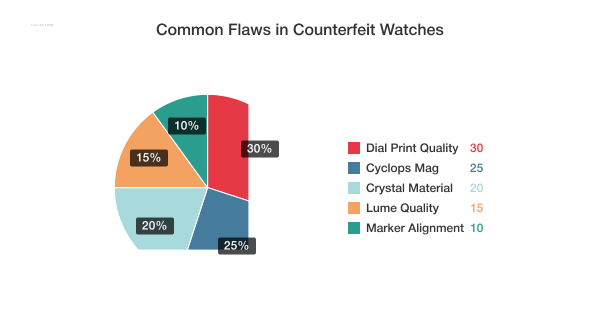
Alright, you've handled it, and it didn't feel like a toy. Good. But don’t celebrate yet. Now, you need to get up close—really close. The devil, and believe me, he’s a meticulous bastard, resides in the microscopic details of that watch face. This is where most fakes completely unravel. They try, oh, they try, but they always slip up somewhere.
Grab a magnifying glass or simply zoom in with your phone camera — it's one of the few free tools available to buyers in the pre-owned luxury watch market before deeper professional inspection begins. Examine the logo. Is it perfectly crisp, without any blur or smearing? What about the text? Are the letters clean, evenly spaced, or do they look like they were stamped by a drunk kindergartner? The hour markers must be perfectly aligned — no leaning, no wonky spacing — a standard that every credible luxury watch dealer will tell you is non-negotiable. True luxury brands are obsessed with this level of precision, and for good reason: it's one of the first things that high end watch dealers check when evaluating a piece from the pre-owned high end watches market. That said, as any reputable second hand watch shop professional will caution, visual inspection alone is never sufficient — today's counterfeits have become alarmingly accurate even under magnification. It's how you spot the real deal at a glance, but it's only the very first step, not the last word.
Now, let’s talk Rolex, specifically their Cyclops lens over the date window. This feature is engineered to magnify the date by exactly 2.5 times, creating a distinctive "black hole effect" around the numeral. It's incredibly difficult to replicate accurately. If you observe weak magnification, or no "black hole" whatsoever—just a cloudy, milky crystal as some Reddit users have noted—that’s a colossal, "run for your life" kind of red flag.
And the crystal itself? Perform a water droplet test. Place a tiny drop of water on the crystal. If it's genuine sapphire, found on authentic watches, the water drop will bead up tightly, forming a perfect little sphere. If it spreads out or flattens, you’re looking at cheap mineral glass, indicating a fake because counterfeiters won’t invest in proper sapphire.
One more thing: the lume. The glowing material on the hands and markers. Take the watch into a dark room. Genuine lume—typically Super-LumiNova—should be bright, evenly applied, and long-lasting. If you see patchy, weak, discolored, or absent glowing, that’s a significant problem.
Every tiny detail on the dial, from the crispness of the print to the consistency of the glow, acts as a critical security feature, and fakes almost always fail to perfect them; your mission is to pinpoint their oversight.
Red Flag 3: The Movement and Caseback Giveaways
Okay, you've meticulously inspected the exterior and scrutinized the watch face. Now, we delve into the true guts of the timepiece: the movement. This is where the real truth about a watch almost always resides, because replicating the intricate mechanics and exquisite finishing of a genuine in-house movement is virtually impossible—or prohibitively expensive—for a counterfeiter.
First, observe the second hand. Does it sweep smoothly around the dial, many times per second? That's characteristic of a real mechanical watch — and a baseline check that any luxury watch dealer will walk you through during an evaluation. If, however, it ticks once per second with distinct, jarring jumps, that indicates a quartz movement. How to Spot a Fake Rolex? | Pawn Stars. While some legitimate watches are quartz, many fakes utilize them to cut costs — a shortcut that no serious high end watch dealer would ever overlook — concealing a cheap, battery-powered mechanism where a sophisticated mechanical one should be. This is particularly critical in the pre-owned luxury watch market, where misrepresented movements are among the most common forms of deception encountered by buyers. Whether you're purchasing from a second hand watch shop or a private seller, understanding movement type is non-negotiable. Reputable dealers specializing in pre-owned high end watches will always verify and disclose the exact movement specifications of every piece they list — because knowing what type of movement is expected for the specific model isn't optional, it's fundamental.
*
If the watch features a display caseback—a clear back revealing the movement—go online. Vintage Watches – How to Spot a Fake, Refurbished or Reprinted Dial Find high-resolution photos from the official brand website and compare every single detail. Fakes invariably use generic Chinese movements that are undecorated, poorly finished, or both. You’ll notice rough screw heads, bridges lacking proper polishing, and an absence of Geneva stripes or perlage—just a plain, uninspired aesthetic. How to spot a fake watch, really not easy! Genuine movements, like those from Patek Philippe, are intricate works of art; a fake simply cannot replicate that.
Finally, consider the caseback itself. Be cautious. If a model should have a solid caseback but features a display, or vice-versa, that's a serious red flag. Counterfeiters often use solid backs to conceal their substandard movements. With Rolex, for instance, nearly all their models have solid, unadorned casebacks—no fancy engravings, no clear windows. The BEST Rolex SUPER-CLONE? | This Fake Submariner Is Insane So, if you encounter a Rolex with a see-through back, unless it’s an incredibly rare, limited edition you’re already aware of, it’s a fake. Period.
The movement is the literal heart of the watch; if it's incorrect, poorly executed, or intentionally hidden, you are undoubtedly holding a cheap knock-off, and you must trust your instincts and insist on seeing what lies within.
Red Flag 4: Inconsistent Serial Numbers and Documentation
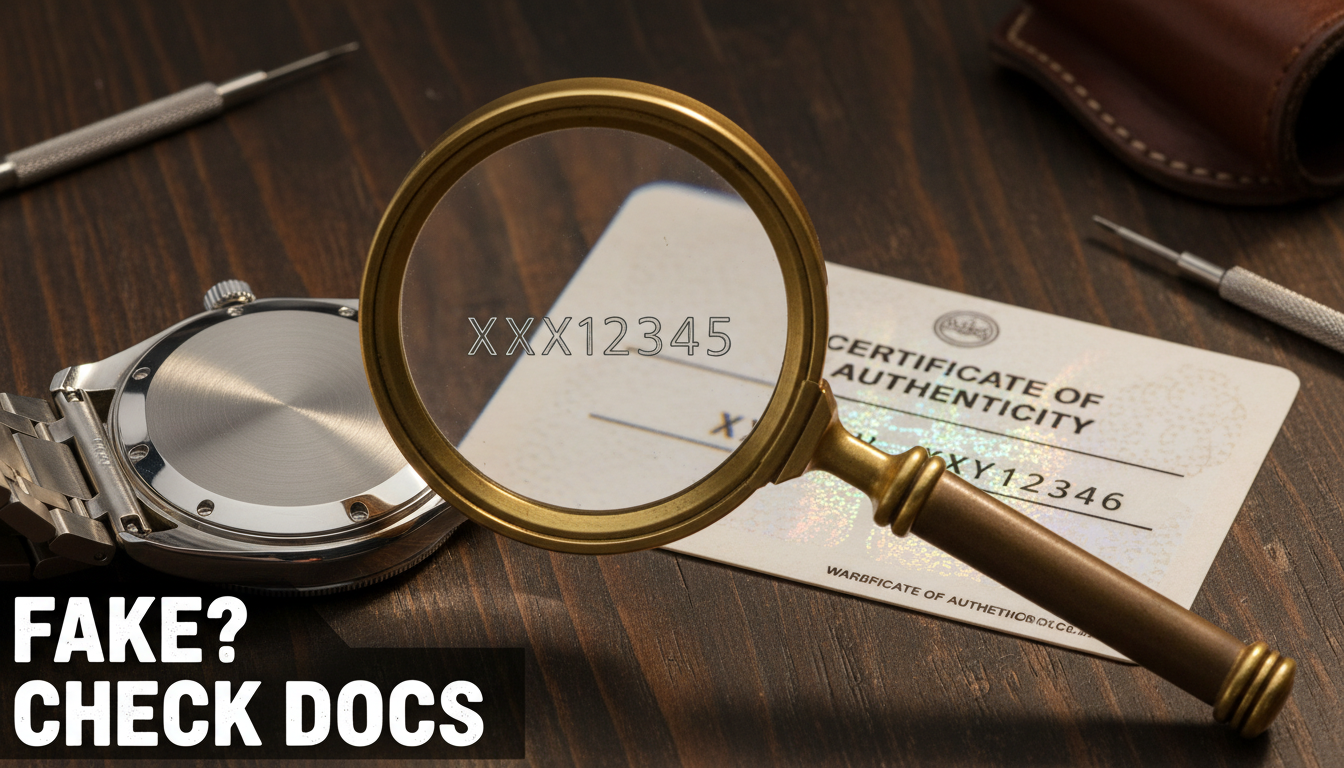
Alright, you’ve got a watch in hand that looks convincing. Perhaps too convincing. But here’s the crucial part: the real story, the ugly truth, isn’t just on the dial; it’s—or should be—etched into the back. Every single genuine luxury watch is assigned a unique serial number and a model number. And I mean etched: deep, precise, not some shallow scratch or uneven mess you could wipe off with your thumb. A flimsy etching almost certainly indicates a forgery, and a poor one at that.
You must cross-reference that number, meticulously. Compare the number on the watch to the warranty card and all accompanying papers. They absolutely have to match, down to every single digit. If they don't, even by one character, you’ve got a major problem—a giant, waving, abandon-ship red flag that countless buyers overlook.
But it gets more complex — and this is where even experienced buyers in the pre-owned luxury watch market get caught off guard. Sophisticated fraudsters don't just fake the watch; they fake the paperwork too. Yes, full sets — with serial numbers on their counterfeit certificates matching the fake watch — presented with enough confidence to fool a casual buyer at a second hand watch shop or an unsuspecting private transaction. So, you must scrutinize the documentation just as intensely as the timepiece itself, a standard that every diligent luxury watch dealer applies without exception. Feel the paper quality. Is it cheap? Is the printing blurry? Are the holograms misaligned or 'off' in any way? These are details that specialists in pre-owned high end watches are trained to detect immediately, yet routinely escape the notice of untrained eyes. A genuine warranty card is a masterpiece of printing and security, flawlessly executed — and any reputable high end watch dealer will tell you that authenticating documentation requires the same forensic rigor as authenticating the movement itself. If it isn't flawless, you're holding a lie.
Furthermore, everyone values a full set: box, papers, all the accessories. These significantly validate a modern, high-value piece. Market analysis, such as that from Similarweb (2026), indicates that complete documentation can increase resale value by 15-25%. But what if they’re missing? This doesn't automatically condemn a vintage watch, as older pieces often change hands many times. For anything manufactured this century, however, missing papers should be treated like a biological hazard—approach with extreme caution. That paper trail is your asset verification, your only true proof of legitimacy.
Here's the real gut punch: some scammers use real documentation—legitimate papers—and pair them with a fake watch or a 'Frankenwatch' (a watch assembled from various genuine and non-genuine parts). So the papers are authentic, but the watch isn’t, or not entirely. It’s a treacherous landscape. Many astute Patek Philippe collectors, for example, will simply refuse to purchase a late-model Patek without its Certificate of Origin. They understand the immense risk; without it, you're buying a gamble no savvy investor wants in their portfolio.
Therefore, never just verify the numbers; meticulously verify the quality and consistency of all accompanying documentation and the watch itself, as discrepancies here are often the most telling indicators of fraud.
Red Flag 5: Suspicious Sellers and Unsafe Transactions

Alright, let's talk about the individuals you're dealing with and the methods you use to transfer funds. This is precisely where most people get scammed. The old adage, "If it's too good to be true, it probably is," still applies to obvious, cheap knock-offs. However, sophisticated scammers are much cleverer. They won't price a fake Rolex at five hundred dollars. Instead, they price their high-end replicas just 5-15% below retail, making it appear like a genuine, attractive deal. It’s a cunning trap.
Therefore, you must stick to reputable, certified luxury watch dealers. Period. Full stop. In the pre-owned luxury watch market, the seller you choose is every bit as important as the watch itself. Seek out high end watch dealers with verifiable guarantees, transparent return policies, and customer reviews you can genuinely cross-reference — not vague anecdotes on a random forum. A trustworthy second hand watch shop will always welcome scrutiny; it's the evasive ones that should set alarm bells ringing. When evaluating where to source pre-owned high end watches, look for dealers who operate with documented authentication processes, clear communication, and an established track record in the industry. Buying from an anonymous Instagram account, a sketchy eBay listing, or someone you've "just met" online is tantamount to playing Russian roulette with your capital — and unlike a transaction with accountable, professional high end watch dealers, it's a gamble you will almost certainly lose.
Regarding payment, any seller who tries to steer you away from a protected platform—insisting on a direct bank wire, Zelle, or cryptocurrency—is waving a giant, siren-blaring scam alert. They want to move the transaction off-platform precisely because that’s where all your buyer protections vanish, instantly. Bank wires and cryptocurrencies are irreversible. Once you send it, it’s gone forever, with no recourse. Fraud reports consistently confirm that these irreversible channels are a scammer's favorite (Similarweb, 2026).
You must also demand high-resolution photos—clear, detailed images of the actual watch from every conceivable angle, not stock photos or press shots. If they refuse, or only provide blurry, low-quality images, that's incredibly suspicious, implying they have something to hide. A legitimate seller will gladly provide a complete photoshoot. For any significant investment, say, anything over five thousand dollars, utilizing an independent escrow service is not optional. This service securely holds your money until you receive the watch, allowing you to take it to a certified watchmaker for authentication. This inspection, typically costing $150-$400, eliminates 95% of your fraud risk—a small price for invaluable peace of mind.
Because your hard-earned money is on the line, a meticulously trustworthy transaction process, supported by verifiable information and third-party protection, is your only true shield against sophisticated fraud.
Frequently Asked Questions
What’s the single biggest tell?
Look, there's no magic bullet. But a ticking quartz movement in a watch that’s supposed to be an automatic? That’s a dead giveaway. An instant fake. But it won't always be that obvious.
Can I spot a 'super clone' just by looking at it?
Hell no. Don't kid yourself. These high-end replicas are insane these days. Visually identical. You need a pro to open that caseback, check the movement, and feel it. That's the only way to be sure, in my opinion.
What if a pre-owned watch doesn't have its box or papers?
It’s not an automatic write-off, especially for vintage pieces. Those old watches have seen things, maybe changed hands a dozen times. But for anything modern? Exercise extreme caution. You absolutely need an independent authentication; it's not an option.
How much does professional authentication cost?
Typically, it ranges anywhere from $150 to $400, depending on the brand and complexity. But you know what? It’s a tiny fraction of the cost of a fake—an essential cost.
Is it safe to buy from social media if the seller has good photos?
Are you kidding? No. That's a classic trap. Social media offers zero protection. Scammers simply steal photos of real watches, take your money, and vanish. Stick to vetted pros, or just walk away. Vetted marketplaces like The Stellaris Collection are a safer alternative.
*
Alright, you've absorbed the playbook. Think that makes you bulletproof? Hardly. The game isn't just about spotting a wonky bezel anymore. It's about knowing the damn difference when the fakes are practically indistinguishable, priced cunningly to trick you, and selling like hotcakes. You snooze, you lose. And believe me, the market doesn't care about your sob story when you’re stuck with a worthless paperweight.
Here’s the thing:
- Those "super clones"? They’re not some back-alley knock-offs. They're precision-engineered garbage, built to fool even the keenest eye. So, never trust just your gut.
- But here's the kicker: The watch is only as real as the hands it comes from. Vet the seller as rigorously as if they were trying to sell you a used kidney. Because in essence, they might as well be.
You must* audit the whole damn thing—inside, out, and the paperwork. Every single detail. Anything less, and you're rolling the dice with your capital.
It’s a minefield out there. Get greedy, get burned. If you want to play in this sandbox, you better know how to dig. Or, at the very least, know when to call in the pros. So, if your gut is screaming, or you harbor even a whisper of doubt on that serial number match, step back. Do not gamble your hard-earned capital on a hunch. Find someone who lives and breathes this stuff—someone who guarantees their authentication. Someone you can unequivocally trust. Reputable platforms like The Stellaris Collection often provide such guarantees. It’s the only way to avoid getting thoroughly screwed.
