

Why a Selective Edit Beats a Bulk Pre-Owned Watch Catalog
The Stellaris Journal
A buyer walking into the pre-owned luxury watch market in 2026 faces a peculiar paradox. There has never been more inventory available. Global pre-owned watch sales are projected at roughly USD 28.99 billion in 2026, on track to nearly USD 60 billion by 2035. Search any reference on a major platform and you will see dozens, sometimes hundreds, of listings. By every visible measure, the selection problem has been solved.
The deeper problem has not. The same report notes that authentication infrastructure, transparent pricing, and expert verification have become the structural bottlenecks of the market. A wider catalog, in other words, is not the same thing as a better one. This is the case for a selective edit.
What "Bulk Catalog" and "Selective Edit" Actually Mean
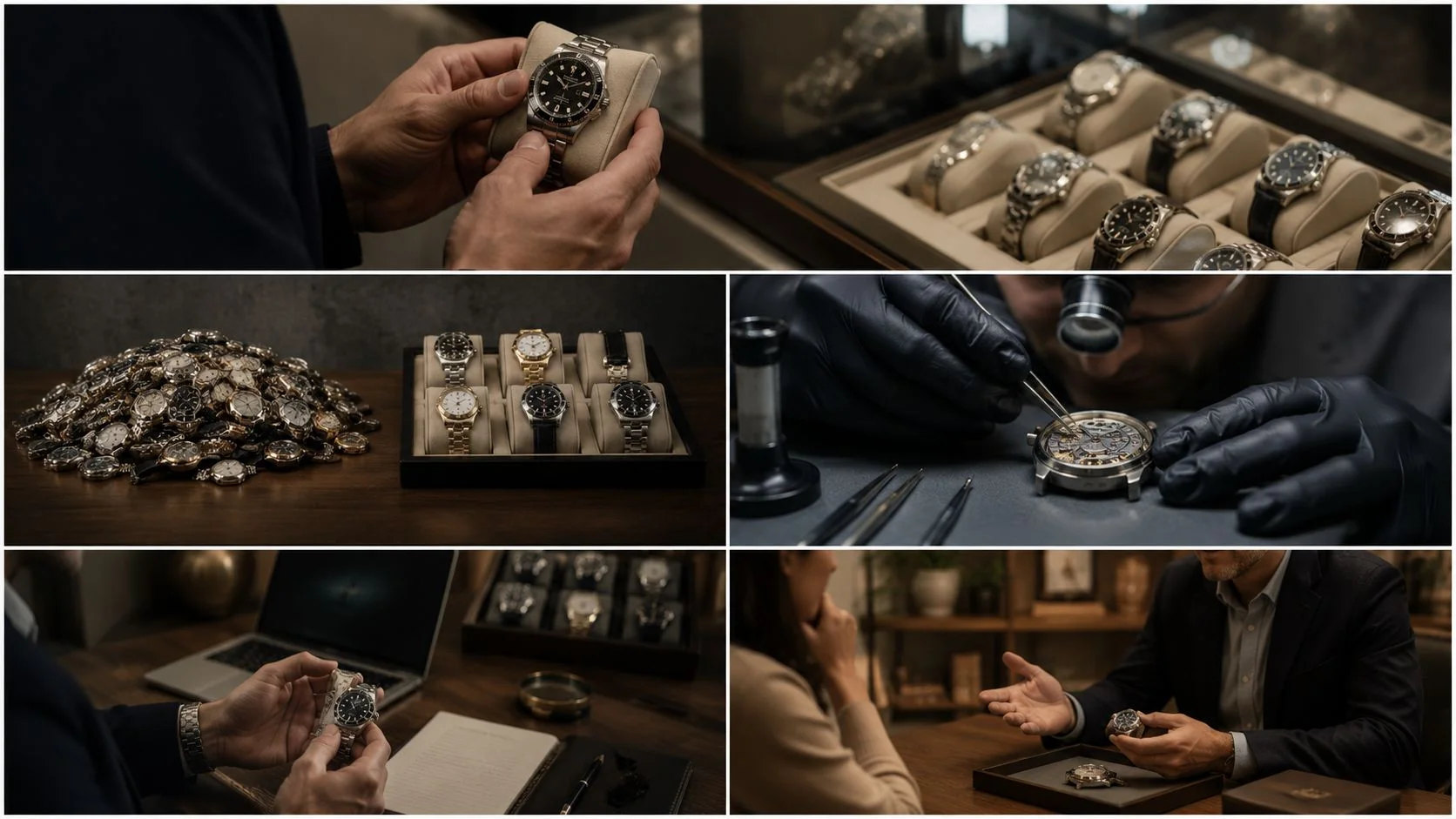
The terms get used loosely, so it helps to define them carefully. A bulk pre-owned catalog is the model used by large online marketplaces and many grey-market dealers: aggregate everything that meets a minimum threshold, list it, and let the buyer filter. Volume is the value proposition. The selection grows because the filter is intentionally permissive.
A selective edit works in the opposite direction. Inventory is built from the top down. Each piece has to clear a documented set of criteria before it is published. Volume is a side effect of the criteria, not the goal. The Stellaris timepiece collection, for instance, is drawn from a defined set of maisons, Rolex, Patek Philippe, Audemars Piguet, Vacheron Constantin, F.P. Journe, Richard Mille, and selected for rarity, mechanical significance, and enduring collector appeal rather than for raw count.
Both models are legitimate. The question is what each one actually delivers to the buyer, and what it costs them in time, risk, and decision fatigue.
The Authentication Math Works Against Bulk
The pre-owned watch market has an authentication problem that scales with inventory volume. Consider two recent data points from major platforms.
Bezel, one of the larger authenticated pre-owned marketplaces, reported that 34% of watches submitted to its platform in 2025 failed verification. The rejection rate climbed as high as 38% in the second half of the year, with Rolex accounting for roughly half of rejected pieces by both volume and value. Watchfinder & Co., owned by Richemont, has publicly stated that approximately 10% of watches submitted to it are fakes, and that the share of fakes requiring serious inspection (versus obvious visual tells) has flipped: a few years ago, 80% of counterfeits were detectable at a glance. Today, only about 20% are.
What this means in practice is that the authentication workload has grown even as the catalog has expanded. Every additional listing requires the same depth of inspection. A platform that lists thousands of references does not suddenly have thousands of trained inspectors. The variance in condition grading, paperwork verification, and movement examination shows up in the rejection rates.
A selective edit handles this differently. A smaller inventory means a smaller authentication surface. Each piece can be examined, documented, and cleared without the time pressure that comes from running a queue. At The Stellaris Collection, every timepiece is independently authenticated before being offered for sale, which is a fundamentally different operational problem from inspecting ten thousand incoming submissions a month. The bottleneck is not just hours, it is the quality of attention available per piece.
In a market where a third of incoming pieces can fail verification, the catalog you see is only as trustworthy as the inspection that produced it.
Selective Editing Filters More Than Fakes
The visible failures get the headlines. The harder problem is everything that passes inspection but should not.
The same Bezel 2025 report described a wide range of issues beyond counterfeits: watches with non-period-correct components, undisclosed alterations, suspicious wear, over-polished cases, replaced hands or dials, and incorrect or counterfeit papers. These are the frankenwatches and misrepresentations that look legitimate in a photo but reveal their problems only under hands-on examination.
A bulk catalog has structural difficulty with this category. When the filter is "does this look right in the listing," subtle issues slip through. When the filter is documented criteria applied by a small, accountable team, more of these problems get caught, and the ones that do reach the buyer are described with a level of specificity that is rare in marketplace listings.
The same logic applies to provenance. A piece with a complete service history, original box and papers, and documented ownership reads differently from a piece described as "condition: very good." A selective edit can prioritize and document provenance because provenance is one of the criteria. A bulk catalog treats provenance as a feature among many, and the listing template usually does not have space for the nuance that provenance actually requires.
This is where the editorial layer matters. A selective edit is not just a smaller catalog. It is a catalog where each piece carries more verifiable information per square inch of description.
Information Density Beats Listing Count
A buyer scrolling through a marketplace with 800 results is not actually evaluating 800 watches. They are evaluating the metadata that helps them narrow to a short list, then judging the photos and descriptions of perhaps a dozen candidates. The rest is noise that costs time and attention.
A selective edit changes the ratio. When a curated catalog lists 40 pieces, every piece is expected to clear the criteria for being on the page. The buyer is not filtering out junk. They are choosing between genuine candidates. The mental model shifts from sorting to selecting, and that is a meaningfully different decision.
The same principle shows up in how pricing is presented. Marketplaces have to compete on price because price is the easiest differentiator at scale. Curated dealers tend to anchor on transparent, market-based pricing that reflects the underlying research into comparable sales, condition, and provenance. Transparent pricing is easier to defend when the reference set is small and known.
A smaller catalog where every piece meets documented criteria gives the buyer more usable information per hour spent looking than a larger catalog where most of the work is elimination.
The Concierge Effect Scales Inversely With Catalog Size
White-glove service is another phrase that gets used loosely. In the pre-owned watch market, it usually means a direct line to someone who can answer questions, coordinate logistics, and resolve issues without routing through a support queue. The trouble is that this kind of attention does not scale linearly with inventory.
When a buyer calls a curated dealer about a specific piece, the person on the other end has typically handled that watch. They know its service history, its provenance, the questions previous buyers asked, and the small details that never make it into a listing. That conversation is hard to replicate at a platform where representatives are managing hundreds of active references at any given moment.
The concierge process at The Stellaris Collection runs from initial inquiry through delivery, with a single point of contact throughout. This works because the operation is sized to the inventory, not the other way around. The same model applied to a marketplace catalog would require either a much larger team or a thinner layer of service per transaction. Most platforms choose the latter.
For buyers, the practical test is simple: before a purchase, can you reach someone who has personally inspected the watch you are considering? If the answer is yes, the concierge claim is real. If the answer is "the listing team," it is a label.

What Bulk Marketplaces Are Still Good At
Selective editing is not the right model for every buyer, and it would be dishonest to pretend otherwise.
Bulk platforms genuinely excel at breadth. A collector searching for a specific discontinued reference, an unusual dial variant, or a configuration that the mainstream catalogs no longer stock will often find it first on a large marketplace. The comparison of Chrono24 to authorized channels makes this point clearly: if you want immediate access to inventory the official channel cannot provide, especially for high-demand sports models and discontinued references, a marketplace is often the only realistic path.
Bulk platforms also serve a different buyer profile well. A collector who already knows exactly what they want, has the technical fluency to evaluate listings independently, and has time to scrutinize seller reputation, return terms, and documentation, can extract real value from a large catalog. The 10% rejection rate, the frankenwatch risk, the variance in grading: a sophisticated buyer can price those risks and discount accordingly. For that buyer, breadth is a feature.
The honest framing is that bulk and curated solve different problems. Bulk solves access. Curated solves confidence. Neither is universally better. The mistake is choosing a bulk platform when what you actually needed was the second problem solved, or vice versa.
What to Look for in Either Model
A few criteria help separate substance from label, regardless of catalog size.
First, ask how authentication actually works. "Authenticated" means nothing on its own. Look for the specifics: who inspects each piece, what they examine, what documentation they produce, and what happens to a watch that fails. A platform that publishes its process and its rejection rate is doing more than one that simply asserts authenticity.
Second, look at the listings themselves. Condition descriptions should be specific, not generic. Provenance should be documented, not summarized. The depth of the listing is a reasonable proxy for the depth of the inspection behind it.
Third, test the service before you buy. Send a specific question about a specific piece and see who responds, how quickly, and how knowledgeable the answer is. The contact process for any serious dealer should feel like talking to someone who has handled the watch, not someone reading a script.
Fourth, compare pricing rationally. The lowest price on a marketplace is rarely the cheapest watch once you account for authentication risk, return friction, and the time you spent filtering. A curated price that looks higher can reflect research that would have taken you hours to replicate.
The pre-owned luxury watch market in 2026 is large enough, and complicated enough, that both bulk and selective models will continue to coexist. They serve different buyers and different needs. What has changed is that the structural pressures on the market, including the documented rise in rejection rates, the increasing sophistication of counterfeits, and the demand for provenance documentation, have made the case for selective editing stronger than it was even three years ago. A smaller, better-considered catalog is not a luxury preference. For many buyers, it is the more efficient way to make a high-conviction purchase.
