

How to Spot a Fake Audemars Piguet Watch: Royal Oak Guide
The Stellaris Journal
A buyer can identify contradictions that suggest a fake Audemars Piguet watch, but a listing photograph, aligned bezel screw, dial texture, serial number, warranty card, or archive extract cannot prove that a Royal Oak is authentic by itself.
The responsible method is to establish the exact reference, compare the whole represented configuration, and send unresolved material questions to qualified physical examination or Audemars Piguet documentation with the correct scope. This guide focuses on the Royal Oak. It is not a universal checklist for every AP collection.
Can You Spot a Fake Audemars Piguet Watch From Photos?
Photographs can reveal contradictions. They can show whether the case, dial, bracelet, clasp, and visible configuration resemble the claimed reference. They can document condition and included accessories. They can also expose a listing that uses stock imagery instead of the actual watch.
Photographs cannot establish every component, internal movement identity, material composition, service history, water resistance, or prior intervention. Lighting and image processing can distort dial color, surface finishing, engraving depth, and edge definition.
Treat a visual problem as a warning sign, not a complete diagnosis. Use three connected checks:
1. Match the watch with the exact Royal Oak reference and configuration.
2. Compare the case, dial, bracelet, movement information, and condition as one system.
3. Use AP records and physical examination according to their defined scope.
This avoids common shortcuts. A familiar octagonal silhouette is not authentication. Neither is a heavy case, smooth seconds motion, patterned dial, decorated movement, or one plausible number. A copied detail can appear on a counterfeit, while a genuine serviced watch may contain later components that require accurate disclosure.
Ask for neutral, high-resolution photographs of the actual front, sides, crown, caseback, bracelet or strap, clasp, identifying marks, and documents. If an internal conclusion matters, a photograph should not substitute for qualified handling.
The image set should be internally consistent. Compare small condition marks, link count, dial details, and reflections across photographs to confirm that the same watch appears throughout the listing. A seller should explain any mixture of current images, archive images, and manufacturer stock photography. A timestamped photograph can connect the seller to the watch at a moment in time, but it does not establish authenticity or legal title by itself.
Seller and transaction checks remain necessary even when the watch appears visually coherent. Verify who owns or controls the watch, how payment is protected, whether the seller will document the exact piece on the invoice, and what happens if a qualified inspection finds a material discrepancy. Authentication cannot repair an unsafe payment method or a return promise that is not written into the transaction.
Check 1: Match the Royal Oak Reference and Configuration
Start with the full reference represented by the seller. Record:
- case material and size;
- dial color and surface treatment;
- complication and display layout;
- bracelet, strap, and clasp configuration;
- stated calibre; and
- production or edition information where documented.
- An Extract from the Archives confirms that the case and movement numbers appear in AP’s records. AP explicitly says the extract does not guarantee the watch’s authenticity.
- A Certificate of Authenticity addresses the watch, materials, and components after AP experts physically examine the watch.
- Authenticity: whether the watch and represented components are genuine within the scope of examination.
- Originality: whether a component remains the one fitted to this individual watch at initial production.
- Condition: current wear, damage, corrosion, refinishing, and mechanical state.
- Completeness: box, card, booklets, links, straps, service records, and other included items.
- identify the exact reference and configuration offered;
- review actual photographs and included items;
- ask for condition, service, replacement, refinishing, and provenance disclosures;
- distinguish documents from physical findings; and
- confirm payment, inspection, return, shipping, and delivery terms.

Compare those facts with an official Audemars Piguet product page, user guide, or historical resource for that exact model.
The official page for Royal Oak Selfwinding reference 15510ST.OO.1320ST.06, for example, describes a specific 41 mm stainless-steel watch and Grande Tapisserie dial configuration. It is useful for a watch represented as that reference. It is not a benchmark for every Royal Oak.
Reference specificity matters because the collection spans more than five decades, many sizes and materials, different movements, and numerous dial treatments. A 39 mm “Jumbo,” 41 mm Selfwinding model, smaller quartz reference, complicated Royal Oak, and Royal Oak Offshore do not share one configuration.
Tapisserie is strongly associated with the collection, but it is not universal. AP’s history of Royal Oak dials documents Petite, Grande, and Mega Tapisserie as well as genuine Royal Oaks with other dial materials and treatments. “No Tapisserie means fake” is therefore false as a general rule.
Ask the seller to name any known service dial, hands, bezel, bracelet, clasp, or other replacement. An unexplained conflict should pause the transaction. It should not be forced into either “counterfeit” or “normal variation” without evidence.
Check 2: Compare the Case, Dial, Bracelet, and Movement
Once the reference is known, evaluate the watch as a connected object.
Bezel, case, and screws
AP’s account of the first Royal Oak cases explains that the visible hexagonal heads are embedded in matching bezel openings and that round nuts secure the case from the back. Groove orientation is part of assembly, but this construction should not be reduced to “all slots must point in one direction.”
Compare bezel form, case geometry, gasket line, fastening construction, and finishing with the exact reference. AP also documents rare construction exceptions and hundreds of Royal Oak interpretations. One viewing angle cannot carry a universal screw rule.
Dial and hands
Check surface treatment, layout, printing, indices, hands, date display, and complications together. A plausible pattern under compressed lighting does not prove that the dial belongs to the watch. The exact reference must support the represented configuration.
Bracelet, clasp, and finishing
The Royal Oak’s case and bracelet combine brushed surfaces, polished bevels, and articulated links. Wear and refinishing can soften edges and change transitions. That may be a condition or originality concern without proving the watch counterfeit.
Ask whether the bracelet, clasp, and links are correct for the reference and whether refinishing or replacement is known. A genuine case can be paired with a later genuine bracelet or an incorrect aftermarket component. The category should be stated precisely.
Movement information
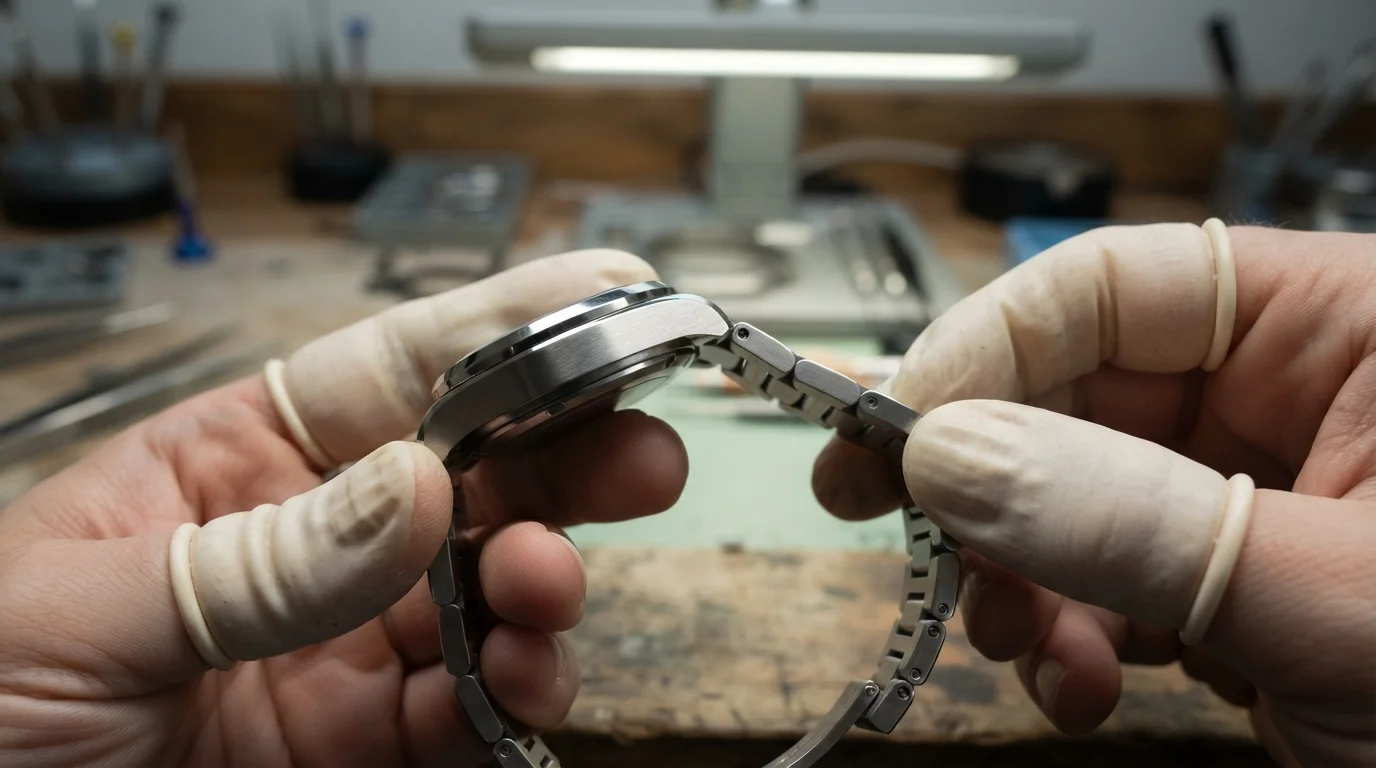
The calibre represented by the seller should agree with the reference. A visible decorated movement is not self-authenticating. If a case opening or internal examination is required, it belongs with a provider qualified to handle and reseal the watch. A buyer should not open the case to complete an online checklist.
The result of Check 2 should be a list of agreements, disclosed changes, and unresolved conflicts. It should not be a score based on isolated visual cues.
Record condition separately while making that comparison. Deep refinishing, bracelet stretch, damaged screw slots, corrosion, water ingress, or a poorly fitted replacement can affect ownership and service decisions even if the core watch is authentic. Conversely, ordinary wear is not evidence of authenticity. A useful report states the observed condition, the claimed component history, and the authentication finding as separate conclusions.
Functional checks must also fit the reference. Verify that the crown, date, time setting, chronograph, calendar, or other available functions operate as the documented user guide describes, without forcing an unfamiliar mechanism. Correct operation can support consistency and reveal a service concern. It cannot prove that every component is genuine, and a malfunction does not automatically mean counterfeit.
Check 3: Use AP Records and Expert Examination Correctly
Documents are valuable when their issuer and scope are clear. A warranty card, sales receipt, service invoice, account registration, archive extract, and Certificate of Authenticity do not mean the same thing.
Audemars Piguet makes a critical distinction on its official services page:
A record match and a physical examination answer different questions. A plausible case or movement number can be copied. A genuine archive document can be separated from the current assembly. Papers should be matched to the watch and used only for the facts they support.
Service history supplies another layer. AP’s authorized after-sales network describes trained watchmakers, genuine parts, and identification through case and movement numbers to trace service history. A service record should still be read for the work performed and the watch it identifies.
Account registration or a warranty screen may support ownership services or service access. It should not be represented as equivalent to an AP Certificate of Authenticity unless AP defines it that way for the exact process.
When the watch is high value, evidence conflicts, internal identity matters, or modification is suspected, arrange the appropriate AP or qualified independent review before relying on the conclusion. Ask what was physically examined, which documents were checked, and what remains outside scope.
Keep copies of the listing, invoice, seller disclosures, inspection report, document photographs, and written answers. Web listings can change or disappear after a sale. The preserved record should identify the exact watch while protecting full serials and personal data from unnecessary circulation. If the examiner cannot reach a conclusion without manufacturer involvement, treat that as a limit rather than rewriting uncertainty as approval.
Authenticity, Originality, and Condition Are Different
An authentic Royal Oak can still contain a genuine service component, refinished case, replacement bracelet, incomplete accessories, or undocumented history. Those details can matter greatly without making the entire watch counterfeit.
Keep the conclusions separate:
Service parts need careful language. A genuine AP service replacement can be authentic without being original to the watch. An aftermarket component has a different status. “Replacement” alone is too vague.
Refinishing also deserves a factual description. A softened bevel can indicate prior polishing, but it does not reveal who performed the work or decide authenticity. Ask for known service records and neutral photographs, then describe what is observed and what is documented.
Unknown history should remain unknown. Do not infer recent service from a clean exterior or short timing observation. Do not call a watch “unpolished” because no polishing invoice was supplied. The absence of a record is not proof that an event never occurred.
This precision protects both parties. A buyer can decide whether reliable wear, preserved original configuration, or a balance of both matters. The seller can disclose a genuine service component without allowing it to be mistaken for counterfeit or factory-original.
What Stellaris Can Confirm About a Specific Watch
The Stellaris FAQ says offered items are guaranteed authentic, authenticated on arrival, inspected, and reverified before shipment. It also says listings use actual-watch photographs and specify included accessories. For a requested watch, the buyer approves the specific piece.
Those public statements support a clear buyer conversation:
Stellaris is an independent dealer and is not affiliated with or authorized by Audemars Piguet. Its authenticity guarantee is the dealer’s guarantee. An AP archive extract, service record, and Certificate of Authenticity retain the separate scopes defined by AP.
The public FAQ does not support claims about a private AP database, routine case opening, staff credentials, rejection rates, or a proprietary Royal Oak protocol. Those details should not be invented.
The current Audemars Piguet collection is the relevant commercial next step. Availability does not reduce the need to ask about the exact watch.
Royal Oak Buyer Checklist
Before paying, confirm:
1. The full reference, material, size, dial, complication, bracelet or strap, and calibre are established.
2. Photographs show the actual watch and included accessories.
3. The case, bezel, dial, hands, bracelet, clasp, and movement information agree with the exact reference.
4. Service components, replacements, modifications, and refinishing are disclosed.
5. Warranty, sales, archive, and service records are matched to the watch and kept within scope.
6. Authentication, originality, condition, and completeness are described separately.
7. Seller identity, payment controls, inspection, return, shipping, and delivery terms are clear.
8. Qualified physical examination is arranged when a material conflict remains.
Do not proceed because one screw, dial pattern, card, or serial “looks right.” Proceed when the whole represented watch and evidence record are coherent and any remaining limit is acceptable.
For an in-stock or requested Royal Oak, contact Stellaris about the exact reference, included items, condition, service history, component disclosures, documents, and scope of the available review.
