

Appraisal vs. Valuation: A Guide to Accurately Pricing Luxury Assets
The Stellaris Journal
Own a luxury asset? Something valued north of half a million dollars? Excellent. Because for transactions exceeding $500,000, federal regulations are unequivocally clear: a formal appraisal is legally mandated. Not a casual estimate from a friend, but a real, licensed appraisal conducted by a qualified professional.
Yet, many investors overlook this crucial distinction. They mistakenly believe 'valuation' is synonymous with 'appraisal.' It isn't. Not even remotely.
This isn't an academic discussion; it's about safeguarding your financial well-being and entire portfolio. Grasping the fundamental difference between an appraisal and a valuation isn't just prudent—it's a non-negotiable cornerstone of sound financial strategy. One ensures legal compliance for high-value transactions, while the other informs your internal planning. Confuse these two distinct concepts, and you risk significant delays, legal complications, or worse, leaving substantial money on the table. Let's clarify this critical distinction.
TL;DR
Here’s the crux: "appraisal" and "valuation" both concern an asset's worth, but they are not interchangeable. Misinterpreting their roles can lead to significant, costly financial complications.
An appraisal is the authoritative, formal opinion of value, issued by a licensed and certified professional adhering to strict regulatory standards like USPAP (as highlighted by Valligent). It's legally mandated for crucial transactions such as mortgages, tax assessments, and insurance claims, serving as an external, often bulletproof, validation of value.
A valuation, conversely, is a more flexible, often quicker, and less expensive assessment. It typically serves internal strategic purposes—guiding investment analysis, portfolio management, or personal financial planning. As BPM notes, valuations offer a time-efficient method for regular reporting, providing the necessary insights without the formality of a full appraisal. Appraisals are for compliance and high-stakes transactions (especially above $500k); valuations are for informed decision-making.
Choosing incorrectly can result in delays, legal issues, or poor investment outcomes. Therefore, for legal compliance or external institutional requirements, demand an appraisal; for proactive internal financial strategy, a valuation typically suffices.
The Formal Appraisal: When Precision is Non-Negotiable
Let's be honest, no one enjoys the appraisal process. It's often perceived as inconvenient, time-consuming, and expensive. However, in certain scenarios, it's not merely an option—it's a legal imperative. A formal appraisal delivers an unbiased, independent, and meticulously researched opinion of your property's true value, rendered by a licensed and certified professional. These experts are bound by stringent rules, such as USPAP guidelines (a standard Valligent frequently discusses), ensuring the resulting figure is credible and legally defensible in court or to a lender.
Financial institutions, especially for real estate loans exceeding a certain threshold (e.g., $500,000), demand appraisals. Federal regulations necessitate an impartial party to meticulously assess the property, safeguarding both the lender from undue risk and, indirectly, the buyer from potential overpayment.
The appraisal process is exhaustive. An appraiser conducts an in-person, detailed inspection of every aspect of the property, not relying solely on images. They delve deep into market data, analyzing comparable sales ("comps")—recently sold properties similar to yours within the local area. They scrutinize features, square footage, age, and other critical differentiators to arrive at an accurate valuation, as BPM emphasizes for securing financing.
So, when is this rigorous, often bureaucratic, instrument truly indispensable? Mortgages are the most common driver. It's also required for estate settlements, tax purposes, property assessment appeals, and for insurance providers to determine their financial exposure. When substantial money and legal standing are at stake, only the bulletproof, objective evidence provided by a formal appraisal will suffice.
The Strategic Valuation: Guiding Your Investment Decisions
If the appraisal is the heavy, slow-moving tank, the valuation is the agile scout vehicle. While appraisals are essential for specific battles, most of your daily market engagements demand something swifter and more cost-effective. This is where a valuation—or "fair value analysis"—proves invaluable. It's still an assessment of an asset's worth, but it’s an estimate, primarily designed for internal records and personal strategic insights.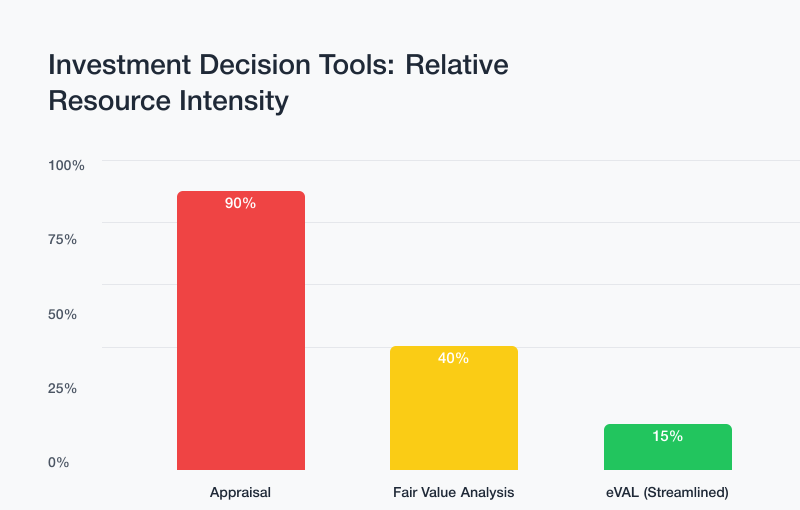
Valuations are favored for their speed and lower cost, significantly more affordable than commissioning a full-scale appraisal. The rigorous depth of an appraisal isn't always necessary for routine reporting or ongoing portfolio monitoring. As BPM highlights, valuations are crucial for formalized, repeatable financial procedures, allowing you to track your portfolio, identify buy/sell/hold opportunities, and understand your current financial standing without the burden of a legally binding document each time.
The methodologies employed in valuations are flexible. They often focus on income potential—a critical factor for commercial properties (as noted by Saunders, these are frequently performed by real estate professionals, not necessarily certified appraisers). Valuations lean heavily on market trends, data analytics, and financial modeling, often without an on-site inspection. The focus is on what the market could bear, aligning with accounting standards like ASC 820 for recurring reporting.
Furthermore, streamlined options like 'eVALs' exist for less complex or lower-risk scenarios, such as loans under $400k (per Valligent). These follow guidelines like IAEG, offering a faster, less frictional assessment without the full USPAP compliance. Because effectively managing your wealth demands agile, practical insights, not perpetual reliance on government-mandated certifications.
Appraisal vs. Valuation: A Side-by-Side Comparison
The common misconception that appraisals and valuations are interchangeable is a critical error. It’s akin to confusing a casual conversation with sworn testimony—the perceived similarity masks vastly different implications and potential consequences that could prove incredibly costly.
This isn't an abstract debate; it directly impacts your financial assets and the risks you navigate. Understanding these distinctions is paramount, as ignorance can and will be leveraged against you.
What's What, Really?
- The Rules. Appraisals are rigidly governed by comprehensive frameworks like the Uniform Standards of Professional Appraisal Practice (USPAP). Valuations, or evaluations, are far more flexible, adhering to general guidelines or internal company standards, such as those from IAEG. Their regulatory weight is incomparable.
- Who Does It. An appraisal mandates a state-licensed or certified appraiser, someone who has undergone extensive training and certification. A valuation, in contrast, can be performed by various real estate professionals, analysts, or even specialized brokers, offering greater accessibility and speed but with a lower bar for credentials.
- Why You Need It. Appraisals serve external stakeholders: lenders, courts, and regulatory bodies requiring an objective, defensible, and legally sound value (as Smith & Co, 2024+--+Mark+Carney.pdf), differentiate between subjective asset value and objective appraisal value). Valuations are for internal strategy: guiding investment decisions, portfolio health checks, and informed speculation.
- The Grind. The appraisal process involves an exhaustive, methodical inspection, deep comparative market analysis, and meticulous data crunching. Valuations are typically quicker, more streamlined, often relying on market data and financial modeling with less physical inspection, potentially sacrificing some accuracy for efficiency.
- Cash & Clock. Appraisals are more expensive and time-consuming, often taking weeks, but deliver an iron-clad figure. Valuations are cheaper and faster, completed in days or even hours, as Valligent confirms regarding the increased time and cost associated with comprehensive appraisal analysis.
- The Irreplaceable Assets. For high-value fine art, vintage vehicles, or precious family heirlooms, formal appraisals are non-negotiable for insurance coverage or estate planning. You require a certified specialist intimately familiar with that specific market niche. As McKissock (2024) emphasizes, value is an economic opinion at a given point in time, and for these assets, that opinion must be rigorously substantiated.
- The Enterprise. When buying or selling a business, the assessment extends beyond physical assets like buildings and equipment. It requires a "Market Value of a Going Concern" appraisal—a comprehensive valuation that includes tangible components alongside critical intangibles such as goodwill, brand equity, patents, and customer relationships. These hidden assets often constitute a significant portion of an enterprise's true worth.
- The Informed Estimates. For exploratory purposes, such as assessing a unique collectible prior to auction or evaluating the future earnings potential of a private company for investment, a strategic valuation provides a pragmatic, educated estimate. It offers sufficient insight to guide your personal investment decisions without the formality and cost of a full appraisal.
- An appraisal is more than a document; it's a legally binding, objective opinion of value, meticulously prepared by a licensed professional in strict adherence to USPAP standards. This underpins your mortgage, insurance, and tax liabilities, making it non-negotiable for critical transactions.
- Conflating these roles invariably leads to friction, costly delays, legal entanglements, and missed opportunities.
The fundamental question to ask is: Is this value intended for an external authority, or is it for my internal strategic blueprint? This distinction dictates your choice.
Case Study: Navigating a $2.5 Million Portfolio After a Layoff

Let's ground this in a real-world scenario, not hypothetical abstractions. Picture a 55-year-old tech veteran, accustomed to a comfortable life with a $1.6 million home and $1.25 million in brokerage accounts. Then, abruptly, the layoff notice arrives. Early retirement, ready or not, becomes his new reality, and suddenly, every number in his financial picture takes on monumental significance.
This isn't merely a "what-if"; it mirrors countless genuine predicaments, like the one faced by an individual on Reddit. Understanding the distinction between an appraisal and a valuation can be critical to financial survival in such circumstances.
His immediate priority? A valuation of his home. Not for a bank yet, but for him. With a $640k mortgage on his $1.6 million estimated home value and $70k in annual expenses, he desperately needs an accurate, current assessment of his home's worth. This insight, combined with his total assets of over $2.5 million, allows him to project a sustainable 4% withdrawal rate of $88k annually (factoring in potential home equity)—a direct answer to his "can I retire?" question. A swift valuation, leveraging market trends, online tools like Zillow (for initial pulse checks), and local broker price opinions, provides the strategic clarity he needs without weeks of waiting or excessive cost. It's his essential personal intelligence.
Should he decide to downsize and sell, that's when the appraisal becomes indispensable. His prospective buyer's mortgage lender will not accept a broker's opinion for such a substantial transaction. They require a formal, objective, and legally defensible appraised value. This official figure underpins the entire deal, protecting both the lender and the seller from valuation discrepancies. As Saunders (2024) aptly notes, market value (what a buyer will pay) and appraised value (the professional, objective opinion) are distinct entities, each essential for different stages. While strategic planning demands agile valuations, any true real estate transaction fundamentally requires a formal appraisal.
Expanding the Scope: Valuing Art, Businesses, and Other Intangibles

The principles of formal versus informal value assessment extend far beyond real estate. They encompass your entire portfolio, from tangible luxury items to complex business entities and even elusive intellectual property. These aren't just possessions; they are assets demanding accurate valuation, whether for taxation, insurance, or estate planning purposes.
It's crucial to recognize that "value" is multifaceted. There's 'Insurable Value' (replacement cost), 'Investment Value' (specific worth to a particular investor based on unique criteria), and 'Value in Use' (worth derived from practical application, distinct from market price). As McKissock (2024) notes, 'book value' is merely an accounting measure (cost minus depreciation) and should never be conflated with true market value. An appraisal provides official, defensible worth, while a valuation fuels your strategic game plan and potential gains.
You've engaged with crucial financial intelligence, distinguishing between concepts often carelessly conflated. Most individuals err by treating a formal appraisal as a mere estimate—a rookie mistake with significant financial repercussions, especially given federal regulations mandating formal appraisals for transactions exceeding $500,000. Online estimates or gut feelings simply do not suffice.
To reiterate the essential distinctions:
A valuation, in contrast, serves as your internal strategic compass. It's a flexible, less formal tool for strategic analysis and portfolio health checks, invaluable for your* planning, but insufficient for banks or regulatory bodies.
Ultimately, ignorance is not bliss when your wealth is on the line—it is unequivocally expensive.
You hold valuable assets. Treat them with the due diligence and precise processes they demand.
Your next step is clear: accurately determine your specific needs, then enlist the appropriate professional. Disregard casual advice. For high-stakes assets, seek out a meticulous expert who provides verifiable facts, not optimistic projections. Choose a professional deeply knowledgeable in their market and capable of executing valuations with absolute rigor.
