

Why the Bracelet Is the Best Clue on a Luxury Watch
The Stellaris Journal
The bracelet gets treated like the side dish at a dinner party. Everyone focuses on the case, the dial, the movement, the clasp mechanism in isolation. Then the bracelet quietly carries more authentication evidence than any of them, and almost nobody bothers to look.
That is a mistake. After years of inspecting pre-owned luxury watches across every price tier, we have come to view the bracelet as the single most undervalued authentication surface on a luxury timepiece. Not because it is more important than the movement, but because it is the part of the watch that records actual use. Wear patterns are extraordinarily difficult to fake convincingly, and reference codes stamped into the links, end pieces, and clasp are easy to misread. The bracelet tells the truth about a watch, and it tells it loudly, if you know how to listen.
This is the part of authentication we want to walk through with you, because we have watched too many buyers and even some dealers skip it, and pay for it later.
Why the Bracelet Is Treated as an Afterthought
Most authentication conversations start at the dial. Logos, lume plots, date font, cyclops magnification, rehaut engraving. Then they move inward to the movement. Balance wheel, jewel count, decoration, rotor engraving. The bracelet barely registers unless a clasp is visibly broken or a link is hanging off.
This is partly because bracelets look simple. A series of metal links. A clasp. What is there to scrutinize? The answer turns out to be: a great deal. Each link is a stamped, numbered component with a manufacturing date, a reference code, an end-link fitting, and a connection point that wears in a specific way over time. Together, those components form a record that is almost impossible to forge from the outside.
It is also because bracelets are routinely swapped. A watch arrives with a service bracelet, an aftermarket bracelet, or a bracelet from a different reference entirely, and the buyer assumes that is normal. Sometimes it is. Sometimes it is a frankenwatch, dressed up to look whole. The bracelet is where frankenwatches are most often built, and it is also where they are most often caught. Our own inspection process treats the bracelet as a primary authentication stream, on par with the movement, and we want to explain why.
The bracelet is not a side dish. It is a recorded history of the watch in metal, and it carries authentication evidence that no fake has yet been able to fully replicate.
What Authentic Bracelet Wear Actually Looks Like
Before you can spot fake wear, you need a clear picture of what real wear looks like.
A genuine vintage bracelet shows consistent wear across all of its components. The clasp mechanism, the center links, the end links, and the inner surfaces where the bracelet meets the case lugs should all show use in proportion to the watch's claimed age and history. A 1972 Submariner bracelet should not look like a 2022 Submariner bracelet, and a 2022 Submariner bracelet should not look artificially distressed to mimic the 1972.
Period-correct wear has a few recognizable characteristics. The brushing on the center links softens with use, but it softens uniformly, not in patches. The polished chamfers on the side links lose their mirror finish gradually, following the wear pattern of how the bracelet actually sat on a wrist. The clasp shows small marks where the folding mechanism has been opened thousands of times, and those marks tend to cluster in consistent spots rather than scattering randomly. End links develop light wear where they contact the case lugs, and that wear matches the lugs themselves. This is what experts mean when they say the patina should be coherent across the watch.
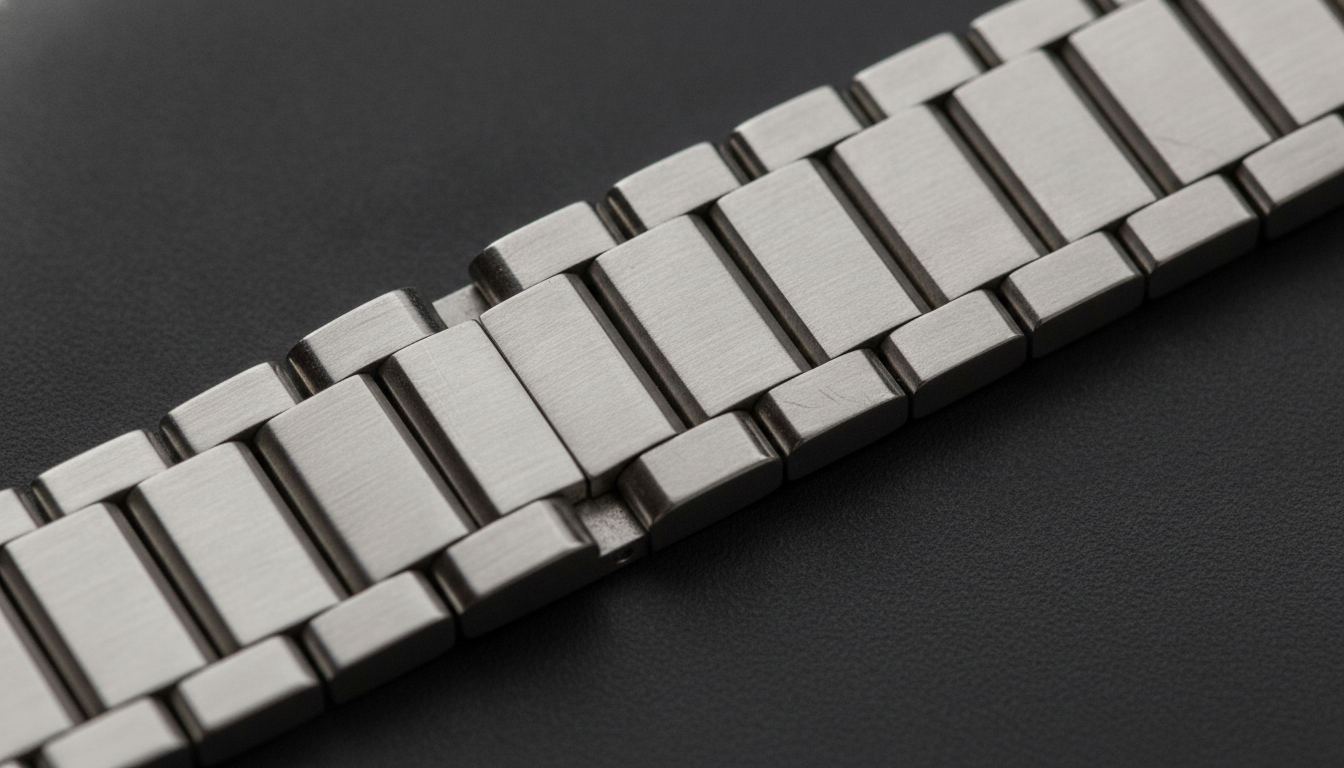
Genuine aging is gradual, mechanical, and consistent with how the watch would actually have been worn. Artificial aging is none of those things. It shows up as scuffing in illogical locations, polishing that is too uniform across parts that should not polish identically, and patina that looks painted on rather than developed. The best fakes today can mimic the surface appearance of a bracelet from a distance, but they struggle to mimic how a real bracelet wears into itself. We have seen frankenwatches where a 1990s case was paired with a 2005 bracelet, and the bracelet looked twenty years younger than the case. That mismatch is the giveaway.
A bracelet that has lived a real life wears into itself coherently. A bracelet that has been dressed up wears against itself.
The Four Streams of Bracelet Authentication
When we inspect a bracelet before listing, we work through four parallel streams of evidence. Each one can confirm the watch. Each one can also break the case if something does not line up.
1. Link Articulation and Stretch
Bracelet stretch is one of the most misunderstood terms in the pre-owned watch market. True metal does not stretch in the way most buyers imagine. What stretches is the connection between links: the pins, the screws, the tubes, and the inner surfaces that rub against each other every time the wrist moves. Over years of wear, friction and skin oils loosen those tolerances, and the bracelet develops play.
A healthy bracelet drapes with controlled flexibility. A worn bracelet sags into a deep curve, sometimes nearly folding back on itself. To evaluate properly, you take the watch off the wrist. A bracelet worn on the arm can mask looseness, because the arm supports the links. Held horizontally in the hand with the case flat, the bracelet reveals what it actually is. A consistent, gentle droop is normal for a vintage piece. An exaggerated arc with visible link separation is a problem.
The hanging test is useful, but it is not the whole story. A Jubilee bracelet is naturally more supple than an Oyster. A 904L solid-link modern bracelet will hang differently than a hollow-link vintage piece. Context matters. What we look for is not a specific shape but consistency: links should flow into each other, the spacing should be even, and the looseness should be proportionate to the age and construction of the bracelet.
On a counterfeit, articulation almost always feels wrong in some way. The links are too stiff, because the metal is cheaper and the tolerances are sloppy. Or they are too loose, because the connection points have been cut to make assembly faster. On integrated bracelets like the Royal Oak or the Nautilus, real links move like liquid. Fake links tend to kink or catch. That is one of the fastest tells we know, and it does not require any tools.
2. Reference Codes and End Link Matching
Every legitimate luxury bracelet is stamped with reference numbers that identify its model, its era, and often its production date. On Rolex bracelets, these codes appear in three places: inside the clasp, on the end links, and on the main links. A bracelet stamped "93150" is a specific generation Oyster bracelet. An end link stamped "558" is a specific fitting designed for a specific case reference. A clasp stamped with a date code like "I4" tells you it was made in the fourth month of 1984.
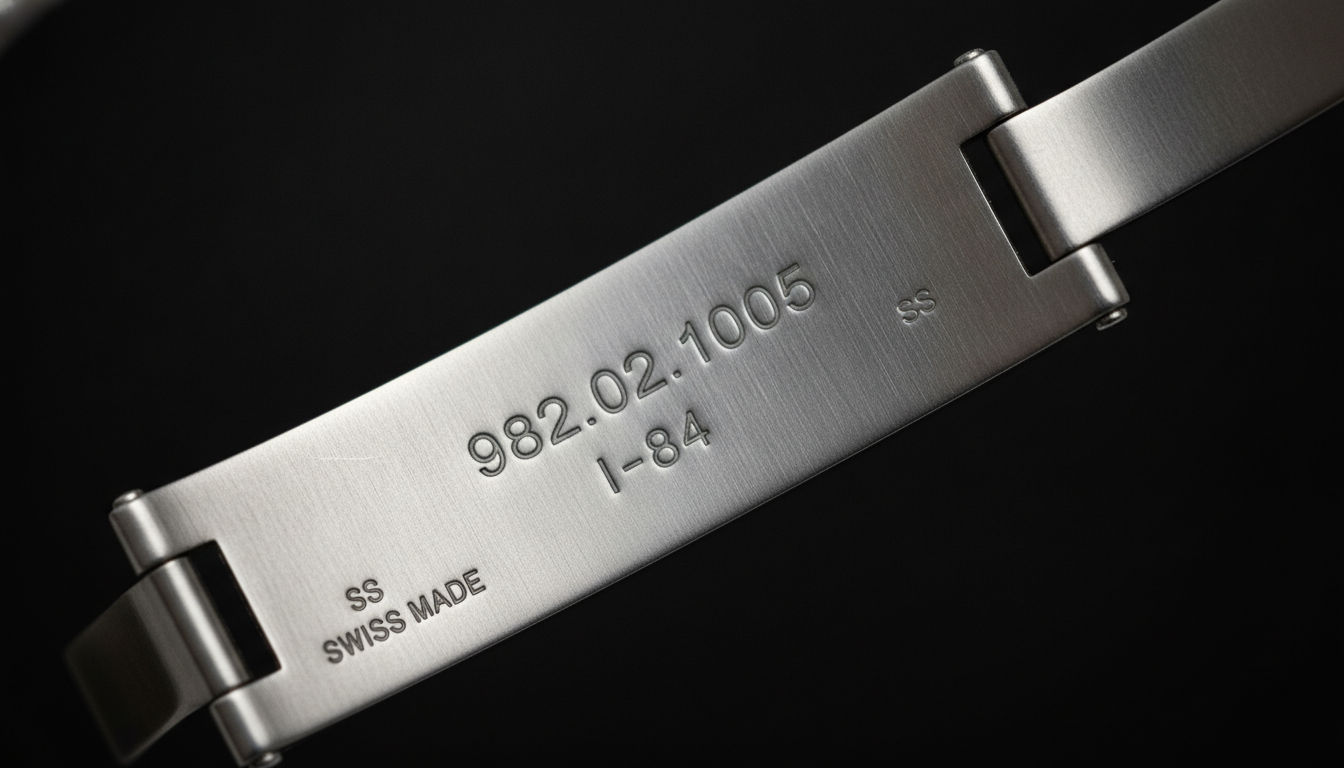
These codes must agree with each other and with the watch they are attached to. A Submariner reference 16610 should carry a 93160 bracelet with 592 end links. If the end links are stamped 558, that bracelet belongs on a Datejust, not a Submariner. Either it has been replaced, or the watch has been assembled from parts of different watches, or the bracelet does not belong to the watch at all.
This is where counterfeiters struggle most. They can replicate the visual appearance of a bracelet, but the reference codes are an entire layer of housekeeping that requires access to original stamping equipment, period-correct dies, and accurate production data. Mismatched codes are one of the first things we check, and one of the most common reasons a watch fails inspection even when the case and dial look perfect. As one detailed reference on Rolex bracelet codes outlines, every bracelet generation has a defined era, a defined end-link pairing, and a defined set of compatible references. The codes are the language, and the language has to make sense.
3. Clasp Engravings and Date Stamps
The clasp is another high-yield authentication surface, and it is one that buyers frequently overlook. Genuine clasps carry sharp, deep engravings: the crown logo, reference numbers, material stamps, and on Rolex specifically, the date code that identifies the year of production.
Authentic engravings have a few consistent characteristics. They are crisp, with defined edges. They are centered and aligned correctly relative to the clasp geometry. They match the era of the bracelet, meaning the font, the depth, and the placement follow what the manufacturer was doing in that period. On a 1972 bracelet, the clasp engraving looks like a 1972 engraving. On a 2005 bracelet, it looks like a 2005 engraving. Counterfeit clasps often have shallow, slightly blurry, or mispositioned text. The crown logo may be a fraction too thick or lean slightly to one side. Once you have handled enough genuine clasps, these deviations become obvious.
On integrated bracelet designs, particularly the Audemars Piguet Royal Oak and the Patek Philippe Nautilus, the clasp inspection is even more important because the clasp integrates directly into the bracelet architecture. A genuine Royal Oak clasp closes with a precise, almost mechanical snap. The AP stamp on the underside is razor-sharp and evenly spaced. A fake closes with a softer action, and the stamp is just slightly off: a fraction heavier in font, a tiny upward lean in the lettering, an inconsistency that you cannot unsee once you know to look for it. Detailed guides on spotting fake Audemars Piguet consistently flag clasp and underside finishing as the highest-yield authentication surfaces for that brand.
4. Underside Finishing and Material Integrity
Most buyers never flip a bracelet over. They should.
On integrated bracelet designs, the underside of the bracelet is finished to the same standard as the top. Every chamfer is hand-polished. Every brushing direction is consistent. Every edge is smooth to the touch. This is part of what makes integrated bracelets expensive to manufacture, and it is one of the first things a counterfeit cuts.
On a genuine Royal Oak, the underside of every link flows seamlessly into the next. On a fake, the underside often reveals sharp edges, inconsistent brushing, and visible casting lines. The bracelet feels lighter, rattlier, and less refined. As one experienced comparison notes, on the real AP every link moves like liquid metal, and the difference becomes obvious the moment you pick the watch up.
On a genuine Nautilus, the same principle applies. The brushing on the underside is uniform, the chamfers are crisp, and the link movement is fluid. Counterfeit Nautilus bracelets tend to be heavier in some sections and lighter in others, with sharp link edges and a stiffness that no genuine Patek bracelet exhibits. Guides on Patek Philippe authentication consistently emphasize bracelet and clasp verification as the most reliable evidence stream for that maison.
Even on non-integrated bracelets like the Rolex Oyster, the underside carries information. The end-link fittings should be solid on later bracelets and clearly stamped with reference numbers. The connection points should show consistent, factory-original finishing. Sloppy underside work is one of the clearest indicators that a bracelet has been reproduced rather than manufactured.
A bracelet's underside is where shortcuts live. The brands do not cut corners there, and when the finishing on the underside is poor, the bracelet is almost certainly not what it claims to be.
Counterfeit-Specific Red Flags on the Bracelet
Pulling the four streams together, a counterfeit bracelet tends to fail in predictable ways. If you know the patterns, you can spot them quickly.
Light and rattly feel. Genuine luxury bracelets feel substantial because they are made from dense materials: 904L stainless steel, 18K gold, platinum. Counterfeit bracelets are made from cheaper alloys that feel hollow and produce a slight rattle when you shake the watch gently. The weight difference is noticeable even before you weigh the watch.
Sharp link edges. Authentic bracelets have hand-finished or precision-machined edges that feel smooth. Counterfeits often leave micro-burrs along the link edges, which you can feel by running a finger along the bracelet slowly. This is one of the simplest and most reliable tests.
Wrong end-link fit. The end links should sit flush against the case lugs with no gap and no overhang. A counterfeit bracelet built from a generic mold rarely fits correctly, and the gap between the end link and the lug is visible even to an untrained eye. A wrong end-link fit also tells you the bracelet may not be the original one for that case.
Inconsistent brushing direction. On a genuine bracelet, the brushing follows the geometry of the links. On a counterfeit, the brushing sometimes runs the wrong way, or the direction changes inconsistently from link to link. This is a finishing defect that factories sometimes miss when reverse-engineering a bracelet.
Over-polished surfaces. Authentic bracelets develop a soft, lived-in finish over years of wear. Counterfeit bracelets are sometimes polished to look newer than they are, and the polishing removes the crisp edges that should still be present on a genuine bracelet. If a 1990s bracelet looks like it left the factory last week, something is wrong.
Mismatched date codes. This bears repeating. On Rolex bracelets specifically, the date code inside the clasp should fall within the production window of the watch case. A 2018 Submariner with a 1998 date code on the bracelet is either a service replacement (which should be disclosed) or a frankenwatch.
These red flags are discussed across the authentication community, including comprehensive guides on how to spot a fake Rolex, and they consistently point to the bracelet and clasp as the most reliable authentication surface. Visual inspection from a distance is no longer sufficient. Modern counterfeits have learned to mimic the dial, the case, and even the weight. The bracelet is where they still fall short.
Service Replacements and the Frankenwatch Question
There is one more layer that complicates bracelet authentication, and we want to address it honestly because it affects real buyers.
Sometimes a genuine bracelet has been replaced. The original bracelet may have been lost, damaged beyond repair, or worn out, and the watch now carries a service bracelet installed by the brand during a service interval. This is legitimate. It happens. Rolex, Audemars Piguet, and Patek Philippe all supply service bracelets, and a service bracelet on a genuine watch is not, by itself, a red flag.
What matters is disclosure. A genuine watch with a service bracelet, properly disclosed, is a normal pre-owned purchase. The same watch presented as "all original" with a service bracelet hidden is a misrepresentation, and it is more common than buyers realize. The way to tell the difference is the bracelet codes: a service bracelet carries codes consistent with the era it was produced, not the era of the watch. A 1985 Submariner with a 2018 bracelet is almost certainly wearing a service replacement.
A frankenwatch is a different problem. A frankenwatch is a watch assembled from parts of multiple watches, often a genuine case and dial paired with a non-original bracelet, bezel, or movement. Frankenwatches are assembled to look complete and are sometimes sold as original. They are not counterfeits in the strict sense, because the parts may all be genuine, but they are misrepresentations. The bracelet is where frankenwatches most often reveal themselves, because the codes do not align with the case, the end links do not fit correctly, or the bracelet shows wear inconsistent with the rest of the watch.
Our authentication process, documented at length on our authenticity guarantee, requires every component to be verified against the watch's claimed configuration. If a piece has a service bracelet, that is disclosed. If a piece has been assembled from multiple sources, that is disclosed. Anything else is a misrepresentation we will not list.
How to Use This Information as a Buyer
You do not need to be a watchmaker to read a bracelet. You need a few habits.
Take the watch off the wrist before judging. A bracelet on the arm hides looseness, drape, and fit problems. Handle it in the hand, with the case horizontal, and let it hang. A healthy bracelet flows. A worn bracelet sags. A fake bracelet feels wrong in some way you will not be able to articulate until you have handled enough genuine pieces.
Flip the bracelet over. Look at the underside. Look at the end links. Look at the connection points. The underside is where shortcuts live, and most buyers never check it.
Read the codes. Every legitimate bracelet carries reference numbers, date codes, and material stamps. Learn where they appear on the brands you collect. The codes do not lie, and they are free to read.
Match the bracelet to the case. The end links should fit the lugs. The reference codes should match the watch's production era. The clasp code should fall within the case's serial range. If anything does not align, ask why before you buy.
Buy from a seller who treats the bracelet as evidence. Not every dealer does. We do, because we have learned that the bracelet is where the truth lives. Our multi-point inspection process covers every component, bracelet included, before a piece ever reaches our inventory.
The dial tells you what a watch claims to be. The bracelet tells you what a watch actually is.
Closing Thought
Authentication is not a single check. It is a layered process, and the bracelet is one of the most reliable layers we have. Not because bracelets are easier to inspect than movements, but because the wear patterns and reference codes that live in a bracelet are extraordinarily difficult to forge, and they are even more difficult to keep consistent across an entire watch.
The next time you handle a luxury timepiece, before you look at the dial, before you open the caseback, flip the bracelet over. Read the codes. Feel the articulation. Check the end-link fit. Look at the underside. Take ten seconds. You will learn more from that ten seconds than from an hour of staring at the dial, and you will start to understand why we treat the bracelet as primary evidence rather than afterthought.
If you are evaluating a piece and want a second opinion from a team that inspects every bracelet before listing, you can reach our concierge directly or browse our current authentication-verified inventory. We handle each piece personally, and we read every bracelet we list.
