

Buying Pre-Owned Watches: What Makes the Cut?
The Stellaris Journal
When buying a pre-owned watch, begin with the exact reference and intended use. Evaluate the seller and channel separately from the individual watch. Require actual-watch evidence for identity, authenticity, condition, component history, included items, and known or unknown service history. Compare the full transaction, not only the asking price.
Use qualified internal examination when a material question requires it. Never treat one photograph, logo, weight, sound, serial result, timing reading, or document as authentication. Before payment, save the approved listing, photographs, disclosures, invoice, and current terms.
The decision sequence is:
Reference → Seller and terms → Exact watch → Condition and function → Originality and documents → Price and ownership cost → Approval and delivery
Buying Pre-Owned Watches: The Short Checklist
Buying pre-owned can provide access to discontinued references, earlier configurations, condition choices, and watches that are unavailable through current new retail. It can also let the buyer select between a complete collector-oriented example and a less complete watch intended for regular wear. It does not guarantee savings or future appreciation.
The tradeoffs are equally real. A watch may carry prior wear, refinishing, uncertain maintenance, later service components, incomplete accessories, or a short seller guarantee. Evidence and transaction terms vary by seller.
Before considering payment, answer these seven questions:
1. Reference: Is the exact reference, material, dial, movement, bracelet or strap, and period correctly represented?
2. Seller: Who owns the watch, who is the seller of record, and which policies apply?
3. Exact piece: Do current photographs and identifying records connect to this watch?
4. Condition: What wear, damage, refinishing, functional state, and service need is known?
5. History: Which components, documents, accessories, and service events are original, later, documented, or unknown?
6. Economics: How does the total cost compare with genuinely similar watches and likely ownership needs?
7. Protection: Which warranty, guarantee, payment, return, shipping, and inspection terms apply?
An ordinary unknown can be disclosed and accepted. A material contradiction needs resolution. Missing service history is an uncertainty. A dial or movement that conflicts with the represented reference is a contradiction until reliable evidence explains it.
“Makes the cut” should therefore mean that the seller can identify and represent the watch responsibly and that the specific example fits the buyer's requirements. It is not evidence of a secret score, investment formula, rejection rate, or universal collector hierarchy.
Define the Exact Reference and Your Requirements
A collection name is not a complete buying target. Record:
- the full reference and any suffix or configuration code;
- case size and material;
- dial, hands, bezel, and display layout;
- movement or calibre where documented;
- bracelet, end links, clasp, strap, and buckle;
- functions or complications;
- relevant production or market context; and
- expected identifiers and document types.
- full dial and multiple angles of the case;
- caseback, crown, pushers, and correctors where applicable;
- bracelet or strap, end links, clasp, and spare links;
- visible identifiers, masked publicly where appropriate;
- documents and accessories included; and
- condition details mentioned in the description.
- scratches, dents, chips, cracks, corrosion, or moisture evidence;
- softened edges, altered profiles, or inconsistent refinishing;
- dial or hand damage, staining, relume, or restoration disclosure;
- worn threads, damaged screw slots, loose controls, or poor fit;
- bracelet stretch, missing links, clasp wear, and strap condition;
- damage around engravings or identifier areas; and
- differences between the current watch and listing photographs.
- Authenticity: whether the watch and represented components are genuine within the examination scope.
- Originality: whether a component remains the one fitted to this individual watch at production.
- Genuine service component: a later part supplied through the manufacturer or authorized network.
- Mismatched genuine component: a real brand part from another reference, period, or watch.
- Aftermarket component: a part made outside the authorized manufacturer supply.
- Condition: current wear, damage, refinishing, restoration, and mechanical state.
- Completeness: the box, papers, links, straps, tools, booklets, and other items included now.
- manufacturer or qualified-provider service assessment;
- replacement of worn straps or missing links;
- correction of disclosed functional issues;
- current water-resistance testing if relevant;
- shipping and coverage for future service;
- insurance or secure storage; and
- taxes, duties, or registration obligations.
- the listing and actual-watch photographs;
- reference and safe identifying information;
- condition, component, service, and provenance disclosures;
- itemized accessories and documents;
- inspection or authentication report and its limits;
- invoice, total price, fees, and payment recipient;
- warranty, guarantee, return, and inspection terms; and
- delivery address, recipient, coverage, and signature requirements.
- Exact reference and buyer requirements established.
- Seller, custody, invoice, and payment recipient verified.
- Actual-watch images and material disclosures saved.
- Authentication scope and qualified-review needs understood.
- Condition, function, originality, service, and completeness described separately.
- Total price and likely ownership costs compared with suitable evidence.
- Warranty, guarantee, return, inspection, and delivery terms read.
- Unknowns accepted explicitly, with contradictions resolved.
Use manufacturer product pages, manuals, archives, dated catalogues, and reference-specific scholarship appropriate to the watch. A current product page may not document an earlier generation. An auction listing can preserve useful evidence but is not automatically a manufacturer record.
Research both what should be present and what changed during production. Dial printing, luminous material, bracelets, clasps, movements, crowns, crystals, and number locations can vary by period. A genuine component correct for another generation can still be wrong for the offered watch.
Then separate requirements from preferences:
| Decision area | Required example | Preferred example |
| ------------- | ------------------------------------ | ------------------------------------------- |
| Configuration | Exact reference and dial | One of two acceptable production periods |
| Condition | No corrosion or material case damage | Light wear rather than refinished surfaces |
| Originality | Correct case and movement | Original dial and bracelet |
| Completeness | Spare links needed for fit | Original box and booklets |
| Service | No unresolved mechanical fault | Recent documented manufacturer service |
| Budget | Maximum total landed amount | Lower target if immediate service is needed |
| Use | Safe, legible regular wear | Current tested water resistance if relevant |
These are examples, not rules. A daily wearer and a period-specific collector can reach different decisions about the same watch. A genuine service dial may support reliable use but fail an original-dial requirement. A watch-only example can fit one buyer while a complete set matters to another.
Do not buy the reference in the abstract. Two examples with the same model number can differ materially in condition, component history, accessories, service need, transaction protections, and price.
Verify the Seller, Listing, and Exact Watch
First identify the commercial structure. Is the seller a direct dealer, authorized certified pre-owned retailer, marketplace seller, auction house, brokered counterparty, or private owner? The channel affects responsibility, but no label verifies the watch.
The FTC's online-shopping guidance recommends researching unfamiliar sellers, comparing terms, reading reviews critically, and keeping records. Verify the business or person's current identity, contact details, invoice entity, payment recipient, and role. If authorization or certification is claimed, confirm the issuer through its official source.
For a marketplace purchase, the FTC's marketplace guidance advises checking who the actual seller is and how platform protections apply. An eligible payment or authentication process may depend on the item, seller, geography, amount, and deadline. Do not move outside the required platform path without understanding what protection is lost.
Request current photographs of the actual watch:
Check continuity across images. Repeated marks, bracelet length, dial details, and reflections should support that the same piece appears throughout. Reverse-image or duplicate-listing checks can expose copied or reused photos, but an original photograph does not authenticate the watch or prove legal title.
Ask whether the seller owns the watch, holds it on consignment, or still needs to source it. Who physically has it? Who created the description? Who inspected it, when, and to what scope? Is any information provisional until the dealer receives the watch?
The invoice should identify the seller and exact piece, while the payment account should agree with that entity or be explained in writing. Treat a last-minute bank, recipient, address, or off-platform payment change as a security event and verify it through a known contact method.
A live video call can support possession and show requested angles or functions. It remains a remote observation. Camera quality, lighting, and seller control limit what it establishes.
Assess Condition, Function, and Qualified Examination
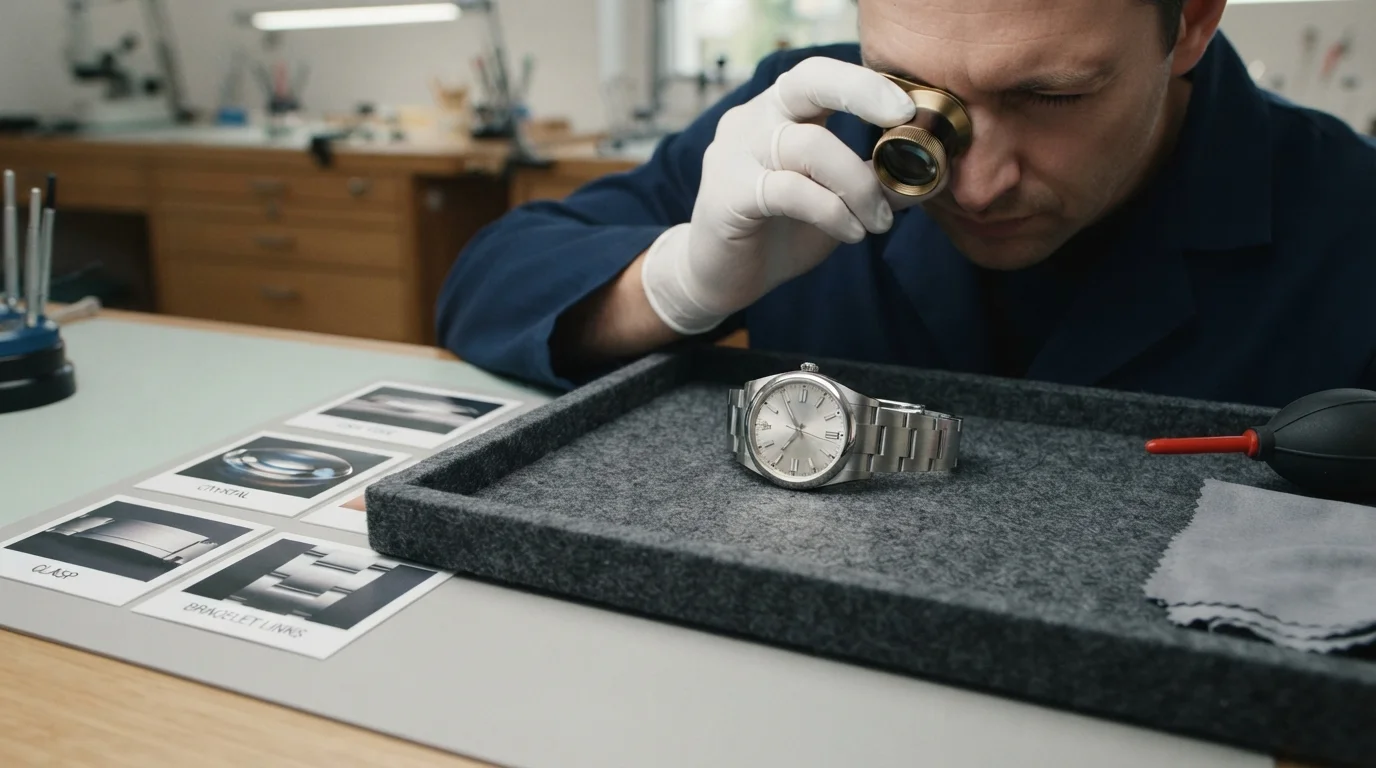
Condition belongs to the individual watch. Review the case, crystal, dial and hands, bezel, crown and pushers, caseback, bracelet or strap, clasp, links, and accessories.
Look for:
Appearance alone cannot explain cause or history. A polished case can be genuine. A clean dial can be original, serviced, restored, or replaced. Matching patina does not prove that components have always been together. Turn each observation into a precise question.
Operate only reference-specific, non-invasive functions allowed by the manufacturer instructions and seller. Do not force a crown, pusher, bezel, corrector, repeater slide, or complication. Some calendar mechanisms have restricted setting periods, and careless testing can damage a genuine watch.
A short timing result describes performance only under the tested conditions. It does not authenticate the case, dial, documents, provenance, or every movement part. A historical water-resistance rating does not establish present resistance. If current resistance matters, request an appropriate test and understand whether it was dry or wet, which pressure was used, and what conclusion the provider supports.
Internal examination belongs with a qualified professional who has the appropriate authorization, tools, handling, resealing, and testing ability. Do not open the case as a buyer checklist step. Ask the examiner to identify the watch, document the scope, list observations and findings, provide relevant images or measurements, and state limitations.
Use brand and reference-specific expertise when necessary. The exact calibre, architecture, finish, identifiers, and component relationships matter. A universal set of visual tells creates false confidence because genuine references vary and counterfeiters can copy isolated features.
Separate Authenticity, Originality, Service History, and Papers
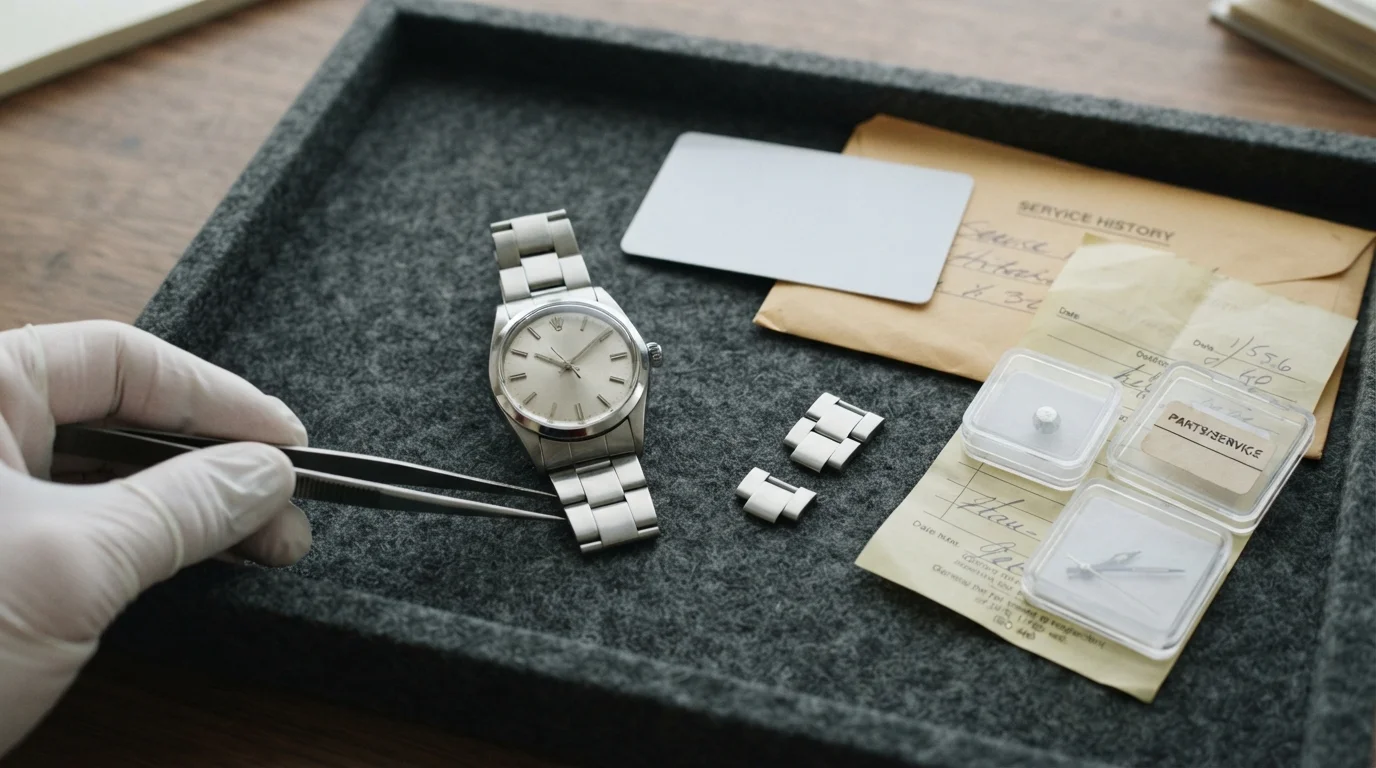
Keep the conclusions distinct:
A genuine watch can contain later genuine service parts. It can also have refinished surfaces, an aftermarket strap, incomplete accessories, or unknown earlier service. Those facts may be acceptable when represented accurately. They should not be collapsed into either “all original” or “fake.”
Build a simple history:
1. What configuration is documented at production or first sale?
2. Which ownership, service, repair, restoration, or replacement events are recorded?
3. What configuration and condition are observed now?
4. Which periods or interventions remain unknown?
Documents answer different questions. A warranty card can support an original sale. An archive extract may transcribe manufacturer records. A service invoice supports the work it states. A receipt supports a transaction. Dated photographs can support possession or condition at a point in time. None authenticates every current component by itself.
Match identifiers where appropriate, but protect complete serials from unnecessary public exposure. A matching paper can be paired with another watch. A copied number can appear on a counterfeit. An absent original certificate does not automatically make a genuine watch counterfeit.
“Full set” is not precise enough. Name the inner and outer boxes, warranty card or Certificate of Origin, booklets, tags, links, straps, buckles, tools, archive papers, and service records included. Confirm whether an item is original to the watch, period-correct, a later replacement, or simply included.
“Certified pre-owned” also needs an issuer and program. Rolex's Certified Pre-Owned program is a brand-specific example with defined eligibility, certification, guarantee, and participating retailers. It does not define every seller's use of “certified.”
Unknown history should remain visible. “No known replacement parts” is not the same as “all original.” A material conflict between the stated reference and present component requires evidence, qualified review, a revised description, or rejection.
Compare Price, Future Costs, Warranty, and Return Terms
Compare genuinely similar examples. Match the exact reference, material, dial, production context, condition, component history, completeness, service status, provenance, seller type, guarantee, return terms, location, and date.
Separate asking prices from completed transactions. A live listing shows what a seller requests, not what a buyer paid. Auction results may add premiums and have different condition or return terms. Currency, tax, duty, shipping, payment fees, and coverage can change the total.
Do not assign fixed premiums to papers, original components, service, or a dealer category. The effect depends on the watch and buyer. Explain which factual difference supports a higher or lower comparison.
Estimate near-term ownership needs without inventing universal costs:
Request a current written estimate when a likely service need could change the decision. “Recently serviced” should identify the provider, date, scope, replaced parts, tests, and warranty. Regulation or a pressure test is not automatically a complete service.
Separate transaction protections. The FTC's warranty guidance distinguishes written warranty terms from service contracts. A manufacturer warranty, seller guarantee, service contract, marketplace process, return policy, and payment-dispute right have different issuers and rules.
Read the inspection and return policy before paying. Confirm eligibility, deadline, authorization process, item condition, excluded watches, restocking fees, return shipping and coverage, refund timing, and jurisdiction. Do not wear, resize, engrave, service, or remove protective material before completing the initial comparison if those actions affect eligibility.
The economically suitable watch is not necessarily the cheapest or most complete. It is the example whose condition, history, fit, total cost, and protections meet the buyer's requirements without relying on an unsupported future-value promise.
Approve, Receive, and Inspect the Same Watch

Before payment or final approval, save:
The watch prepared for shipment should be the approved piece. If condition, strap, bracelet sizing, documents, service, or included items change, require updated disclosure before dispatch.
At delivery, inspect the parcel under the applicable carrier and seller process. Photograph visible damage or tampering where practical. Keep the box, cushioning, seals, and all contents. Compare the watch, identifiers, condition, and accessories with the saved approval before wearing, resizing, or altering it.
Report a discrepancy promptly through the required channel. Preserve evidence and state the specific difference. A buyer's arrival check does not transfer the seller's authentication responsibility; it helps distinguish a listing, fulfillment, or transit problem while the applicable remedies remain available.
For a Stellaris purchase, the current FAQ says listings use actual-item photographs, specify included accessories, and that watches are authenticated on arrival, inspected, and reverified before shipment. The shipping policy and refund policy control the current delivery and return process. Stellaris is an independent dealer, so its authenticity guarantee is a dealer commitment rather than manufacturer authorization.
Final pre-payment checklist
For a specific watch, use the Stellaris contact page to ask what is known, what is included, which inspection supports the listing, and what remains unresolved. A pre-owned watch makes the cut when its identity, evidence, condition, history, price, and transaction terms agree with the buyer's actual requirements.
