

How to Spot a Fake Patek Philippe Watch
The Stellaris Journal
A buyer can spot contradictions that suggest a fake Patek Philippe, but no logo, weight, dial detail, visible Seal, number, document, or photograph proves the whole watch is authentic by itself.
Start by confirming the exact reference and configuration. Then match the actual watch with its records and disclosed history. Use authorized examination when internal case or movement identifiers matter. This separates a preliminary buyer screen from manufacturer-authorized physical work and prevents a familiar detail from carrying a conclusion it cannot support.
Can You Spot a Fake Patek Philippe From Photos?
Photographs can expose an impossible or unexplained configuration. They can show whether the case, dial, hands, crown, pushers, bracelet or strap, clasp, and visible functions resemble the represented reference. They also document condition and included accessories.
Convincing photographs do not confirm internal identity, component history, water resistance, service condition, or the relationship between loose documents and the physical watch. Lighting, editing, compression, and camera angle can change dial color, surface texture, engraving depth, and case definition.
Use the complete evidence sequence:
1. Establish the exact reference, material, movement, functions, and period.
2. Review actual-watch photographs and written component disclosures.
3. Match the Certificate of Origin, Extract from the Archives, service records, receipts, and seller account within their scopes.
4. Reserve internal identifiers, movement examination, and material conflicts for the authorized level of access specified by Patek Philippe.
A visual inconsistency is a reason to stop and investigate. It is not permission to invent a rare variation. Likewise, a clean-looking dial or familiar movement layout is not permission to skip the rest of the watch.
Authentication, originality, condition, and completeness are related but separate. A genuine Patek Philippe can contain genuine service parts. A watch can be authentic and polished, incomplete, or mechanically overdue for service. Papers can be genuine but mismatched.
Check the seller and transaction alongside the object. Ask who owns or controls the watch, whether it is physically available for current photographs or examination, how the exact piece will be identified on the invoice, and what remedy applies if a qualified inspection finds a material discrepancy. A plausible watch cannot make an unsafe payment path or vague return promise acceptable.
Look for continuity across the image set. Repeated condition marks, bracelet length, dial details, and reflections should support that the same watch appears throughout. Manufacturer images can explain a reference, but they must not substitute for photographs of the piece being sold. A timestamped photograph can support current possession without authenticating the watch or proving legal title.
Match the Exact Reference and Configuration
“Patek Philippe Nautilus” or “vintage Calatrava” is not a complete identification. Record:
- the full reference;
- represented production period;
- case material and dimensions;
- dial and hand configuration;
- bracelet or strap and clasp;
- calibre where documented; and
- functions and complications.
- authentication: whether the watch and represented components are genuine;
- originality: whether components remain as initially delivered or were later replaced or restored;
- condition: wear, damage, polishing, corrosion, and current function; and
- completeness: box, Certificate of Origin, booklets, service papers, links, tools, and other accessories.
- a service invoice supports the work it states;
- a seller receipt supports a transaction;
- a warranty record supports its defined coverage;
- dated photographs can support condition or possession at a point in time.
- exact reference and represented configuration;
- actual-watch photographs;
- condition and included items;
- known service, restoration, replacement, and refinishing;
- provenance and documents available;
- observations, documented findings, and unresolved questions; and
- payment, inspection, return, shipping, and delivery terms.
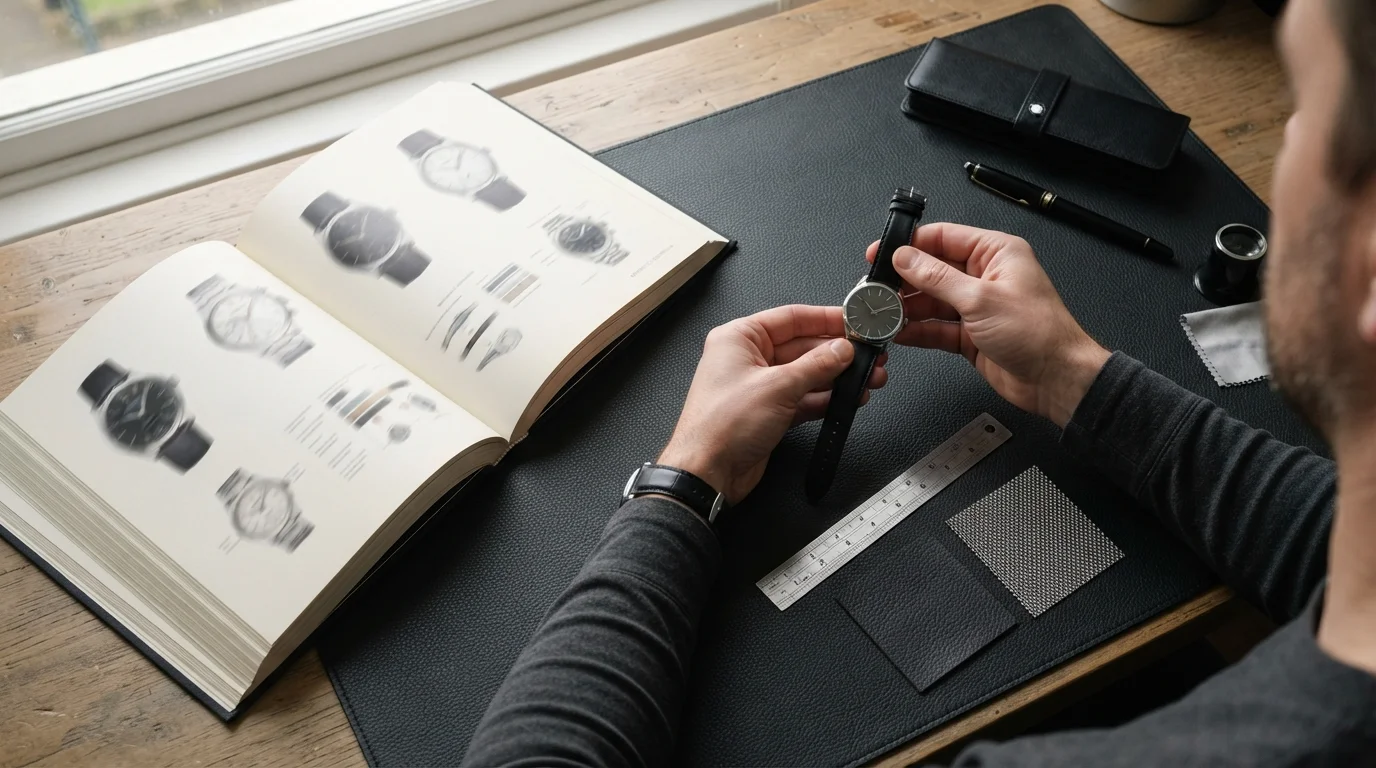
Current Patek Philippe product pages and instructions can establish the technical characteristics of current references. Discontinued and vintage watches may require older catalogues, archival sources, documented service material, or reliable reference scholarship.
Compare the complete configuration rather than decoding one suffix from memory. Naming conventions and production variations can differ across periods. The reference should agree with the case, dial, movement context, functions, and fitted components.
Ask the seller which source supports the representation. If the claimed dial, material, calibre, or bracelet does not agree, pause until evidence explains whether the issue is a genuine service replacement, restoration, aftermarket modification, mismatched component, or incorrect listing.
Do not allow “rare factory variation” to close the question without support. A high price or famous family name does not improve weak evidence.
Actual reference matching should also account for operating instructions. A calendar, chronograph, world-time display, minute repeater, or other complication must be evaluated according to the maker’s documentation for that calibre. Generic operation can damage a watch or create a false failure.
Documented production variation still needs boundaries. A dial or case option seen on another reference does not become correct because it came from Patek Philippe. If the seller cites a rare variation, request the archive, catalogue, prior dated image, or qualified reference scholarship that connects it to the represented watch and period. Treat an auction description as attributed market evidence rather than automatic manufacturer confirmation.
The baseline should also identify what is not expected. A display, pusher, hallmarked surface, movement feature, or bracelet type that belongs to another generation can be more informative than one familiar detail that matches. Record both agreements and conflicts so a reviewer can test the reasoning instead of receiving only a favorable conclusion.
Review the Actual Watch, Condition, and Components
Reference research defines what should be present. The physical watch determines what is being sold.
Request clear photographs of the actual dial, case, caseback, crown, pushers where applicable, bracelet or strap, clasp, and documents. Ask for more than one angle where polishing, damage, engraving, or surface condition affects the decision.
The written description should distinguish:
A genuine service dial, hand set, crown, crystal, bracelet, or movement component is not automatically factory-original to the individual watch. An aftermarket component has a different status. “Replacement” is too broad when the category matters.
Do not call a case unpolished because no invoice mentions polishing. Do not claim recent service because the watch runs during a short observation. Matching ageing can support a condition description without proving the components have always been together.
Ask for known service, restoration, refinishing, and replacement history. If no reliable record exists, state the gap. “Service history unknown before 2016” is more credible than a complete narrative created from appearance.
The same discipline applies to value. The reference name does not determine the exact watch’s price. Condition, component history, provenance, completeness, service needs, seller, and transaction terms all affect the comparison. Authentication content should not become an investment forecast.
Review the case and external components as a system. Case geometry, engravings, crown and pusher form, crystal, lugs, bracelet end links, clasp, dial, hands, and visible functions should agree with the reference and with one another. Polishing can soften a genuine case. A later genuine crown can appear newer than the case. A mismatched genuine bracelet can carry convincing factory marks while remaining incorrect for the watch.
Functional observation has a limited role. Confirm only those functions that can be operated safely under the exact instructions, and record what was not tested. Correct date change, chronograph reset, or power-reserve movement can support consistency and reveal a service concern. It cannot establish internal identity, authenticity, long-term accuracy, or future reliability. Never force a corrector, pusher, repeater slide, or crown to complete an online checklist.
If the watch has been recently serviced, ask for the provider, date, scope, replaced components, tests performed, and warranty terms. “Serviced” can mean a complete manufacturer intervention, limited regulation, exterior work, or an undocumented seller claim. Read the invoice rather than assigning it the broadest meaning.
What Patek Philippe Documents Actually Prove
Patek Philippe distinguishes the Certificate of Origin from an Extract from the Archives.
The Certificate of Origin accompanies a new watch. Patek Philippe describes it as identifying the watch through movement, case, and reference numbers. The company’s watch-authenticity FAQ says a lost Certificate of Origin cannot be reissued.
An Extract from the Archives is a partial transcript of information in Patek Philippe’s historical records. The current Extract FAQ says an eligible watch must have been first sold more than ten years before the request and requires photographs for visual comparison with archive information.
The Extract does not replace the Certificate of Origin. It supports recorded manufacturing and sale information within the archive. It is not a current condition report, service estimate, or statement that every component remains as originally delivered.
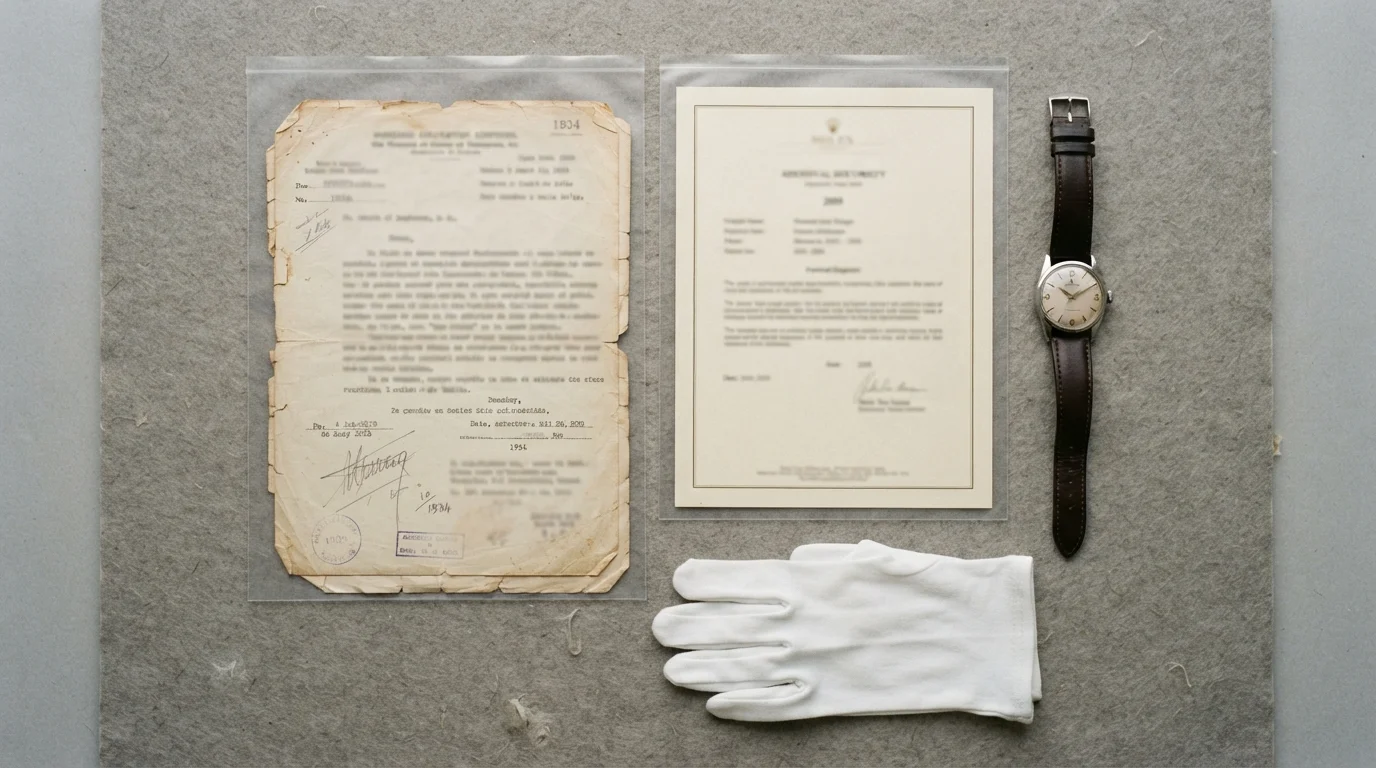
Other records have narrower jobs:
Each document must be matched to the physical watch. A genuine paper can be paired with another watch. A watch can also be genuine after its original Certificate has been lost.
Numbers are relational evidence, not a public decoder. Check that the identifiers recorded across the Certificate, Extract, service papers, invoice, and authorized report agree where they are supposed to, while limiting exposure of complete numbers in public images. A matching document does not prove current component originality or clean ownership history. Conversely, a redacted public listing can still be responsible if the complete identifiers are available through an appropriate private review.
Provenance should be stated at the level supported by records. A prior auction invoice documents a sale through that auction house. A family account may be meaningful but remains testimony unless corroborated. Do not transform an incomplete ownership gap into a continuous history or use a prestigious prior owner claim without evidence and permission to disclose it.
If documents are absent, disclose the gap. If personal information is redacted, preserve the watch-specific identifiers and note the redaction. Never stretch one favorable document into proof of current movement identity, condition, originality, ownership history, and authenticity.
Case Numbers, the Patek Philippe Seal, and Authorized Review
Internal identifiers matter, but accessing them is not a buyer task. Patek Philippe’s official FAQ says the movement number is engraved on the movement and the case number inside the caseback. It also says the caseback should be removed only by an Authorized Retailer or Authorized Service Center.
That rule prevents damage and preserves the quality of the evidence. Incorrect opening can scratch the case, disturb seals, introduce contamination, affect water resistance, or harm the movement.
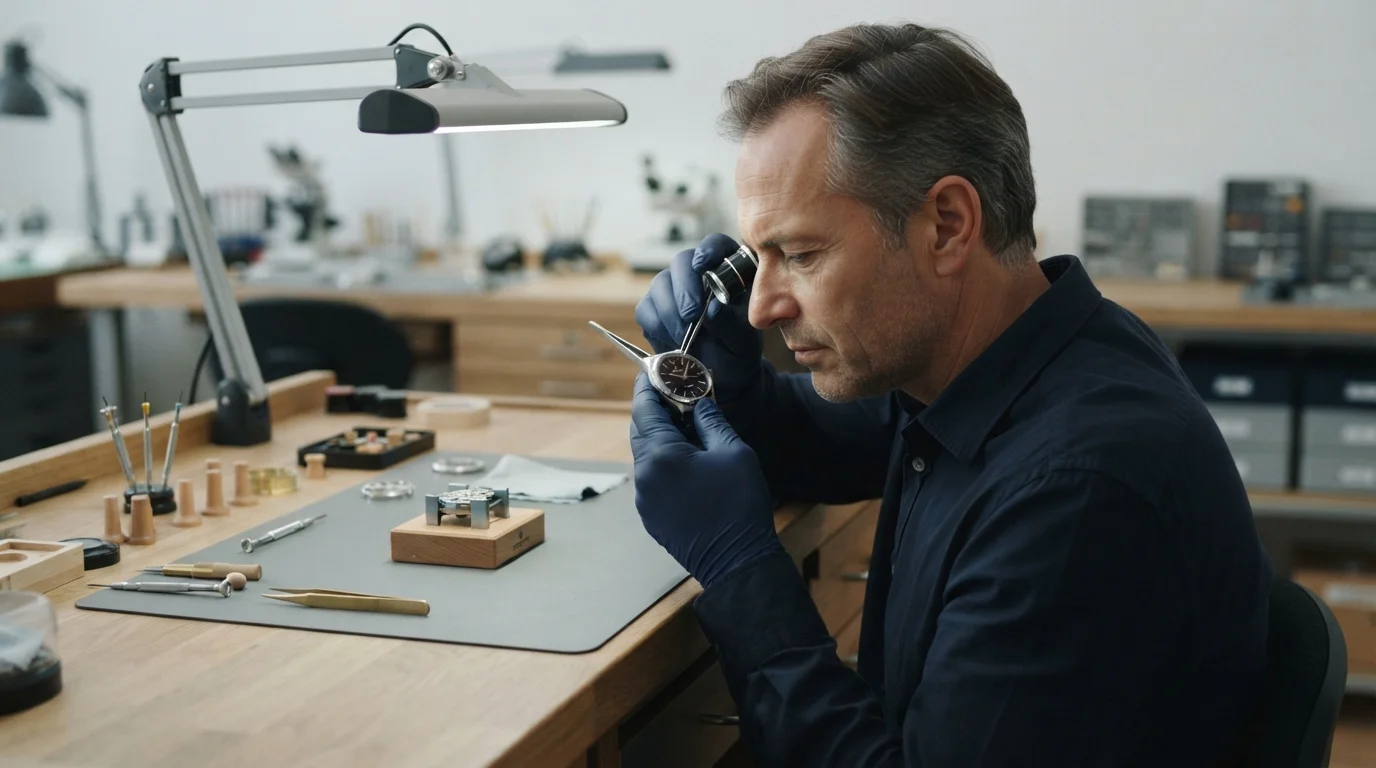
Use Patek Philippe’s service-center directory to verify claimed authorization. A seller or repairer does not become authorized by using the words “factory inspection.”
The Patek Philippe Seal also requires restraint. Introduced in 2009, it applies to the completed cased watch and covers technical, functional, aesthetic, precision, dependability, and service criteria. It is a manufacturer quality standard. A visible emblem or Seal claim does not authenticate a pre-owned assembly by appearance.
Timing is not a shortcut. A short timegrapher result can describe rate under limited conditions. It does not authenticate the case, dial, documents, provenance, or every movement component. A watch outside a published tolerance may need service, while a counterfeit can be adjusted to produce a plausible reading.
Water resistance is reference-specific too. Use the exact product instructions and a current appropriate test. Do not transfer one general Patek statement to every vintage, complicated, or chiming reference.
Escalate when internal identifiers matter, the calibre conflicts, a complication behaves unexpectedly, service history is unclear, modification is suspected, or the transaction value makes uncertainty material. Ask what was examined and which questions remained outside scope.
What Stellaris Can Confirm About a Specific Watch
The Stellaris FAQ says watches are authenticated on arrival, inspected, reverified before shipment, shown through actual-item photographs, and listed with included accessories. For a requested watch, the buyer approves the specific piece.
Those public statements support buyer-visible checkpoints:
Stellaris is an independent dealer and is not affiliated with or authorized by Patek Philippe. Its authenticity guarantee is a dealer guarantee. Patek-issued documents and authorized service retain the separate scopes defined by Patek Philippe.
The public FAQ does not support claims that Stellaris has private archive access, routinely opens every Patek, employs Patek-certified watchmakers, or uses a “maison-specific protocol.” Those claims should not be invented.
The current Patek Philippe collection is the relevant commercial next step. Availability should lead to exact-watch questions, not reduce them.
Patek Philippe Buyer Checklist
Before paying, confirm:
1. The full reference, material, dial, movement, functions, and period are established from a reliable source.
2. Photographs show the actual watch and actual included accessories.
3. Polishing, service, restoration, replacement, and modification history is disclosed.
4. Authentication, originality, condition, and completeness are described separately.
5. The Certificate of Origin, Extract, service records, and receipts are matched to the watch and kept within scope.
6. Any internal case-number or movement question is referred to the authorized level specified by Patek Philippe.
7. Seal, timing, and water-resistance claims are reference-specific.
8. Seller identity, payment path, delivery, inspection, and return terms are in writing.
9. Unknown history remains visible.
Stop when a material inconsistency remains unexplained. Do not proceed because the dial, paper, Seal, or movement photograph appears convincing in isolation.
For an in-stock or requested watch, use the Stellaris contact page to ask about the exact reference, condition, components, documents, service history, included items, and any need for authorized examination.
